
Thailand Renal Replacement Therapy Registry 2023: Epidemiology and Trends in Incident Dialysis Patients
Article Sidebar
Main Article Content
Abstract
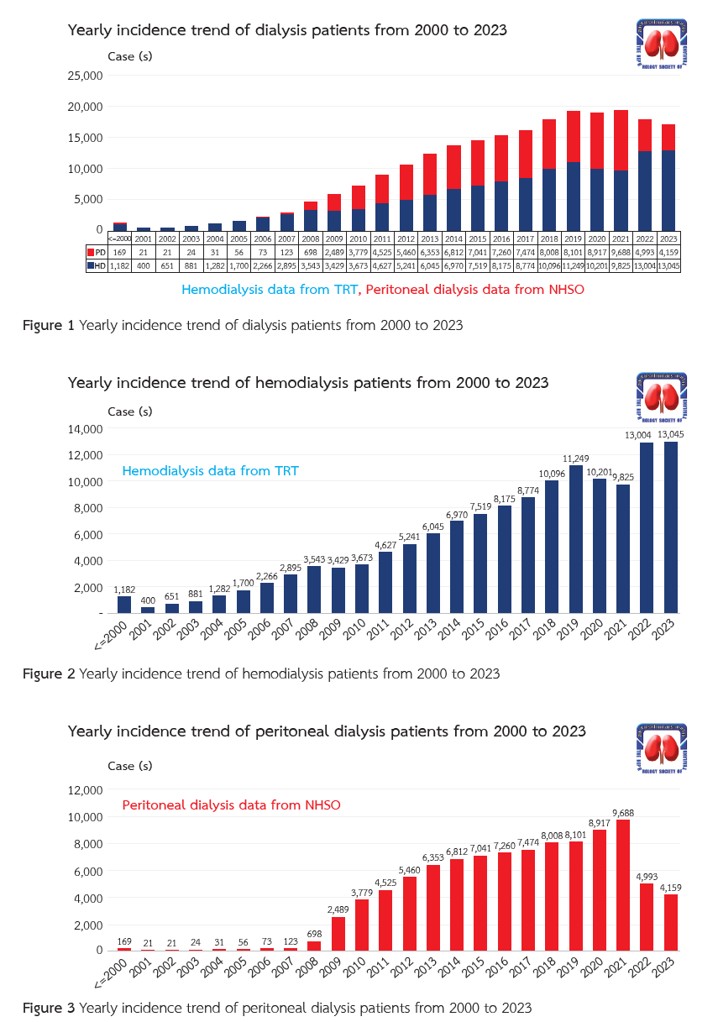
This study examines data from the Thailand Renal Replacement Therapy (TRT) Registry, highlighting trends, challenges, and opportunities in managing End-Stage Kidney Disease (ESKD) and delivering renal replacement therapy (RRT) in Thailand. Between 2000 and 2023, the number of new patients initiating hemodialysis rose by 13,045 in 2023, while new peritoneal dialysis cases declined by nearly 50% compared to 2021. Diabetic nephropathy and hypertension remained the leading causes of ESKD, accounting for over 80% of cases. Despite the growing burden of ESKD, significant gaps in care persist, including challenges with vascular access and disparities in dialysis adequacy. Kidney transplantation rates remain low, with only a small percentage of patients on the waiting list. Additionally, the study highlights concerns about malnutrition and low vaccination coverage among dialysis patients. In 2023, the mortality rate among incident dialysis patients was 3.6%, with cardiac disease and infections as the leading causes of death. These findings emphasize the urgent need for targeted interventions in hypertension and diabetes management, infection prevention, and improved access to transplantation and vaccination. This analysis provides critical insights to inform policy development and enhance the quality of care for ESKD patients in Thailand.
Article Details

This work is licensed under a Creative Commons Attribution-NonCommercial-NoDerivatives 4.0 International License.
This article is published under CC BY-NC-ND 4.0 license, which allows for non-commercial reuse of the published paper as long as the published paper is fully attributed. Anyone can share (copy and redistribute) the material in any medium or format without having to ask permission from the author or the Nephrology Society of Thailand.
References
Thurlow JS, Joshi M, Yan G, Norris KC, Agodoa LY, Yuan CM, et al. Global Epidemiology of End-Stage Kidney Disease and Disparities in Kidney Replacement Therapy. Am J Nephrol 2021;52(2):98-107. doi: 10.1159/000514550.
United States Renal Data System. 2023 USRDS Annual Data Report: Epidemiology of kidney disease in the United States. National Institutes of Health, National Institute of Diabetes and Digestive and Kidney Diseases, Bethesda, MD, 2023.
Kanjanabuch T, Takkavatakarn K. Global Dialysis Perspective: Thailand. Kidney360 2020;1(7):671-5. doi: 10.34067/KID.0000762020.
Chuengsaman P, Kasemsup V. PD First Policy: Thailand’s Response to the Challenge of Meeting the Needs of Patients With End-Stage Renal Disease. Semin Nephrol 2017;37(3):287-95. doi: 10.1016/j.semnephrol.2017.02.008.
Premprasong A, Nata N, Tangwonglert T, Supasyndh O, Satirapoj B. Risk factors associated with mortality among patients on maintenance hemodialysis: The Thailand Renal Replacement Therapy registry. Ther Apher Dial 2024;28(6):839-54. doi: 10.1111/1744-9987.14166.
Jirapanakorn S, Witthayapipopsakul W, Kusreesakul K, Lakhotia D, Tangcharoensathien V, Suphanchaimat R. All-cause excess mortality among end-stage renal disease (ESRD) patients during the COVID-19 pandemic in Thailand: a cross-sectional study from a national-level claims database. BMJ Open 2024;14(1):e081383. doi: 10.1136/bmjopen-2023-081383.
Noppakun K, Tantraworasin A, Khorana J, Nochaiwong S, Vongsanim S, Narongkiatikhun P, et al. Survival rates in comprehensive conservative care compared to dialysis therapy in elderly end-stage kidney disease patients: a propensity score analysis. Ren Fail 2024;46(2):2396448. doi: 10.1080/0886022X.2024.2396448.
Cha’on U, Tippayawat P, Sae-Ung N, Pinlaor P, Sirithanaphol W, Theeranut A, et al. High prevalence of chronic kidney disease and its related risk factors in rural areas of Northeast Thailand. Sci Rep 2022;12(1):18188. doi: 10.1038/s41598-022-22538-w.
Ong-Ajyooth L, Vareesangthip K, Khonputsa P, Aekplakorn W. Prevalence of chronic kidney disease in Thai adults: a national health survey. BMC Nephrol 2009;10:35. doi: 10.1186/1471-2369-10-35.
Nata N, Rangsin R, Supasyndh O, Satirapoj B. Impaired Glomerular Filtration Rate in Type 2 Diabetes Mellitus Subjects: A Nationwide Cross-Sectional Study in Thailand. J Diabetes Res 2020;2020:6353949. doi: 10.1155/2020/6353949.
Ophascharoensuk, V., & Peerapornratana, S. Executive Summary of the 2022 Thailand Hemodialysis Clinical Practice Guideline. Journal of the Nephrology Society of Thailand, 2003: 29(4), 289–300. .
Ikizler TA, Burrowes JD, Byham-Gray LD, Campbell KL, Carrero JJ, Chan W, et al. KDOQI Clinical Practice Guideline for Nutrition in CKD: 2020 Update. Am J Kidney Dis 2020;76(3 Suppl 1):S1-S107. doi: 10.1053/j.ajkd.2020.05.006.
Kilpatrick RD, McAllister CJ, Kovesdy CP, Derose SF, Kopple JD, Kalantar-Zadeh K. Association between serum lipids and survival in hemodialysis patients and impact of race. J Am Soc Nephrol 2007;18(1):293-303. doi: 10.1681/ASN.2006070795.
Timofte D, Tanasescu MD, Balcangiu-Stroescu AE, Balan DG, Tulin A, Stiru O, et al. Dyselectrolytemia-management and implications in hemodialysis (Review). Exp Ther Med 2021;21(1):102. doi: 10.3892/etm.2020.9534.
Aiumtrakul N, Wiputhanuphongs P, Supasyndh O, Satirapoj B. Hyperuricemia and Impaired Renal Function: A Prospective Cohort Study. Kidney Dis (Basel) 2021;7(3):210-8. doi: 10.1159/000511196.
Zawada AM, Carrero JJ, Wolf M, Feuersenger A, Stuard S, Gauly A, et al. Serum Uric Acid and Mortality Risk Among Hemodialysis Patients. Kidney Int Rep 2020;5(8):1196-206. doi: 10.1016/j.ekir.2020.05.021.
Van Buren PN, Toto R. Hypertension in diabetic nephropathy: epidemiology, mechanisms, and management. Adv Chronic Kidney Dis 2011;18(1):28-41. doi: 10.1053/j.ackd.2010.10.003.
Young EW, Wang D, Kapke A, Pearson J, Turenne M, Robinson BM, et al. Hemoglobin and Clinical Outcomes in Hemodialysis: An Analysis of US Medicare Data From 2018 to 2020. Kidney Med 2023;5(2):100578. doi: 10.1016/j.xkme.2022.100578.
Mukherjee T, Devi G, Geetha S, Anchan NJ, Sankarasubbaiyan S. A Comparison of Practice Pattern and Outcome of Twice-weekly and Thrice-weekly Hemodialysis Patients. Indian J Nephrol 2017;27(3):185-9. doi: 10.4103/0971-4065.202844.
Mendonca S, Bhardwaj S, Sreenivasan S, Gupta D. Is Twice-weekly Maintenance Hemodialysis Justified? Indian J Nephrol 2021;31(1):27-32. doi: 10.4103/ijn.IJN_338_19.
Akoh JA. Use of permanent dual lumen catheters for long-term haemodialysis. Int Surg 1999;84(2):171-5.
Mailloux LU, Bellucci AG, Wilkes BM, Napolitano B, Mossey RT, Lesser M, et al. Mortality in dialysis patients: analysis of the causes of death. Am J Kidney Dis 1991;18(3):326-35. doi: 10.1016/s0272-6386(12)80091-6.122
