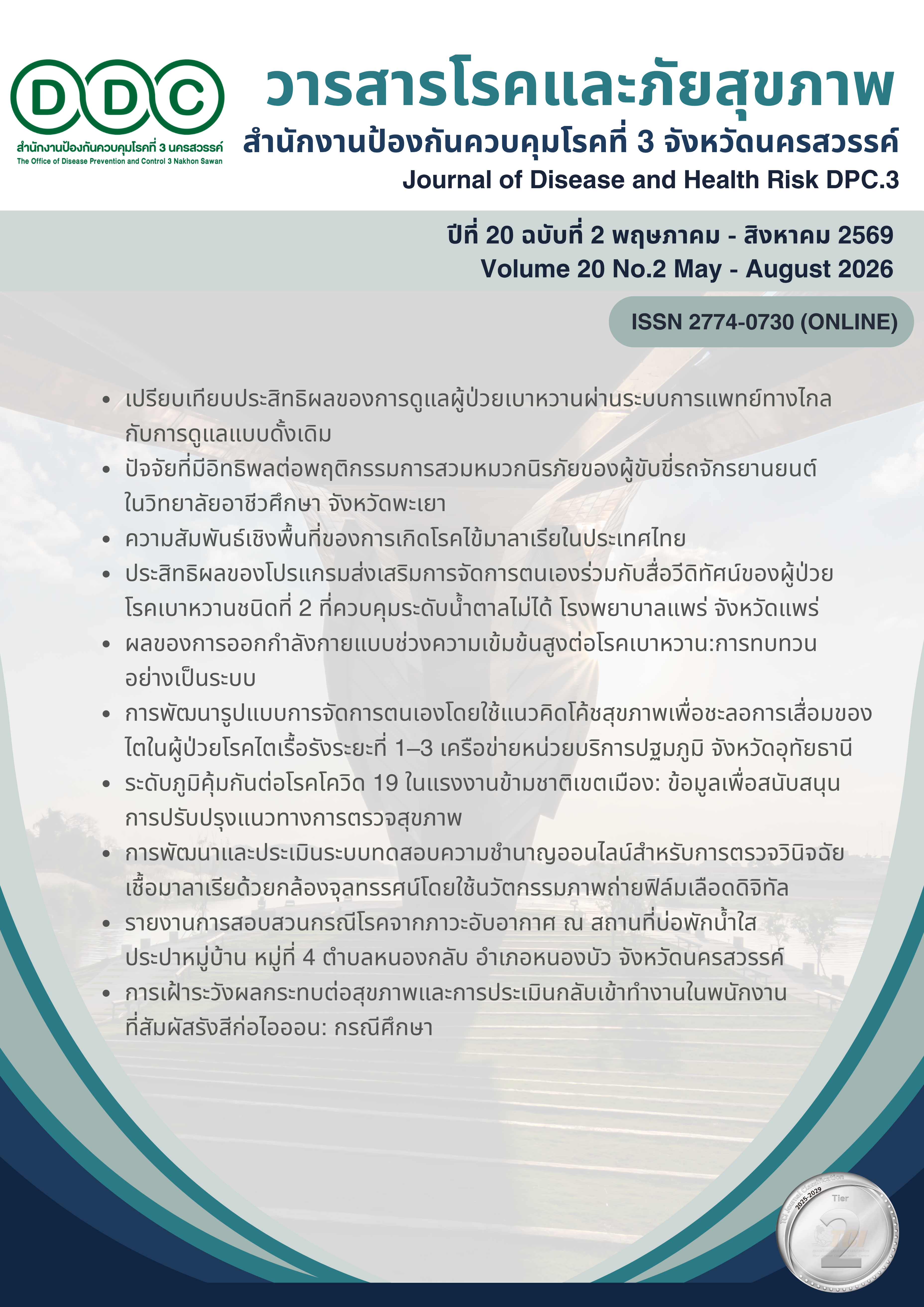
การพัฒนาและประเมินระบบทดสอบความชำนาญออนไลน์สำหรับการตรวจวินิจฉัย เชื้อมาลาเรียด้วยกล้องจุลทรรศน์โดยใช้นวัตกรรมภาพถ่ายฟิล์มเลือดดิจิทัล
คำสำคัญ:
มาลาเรีย, การทดสอบความชำนาญ, การตรวจวินิจฉัยด้วยกล้องจุลทรรศน์บทคัดย่อ
การศึกษาวิจัยนี้มีวัตถุประสงค์เพื่อพัฒนาและประเมินระบบทดสอบความชำนาญแบบออนไลน์สำหรับการตรวจวินิจฉัยเชื้อมาลาเรียด้วยกล้องจุลทรรศน์ พัฒนาโดยใช้นวัตกรรมภาพถ่ายดิจิทัลของฟิล์มเลือดจริง และศึกษาความสอดคล้องของผลการประเมินเมื่อเปรียบเทียบระหว่างออนไลน์กับระบบการประเมินแบบดั้งเดิม กลุ่มตัวอย่างประกอบด้วยบุคลากรห้องปฏิบัติการที่เข้าร่วมทดสอบด้วยวิธีดั้งเดิมจำนวน 94 ราย และวิธีออนไลน์จำนวน 134 ราย โดยใช้ฟิล์มเลือดมาตรฐานจำนวน 9 เคสที่ผ่านการยืนยันจากผู้เชี่ยวชาญระดับ level 1 และ level 2 ขององค์การอนามัยโลก และยืนยันซ้ำด้วยวิธี Real-time PCR วิเคราะห์ข้อมูลด้วยสถิติ one-way ANOVA, paired t-test และ Bland-Altman plot ผลการศึกษาพบว่าวิธีดั้งเดิมมีค่าเฉลี่ยร้อยละของสมรรถนะด้านการจำแนกชนิดเชื้อ การหาเชื้อ และการนับเชื้อ เท่ากับ 84.75, 97.40 และ 70.39 ขณะที่วิธีออนไลน์มีค่าเท่ากับ 81.96, 97.14 และ 78.78 ตามลำดับ การวิเคราะห์ด้วย paired t-test พบว่าค่า p-value ของทั้ง 3 ด้าน เท่ากับ 0.53, 0.78 และ 0.06 ซึ่งไม่มีความแตกต่างอย่างมีนัยสำคัญทางสถิติ (p>0.05) การวิเคราะห์ความสอดคล้องด้วย Bland-Altman plot พบว่าสมรรถนะด้านการหาเชื้อมีความสอดคล้องสูงสุด โดยมีค่าความเอนเอียงเท่ากับ 0.26 และช่วงขอบเขตความสอดคล้องอยู่ระหว่าง -5.15 ถึง 5.66 ผู้ใช้งานมีความพึงพอใจโดยรวมเฉลี่ยร้อยละ 90 ผลการศึกษาสรุปได้ว่าระบบทดสอบความชำนาญออนไลน์โดยใช้ภาพถ่ายฟิล์มเลือดดิจิทัลเป็นวิธีทางเลือกที่มีประสิทธิภาพสามารถใช้ทดแทนวิธีดั้งเดิมได้อย่างมีประสิทธิภาพ เป็นเครื่องมือที่เหมาะสม ในการนำไปใช้ประเมินบุคลากรเครือข่ายห้องปฏิบัติการเพื่อเพิ่มความครอบคลุมซึ่งสามารถสนับสนุนส่งเสริมระบบประกันคุณภาพด้านการตรวจวินิจฉัยเชื้อมาลาเรียด้วยกล้องจุลทรรศน์ เพื่อสนับสนุนเป้าหมายการกำจัดโรคไข้มาลาเรียของประเทศไทย
เอกสารอ้างอิง
World Health Organization. World malaria report 2024. Geneva: World Health Organization [Internet]. 2024 [cited 2025 Dec 25]. Available from: https://www.who.int/teams/global-malaria-programme/reports/world-malaria-report-2024.
World Health Organization. Basic malaria microscopy: Part 1 Learner's Guide. 1991.
Ishengoma D, Rwegoshora R, Mdira K, Kamugisha M, Anga E, Bygbjerg I, et al. Health laboratories in the Tanga region of Tanzania: the quality of diagnostic services for malaria and other communicable diseases. Ann Trop Med Parasitol. 2009;103(5):441-53.
Milne L, Kyi M, Chiodini P, Warhurst D. Accuracy of routine laboratory diagnosis of malaria in the United Kingdom. J Clin Pathol. 1994;47(8):740-2.
Mukadi P, Gillet P, Lukuka A, Atua B, Kahodi S, Lokombe J, et al. External quality assessment of malaria microscopy in the Democratic Republic of the Congo. Malar J. 2011;10(1):308. doi: 10.1186/1475-2875-10-308
Ahmed L, Seal LH, Ainley C, De la Salle B, Brereton M, Hyde K, et al. Web-based virtual microscopy of digitized blood slides for malaria diagnosis: an effective tool for skills assessment in different countries and environments. J Med Internet Res. 2016;18(8):e213. doi: 10.2196/jmir.6027
Pollak JJ, Houri-Yafin A, Salpeter SJ. Computer vision malaria diagnostic systems—progress and prospects. Front Public Health. 2017;5:219. doi: 10.3389/fpubh.2017.00219
Shambhu S, Koundal D, Das P, Hoang VT, Tran-Trung K, Turabieh H. Computational methods for automated analysis of malaria parasite using blood smear images: recent advances. Comput Intell Neurosci. 2022;2022(1):3626726. doi: 10.1155/2022/3626726
Marchevsky AM, Wan Y, Thomas P, Krishnan L, Evans-Simon H, Haber H. Virtual microscopy as a tool for proficiency testing in cytopathology: a model using multiple digital images of Papanicolaou tests. Arch Pathol Lab Med. 2003;127(10):1,320-4.
World Health Organization. Malaria Microscopy Quality Assurance Manual-Version 2. 2016.
Ashraf S, Kao A, Hugo C, Christophel EM, Fatunmbi B, Luchavez J, et al. Developing standards for malaria microscopy: external competency assessment for malaria microscopists in the Asia-Pacific. Malar J. 2012;11:352. doi: 10.1186/1475-2875-11-352
Bland JM, Altman D. Statistical methods for assessing agreement between two methods of clinical measurement. The lancet. 1986;327(8476):307-10.
Bland JM, Altman DG. Statistical methods for assessing agreement between two methods of clinical measurement. International journal of nursing studies. 2010;47(8):931-6.
Gerke O. Reporting standards for a Bland–Altman agreement analysis: A review of methodological reviews. Diagnostics. 2020;10(5):334. doi: 10.3390/diagnostics10050334
Rosado L, Da Costa JMC, Elias D, Cardoso JS. Automated detection of malaria parasites on thick blood smears via mobile devices. Procedia Computer Science. 2016;90:138-44.
Beck HP. Digital microscopy and artificial intelligence could profoundly contribute to malaria diagnosis in elimination settings. Front Artif Intell. 2022;5:510483. doi: 10.3389/frai.2022.510483.
Maguire JD, Lederman ER, Barcus MJ, O'Meara WAP, Jordon RG, Duong S, et al. Production and validation of durable, high quality standardized malaria microscopy slides for teaching, testing and quality assurance during an era of declining diagnostic proficiency. Malar J. 2006;5:92. doi: 10.1186/1475-2875-5-92
Tegegne B, Ejigu K, Alemu G, Fetene Y, Endaylalu K, Melese M. Performance of malaria microscopy external quality assessment and networking among health facilities in west Amhara region, Ethiopia. BMC Infect Dis. 2020;20(1):355. doi: 10.1186/s12879-020-05077-5
Holmström O, Linder N, Ngasala B, Mårtensson A, Linder E, Lundin M, et al. Point-of-care mobile digital microscopy and deep learning for the detection of soil-transmitted helminths and Schistosoma haematobium. Glob Health Action. 2017;10(sup3):1337325. doi: 10.1080/16549716.2017.1337325
Sudathip P, Saejeng A, Khantikul N, Thongrad T, Kitchakarn S, Sugaram R, et al. Progress and challenges of integrated drug efficacy surveillance for uncomplicated malaria in Thailand. Malar J. 2021;20(1):261. doi: 10.1186/s12936-021-03791-2
ดาวน์โหลด
เผยแพร่แล้ว
รูปแบบการอ้างอิง
ฉบับ
ประเภทบทความ
สัญญาอนุญาต
ลิขสิทธิ์ (c) 2026 วารสารโรคและภัยสุขภาพ สำนักงานป้องกันควบคุมโรคที่ 3 จังหวัดนครสวรรค์

อนุญาตภายใต้เงื่อนไข Creative Commons Attribution-NonCommercial-NoDerivatives 4.0 International License.
ประกาศเกี่ยวกับลิขสิทธิ์
|
บทความที่เผยแพร่ในวารสารโรคและภัยสุขภาพสำนักงานป้องกันควบคุมโรคที่ 3 จังหวัดนครสวรรค์ ถือว่าเป็นผลงานทางวิชาการหรือการวิจัย และวิเคราะห์ ตลอดจนเป็นความเห็นส่วนตัวของผู้เขียน ไม่ใช่ความเห็นของสำนักงานป้องกันควบคุมโรคที่ 3 จังหวัดนครสวรรค์ หรือกองบรรณาธิการแต่ประการใด ผู้เขียนต้องรับผิดชอบต่อบทความของตน |
นโยบายความเป็นส่วนตัว
|
ชื่อและที่อยู่ อีเมล์ ที่ระบุในวารสารโรคและภัยสุขภาพสำนักงานป้องกันควบคุมโรคที่ 3 จังหวัดนครสวรรค์ จะใช้เพื่อระบุตามวัตถุประสงค์ของวารสารเท่านั้น และจะไม่นำไปใช้สำหรับวัตถุประสงค์อื่น หรือต่อบุคคลอื่น |