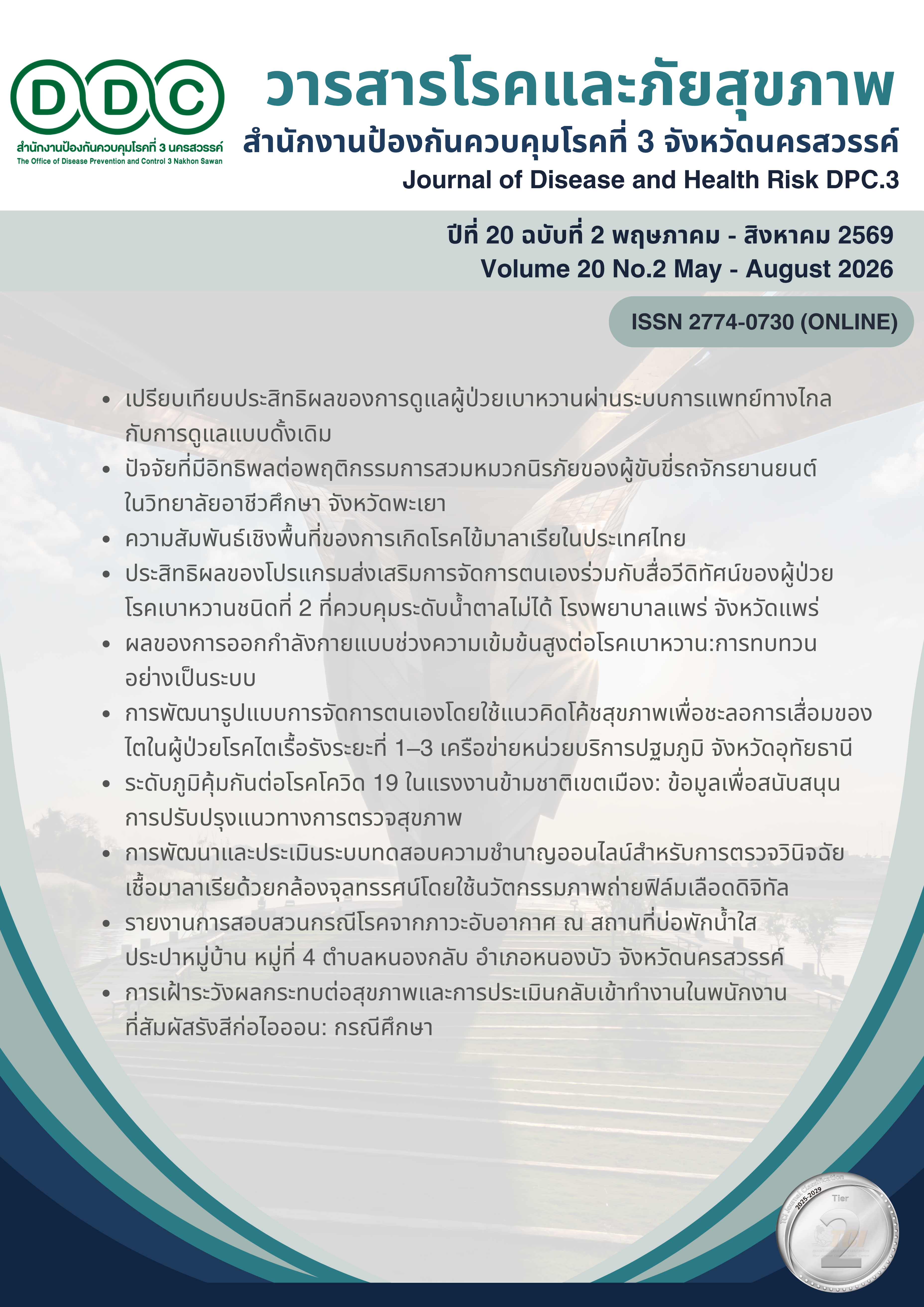
Development of a Self-Management Model Based on Health Coaching to Delay Chronic Kidney Disease Progression in Patients with Stages 1–3 CKD in Primary Care Settings Uthai Thani Province
Keywords:
Chronic Kidney Disease (CKD) stages 1–3 , Self-Management , Health Coaching , CKD progression , eGFRAbstract
This research and development study aimed to develop and evaluate the effectiveness of a self-management model based on the health coaching concept to delay disease progression among patients with chronic kidney disease (CKD) stages 1–3. A mixed-methods approach was employed and conducted in three phases. Phase 1 involved a situational analysis of problems, related factors, and needs among 140 patients with CKD stages 1–3, selected using purposive sampling based on inclusion criteria, including age ≥18 years and a confirmed diagnosis of CKD stages 1–3. Phase 2 focused on the development and synthesis of the self-management model by integrating Self-Management Theory with the health coaching concept. Phase 3 involved the implementation and evaluation of the model using a quasi-experimental pretest–posttest control group design. The sample consisted of 60 patients, divided into an intervention group (n = 30) and a comparison group (n = 30). Stratified random sampling combined with simple randomization was applied to minimize contamination. The intervention was conducted over a 12-week period. Research instruments included health behavior and self-management questionnaires with reliability coefficients (Cronbach’s alpha) ranging from 0.87 to 0.92, as well as clinical data obtained from medical records, including estimated glomerular filtration rate (eGFR), serum creatinine, glycated hemoglobin (HbA1c), and blood pressure. Data were analyzed using descriptive statistics, t-tests (independent and paired), and analysis of covariance (ANCOVA). The results revealed that, after the intervention, the intervention group demonstrated significantly higher self-management and health behavior scores compared to both baseline and the comparison group (p < .001), with an adjusted mean self-management score of 4.01. After controlling for baseline values, the intervention group showed significantly better outcomes than the comparison group. Clinical outcomes also improved significantly in the intervention group, with eGFR increasing from 61.2 ± 18.4 to 63.8 ± 18.1 ml/min/1.73m² (p = 0.003). ANCOVA results further indicated that the intervention group had significantly higher eGFR than the comparison group (F = 6.84, p = 0.011), while no significant changes were observed in the comparison group. In conclusion, the self-management model based on the health coaching concept was effective in enhancing self-management and health behaviors, as well as delaying disease progression among patients with CKD stages 1–3. The model demonstrates strong potential for implementation in primary healthcare and community-based health systems.
References
Global Burden of Disease Collaborative Network. Global burden of disease study 2019 (GBD 2019) results. Seattle (WA): Institute for Health Metrics and Evaluation; 2020.
Department of Disease Control, Ministry of Public Health. National report on noncommunicable diseases: diabetes, hypertension and related risk factors. Nonthaburi: Department of Disease Control; 2022.
Department of Disease Control, Ministry of Public Health. Epidemiology of chronic kidney disease in Thailand. Nonthaburi: Department of Disease Control; 2021.
Hfocus News Agency. Rising burden of chronic kidney disease in Thailand: one in 25 patients with diabetes and hypertension develops CKD. Bangkok: Hfocus; 2023.
National Health Security Office. Chronic kidney disease (CKD). Bangkok: National Health Security Office; 2020.
The Coverage. Thailand’s chronic kidney disease crisis: what happens if no action is taken? Bangkok: The Coverage; 2023.
National Kidney Foundation. K/DOQI clinical practice guidelines for chronic kidney disease: evaluation, classification, and stratification. Am J Kidney Dis. 2002;39(Suppl 1):S1–266.
The Nephrology Society of Thailand. Clinical practice guidelines for chronic kidney disease management. Bangkok: The Nephrology Society of Thailand; 2022.
Ibrahim H, Mondress M, Tello A, Fan Y, Koopmeiners J, Thomas W. An alternative formula to the Cockcroft–Gault and MDRD equations in predicting GFR. Kidney Int. 2005;68(2):1,053–8.
Ryan P, Sawin KJ. The individual and family self-management theory: background and perspectives. Nurs Outlook. 2009;57(4):217–25.
Oliveira JS, Sherrington C, Zheng ER, Franco MR. Effect of health coaching on chronic conditions: a systematic review and meta-analysis. BMJ Open. 2020;10:e035420.
Health Data Center (HDC). Chronic kidney disease data of Nongkae Primary Care Network, Mueang Uthai Thani District, Uthai Thani Province; 2022–2024.
Lampang Hospital Journal Editorial Board. Self-care practices to reduce risk and slow progression of chronic kidney disease. Lampang Hosp J. 2014;34(2):45–52.
World Health Organization. Innovative care for chronic conditions: building blocks for action. Geneva: World Health Organization; 2002.
Wagner EH, Austin BT, Von Korff M. Organizing care for patients with chronic illness. Milbank Q. 1996;74(4):511–44.
Cochran WG. Sampling techniques. 3rd ed. New York: John Wiley & Sons; 1977.
Cohen J. Statistical power analysis for the behavioral sciences. 2nd ed. Hillsdale (NJ): Lawrence Erlbaum Associates; 1988.
Kivelä K, Elo S, Kyngäs H, Kääriäinen M. The effects of health coaching on adult patients with chronic diseases: a systematic review. Patient Educ Couns. 2022;105(5):957–68.
O’Connor S, Hanlon P, O’Donnell CA, Garcia S, Glanville J, Mair FS. Understanding factors affecting patient adherence to self-management interventions for chronic diseases: a systematic review. BMC Public Health. 2023;23:112.
Zhang Y, Liu C, Luo S, Xie Y, Liu F, Li X. Effectiveness of health coaching interventions for patients with chronic diseases: a meta-analysis. Int J Nurs Stud. 2022;129:104214.
Chen SH, Tsai YF, Sun CY, Wu IW, Lee CC, Wu MS. The impact of self-management support on outcomes in patients with chronic kidney disease: a systematic review and meta-analysis. Nephrol Dial Transplant. 2021;36(2):249–60.
Kelly JT, Campbell KL, Hoffmann T, Reidlinger DP. Healthy dietary patterns and risk of chronic kidney disease progression: a systematic review. Clin J Am Soc Nephrol. 2023;18(4):584–596.
Peng S. Health literacy and its association with self-management in patients with chronic kidney disease: a cross-sectional study. BMC Nephrol. 2022;23:67.
Li H. Social support, self-efficacy and self-management among patients with chronic kidney disease: a structural equation model. Int J Environ Res Public Health. 2023;20(5):4,123.
Jiraporncharoen W, Srisuphan W, Nantsupawat R. Self-management behaviors among patients with chronic kidney disease in community settings in Thailand. Thai J Nurs Res. 2022;26(3):45–58.
Phrommintikul A, Haas SJ, Elsik M, Krum H. Mortality and target hemoglobin concentrations in chronic kidney disease patients treated with erythropoietin: a meta-analysis. J Am Soc Nephrol. 2021;32(1):45–56.
Kidney Disease: Improving Global Outcomes (KDIGO). KDIGO 2022 clinical practice guideline for the evaluation and management of chronic kidney disease. Kidney Int Suppl. 2022;12(1):S1–115.
Downloads
Published
How to Cite
Issue
Section
License
Copyright (c) 2026 Journal of Disease and Health Risk DPC.3

This work is licensed under a Creative Commons Attribution-NonCommercial-NoDerivatives 4.0 International License.
Copyright notice
Article published in the Journal of Disease and Health Risk DPC.3 Nakhon Sawan. It is considered a work of academic research and analysis as well as the personal opinion of the author. It is not the opinion of the Office of Disease Prevention and Control 3, Nakhon Sawan. Or the editorial team in any way Authors are responsible for their articles.
Privacy Policy
Name, address and e-mail address specified in the Journal of Disease and Health Risk DPC.3 Nakhon Sawan. It is used for identification purposes of the journal. And will not be used for any other purpose. Or to another person.