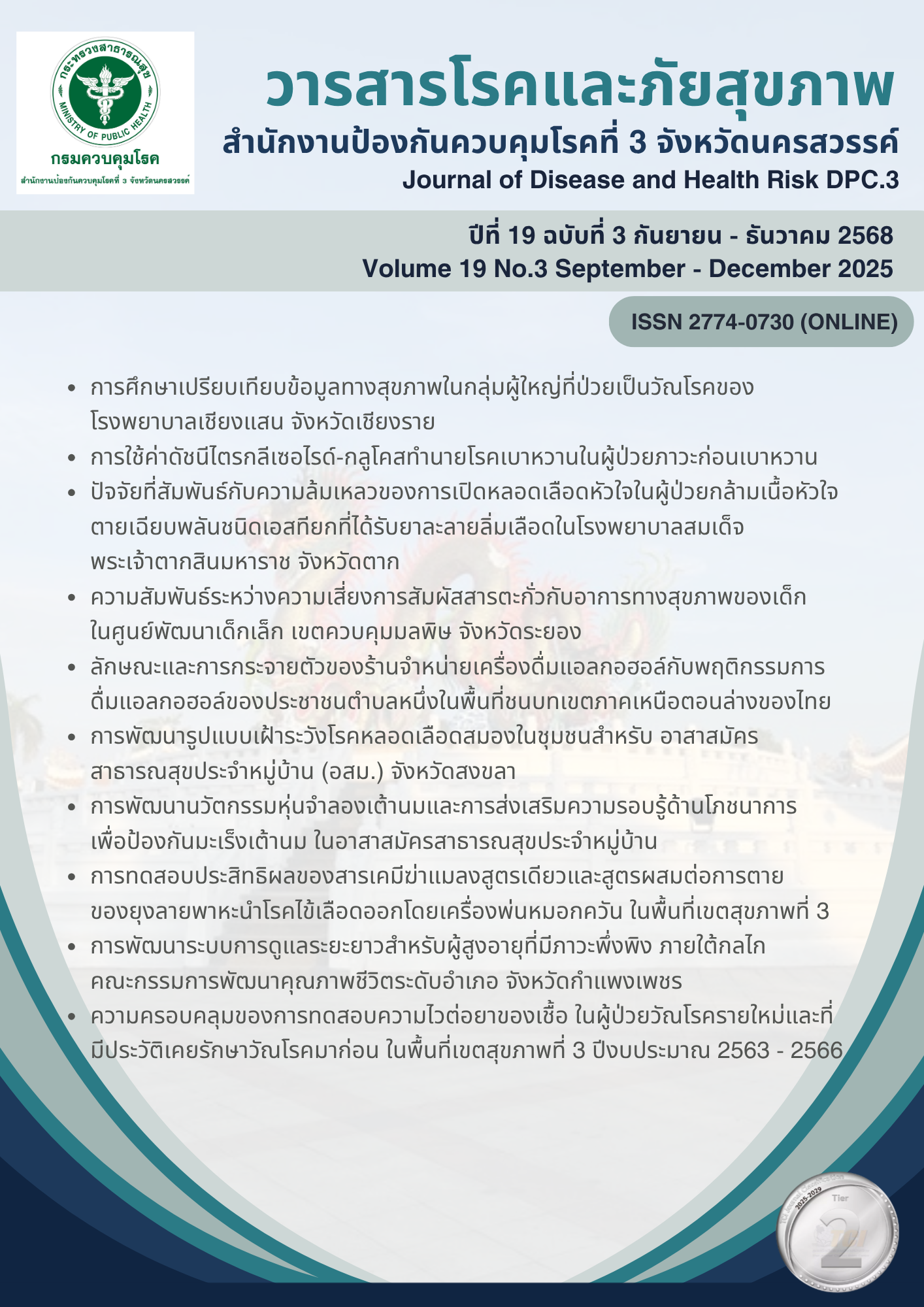
Factors associated with reperfusion failure of ST-elevation myocardial infarction following thrombolytic therapy in Somdejphrajaotaksin Maharaj hospital, Tak province
Keywords:
ST-elevation myocardial infarction (STEMI), Thrombolytic therapy, Reperfusion failureAbstract
This study objectivity to study the factors associated with reperfusion failure in ST-elevation acute myocardial infarction (STEMI) patients received thrombolytic therapy at Somdetphrajaotaksin Maharaj Hospital. This is a cross-sectional analytical study collected data between July 2019 and June 2024, involving acute ST-segment elevation myocardial infarction (STEMI) patients who received thrombolytic therapy. Data were analyzed using descriptive statistics, tests of differences among variable factors, and binary logistic regression analysis to explore associations between variable factors and results were presented with adjusted odds ratios (adjusted OR) and 95% confidence intervals (95%CI). The level of statistical significance was set at 0.05. The 84 patients were included with a mean age of 66.3 ± 11.34 years. 95.2% of patients received Streptokinase, while 4.8% of patients received Tenecteplase. Reperfusion failure occurred in 48.8% of patients, with 75.6% being male and 24.4% female. Three factors contributing to reperfusion failure are age (adjusted OR 1.081, 95%CI 1.001-1.168; p = 0.047, mean age 69.5 ± 9.72 years), alcohol consumption (adjusted OR 8.893, 95%CI 1.653-47.837; p = 0.011), and HbA1C levels (adjusted OR 3.081, 95%CI 1.085-8.746; p = 0.035). Complications following thrombolytic therapy included hypotension in 16.7% of patients and bleeding in 9.5%, which is consistent with previous studies. This study found that age, alcohol consumption, and HbA1C were factors contributing to reperfusion failure in acute STEMI patients. Further studies should include network hospitals to increase the sample size, which may reveal associations with other variable factors.
References
World Heart Federation. World heart report 2023: confronting the World’s number one killer. Geneva: World Heart Federation; 2023.
Gerc V, Masic I, Salihefendic N, Zidzic M. Cardiovascular Diseases (CVDs) in COVID-19 Pandemic era. Materia Socio-Medica. 2020;32(2):158-64.
Namwong T, Arrirak N. Prevalence and risk factors of ST-elevation myocardial infarction (STEMI) among the elderly in yasothon province. Journal of Health Science. 2022;31 (suppl2):S260-8. (in Thai).
Wachiradilok P, Doungthipsirikul S, Sirisamutr T, Neungaud A. Seamless and integrated emergency medical services system for mental health crisis patients in Thailand. Journal of Health Systems Research. 2023;17(2):264-78.
Buntongmai Y, Jabprapai P, Ongartthaweechai S. Development of a nursing model for patients with acute myocardial infarction with ST-segment elevation (STEMI) in the pandemic of the coronavirus disease 2019 emergency department phraphutthabat hospital. Region 11 Medical Journal. 2022;36(2):50-64.
Kaewna P. Factors associated with streptokinase failure in the treatment of STEMI patients in District hospital: a retrospective study. Academic Journal of Mahasarakham Provincial Public Health Office. 2023;7(14):113-22.
Untaja P, Sindhu S, Davidson PM, Thosingha O, Viwatwongkasem C. Predictors of myocardial reperfusion in patients with ST-elevation myocardial infarction following thrombolytic treatment in rural community. Walailak Journal of Science and Technology (WJST). 2020;17(6):608-19.
Surat V, Yensabai R, Khajonvittayakul N. Factors associated with streptokinase failure in the treatment of STEMI patients: a retrospective study. Journal of Health Systems Research. 2014;8:3.
Mishra A, Prajapati J, Dubey G, Patel I, Mahla M, Bishnoi S, et al. Characteristics of ST-elevation myocardial infarction with failed thrombolysis. Asian Cardiovascular and Thoracic Annals. 2020;28(5):266-72.
Tak provincial public health office. Health information warehouse system: Health data center (HDC) provincial level [Internet]. 2019 [cited 2024 Sep 16] Available from: https://hdcservi ce.moph.go.th/hdc/reports/report.php?&cat_id=b91a30012c36ef54910261d9cfc6d7f5&id= 8ec43f9ee8a5b450912a021b7b914f7e.
The heart association of Thailand under royal patronage. Treatment of ST-Segment elevation myocardial infarction (STEMI) [Internet]. 2019 [cited 2024 Sep 17] Available from: http:// www.thai heart.org/images/introc_1599350902/Thai%20ACS%20Guidelines%202020.pdf.
National drug policy division.2.10 Fibrinolytic drugs [Internet]. 2016 [cited 2024 Sep 18] Available from: https://ndi.fda.moph.go.th/drug_national/drugs_current?p=[%E0%B8%9A% =%202&g2=10.
Suesat T, Nomkuson J, Inpim P, Pholyiam P, Suraphee S. Factors associated with treatment result of acute coronary syndrome patients. KKU Journal for Public Health Research. 2563;13(2):11.
Sun X, Feng Y, Gong C, Bao X, Wei Z, Chang L, et al. Hypertension-driven regulatory T-cell perturbations accelerate myocardial ischemia-reperfusion injury. Hypertension. 2023;80(10): 2046-58.
Koeth O, Nibbe L, Arntz HR, Dirks B, Ellinger K, Genzwürker H, et al. Fate of patients with prehospital resuscitation for ST-elevation myocardial infarction and a high rate of early reperfusion therapy (results from the PREMIR [Prehospital Myocardial Infarction Registry]). The American journal of cardiology. 2012;109(12):1733-7.
Sun X, Feng Y, Gong C, Bao X, Wei Z, Chang L, et al. Hypertension-driven regulatory T-cell perturbations accelerate myocardial ischemia-reperfusion injury. Hypertension. 2023;80(10): 2046-58.
Koeth O, Nibbe L, Arntz HR, Dirks B, Ellinger K, Genzwürker H, et al. Fate of patients with prehospital resuscitation for ST-elevation myocardial infarction and a high rate of early reperfusion therapy (results from the PREMIR [Prehospital Myocardial Infarction Registry]). The American Journal of Cardiology. 2012;109(12):1733-7.
Babbs CF. Hemodynamic mechanisms in CPR: a theoretical rationale for resuscitative thoracotomy in non-traumatic cardiac arrest. Resuscitation. 1987;15(1):37-50.
Kurz MC. Hypercoagulation after cardiac arrest. Journal of Eta Maritime Science [Internet]. 2019 [cited 2024 Sep 24] Available from: https://www.jems.com/news/hypercoagulation-after-cardiac-arrest/.
Hamid S, Kundal V, Mahajan N, Singh P. Failure of thrombolysis with streptokinase in acute myocardial infarction using ECG criteria: an observational study. JK Science. 2015;17(3):123.
Downloads
Published
How to Cite
Issue
Section
License
Copyright (c) 2025 Journal of Disease and Health Risk DPC.3

This work is licensed under a Creative Commons Attribution-NonCommercial-NoDerivatives 4.0 International License.
Copyright notice
Article published in the Journal of Disease and Health Risk DPC.3 Nakhon Sawan. It is considered a work of academic research and analysis as well as the personal opinion of the author. It is not the opinion of the Office of Disease Prevention and Control 3, Nakhon Sawan. Or the editorial team in any way Authors are responsible for their articles.
Privacy Policy
Name, address and e-mail address specified in the Journal of Disease and Health Risk DPC.3 Nakhon Sawan. It is used for identification purposes of the journal. And will not be used for any other purpose. Or to another person.