
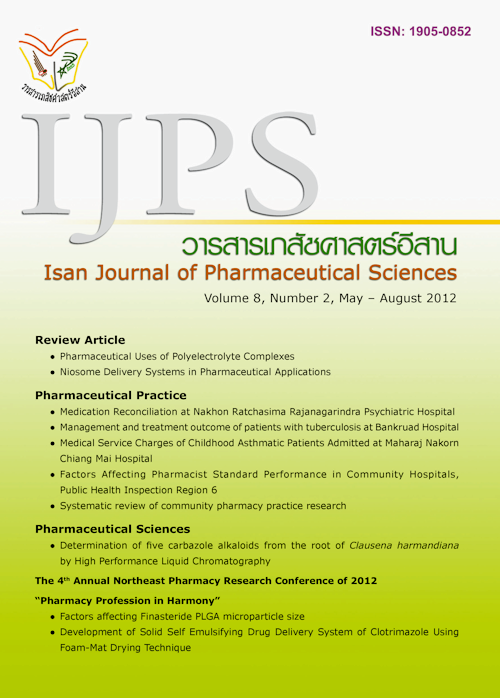
การประสานรายการยา ณ โรงพยาบาลจิตเวชนครราชสีมาราชนครินทร์
Article Sidebar
Main Article Content
บทคัดย่อ
บทนํา: ความคลาดเคลื่อนทางยาเป็นสาเหตุหนึ่งของการเกิดเหตุการณ์ไม่พึงประสงค์ ซึ่งมักเกิดที่จุดรอยต่อของการให้บริการและเกิดจากปัญหาการสื่อสารระหว่างผู้ป่วยกับบุคลากรทางการแพทย์ โดยทั่วไปผู้ป่วยจิตเวชอาจมีปัญหาการสื่อสารจนก่อให้เกิดความคลาดเคลื่อนได้ การประสานรายการยามีความสำคัญยิ่งต่อความปลอดภัยของผู้ป่วย การศึกษานี้มีวัตถุประสงค์เพื่อศึกษา 1) ความถี่และประเภทของความคลาดเคลื่อนทางยา 2) ปัจจัยที่มีผลต่อความคลาดเคลื่อนทางยา 3) ผลการตอบสนองของแพทย์ และ 4) ระยะเวลาที่เภสัชกรใช้ในการประสานรายการยา วิธีการศึกษา: การศึกษานี้เป็นการศึกษาเชิงพรรณนาแบบเก็บข้อมูลไปข้างหน้า ในผู้ป่วยในที่มีการประสานรายการยา ณ โรงพยาบาลจิตเวชนครราชสีมาราชนครินทร์ ระหว่างวันที่ 15 กุมภาพันธ์ - 15 มีนาคม 2554 โดยเภสัชกร 1 คนทำการประสานรายการยาในจุดแรกรับและจุดจำหน่ายผู้ป่วย ประเมินความแตกต่างของรายการยาและความคลาดเคลื่อนทางยา รวมทั้งบันทึกการตอบสนองของแพทย์และระยะเวลาที่ใช้ในการประสานรายการยา ซึ่งประกอบด้วย4 ขั้นตอน ได้แก่ 1) การทวนสอบข้อมูล 2) การตรวจสอบข้อมูล 3) การเปรียบเทียบรายการยาและการประสานกับแพทย์ 4) การส่งต่อข้อมูล ผลการศึกษา: พบความคลาดเคลื่อนทางยาในผู้ป่วย 27 ราย (13.1%) จาก 206 ราย รวม 65 ครั้ง (ขั้นตอนแรกรับ 36 ครั้งและจำหน่าย 29 ครั้ง) เป็นความคลาดเคลื่อนประเภท Omission Error 49 ครั้ง (75.3%) รองลงมาคือ Incorrect Dose และ Incorrect Time อย่างละ 5 ครั้ง (7.7%) โดยปัจจัยที่พบว่ามีผลต่อการเกิดความคลาดเคลื่อนทางยาคือ การมีโรคเรื้อรังร่วม จำนวนรายการยาก่อนแรกรับ ก่อนจำหน่ายและขั้นตอนจำหน่าย เมื่อทำการประสานรายการยา พบว่าเภสัชกรสามารถป้องกันการเกิดความคลาดเคลื่อนทางยาได้โดยได้รับการตอบรับจากแพทย์ทั้งสิ้น 62 ครั้ง (95.4%) เวลาเฉลี่ยต่อรายในการรวบรวมข้อมูลผู้ป่วย 13.7±2.7 นาที ในการสร้างรายการยาในขั้นตอนแรกรับและจำหน่าย 5.0±1.2 และ 5.0±1.3 นาที ตามลําดับ เวลาที่ใช้ประเมินความคลาดเคลื่อนทางยาในขั้นตอนแรกรับและจำหน่ายเป็น 5.5±2.4 และ 4.4±1.4 นาที ตามลําดับ เวลาเฉลี่ยที่ใช้ในการประสานกับแพทย์และติดตามการตอบสนองในขั้นตอนแรกรับและจำหน่าย 7.3±1.7 และ 7.0±2.2 นาทีต่อราย ตามลําดับ สรุปผล: แม้ว่าการประสานรายการยาต้องใช้เวลาของเภสัชกรมากขึ้น แต่พบว่ามีแนวโน้มลดการเกิดความคลาดเคลื่อนทางยาในช่วงรอยต่อของการให้บริการได้ โดยผู้ป่วยที่มีโรคทางจิตเวชร่วมกับโรคเรื้อรังที่เป็นร่วม และผู้ป่วยที่ใช้ยาหลายรายการ ควรได้รับการดูแลอย่างใกล้ชิดเพื่อลดการเกิดความคลาดเคลื่อนทางยา
Article Details
กรณีที่ใช้บางส่วนจากผลงานของผู้อื่น ผู้นิพนธ์ต้อง ยืนยันว่าได้รับการอนุญาต (permission) ให้ใช้ผลงานบางส่วนจากผู้นิพนธ์ต้นฉบับ (Original author) เรียบร้อยแล้ว และต้องแนบเอกสารหลักฐาน ว่าได้รับการอนุญาต (permission) ประกอบมาด้วย
เอกสารอ้างอิง
Bandhukul A. Knowledge of chronic disease [online]. 2010 Feb [cited2010 Sep 10]; [50 screens]. Available from: http://www.npc-se.co.th/pdf/book_safety/BookChronicDiseases.pdf
Bate DW, Spell N, Cullen DJ, et al. Incidence of adverse drug events and potential adverse drug events: implication for prevention. JAMA1995; 274: 24-34.
Cornish PL, Knowles SR, Marchesano R, et al.Unintended medication discrepancies at the time of hospital admission. Arch Intern Med 2005; 165: 424-9.
Gleason KM, Groszek JM, Sullivan C, et al. Reconciliation of discrepancies in medication histories and admission orders of newly hospitalized patients. Am J Health-Syst Pharm 2004; 61: 1689-95.
Gleason KM, McDaniel MR, Feinglass J, et al.Results of the Medications At Transitions and Clinical Handoffs(MATCH) Study: An Analysis of Medication Reconciliation Errors and Risk Factors at Hospital Admission. J Gen Intern Med 2010; 25(5): 441-7.
Insitute for health care improvement. Medication safety reconciliation tool kit [online]. 2006 May [cite 2010 Jul 18]. Available from: http://www.ihi.org/IHI/Topics/PatientSafety/MedicationSystems/Tools/MedicationSafetyReconciliationToolKit.htm
Liang BA, Alper E, Hickner J, et al. The physician’s role in medication reconciliation: issues, strategies, and safety principles. AMA 2007; 1-28.
Lizer MH, Brackbill ML. Medication history reconciliation by pharmacists in an inpatient behavioural health unit. Am J Health-Syst Pharm 2007; 64: 1087-91.
National Coordinating Council for Medication Error Reporting and Prevention. Medication Error Definition [online] 1998 [cited 2010 August 14] Available from, http://www.nccmerp.org/aboutMedErrors.html.
Nester TM, Hale LS. Effectiveness of a pharmacists-acquired medication history in promoting patient safety.Am J Health-Syst Pharm2002; 59: 2221-5.
Ningsanon T. Part I: Medication reconciliation. In: Ningsanon T, Montakantikul P, Chu-lawatanaton S, editors. Medication reconciliation. 2nd ed. Bangkok: Public company limited; 2008. 1-25.
Pippins JR, Gandhi TK, Hamann C, et al.Classifying and Predicting Errors of Inpatient Medication Reconciliation.J Gen Intern Med 2008; 23(9): 1414-22.
Reeder TA, Mutnick A. Pharmacist- versus physi-cian-obtained medication histories. Am J Health-Syst Pharm 2008; 65: 857-60.
Rozich J, Resar R. Medication safety: One organizations approach to the challenge. J Clin Outcomes Manage 2001; 8: 27-34.
Strunk LB, Matson AW, Steinke D. Impact of a pharmacist on medication reconciliation on patient admission to a veterans affairs medical centre. Hosp Pharm 2008; 43: 643-9.
Sue-tong C. Developing and implementing medication reconciliation process following transition points in inpatient medication system [master thesis in pharmaceutical science]. Graduate school: Chulalongkorn University; 2005.
Tatro DS. Drug interaction facts TM the authority on drug interactions 2009. St. Louis: Wolters Kluwer Health; 2009. 1524.
The Joint Commission on Accreditation of Healthcare Organizations. Using medication reconciliation to prevent errors: in sentinel event alert [online]. 2008 Apr [cite 2010 Jul 20]. Available from: http://www.jointcommission.org/sentinelevents/sentineleventalert/sea_39.htm
The Healthcare Accreditation Institute (Public Organization) of Thailand. Hospital standards and health services commemoration of the 60th anniversary celebrations [online] 2007 [cited 2010 August 18]. Available from http://www.wrwhos.org/wordpress/data/HA60yr53.pdf.
The healthcare accreditation institute (Public organization). SPA II-6 medication management.[online]2009 Dec [cite 2010 Sep 10]; [26 screens]. Available from: http://medinfo.psu.ac.th/nurse/m_kmnurse_kmstandards/SPA%20Part%20II%20Ch%206%20Medi-cation%20Management%20Sy.pdf
Vira T, Colquhoun M, Etchells E. Reconciliation differences: correcting medication errors at hospital admission and discharge.Qual Saf Health Care2006; 15: 122-6.
