
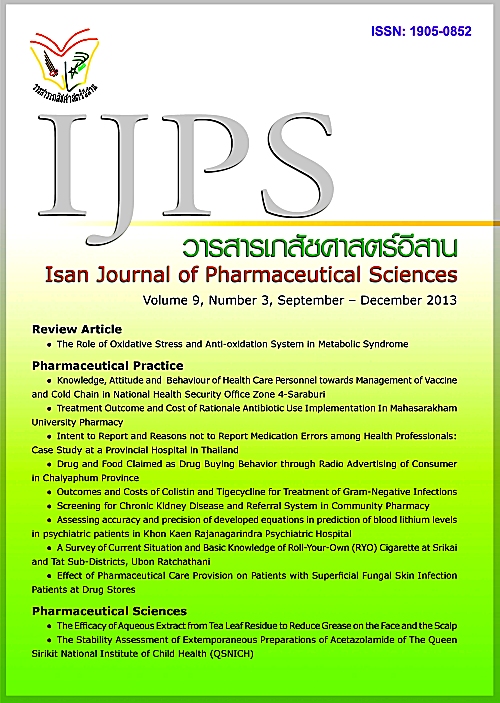
บทบาทของภาวะเครียดออกซิเดชั่นและระบบต้านอนุมูลอิสระต่อกลุ่มโรคเมแทบอลิก
Article Sidebar
Main Article Content
บทคัดย่อ
อนุมูลอิสระ (reactive oxygen species) เป็นผลิตภัณฑ์จากกระบวนการสันดาปของเซลล์ในร่างกายที่มีความสำคัญต่อระบบต่างๆ ทางกายภาพ โดยสารดังกล่าวสามารถก่อให้เกิดอันตรายจากภาวะเครียดออกซิเดชั่นเมื่อการผลิตอนุมูลอิสระมีมากกว่าขีดความสามารถในการกำจัดของร่างกาย ภาวะเครียดออกซิเดชั่นส่งผลรบกวนระบบต่างๆ ในร่างกายและเป็นปัจจัยสำคัญหนึ่งของโรคเมแทบอลิกต่างๆ อาทิ โรคอ้วน ภาวะดื้อต่ออินซูลิน และภาวะไขมันพอกตับ เป็นต้น การศึกษาที่ผ่านมาพบความสัมพันธ์ระหว่างการเพิ่มขึ้นของค่าดัชนีมวลกายและเส้นรอบเอวในภาวะอ้วนลงพุงกับการเพิ่มขึ้นของดัชนีบ่งชี้ภาวะลิปิดเปอร์ออกซิเดชั่น ซึ่งได้แก่ thiobarbituric acid reactive substances (TBARS) ในพลาสม่า และ 8-epi-prostaglandin-F2α ในปัสสาวะ ในทางตรงกันข้ามกลับส่งผลลดระดับอะดิโพเนกตินและลดสมรรถนะของเอนไซม์ต้านภาวะเครียดออกซิเดชั่นต่างๆ ได้แก่ superoxide dismutase, glutathione peroxidase และ catalase (CAT) สอดคล้องกับการเพิ่มขึ้นของระดับ TBARS และไฮโดรเจนเปอร์ออกไซด์ในพลาสม่าและเนื้อเยื่อไขมันขาวของหนูไมส์ที่ถูกชักนำภาวะอ้วนลงพุงและเบาหวาน ร่วมกับการลดลงของการแสดงออกของยีนอะดิโพเนกติน และเพอร์ออกซิโซมโพรลิฟเฟอเรเตอร์แอคติเวทรีเซพเตอร์แกมม่า (PPAR-γ) ในขณะที่การแสดงออกของยีนทูเมอร์เนโครซิสแฟคเตอร์อัลฟ่า (TNF-α) พลาสมิโนเจนแอคติเวเตอร์อินฮิบิทเตอร์วัน (PAI-1) และ นิโคตินาไมด์อดีนีนไดนิวคลีโอไทด์ฟอสเฟตออกซิเดสสับยูนิต (NADPH oxidase subunits) ต่างๆ กลับเพิ่มขึ้น นอกจากนี้ ยังสอดคล้องรายงานการเพิ่มขึ้นของระดับ conjugated dienes และ malondialdehyde ซึ่งเป็นดัชนีบ่งชี้ภาวะลิปิดเปอร์ออกซิเดชั่น ร่วมกับการลดลงของกลูตาไทโอนและสมรรถนะของเอนไซม์ CAT ในผู้ป่วยไขมันพอกตับ ดังนั้น จึงอาจกล่าวได้ว่าโรคเมแทบอลิกต่างๆ นั้นมีความเกี่ยวพันกับความไม่สมดุลของระบบต้านออกซิเดชั่น หรืออีกนัยหนึ่งการเพิ่มขึ้นของภาวะเครียดออกซิเดชั่นเป็นปัจจัยกระตุ้นหนึ่งของโรคเมแทบอลิก การศึกษาต่อยอดเพื่อความเข้าใจตัวแปรต่างๆ ที่เกี่ยวข้องกับภาวะเครียดออกซิเดชั่นและกลไกของโรคเมแทบอลิก จึงมีความน่าสนใจและจำเป็นต่อการป้องกันหรือชะลอโรคเมแทบอลิกได้
Article Details
กรณีที่ใช้บางส่วนจากผลงานของผู้อื่น ผู้นิพนธ์ต้อง ยืนยันว่าได้รับการอนุญาต (permission) ให้ใช้ผลงานบางส่วนจากผู้นิพนธ์ต้นฉบับ (Original author) เรียบร้อยแล้ว และต้องแนบเอกสารหลักฐาน ว่าได้รับการอนุญาต (permission) ประกอบมาด้วย
เอกสารอ้างอิง
Adachi Y, Yoshikawa Y, Yoshida J, et al. Improvement of diabetes, obesity and hypertension in type 2 diabetic KKAy mice by bis(allixinato)oxovanadium(IV) complex. Biochem Biophys Res Commun 2006; 345(3): 945-950.
Alberti KG, Eckel RH, Grundy SM, et al. Harmonizing the metabolic syndrome: a joint interim statement of the international diabetes federation task force on epidemiology and prevention; national heart, lung, and blood institute; american heart association; world heart federation; international atherosclerosis society; and international association for the study of obesity. Circulation 2009; 120(16): 1640-1645.
Al-Busafi SA, Bhat M, Wong P, Ghali P, Deschenes M. Antioxidant therapy in nonalcoholic steatohepatitis. Hepat Res Treat [serial online] 2012 [cited 2012 Dec 25]; Article ID 947575: [8 screens]. Available from: https://www.hindawi.com/journals/heprt/2012/947575/.
Amirkhizi F, Siassi F, Djalali M, Shahraki SH. Impaired enzymatic antioxidant defense in erythrocytes of women with general and abdominal obesity. Obes Res Clin Pract 2012 [cited 2013 Feb 10]; [9 screens] Available from: https://www.sciencedirect.com/science/article/pii/S1871403X12000403.
Azzi A, Stocker A. Vitamin E: non-antioxidant roles. Prog Lipid Res 2000; 39(3): 231-255.
Baynes JW, Thorpe SR. Role of oxidative stress in diabetic complications: a new perspective on an old paradigm. Diabetes 1999; 48(1): 1-9.
Buetler TM, Krauskopf A, Ruegg UT. Role of superoxide as a signaling molecule. News Physiol Sci 2004; 19(3): 120-123.
Comhair, SA, Erzurum SC. Redox Control of asthma: Molecular mechanisms and therapeutic opportunities. Antioxid Redox Signal 2012; 12(1): 93-124.
Dalle-Donne I, Rossi R, Colombo R, Giustarini D, Milzani A. Biomarkers of oxidative damage in human disease. Clin Chem 2006; 52(4): 601-623.
Dandona P, Aljada A, Chaudhuri A, Mohanty P, Garg R. Metabolic syndrome: a comprehensive perspective based on interactions between obesity, diabetes, and inflammation. Circulation 2005; 111(11): 1448-1454.
Day CP, James OF. Hepatic steatosis: innocent bystander or guilty party? Hepatology 1998; 27(6): 1463-1466.
Diani AR, Sawada GA, Zhang NY, et al. The KKAy mouse: a model for the rapid development of glomerular capillary basement membrane thickening. Blood Vessels 1987; 24(6): 297-303.
Dröge W. Free radicals in the physiological control of cell function. Physiol Rev 2002; 82(1): 47-95.
Evans JL, Goldfine ID, Maddux BA, Grodsky GM. Oxidative stress and stress-activated signaling pathways: a unifying hypothesis of type 2 diabetes. Endocr Rev 2002; 23(5): 599-622.
Farmer JA. Obesity and Inflammation: Implications for Atherosclerosis. In: Packer L, Cadenas E, editors. Oxidative stress and inflammatory mechanisms. Boca Raton (FL): CRC Press, Taylor & Francis Group; 2008. 139-166.
Feillet-Coudray C, Sutra T, Fouret G, et al. Oxidative stress in rats fed a high-fat high-sucrose diet and preventive effect of polyphenols: Involvement of mitochondrial and NAD(P)H oxidase systems. Free Radic Biol Med 2009; 46(5): 624-632.
Fujita K, Nishizawa H, Funahashi T, Shimomura I, Shimabukuro M. Systemic oxidative stress is associated with visceral fat accumulation and the metabolic syndrome. Circ J 2006; 70(11): 1437-1442.
Furukawa S, Fujita T, Shimabukuro M, et al. Increased oxidative stress in obesity and its impact on metabolic syndrome. Clin Invest 2004; 114(12): 1752-1761.
Grundy SM, Cleeman JI, Daniels SR, et al. Diagnosis and management of the metabolic syndrome: an American Heart Association/National Heart, Lung, and Blood Institute Scientific Statement. Circulation 2005; 112(17): 2735–2752.
Haffner SM. Relationship of metabolic risk factors and development of cardiovascular disease and diabetes. Obesity 2006; 14(Suppl 3): 121S-127S.
Huang PL. A comprehensive definition for metabolic syndrome. Dis Model Mech 2009; 2(5-6): 231-237.
Kumar A, Sharma A, Duseja A, et al. Patients with nonalcoholic fatty liver disease (NAFLD) have higher oxidative stress in comparison to chronic viral hepatitis. J Clin Exp Hepatol 2013; 3(1): 12-18.
Lam BP, Younossi ZM. Treatment regimens for non-alcoholic fatty liver disease. Ann Hepatol 2009; 8(Suppl 1): S51-S59.
Lee AY, Chung SS. Contributions of polyol pathway to oxidative stress in diabetic cataract. FASEB J 1999; 13(1): 23-30.
Maritim AC, Sanders RA, Watkins JB 3rd. Diabetes, oxidative stress, and antioxidants: a review. J Biochem Mol Toxicol 2003; 17(1): 24-38.
Marnett LJ. Oxy radicals, lipid peroxidation and DNA damage. Toxicology 2002; 181-182: 219-222.
Mehta JL, Rasouli N, Sinha AK, Molavi B. Oxidative stress in diabetes: a mechanistic overview of its effects on atherogenesis and myocardial dysfunction. Int J Biochem Cell Biol 2006; 38(5-6): 794-803.
Narasimhan S, Gokulakrishnan K, Sampathkumar R, et al. Oxidative stress is independently associated with non-alcoholic fatty liver disease (NAFLD) in subjects with and without type 2 diabetes. Clin Biochem 2010; 43(10-11): 815-821.
Robertson RP, Harmon J, Tran PO, Tanaka Y, Takahashi H. Glucose toxicity in beta-cells: type 2 diabetes, good radicals gone bad, and the glutathione connection. Diabetes 2003; 52(3): 581-587.
Robertson RP, Zhang HJ, Pyzdrowski KL, Walseth TF. Preservation of insulin mRNA levels and insulin secretion in HIT cells by avoidance of chronic exposure to high glucose concentrations. J Clin Invest 1992; 90: 320–325.
Rolo AP, Teodoro JS, Palmeira CM. Role of oxidative stress in the pathogenesis of nonalcoholic steatohepatitis. Free Radic Biol Med 2012; 52(1): 59-69.
Seneff S, Wainwright G, Mascitelli L. Is the metabolic syndrome caused by a high fructose, and relatively low fat, low cholesterol diet? Arch Med Sci 2011; 7(1): 8-20.
Singh PP, Mahadi F, Roy A, Sharma P. Reactive oxygen species, reactive nitrogen species and antioxidants in etiopathogenesis of diabetes mellitus type-2. Indian J Clin Biochem 2009; 24(4): 324-342.
Sun Y, Oberley LW, Li Y. A simple method for clinical assay of superoxide dismutase. Clin Chem 1988; 34(3): 497-500.
Traber MG, Stevens JF. Vitamins C and E: beneficial effects from a mechanistic perspective. Free Radic Biol Med. 2011; 51(5): 1000-1013.
Valko M, Leibfritz D, Moncol J, Cronin MT, Mazur M, Telser J. Free radicals and antioxidants in normal physiological functions and human disease. Int J Biochem Cell Biol 2007; 39(1): 44-84.
World Health Organization. Global health observatory data Repository. in overweight/obesity:overweight (body mass index ≥ 25) [Online]. 2008 [cited 2012 Dec 25]. Available from: https://apps.who.int/gho/data?theme=main&vid=2430.
World Health Organization. Global health observatory data repository. in overweight/obesity:obesity (body mass index ≥ 30) [Online]. 2008 [cited 2012 Dec 25]. Available from: https://apps.who.int/gho/data? theme=main&vid=2450.
Zivkovic AM, German JB, Sanyal AJ. Comparative review of diets for the metabolic syndrome: implications for nonalcoholic fatty liver disease. Am J Clin Nutr 2007; 86(2): 285-300.
