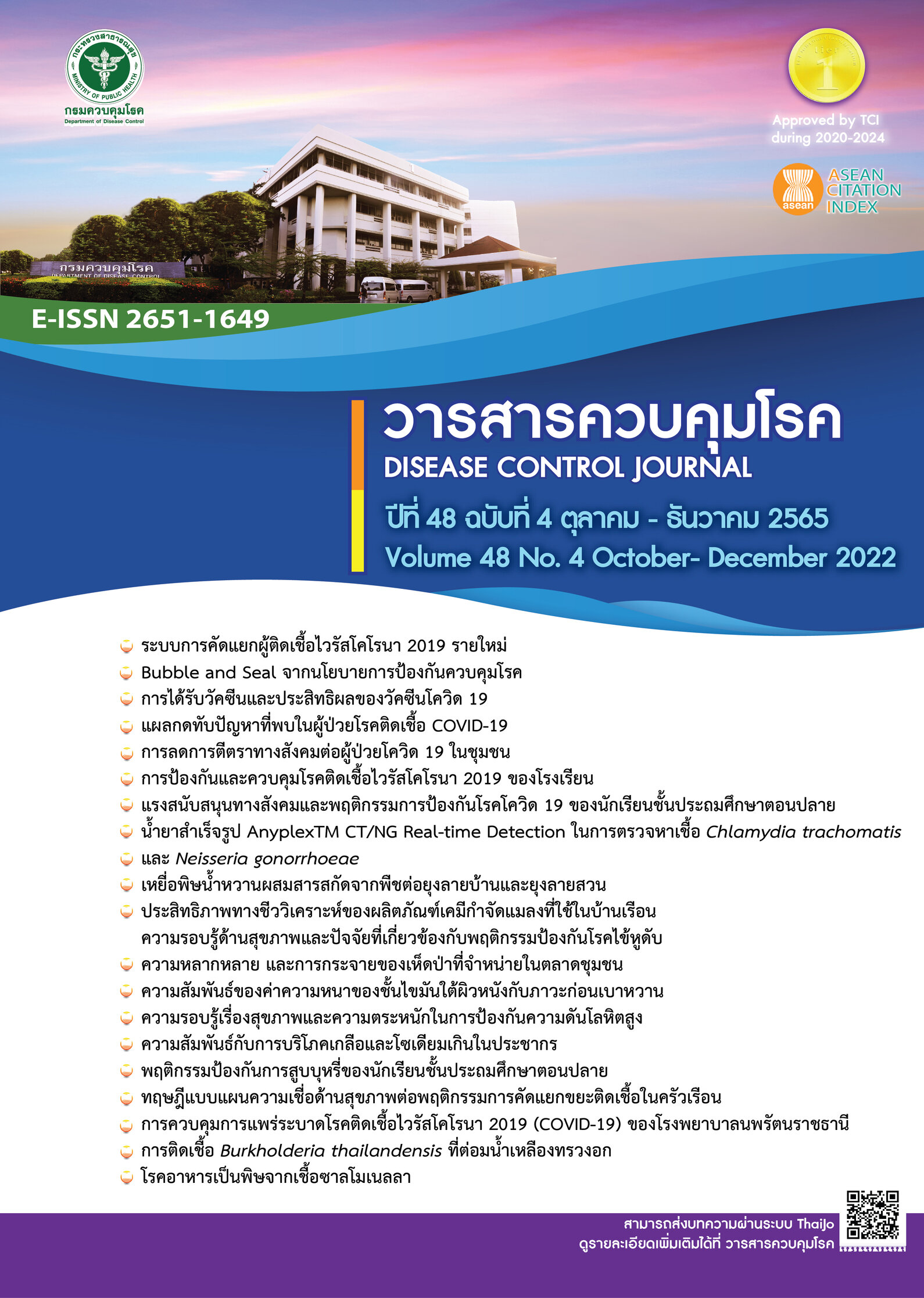
ปัจจัยที่มีผลต่อพฤติกรรมป้องกันการสูบบุหรี่ของนักเรียนชั้นประถมศึกษาตอนปลาย จังหวัดพิษณุโลก
DOI:
https://doi.org/10.14456/dcj.2022.75คำสำคัญ:
พฤติกรรมป้องกันการสูบบุหรี่, นักเรียน, โรงเรียนประถมศึกษาตอนปลายบทคัดย่อ
การวิจัยเชิงทำนายนี้มีวัตถุประสงค์เพื่อศึกษาพฤติกรรมการป้องกันการสูบบุหรี่และปัจจัยที่มีผลต่อพฤติกรรมป้องกันการสูบบุหรี่ของนักเรียนชั้นประถมศึกษาตอนปลายในจังหวัดพิษณุโลก กลุ่มตัวอย่างจำนวน 460 คน เก็บรวบรวมข้อมูลโดยให้ตอบแบบสอบถามด้วยตัวเอง วิเคราะห์ข้อมูลด้วยการแจกแจงความถี่ ร้อยละ ค่าเฉลี่ย ส่วนเบี่ยงเบนมาตรฐาน และวิเคราะห์ถดถอยเชิงเส้นพหุคูณ ผลการศึกษาพบว่า พฤติกรรมการป้องกันการสูบบุหรี่อยู่ในระดับมาก ( 2.46, SD=0.43) โดยข้อที่ปฏิบัติได้ในระดับมาก ได้แก่ การใช้เวลาว่างที่เป็นประโยชน์หรือใช้เวลาว่างในการทำกิจกรรมอื่นแทนการสูบบุหรี่ ร้อยละ 77.8 รองลงมาเป็นการปฏิเสธหากเพื่อนชวนสูบบุหรี่ ร้อยละ 76.3 ปัจจัยที่มีผลต่อพฤติกรรมการป้องกันการสูบบุหรี่ อย่างมีนัยสำคัญทางสถิติที่ระดับ 0.05 ได้แก่ ทักษะชีวิต (β=0.339, p<0.001) การได้รับแรงสนับสนุนจากผู้ปกครอง ครู เพื่อน และบุคคลที่มีชื่อเสียง (β=0.163, p<0.001) บรรทัดฐานทางสังคม (β=0.141, p=0.001) บทบาทหน้าที่ของสถาบันครอบครัว (β=0.122, p=0.002) การดำเนินนโยบายป้องกันการสูบบุหรี่ในโรงเรียน (β=0.097, p=0.022) บทบาทการป้องกันการสูบบุหรี่ของครู (β=0.093, p=0.028) และเพศ (β=-0.079, p=0.034) โดยสามารถอธิบายการผกผันพฤติกรรมการป้องกันการสูบบุหรี่ ได้ร้อยละ 41.4 (R2=0.414, F=45.227, p<0.001) ดังนั้น หน่วยงานที่เกี่ยวข้องควรมีการดำเนินการเพื่อส่งเสริมและพัฒนาทักษะชีวิตให้นักเรียนสามารถจัดการกับปัญหาและสถานการณ์ต่าง ๆ ที่เกิดขึ้นในชีวิตประจำวันได้อย่างมีประสิทธิภาพ และสนับสนุนกิจกรรมที่ส่งเสริมให้เกิดแรงสนับสนุนจากครอบครัว ครู เพื่อเพิ่มการแสดงออกถึงพฤติกรรมป้องกันการสูบบุหรี่ให้มากขึ้น
Downloads
เอกสารอ้างอิง
International Health Policy Program. Report on the burden of disease from risk factors in the Thai population 2014. Nonthaburi: International Health Policy Program; 2018. (in Thai)
Iamwut A, Noinampu P, Jasangcharoen R, Suwutto S. Tobacco disaster destroys you. 5th ed. Bangkok: Mahidol university; 2016. (in Thai)
World Health Organization. WHO report on the global tobacco epidemic, 2013: Enforcing bans on tobacco advertising promotion and sponsorship [Internet]. [cited 2021 Apr 21]. Available from: https://apps.who.int/iris/bitstream/handle/10665/85380/9789241505871_eng.pdf;jsessionid=7C89AEDED40800408C82675763024F2C?sequence=1
Prachuaplarp P. Golden opportunity of smoking addiction "commit to quit" world no tobacco day for the year 2020 [Internet]. Bangkok: Ashthailand; 2021 [cited 2022 Feb 2]. Available from: http://ashthailand.or.th/smartnews/post/detail/480/news_all.php (in Thai)
National Statistical Office (TH). Smoking behavior survey and drinking of the population 2017 the smoking and drinking behavior survey 2017. Bangkok: National Statistical Office; 2018. (in Thai)
National Statistical Office (TH). The 2021 health behavior of population survey. Bangkok: National Statistical Office; 2022. (in Thai)
Mahidol University, Institute for Population and Social Research. Effects of tobacco control policy in Thailand youth group, round 6 (2012). 1st ed. Nakhon Pathom: Mahidol University; 2013. (in Thai)
Thanomsat K, Sansern R. Factors related to early smoking stage among male students at lower secondary schools under the jurisdiction of Trat education service area office. Journal of Nursing and Education. 2011;4(3):38-47. (in Thai)
Encyclopedia of Public Health. Gateway drug theory [Internet]. 2002 [cited 2021 Oct 29]. Available from: https://www.encyclopedia.com/education/encyclopedias-almanacs-transcripts-and-maps/gateway-drug-theory
Department of Health and Human Services (US). Preventing tobacco use among young people: a report of the surgeon general (executive summary). Morbidity and Mortality Weekly Report. 1994;43(RR-4):1-10.
Dearden KA, Crookston BT, De La Cruz NG, Lindsay GB, Bowden A, Carlston L, et al. Teens in trouble: Cigarette use and risky behaviors among private, high school students in La Paz, Bolivia. Revista Panamericana de Salud Publica. 2007;22(3):160-8.
Hooman S, Zahra H, Safa M, Hassan FM, Reza MM. Association between cigarette smoking and suicide in psychiatric inpatients. Tobacco Induced Diseases. 2013;11(1):5.
Peltzer K, Pengpid S. Early substance use initiation and suicide ideation and attempts among school-aged adolescents in four pacific island countries in Oceania. International Journal of Environmental Research and Public Health. 2015;12(10):12291-303.
Department of Disease Control (TH), Bureau of Tobacco Control. National strategic plan for tobacco control 2012-2014. 1st ed. Nonthaburi: Department of Disease Control (TH); 2016. (in Thai)
Suwanwong C, Pimthong S. Factors affecting smoking prevention behavior among adolescents: research synthesis by systematic review. Journal of Behavioral Sciences. 2018;24(1):63-82. (in Thai)
Usaha J, Kanwihak T, Chulaserikul S, Haruehansapong W. Meta synthesis of preventive factors for cigarette smoking among Thai youths. Journal of Disease Control. 2015;41(4):271-84. (in Thai)
Akkarakittipong P, Kaewsutha N, Intarakamhang U. Psycho-Social factors related cigarette smoking prevention behaviors of primary school students year 4-6 in Bangkok metropolitan. Veridian E-Journal, Silpakorn University. 2018;11(2):50-62. (in Thai)
Voraaroon O, Khajornchaikul P, Pruitpinyo C, Techaboonsermsak P, Pitikultang S. Factors related to smoking self-control among lower secondary school students, Suphanburi Province. The Public Health Journal of Burapha University. 2017;12(2):75-85. (in Thai)
Chankasem T, Muenkrut K, Konpetch K. Factors predicting smoking prevention behaviors of secondary school students in Ban Rai Wittaya School, Uthaithani Province. Journal of Disease and Health Risk DPC.3. 2019;2(1):1-13. (in Thai)
Chaikulwatana C, Sutthi P, Jaimalai W. Smoking behavior and risk factors associated with smoking of early adolescents in Phayao Province, Thailand. Nursing Journal of the Ministry of Public Health. 2017;27(3):57-67. (in Thai)
Qing Y, Termssurukulchai L, Vatanasomboonet P, Sujirarat D, Tanasugarn C, Kengganpanich M. Factors related to tobacco use among middle school students in hina. Southeast Asian J Trop Med Public Health. 2011;42(5):1249-61.
Ketman P. Adolescent Development [Internet]. [cited 2007 Apr 17]. Available from: http://www.psyclin.co.th/new_page_56.htm (in Thai)
Fongkerd S, Pookitsana S, Tangjirawattana M, Tantalanukul S. Factors Influencing health promoting behaviors of Thai adolescents. Nursing Journal of the Ministry of Public Health. 2017;27(special):196-209. (in Thai)
Wayne WD, Chad LC. Biostatistics: a foundation of analysis in the health sciences. 6th ed. Las Vegas: University of Nevada; 1995.
Bronfenbrenner U. The ecology of human development: experiments by nature and design. Cambridge: Harvard University Press; 1979.
Charoen J. Innovations that promote the insertion of Sukhothai youth [Thesis]. Phitsanulok: Naresuan University; 2016. 111 p. (in Thai)
Fakbua W. Factors influencing smoking among male junior high school students Wachirabarami District Phichit Province [Thesis]. Phitsanulok: Naresuan University. 2018. 97 p. (in Thai)
Bandura A. Social foundations of thought and action: A social cognitive theory. Maryland: National Institute of Mental Health (US); 1986.
Huver RME, Engels RCM, Vries H. Are anti-smoking preventing practices related to adolescent smoking cognitions and behavior? Health Educ Res. 2006;21(1):66-77.
Jackson C. Initial and experimental stages of tobacco and alcohol use during rate childhood: relation to peer, parent, and personal risk factors. Addict Behav. 1997;22(6):685-98.
Botvin GJ, Eng A, Williams CL. Preventing the onset of cigarette smoking through life skills training. Prev Med. 1980;9(1):135-43.
Mongkolsilp D. The effect of using learning processes to improve life skills on smoking prevention behaviors in early adolescents [dissertation]. Bangkok: Chulalongkorn University; 2007. 197 p. (in Thai)
Becker MH. The health belief model and sick role behavior. Health Education Monographs. 1974;2(4):409-19.
McLeroy KR, Bibeau D, Steckler A, Glanz K. An ecological perspective on health Promotion programs. Health Educ Q. 1988;15(4):351-77.
ดาวน์โหลด
เผยแพร่แล้ว
รูปแบบการอ้างอิง
ฉบับ
ประเภทบทความ
สัญญาอนุญาต
ลิขสิทธิ์ (c) 2022 วารสารควบคุมโรค

อนุญาตภายใต้เงื่อนไข Creative Commons Attribution-NonCommercial-NoDerivatives 4.0 International License.
บทความที่ลงพิมพ์ในวารสารควบคุมโรค ถือว่าเป็นผลงานทางวิชาการหรือการวิจัย และวิเคราะห์ตลอดจนเป็นความเห็นส่วนตัวของผู้เขียน ไม่ใช่ความเห็นของกรมควบคุมโรค ประเทศไทย หรือกองบรรณาธิการแต่ประการใด ผู้เขียนจำต้องรับผิดชอบต่อบทความของตน