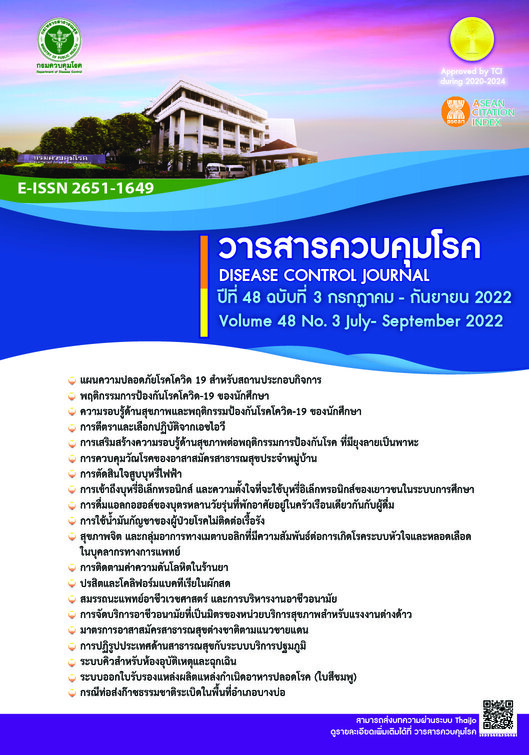
สิ่งคุกคามทางด้านสุขภาพจิต และกลุ่มอาการทางเมตาบอลิกที่มีความสัมพันธ์ต่อการเกิดโรคระบบหัวใจและหลอดเลือดในบุคลากรทางการแพทย์ ในโรงพยาบาลแห่งหนึ่ง ของจังหวัดชลบุรี
DOI:
https://doi.org/10.14456/dcj.2022.50คำสำคัญ:
สิ่งคุกคามทางด้านสุขภาพจิต, บุคลากรทางการแพทย์, โรคระบบหัวใจและหลอดเลือด, กลุ่มอาการทางเมตาบอลิกบทคัดย่อ
วิจัยนี้เป็นการศึกษาเชิงพรรณนา (Descriptive research) โดยใช้ข้อมูลย้อนหลัง(Retrospective study) จากฐานข้อมูลทุติยภูมิร่วมกับการศึกษาแบบภาคตัดขวาง(Cross sectional study) เพื่อศึกษาความสัมพันธ์ระหว่างผลร่วมของสิ่งคุกคามทางด้านสุขภาพจิตและกลุ่มอาการทางเมตาบอลิก กับการเกิดโรคระบบหัวใจและหลอดเลือด ในกลุ่มบุคลากรทางการแพทย์ ในโรงพยาบาลแห่งหนึ่งจังหวัดชลบุรี มีกลุ่มตัวอย่างทั้งสิ้น 281 คน ผลการศึกษาเป็นเพศชายจำนวน 55 คน(ร้อยละ19.6) เพศหญิง 226 คน(ร้อยละ80.4) อายุเฉลี่ย 47.27 ปี (SD=6.93) เป็นกลุ่มเสี่ยงต่อกลุ่มอาการทางเมตาบอลิก 208 คน (ร้อยละ74) และมีกลุ่มอาการทางเมตาบอลิก 73 คน (ร้อยละ23) เมื่อวิเคราะห์ความสัมพันธ์ต่อการเกิดโรคระบบหัวใจและหลอดเลือด (Univariate analysis) พบตัวแปรที่มีนัยสำคัญทางสถิติ P< 0.05 ได้แก่ เพศหญิง OR=0.38(95%CI 0.20-0.70) อายุมากกว่า 50 ปี OR=0.45 (95%CI 0.27-0.76) การทำงานมากกว่า 25 ปี OR=1.9(95%CI 1.12-3.21) และกลุ่มอาการทางเมตาบอลิก OR=2.08 (95% CI 1.12-3.21) และเมื่อนำวิเคราะห์พหุตัวแปรด้วยสถิติถดถอยแบบทวิ พบว่ามีปัจจัยที่สามารถทำนายการเกิดโรคหัวใจและหลอดเลือดได้ร้อยละ 20 (P<0.05) ได้แก่ เพศหญิง(Adjusted OR=0.28) การไม่ออกกำลังกาย (Adjusted OR=2.48) กลุ่มอาการทางเมตาบอลิก (Adjusted OR=2.07) และความวิตกกังวลมากกว่าระดับปานกลางขึ้นไป (Adjusted OR=2.98) ทั้งนี้เพศหญิงไม่สอดคล้องกับอุบัติการณ์การโรคระบบหัวใจและหลอดเลือดที่พบในประเทศไทยและต่างประเทศซึ่งพบในชายมากกว่าหญิง ซึ่งอาจเกิดจากข้อจำกัดของกลุ่มตัวอย่าง
Downloads
เอกสารอ้างอิง
Non-communicable division. Department of Disease Control. Ministry of Public Health (TH). Issues in campaign for the day of heart disease. 2019. (in Thai)
Mottillo S, Filion KB, Genest J, Joseph L, Pilote L, Poirier P, et al. The Metabolic Syndrome and Cardiovascular Risk : A Systematic Review and Meta-Analysis. Journal of the American College of Cardiology. 2010;56(14 ):1113-32.
Fadel M, Sembajwe G, Gagliardi D, Pico F, Li J, Ozguler A, et al. Association Between Reported Long Working Hours and History of Stroke in the CONSTANCES Cohort. AHA Journal. 2019;50(7):1879-82.
Talmage JB, Melhorn JM, Hyman MH. AMA guides to the evaluation of work ability and return to work 2nd ed. 2011:49-50.
Techarujira K, Leelahakul V, Changmai S. The outcome of behavior change program to reduce the risks of cardiovascular disease in the staffs with metabolic syndromeat a private hospital. Journal of Charoenkrung Pracharak Hospital. 2019;15(2):14-33. (in Thai)
Pumfang S, Srisatidnarakul B. Factors of Job Stress for Professional Nurses in Tertiary Hospital. Kuakarun Journal of Nursing. 2015;22(2):140-53. (in Thai)
Bangxang JN. Resident Burnout: Prevalence and Associated Factors in Rajavithi Hospital. J Psychiatr Assoc Thailand 2019;64(1):61-76. (in Thai)
Detection NCEPEPo, Adults ToHBCi. Third report of the National Cholesterol Education Program (NCEP) Expert Panel on detection, evaluation, and treatment of high blood cholesterol in adults (Adult Treatment Panel III): The Program; 2002.
Krejcie RV, Morgan DW. Determining sample size for research activities. Educational And Psychological Measurement. 1970;30:607-10.
Phakthongsuk P, Apakupakul N. Psychometric properties of The Thai version of the 22-item and 45-item Karasek Job Content Questionnaire. International Journal of Occupational Medicine and Environmental Health. 2008;21(4):331-44.
Oei TPS, Sawang S, Yong WG, Mukhtar F. Using the Depression Anxiety Stress Scale 21 (DASS-21) across cultures. International Journal of Psychology. 2013;48(6):1018-29.
Department of Disease Control (TH). Coronary Artery Disease (CAD) REPORT. 2018.
Chen WL, Wang CC, Chiang ST, Wang YC, Sun Y, Wei WT, et al. The impact of occupational psychological hazards and metabolic syndrome on the 8 year risk of cardiovascular diseases—A longitudinal study. PLOS one. 2018;13(8).
Esquirol Y, Perret B, Ruidavets JB, Marquie JC, Dienne E, Niezborala M, et al. Shift work and cardiovascular risk factors: New knowledge from the past decade. Archives of Cardiovascular Diseases. 2011;104(12):636-68.
Mark H, Molloy GJ, Emmanuel S. Psychological distress as a risk factor for cardiovascular events: pathophysiological and behavioral mechanisms. Journal of the American College of Cardiology. 2008;52(25):2156-62.
Vaccarino V, Shah AJ, Mehta PK, Pearce B, Raggi P, Bremner JD, et al. Brain-heart connections in stress and cardiovascular disease: Implications for the cardiac patient. Atherosclerosis. 2021;328:74-82.
Ginty AT, Kraynak TE, Fisher JP, Gianaros PJ. Cardiovascular and autonomic reactivity to psychological stress: Neurophysiological substrates and links to cardiovascular disease. Autonomic neuroscience : basic & clinical. 2017;207:2-9.
Kivimäki M, Steptoe A. Effects of stress on the development and progression of cardiovascular disease. Nature reviews Cardiology. 2018;15(4):215-29.
Thangtham W, Klumpakorn S, Lumkampan S. Predictive Factors associated to stress in workplace among male nurse in Thailand. Journal of Nursing Division 2014;41(2). (in Thai)
Cui R, Iso H, Toyoshima H, Date C, Yamamoto A, Kikuchi S, et al. Body mass index and mortality from cardiovascular disease among Japanese men and women: the JACC study. Stroke. 2005;36(7):1377-82.
Chueybudda S. Factors Affected to Risk of Cardiovascular Disease Among People aged over 35 year old in Nong Bua subdistrict, Ban Fang District, Khon Kaen. Community Health Development Quarterly Khon Kaen University. 2015;3(4):547-60. (in Thai)
Karasek R, Theorell T. Healthy work: Stress, productivity, and the reconstruction of working life. New York: Basic Book; 1990.
Tang F, Wang G, Lian Y. Association between anxiety and metabolic syndrome: A systematic review and meta-analysis of epidemiological studies. Psychoneuroendocrinology. 2017;77:112-21.
ดาวน์โหลด
เผยแพร่แล้ว
รูปแบบการอ้างอิง
ฉบับ
ประเภทบทความ
สัญญาอนุญาต
ลิขสิทธิ์ (c) 2022 วารสารควบคุมโรค

อนุญาตภายใต้เงื่อนไข Creative Commons Attribution-NonCommercial-NoDerivatives 4.0 International License.
บทความที่ลงพิมพ์ในวารสารควบคุมโรค ถือว่าเป็นผลงานทางวิชาการหรือการวิจัย และวิเคราะห์ตลอดจนเป็นความเห็นส่วนตัวของผู้เขียน ไม่ใช่ความเห็นของกรมควบคุมโรค ประเทศไทย หรือกองบรรณาธิการแต่ประการใด ผู้เขียนจำต้องรับผิดชอบต่อบทความของตน