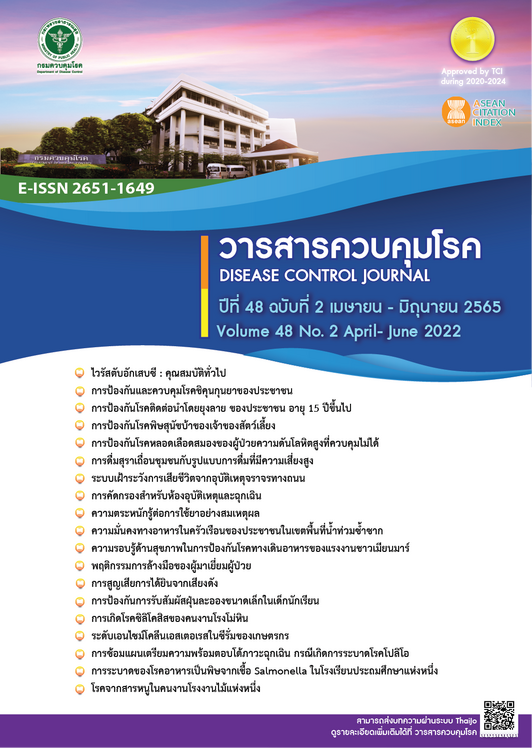
การมีส่วนร่วมในการป้องกันและควบคุมโรคชิคุนกุนยาของประชาชนในเขตพื้นที่รับผิดชอบของคลินิกหมอครอบครัวหนองสาหร่าย อำเภอปากช่อง จังหวัดนครราชสีมา
DOI:
https://doi.org/10.14456/dcj.2022.22คำสำคัญ:
การมีส่วนร่วม, การป้องกันและควบคุมโรค, โรคชิคุนกุนยาบทคัดย่อ
การวิจัยเชิงพรรณนานี้มีวัตถุประสงค์เพื่อศึกษาการมีส่วนร่วมในการป้องกันและควบคุมโรคชิคุนกุนยา และปัจจัยที่มีความสัมพันธ์กับการมีส่วนร่วมในการป้องกันและควบคุมโรคชิคุนกุนยา กลุ่มตัวอย่าง คือ ตัวแทนครัวเรือนในเขตพื้นที่รับผิดชอบของคลินิกหมอครอบครัวหนองสาหร่าย จำนวน 354 คน จากการสุ่มตัวอย่างแบบชั้นภูมิ เก็บข้อมูลจากแบบสอบถาม วิเคราะห์ข้อมูลด้วยสถิติเชิงพรรณนา Chi-squared test, Fisher’s exact test และ Spearman correlation coefficient ผลการศึกษาพบว่า กลุ่มตัวอย่างเกือบครึ่งหนึ่ง (ร้อยละ 46.9) มีส่วนร่วมในการป้องกันและควบคุมโรคชิคุนกุนยาโดยรวมอยู่ในระดับมาก ปัจจัยที่มีความสัมพันธ์กับการมีส่วนร่วมในการป้องกันและควบคุมโรคชิคุนกุนยาอย่างมีนัยสำคัญทางสถิติ แบ่งเป็น 3 กลุ่ม ดังนี้ ปัจจัยนำ ได้แก่ การทำหน้าที่เป็นอาสาสมัครสาธารณสุขประจำหมู่บ้าน (p<0.001) การทำหน้าที่เป็นผู้นำชุมชน (p<0.01) ความรู้เกี่ยวกับโรคชิคุนกุนยา (rs=0.525, p<0.01) และการรับรู้เกี่ยวกับโรคชิคุนกุนยา (rs=0.336, p<0.01) ปัจจัยเอื้อ คือ การมีแหล่งจำหน่ายผลิตภัณฑ์/อุปกรณ์เพื่อป้องกันและควบคุมโรคชิคุนกุนยาในชุมชน (p<0.001) และปัจจัยเสริม ได้แก่ การได้รับข้อมูลข่าวสาร (p<0.01) การได้รับการอบรม (p<0.001) และการได้รับเอกสาร/แผ่นผับ/คู่มือเกี่ยวกับแนวทางการปฏิบัติตัวเพื่อป้องกันโรค (p<0.001) หน่วยงานที่เกี่ยวข้องควรส่งเสริมให้ประชาชนมีส่วนร่วมในการป้องกันและควบคุมโรคชิคุนกุนยาทุกด้านเพื่อสนับสนุนให้เกิดความร่วมมือของชุมชนอย่างยั่งยืน
Downloads
เอกสารอ้างอิง
World Health Organization. Chikungunya [Internet]. Geneva: World Health Organization; 2020 [cited 2020 May 31]. Available from: https://www.who.int/news-room/fact-sheets/detail/chikungunya
Thavara U, Tawatsin A, Pengsakul T, Bhakdeenuan P, Chanama S, Anantapreecha S, et al. Outbreak of Chikungunya fever in Thailand and virus detection in field population of vector mosquitoes, Aedes aegypti (L.) and Aedes albopictus skuse (Diptera: Culicidae). Southeast Asian J Trop Med Public Health. 2009;40(5):951-60.
Department of Disease Control (TH), Division of Epidemiology. Annual epidemiological surveillance Report 2019. Nonthaburi: Department of Disease Control; 2019. (in Thai)
Department of Disease Control (TH), Division of General Communicable. Chikungunya (ICD-10 A92.0) [Internet]. Nonthaburi: Department of Disease Control; 2020 [cited 2021 Jan 4]. 4 p. Available from: https://ddc.moph.go.th/uploads/ckeditor2//files/5%20Chikungunya%203%20Dec.pdf (in Thai)
Pakchongnana Hospital. Epidemiological surveillance report 2019. Pakchong: Pakchongnana Hospital; 2019. (in Thai)
Pakchongnana Hospital. Epidemiological surveillance report 2020. Pakchong: Pakchongnana Hospital; 2020. (in Thai)
The Primary Health Care Division, The Department of Health Service Support (TH). The four-decade development of primary health care in Thailand 1978-2014. Bangkok: The War Veterans Organization of Thailand Under Royal Patronage of His Majesty The King; 2014. (in Thai)
Green LW, Kreuter MW. Health program planning: An educational and ecological approach. mountain view. California: Mayfeld publishing company; 1999.
Ua-Kit N, Pensri L. Utilization of the PRECEDE MODEL in health promotion. TRCN J. 2019;12 (1):38-48. (in Thai)
Cohen JM, Uphoff NT. Rural development participation: Concepts and measures for project design, implementation and evaluation. New York: Cornell University; 1980.
Krejcie RV, Morgan DW. Determining sample size for research activities. Educ Psychol Meas. 1970;30:607-10.
Bloom BS, Hastings JT, Madaus G. Hand book on formative and summative evaluation of student learning. New York: Graw-Hill Book Company; 1971.
Best JW. Research in education. 3rd ed. New Jersey: Prentice hall Inc; 1977.
Tohelay W. People participation in prevention and control of chikungunya in Yarung district, Pattani province [Thesis]. Chonburi: Burapha University; 2009. 88 p. (in Thai)
Nijinikaree N. People participation in prevention and control of chikungunya in Ra-ngae district, Narathiwat province [Thesis]. Chonburi: Burapha University; 2009. 102 p. (in Thai)
Mingmaleechokcha S. 2009-2017 Spread of chikungunya virus in Thailand (Bachelor of Science) Phitsanulok: Naresuan University; 2018. 65 p. (in Thai)
Gordon JE. Epidemiology in modern perspective. Proc R Soc Med. 1954;47(7):564-70.
Pakchongnana Hospital. Epidemiological surveillance report 2021. Pakchong: Pakchongnana Hospital; 2021. (in Thai)
Pakchong today news. Volunteer health care pakchong kill mosquito [Internet]. Pakchong: Pakchong today news; 2020 [cited 2021 Apr 1]. Available from: http://www.pakchongnews.com/news/volunteer-health-care-pakchong-kill-mosquito/(in Thai)
Centers for Disease Control and Prevention (US). Chikungunya virus [Internet]. Georgia: Centers for Disease Control and Prevention; 2022 [cited 2022 Apr 4]. Available from: https://www.cdc.gov/chikungunya/symptoms/index.html
Department of Disease Control (TH). Guidelines on clinical management of chikungunya fever. Nonthaburi: Department of Disease Control; 2020. (in Thai)
Office of the Public Sector Development Commission (TH). Participatory Governance
[Internet]. Office of the Public Sector Development Commission; 2020 [cited 2021 Apr 1]. Available from: https://www.opdc.go.th/content/Mjc4Nw (in Thai)
Huaysai P, Sukserm T, Khunluek K. The participation of the population of Huai Phuang district, Kalasin province in the prevention and control of dengue hemorrhagic fever. Prae-wa Kalasin. 2016;3(1):64-81. (in Thai)
Keawwandee N, Siriswang W, Borriharn S. Factors relating to the participation of people in prevention and control of dengue hemorrhagic fever in Nakornjaedee subdistrict Pasang district, Lamphun province. In: Insombat B,
editor. Proceedings of 15th National and International conference interdisciplinary research for local development sustainability; 2015 Jul 23; Nakhon Sawan Rajabhat University, Nakhon Sawan. Nakhon Sawan: 2015. p. 73-86. (in Thai).
Rosenstock IM. Historical original of the health belief model. Health Educ Monogr. 1974;2(4):328-35.
Becker MH. The health belief model and sick role behavior. Health Educ Monogr. 1974;2(4):409-19.
ดาวน์โหลด
เผยแพร่แล้ว
รูปแบบการอ้างอิง
ฉบับ
ประเภทบทความ
สัญญาอนุญาต
ลิขสิทธิ์ (c) 2022 วารสารควบคุมโรค

อนุญาตภายใต้เงื่อนไข Creative Commons Attribution-NonCommercial-NoDerivatives 4.0 International License.
บทความที่ลงพิมพ์ในวารสารควบคุมโรค ถือว่าเป็นผลงานทางวิชาการหรือการวิจัย และวิเคราะห์ตลอดจนเป็นความเห็นส่วนตัวของผู้เขียน ไม่ใช่ความเห็นของกรมควบคุมโรค ประเทศไทย หรือกองบรรณาธิการแต่ประการใด ผู้เขียนจำต้องรับผิดชอบต่อบทความของตน