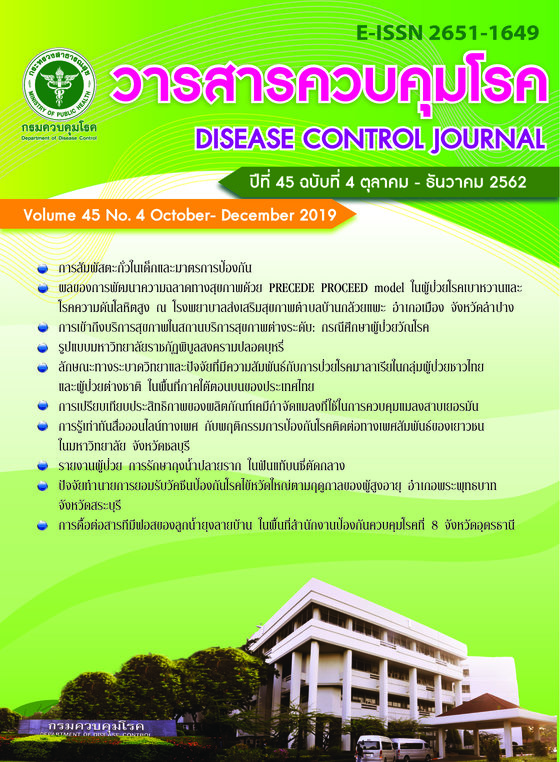
การเปรียบเทียบประสิทธิภาพของผลิตภัณฑ์เคมีกำจัดแมลง ที่ใช้ในการควบคุมแมลงสาบเยอรมัน
DOI:
https://doi.org/10.14456/dcj.2019.36คำสำคัญ:
แมลงสาบเยอรมัน, ทดสอบฤทธิ์สัมผัส, ไซเพอร์เมทริน, คลอร์ไพริฟอส, ฟิโพรนิล, คลอร์เฟนาเพอร์บทคัดย่อ
การศึกษาประสิทธิภาพทางชีววิเคราะห์ของผลิตภัณฑ์เคมีกำจัดแมลงสาบ จำนวน 4 สูตร คือ cypermethrin 25% w/v EC, chlorpyrifos 40% w/v EC, fipronil 5% w/v SC และ chlorfenapyr 24% w/v SC ที่อัตราการใช้ 0.1, 0.25, 0.1 และ 0.25 g a.i./m2 ตามลำดับ ตามอัตราการใช้ได้อ้างอิงตามที่องค์การอนามัยโลกกำหนด หรือตามฉลากที่ผลิตภัณฑ์แนะนำ ทดสอบกับตัวเต็มวัยแมลงสาบเยอรมัน (Blattella germanica) เพศเมีย ด้วยวิธีทดสอบฤทธิ์สัมผัส (surface contact exposure method) โดยให้แมลงสาบเดินสัมผัสสารเคมีที่เคลือบอยู่บนแผ่นกระจกขนาด 20x20 ตารางเซนติเมตร เป็นระยะเวลา 5 นาที 10 นาที 30 นาที และ 60 นาที ผลการทดสอบพบว่า สารออกฤทธิ์ cypermethrin และ fipronil มีประสิทธิภาพดีในการทำให้แมลงสาบเยอรมันหงายท้องและตาย โดยที่แมลงสาบเดินสัมผัสสาร cypermethrin หรือ fipronil เพียง 5 นาที พบว่า แมลงสาบมีอัตราการตายร้อยละ 100 และมีค่า KT50 เท่ากับ 4.27 นาที และ 3.87 นาที ตามลำดับ ในขณะที่สารออกฤทธิ์ chlorfenapyr ใช้เวลามากขึ้นในการทำให้แมลงสาบตายร้อยละ 100 คือ ให้แมลงสาบเดินสัมผัสนาน 10 นาที มีค่า KT50 เท่ากับ 9.46 นาที สำหรับสารออกฤทธิ์ chlorpyrifos พบว่า มีฤทธิ์ทำให้แมลงสาบตายร้อยละ 100 โดยใช้เวลานานที่สุดคือ 30 นาที แต่ไม่มีค่า KT50 เมื่อเปรียบเทียบประสิทธิภาพของผลิตภัณฑ์เคมีกำจัดแมลงต่อการทำให้แมลงสาบเยอรมันหงายท้องและตาย โดยเรียงจากประสิทธิภาพมากไปน้อย ดังนี้ fipronil ~ cypermethrin > chlorfenapyr > chlorpyrifos
Downloads
เอกสารอ้างอิง
2.Atiokeng Tatang RJ, Tsila HG, Wabo Poné J. Medically Important Parasites Carried by Cockroaches in Melong Subdivision, Littoral, Cameroon. J Parasitol Res 2017;2017:7967325.
3. Raghavendra K, Barik TK, Sharma P, Bhatt RM, Srivastava HC, Sreehari U, et al. Chlorfenapyr: a new insecticide with novel mode of action can control pyrethroid resistant malaria vectors. Malar J 2011;10:16.
4. World Health Organization. WHO specifications and evaluations for public health pesticides– Chlorfenapyr. Geneva: World Health Organization; 2017 [cited 2018 Dec 28]. 37 p. Available from: https://www.who.int/whopes/quality/Chlorfenapyr_specs_eval_WHO_December_2017.pdf
5. Sathantriphop S, Ya-umphan P, Mukkhan P, Paeporn P, Suphapathom K. Bioefficacy of formulated insecticide products against adult Blattella germanica, the German cockroach. J Health Sci 2017;26:930-6. (in Thai)
6. World Health Organization. Pesticides and their application – For the control of vectors and pests of public health importance. 6th edition 2006. Document WHO/CDS/NTD/WHOPES/GCDPP/2006.1.
7. Abd-Elghafar SF, Appel AG, Mack TP. Toxicity of several insecticide formulations against adult German cockroaches (Dictyoptera: Blattellidae). J Econ Entomol 1990;83:2290-4.
8. Kaakeh W, Reid BL, Bennett GW. Toxicity of fipronil to German and American cockroaches. Entomol Exp Appl 1997;84:229-37.
9. Ahmad I, Suliyat A. Development of fipronil gel bait against German cockroaches, Blattella germanica (Dictyoptera: Blattellidae): laboratory and field performance in Bandung, Indonesia. J Entomol 2011;8:288-94.
10. Nasirian H, Ladonni H, Vatandoost H. Duration of Fipronil topical application toxicity in Blattella germanica field population strains. Pakistan J Biol Sci 2006;9:800-4.
11. Oxborough RM, N'Guessan R, Jones R, Kitau J, Ngufor C, Malone D, et al. The activity of the pyrrole insecticide chlorfenapyr in mosquito bioassay: towards a more rational testing and screening of non-neurotoxic insecticides for malaria vector control. Malar J 2015;14:124.
12. Rahayu R, Ahmad I, Ratna ES, Tan MI, Hariani N. Present status of carbamate, pyrethroid and phenylpyrazole insecticide resistance to German cockroach, Blattella germanica (Dictyoptera: Blattellidae) in Indonesia. J Entomol 2012;9:361-7.
13. Nodez SMM, Rafatpanah A, Khosravani M, Hakak FS, Paksa A. Susceptibility status of German cockroaches, Blattella germanica (L.) to carbamate and pyrethroid insecticides within surface contact method in Shiraz city, Iran. J Entomol Zool Stud 2018;6:1043-6.
14. Zhai J, Robinson WH. Pyrethroid resistance in a field population of German cockroach, Blattella germanica (L.) Japan J San Zool 1991;42:241-4.
15. Limoee M, Davari B, Moosa-Kazemi SH. Toxicity of pyrethroid and organophosphorous insecticides against two field collected strains of the German cockroach Blattella germanica (Blattaria: Blattellidae). J Arthropod Borne Dis 2012;6:112-8.
16. Stock T. Model integrated pest management plan for Oregon schools [internet]. 2017 [cited 2019 Jan 17]. Available from: https://www.pleasanthill.k12.or.us/shop/wpimages/phsd-ipm-plan-2017.pdf
17. Dingha BN, O'Neal J, Appel AG, Jackai LEN. Integrated pest management of the German cockroach (Blattodea: Blattellidae) in manufactured homes in rural North Carolina. Florida Entomological Society 2016;99:587-92.
ดาวน์โหลด
เผยแพร่แล้ว
รูปแบบการอ้างอิง
ฉบับ
ประเภทบทความ
สัญญาอนุญาต
บทความที่ลงพิมพ์ในวารสารควบคุมโรค ถือว่าเป็นผลงานทางวิชาการหรือการวิจัย และวิเคราะห์ตลอดจนเป็นความเห็นส่วนตัวของผู้เขียน ไม่ใช่ความเห็นของกรมควบคุมโรค ประเทศไทย หรือกองบรรณาธิการแต่ประการใด ผู้เขียนจำต้องรับผิดชอบต่อบทความของตน