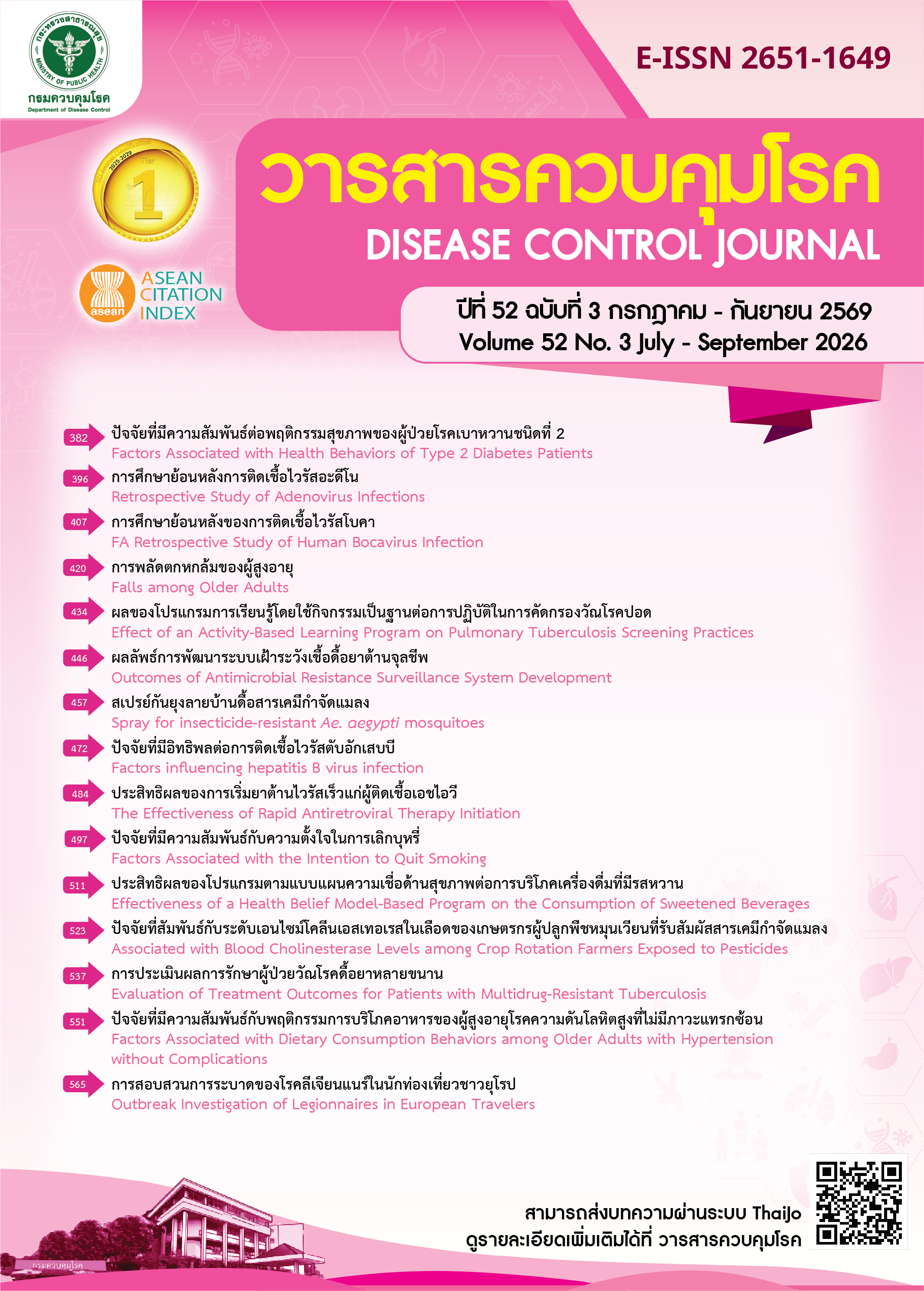
Effectiveness of a Health Belief Model-Based Program on the Consumption of Sweetened Beverages among Health Science Students
DOI:
https://doi.org/10.14456/dcj.2026.41Keywords:
health belief model, sweetened beverages, health science studentAbstract
This quasi-experimental study with a two-group pretest-posttest design aimed to examine the effectiveness of a Health Belief Model-based program on the consumption of sweetened beverages among health science students. The sample consisted of 66 students from Sirindhorn College of Public Health Phitsanulok. The two curricula were randomly designated as the experimental and control groups by drawing lots. Subsequently, 33 students from each curriculum were selected by simple random sampling without replacement. The experimental group participated in a four-week Health Belief Model-based program designed to improve sweetened beverage consumption behaviors, whereas the control group continued their usual routines by attending regular classes or engaging in self-directed learning activities. Data were collected between December 2024 and February 2025 using self-administered questionnaires. Descriptive statistics, independent samples t-test, and paired samples t-test were employed for data analysis. The results showed that, before the intervention, the mean scores of health beliefs and sweetened beverage consumption behaviors did not differ between the experimental and control groups (MD=0.06, 95% CI=-0.01-0.12 and MD=0.06, 95% CI=−0.09-0.21, respectively). After the intervention, the mean scores of health beliefs and sweetened beverage consumption behaviors differed significantly between the experimental and control groups at the 0.05 level (MD=2.11, 95% CI=2.01-2.23 and MD=2.15, 95% CI=1.95-2.36, respectively), with the experimental group having higher mean scores than the control group. In addition, within the experimental group, the post-intervention mean scores of health beliefs and sweetened beverage consumption behaviors differed significantly from the pre-intervention scores at the 0.05 level (MD=−2.08, 95% CI=−2.20-−1.97 and MD=−2.12, 95% CI=−2.35-−1.89, respectively), with the post-intervention mean scores being higher than the pre-intervention scores. In contrast, within the control group, the mean scores of health beliefs and sweetened beverage consumption behaviors did not differ from the pre-intervention scores (MD=−0.03, 95% CI=−0.07-0.03 and MD=−0.03, 95% CI=−0.15-0.10, respectively). These findings indicate that effective modification of sweetened beverage consumption behaviors requires the development of accurate health beliefs.
Downloads
References
Ge C, Xiong J, Zhu R, Hong Z, He Y. Global burden of high sugar-sweetened beverage consumption among young adults. Diabetol Metab Syndr [Internet]. 2025 [cited 2025 Nov 7];17:259. Available from: https://pubmed.ncbi.nlm.nih.gov/40635083/
Hongsanun W, Kitreerawutiwong N. Implementation of health promotion strategies to practice in reducing sugar-sweetened beverage consumption to reduce the risk of overweight and obesity. J Public Health Naresuan Univ [Internet]. 2019 [cited 2025 Nov 7];1(2):1-15. Available from: https://he01.tci-thaijo.org/index.php/JPHSR/article/view/221080/157242 (in Thai)
Hoffer A, Macumber-Rosin J. Soda taxes won’t fix global health [Internet]. Washington (DC): Tax Foundation; 2025 [cited 2025 Nov 7]. Available from: https://taxfoundation.org/research/all/global/sugar-tax-soda-tax-ssb/
Becker MH, Maiman LA. Sociobehavioral determinants of compliance with health and medical care recommendations. Med Care [Internet]. 1975 [cited 2025 Nov 7];13(1):10-24. Available from: https://pubmed.ncbi.nlm.nih.gov/1089182/
Thai Health Promotion Foundation (TH). Check the recommended sugar intake [Internet]. 2025 Mar 25 [cited 2025 Nov 7]. Available from: https://www.thaihealth.or.th/?p=384064 (in Thai)
Institute for Population and Social Research, Mahidol University (TH). Survey to monitor the behavior of consuming sweetened beverages and beverages with healthier-choice labels [Internet]. Nakhon Pathom: Institute for Population and Social Research, Mahidol University; 2023 [cited 2025 Nov 7]. Available from: https://ipsr.mahidol.ac.th/wp-content/uploads/ 2024/07/Food-Sweet-Beverage-Choice.png (in Thai)
Health Data Center, Phitsanulok Provincial Public Health Office, Health Region 2 (TH). Standard report [Internet]. 2023 [cited 2025 Nov 7]. Available from: https://hdc.moph.go.th/plk/public/main (in Thai)
Papadakul S, Saewhiw P, Jaikam S, Kaewjomphaeng W. Survey of sugar content in sweetened beverages sold in beverage shops in Phitsanulok Province, fiscal year 2021 [Internet]. 2022 [cited 2024 Nov 7]. Available from: https://hpc2appcenter.anamai.moph.go.th/academic/web/site/proceeding?event_id=3&page=r2r (in Thai)
Department of Health, Ministry of Public Health (TH). Thai children increasingly addicted to sweetened beverages; schools should offer low-sugar drinks as healthier choice [Internet]. 2022 Oct 29 [cited 2025 Nov 7]. Available from: https://multimedia.anamai.moph.go.th/news/news291065/ (in Thai)
Wongsawat P. Experimental research design: application for research to improve health behaviors. Bangkok: Charoen Dee Munkong Printing; 2018. p.163-5. (in Thai)
Wangmukklang S, Uthis P, Suktrakul S. The effects of behavioral family counseling program on alcohol consumption in persons with alcohol dependence. J Nurs Sci Chulalongkorn Univ. 2021;33(2):51-62. doi: 10.58837/CHULA.JNRIH.33.2.5. (in Thai)
Nitko AJ, Brookhart SM. Educational assessment of students. 7th ed. Boston: Pearson; 2014.
Pommee P, Sirisopon N, Phungdee T, Phraknoi N, Thipnet A. Effectiveness of health education program management using the applied Health Belief Model to prevent sweetened beverage consumption among lower secondary school students. J Health Phys Educ Recreat [Internet]. 2021 [cited 2025 Nov 7];47(1):254-67. Available from: https://so03.tci-thaijo.org/index.php/tahper/article/view/250332/169148 (in Thai)
Supphakityothin T. A behavior modification program for sugar-sweetened beverage consumption among Thai adolescents using the Theory of Planned Behavior. J Health Sci Pedagogy [Internet]. 2023 [cited 2025 Nov 7];3(3):87-101. Available from: https://he02.tci-thaijo.org/index.php/JHSP/article/view/262310/87-101 (in Thai)
Pimpasorn W. Effectiveness of a health promotion program on reducing sugar-sweetened beverage consumption among village health volunteers in Tak Province. J Health Sci Thai [Internet]. 2024 [cited 2025 Nov 7];33(3):417-29. Available from: https://thaidj.org/index.php/JHS/article/download/15137/12268/34522 (in Thai)
Downloads
Published
How to Cite
Issue
Section
License
Copyright (c) 2026 Disease Control Journal

This work is licensed under a Creative Commons Attribution-NonCommercial-NoDerivatives 4.0 International License.
Articles published in the Disease Control Journal are considered as academic work, research or analysis of the personal opinion of the authors, not the opinion of the Thailand Department of Disease Control or editorial team. The authors must be responsible for their articles.