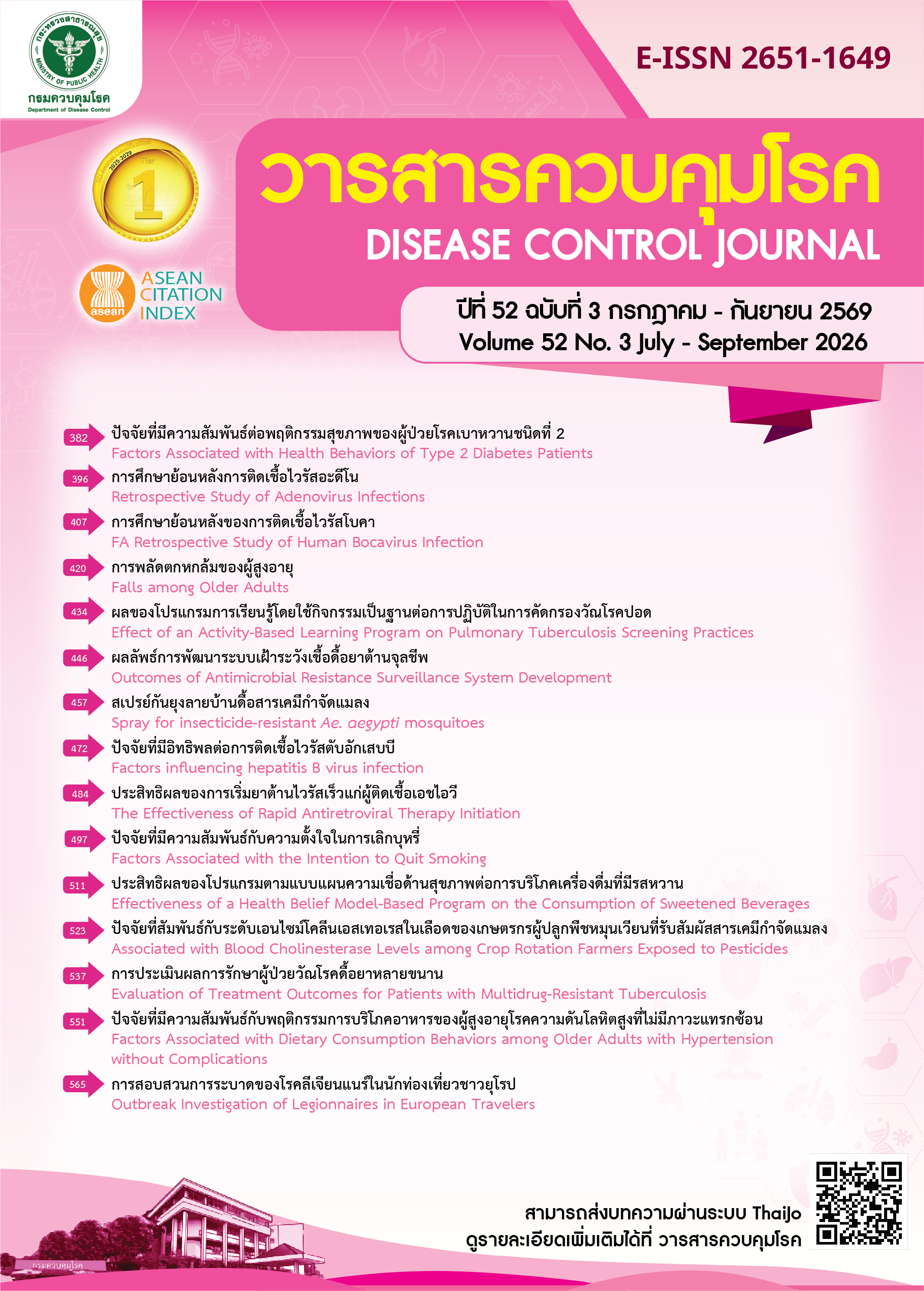
ประสิทธิผลของโปรแกรมตามแบบแผนความเชื่อด้านสุขภาพต่อการบริโภคเครื่องดื่มที่มีรสหวานของนักศึกษาวิทยาศาสตร์สุขภาพ
DOI:
https://doi.org/10.14456/dcj.2026.41คำสำคัญ:
ความเชื่อด้านสุขภาพ, เครื่องดื่มที่มีรสหวาน, นักศึกษาวิทยาศาสตร์สุขภาพบทคัดย่อ
การวิจัยกึ่งทดลอง ชนิดสองกลุ่มวัดก่อนและหลังการทดลองนี้ มีวัตถุประสงค์เพื่อศึกษาประสิทธิผลของโปรแกรมตามแบบแผนความเชื่อด้านสุขภาพต่อการบริโภคเครื่องดื่มที่มีรสหวานของนักศึกษาวิทยาศาสตร์สุขภาพ กลุ่มตัวอย่าง คือ นักศึกษาวิทยาศาสตร์สุขภาพ วิทยาลัยการสาธารณสุขสิรินธร จังหวัดพิษณุโลก แบ่งเป็นกลุ่มทดลองและกลุ่มควบคุม กลุ่มละ 33 คน ใช้การสุ่มหลักสูตรให้เป็นกลุ่มทดลองและกลุ่มควบคุมด้วยวิธีการจับฉลาก จากนั้นสุ่มเลือกนักศึกษาภายในแต่ละหลักสูตรด้วยวิธีการจับฉลากแบบไม่ใส่คืนจนครบกลุ่มละ 33 คน โดยกลุ่มทดลองเข้าร่วมกิจกรรมตามโปรแกรมตามแบบแผนความเชื่อด้านสุขภาพต่อการบริโภคเครื่องดื่มที่มีรสหวานของนักศึกษาวิทยาศาสตร์สุขภาพ จำนวน 4 สัปดาห์ ส่วนกลุ่มควบคุมดำเนินการตามปกติโดยเข้าร่วมกิจกรรมการเรียนการสอนหรือเข้าร่วมกิจกรรมศึกษาค้นคว้าด้วยตนเอง เก็บรวบรวมข้อมูลระหว่างเดือนธันวาคม 2567 ถึงเดือนกุมภาพันธ์ 2568 วิเคราะห์ข้อมูลด้วยสถิติเชิงพรรณนา Independent samples t-test และ Paired samples t-test ผลการวิจัย พบว่า ก่อนทดลอง ค่าเฉลี่ยความเชื่อด้านสุขภาพและพฤติกรรมการบริโภคเครื่องดื่มที่มีรสหวานของกลุ่มทดลองและกลุ่มควบคุมไม่แตกต่างกัน (MD=0.06, 95% CI=-0.01-0.12 และ MD=0.06, 95% CI=-0.09-0.21 ตามลำดับ) ส่วนหลังทดลอง ค่าเฉลี่ยความเชื่อด้านสุขภาพและพฤติกรรมการบริโภคเครื่องดื่มที่มีรสหวานของกลุ่มทดลองและกลุ่มควบคุมแตกต่างกัน อย่างมีนัยสำคัญทางสถิติที่ระดับ 0.05 (MD=2.11, 95% CI=2.01-2.23 และ MD=2.15, 95% CI=1.95-2.36 ตามลำดับ) โดยกลุ่มทดลองมีค่าเฉลี่ยสูงกว่ากลุ่มควบคุม นอกจากนี้ ภายในกลุ่มทดลอง ค่าเฉลี่ยความเชื่อด้านสุขภาพและพฤติกรรมการบริโภคเครื่องดื่มที่มีรสหวานหลังทดลองแตกต่างจากก่อนทดลอง อย่างมีนัยสำคัญทางสถิติที่ระดับ 0.05 (MD=−2.08, 95% CI=−2.20-−1.97 และ MD=-2.12, 95% CI=-2.35--1.89 ตามลำดับ) โดยหลังทดลองมีค่าเฉลี่ยสูงกว่าก่อนทดลอง ขณะที่กลุ่มควบคุมมีค่าเฉลี่ยความเชื่อด้านสุขภาพและพฤติกรรมการบริโภคเครื่องดื่มที่มีรสหวานไม่แตกต่างจากก่อนทดลอง (MD=−0.03, 95% CI=−0.07-0.03 และ MD=−0.03, 95% CI=−0.15-0.10 ตามลำดับ) ดังนั้น การปรับเปลี่ยนพฤติกรรมการบริโภคเครื่องดื่มที่มีรสหวานมีความจำเป็นต้องสร้างความเชื่อด้านสุขภาพที่ถูกต้อง
Downloads
เอกสารอ้างอิง
Ge C, Xiong J, Zhu R, Hong Z, He Y. Global burden of high sugar-sweetened beverage consumption among young adults. Diabetol Metab Syndr [Internet]. 2025 [cited 2025 Nov 7];17:259. Available from: https://pubmed.ncbi.nlm.nih.gov/40635083/
Hongsanun W, Kitreerawutiwong N. Implementation of health promotion strategies to practice in reducing sugar-sweetened beverage consumption to reduce the risk of overweight and obesity. J Public Health Naresuan Univ [Internet]. 2019 [cited 2025 Nov 7];1(2):1-15. Available from: https://he01.tci-thaijo.org/index.php/JPHSR/article/view/221080/157242 (in Thai)
Hoffer A, Macumber-Rosin J. Soda taxes won’t fix global health [Internet]. Washington (DC): Tax Foundation; 2025 [cited 2025 Nov 7]. Available from: https://taxfoundation.org/research/all/global/sugar-tax-soda-tax-ssb/
Becker MH, Maiman LA. Sociobehavioral determinants of compliance with health and medical care recommendations. Med Care [Internet]. 1975 [cited 2025 Nov 7];13(1):10-24. Available from: https://pubmed.ncbi.nlm.nih.gov/1089182/
Thai Health Promotion Foundation (TH). Check the recommended sugar intake [Internet]. 2025 Mar 25 [cited 2025 Nov 7]. Available from: https://www.thaihealth.or.th/?p=384064 (in Thai)
Institute for Population and Social Research, Mahidol University (TH). Survey to monitor the behavior of consuming sweetened beverages and beverages with healthier-choice labels [Internet]. Nakhon Pathom: Institute for Population and Social Research, Mahidol University; 2023 [cited 2025 Nov 7]. Available from: https://ipsr.mahidol.ac.th/wp-content/uploads/ 2024/07/Food-Sweet-Beverage-Choice.png (in Thai)
Health Data Center, Phitsanulok Provincial Public Health Office, Health Region 2 (TH). Standard report [Internet]. 2023 [cited 2025 Nov 7]. Available from: https://hdc.moph.go.th/plk/public/main (in Thai)
Papadakul S, Saewhiw P, Jaikam S, Kaewjomphaeng W. Survey of sugar content in sweetened beverages sold in beverage shops in Phitsanulok Province, fiscal year 2021 [Internet]. 2022 [cited 2024 Nov 7]. Available from: https://hpc2appcenter.anamai.moph.go.th/academic/web/site/proceeding?event_id=3&page=r2r (in Thai)
Department of Health, Ministry of Public Health (TH). Thai children increasingly addicted to sweetened beverages; schools should offer low-sugar drinks as healthier choice [Internet]. 2022 Oct 29 [cited 2025 Nov 7]. Available from: https://multimedia.anamai.moph.go.th/news/news291065/ (in Thai)
Wongsawat P. Experimental research design: application for research to improve health behaviors. Bangkok: Charoen Dee Munkong Printing; 2018. p.163-5. (in Thai)
Wangmukklang S, Uthis P, Suktrakul S. The effects of behavioral family counseling program on alcohol consumption in persons with alcohol dependence. J Nurs Sci Chulalongkorn Univ. 2021;33(2):51-62. doi: 10.58837/CHULA.JNRIH.33.2.5. (in Thai)
Nitko AJ, Brookhart SM. Educational assessment of students. 7th ed. Boston: Pearson; 2014.
Pommee P, Sirisopon N, Phungdee T, Phraknoi N, Thipnet A. Effectiveness of health education program management using the applied Health Belief Model to prevent sweetened beverage consumption among lower secondary school students. J Health Phys Educ Recreat [Internet]. 2021 [cited 2025 Nov 7];47(1):254-67. Available from: https://so03.tci-thaijo.org/index.php/tahper/article/view/250332/169148 (in Thai)
Supphakityothin T. A behavior modification program for sugar-sweetened beverage consumption among Thai adolescents using the Theory of Planned Behavior. J Health Sci Pedagogy [Internet]. 2023 [cited 2025 Nov 7];3(3):87-101. Available from: https://he02.tci-thaijo.org/index.php/JHSP/article/view/262310/87-101 (in Thai)
Pimpasorn W. Effectiveness of a health promotion program on reducing sugar-sweetened beverage consumption among village health volunteers in Tak Province. J Health Sci Thai [Internet]. 2024 [cited 2025 Nov 7];33(3):417-29. Available from: https://thaidj.org/index.php/JHS/article/download/15137/12268/34522 (in Thai)
ดาวน์โหลด
เผยแพร่แล้ว
รูปแบบการอ้างอิง
ฉบับ
ประเภทบทความ
สัญญาอนุญาต
ลิขสิทธิ์ (c) 2026 วารสารควบคุมโรค

อนุญาตภายใต้เงื่อนไข Creative Commons Attribution-NonCommercial-NoDerivatives 4.0 International License.
บทความที่ลงพิมพ์ในวารสารควบคุมโรค ถือว่าเป็นผลงานทางวิชาการหรือการวิจัย และวิเคราะห์ตลอดจนเป็นความเห็นส่วนตัวของผู้เขียน ไม่ใช่ความเห็นของกรมควบคุมโรค ประเทศไทย หรือกองบรรณาธิการแต่ประการใด ผู้เขียนจำต้องรับผิดชอบต่อบทความของตน