
CORRELATION AMONG INSOMNIA, SYMPTOM MANAGEMENT STRATEGIES, AND QUALITY OF SLEEP IN END STAGE RENAL DISEASE PATIENTS UNDERGOING HEMODIALYSIS AT POLICE GENERAL HOSPITAL
Keywords:
insomnia, management of symptoms, sleep quality, end-stage chronic kidney disease, hemodialysisAbstract
This study examined the levels of, and relationships among, insomnia symptoms, symptom-management strategies, and sleep quality. The sample comprised 80 patients with end-stage renal disease receiving hemodialysis at the Hemodialysis Unit of the Police General Hospital, purposively selected. The research instruments were: (1) a personal data questionnaire, (2) an insomnia symptom assessment, (3) an insomnia symptom-management questionnaire, and (4) a sleep quality assessment. Five experts examined content validity, and the reliability of the instruments measuring insomnia symptoms, symptom-management strategies, and sleep quality, determined by Cronbach’s alpha coefficient, was .73, .56, and .74, respectively. Data were analyzed using frequencies, percentages, means, standard deviations, and Pearson’s product-moment correlation coefficient.
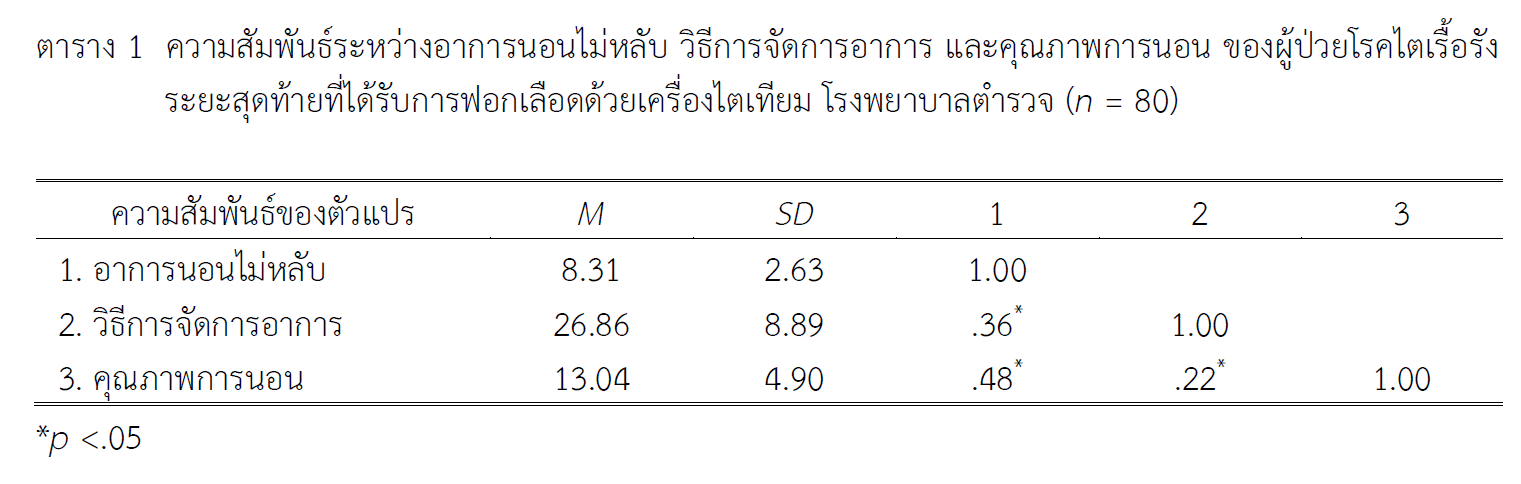
The results revealed that: (1) the sample had a mean insomnia symptom score at the subthreshold (early-stage) insomnia level (M = 8.31, SD = 2.63); more than half experienced early-morning awakening, resulting most frequently in daytime sleepiness (75%), followed by fatigue (70%); (2) regarding insomnia symptom-management strategies, at the personal level most participants watched television, played games, or used social media before bed (76.3%), at the environmental level they slept in a darkened room with the lights off (82.5%), and at the health level they managed itching before bed (31.1%); (3) for sleep quality, the sample had a mean score of 13.04 (SD = 4.90), indicating poor sleep quality, even though 43.8% went to bed before 8:00 p.m.; and (4) the correlation analysis revealed that insomnia symptoms had the strongest, moderate positive relationship with sleep quality, which was statistically significant at the .05 level (r = .48, p < .05), followed by a positive relationship between insomnia symptoms and symptom-management strategies (r = .36, p < .05), while symptom-management strategies had a low positive relationship with sleep quality, statistically significant at the .05 level (r = .22, p < .05).
Therefore, to address the problem of sleep quality, hemodialysis nurses should assess and screen for insomnia symptoms from the onset of hemodialysis treatment, as well as advise patients to reduce electronic media use before bed and concurrently manage disruptive symptoms such as itching.
Downloads
References
Alshammari, B., Alkubati, S. A., Pasay-An, E., Alrasheeday, A., Alshammari, H. B., Asiri, S. M., . . . Alshammari, F. (2023). Sleep Quality and Its Affecting Factors among Hemodialysis Patients: A Multicenter Cross-Sectional Study. Healthcare (Basel, Switzerland), 11(18), 2536. https://doi.org/10.3390/healthcare11182536
Bureau of Policy and Strategy, Office of the Permanent Secretary of Public Health. (2025). Public Health Statistics B.E. 2563–2566. Ministry of Public Health.
Buysse, D. J., Reynolds, C. F., Monk, T. H., Berman, S. R., & Kupfer, D. J. (1989). The Pittsburgh sleep quality index: A new instrument for psychiatric practice and research. Psychiatry Research, 28(2), 193–213. https://doi.org/10.1016/0165-1781(89)90047-4
Carpi, M. (2025). The Pittsburgh sleep quality index: A brief review. Occupational Medicine, 75(1), 14–16. https://doi.org/10.1093/occmed/kqae121
Chu, G., Yu, F., Ho, Y. F., Chao, C. T., & Viecelli, A. K. (2025). A Systematic Review of Sleep Hygiene Strategy in CKD. Kidney International Reports, 10(9), 3006–3022. https://doi.org/10.1016/j.ekir.2025.06.018
Cukor, D., Unruh, M., McCurry, S. M., & Mehrotra, R. (2021). The challenge of insomnia for patients on haemodialysis. Nature Reviews Nephrology, 17(3), 147–148. https://doi.org/10.1038/s41581-021-00396-5
Dodd, M., Janson, S., Facione, N., Faucett, J., Froelicher, E. S., Humphreys, J., & Taylor, D. (2001). Advancing the science of symptom management. Journal of Advanced Nursing, 33(5), 668–676. https://doi.org/10.1046/j.1365-2648.2001.01697.x
Döner, A., Taşci, S., & Bilgin, A. (2025). The effect of massage, acupressure and reflexology on restless legs syndrome severity and sleep quality in patients receiving haemodialysis treatment: A systematic review and meta-analysis. Nursing Open, 12, e70135. https://doi.org/10.1002/nop2.70135
Edinger, J. D., Arnedt, J. T., Bertisch, S. M., Carney, C. E., Harrington, J. J., Lichstein, K. L., . . . Martin, J. L. (2021). Behavioral and psychological treatments for chronic insomnia disorder in adults: An American Academy of Sleep Medicine clinical practice guideline. Journal of Clinical Sleep Medicine, 17(2), 255-262. https://doi.org/10.5664/jcsm.8986
Fadlilah, L., Ratri, T. H., & Yuliani, F. C. (2025). The effects intradialytic exercise on hemodialysis: A systematic review. Jurnal Ners, 9(3), 5421-5425. Retrieved from https://reposister.almaata.ac.id/id/eprint/5220/1/Jurnal%20Penelitian.pdf
Feng, X., Sun, J., Wang, Z., Zhang, N., Liu, Y., Wang, Z., . . . Ma, Y. (2025). The impact of intradialytic elastic band exercise on physical and cognitive abilities in patients on maintenance hemodialysis: A randomized controlled trial. Renal failure, 47(1), 2482124. https://doi.org/10.1080/0886022X.2025.2482124
Gopal, A., Farragher, J., Jassal, S. V., & Mucsi, I. (2025). Sleep disorders in CKD: A review. American Journal of Kidney Diseases, 85(6), 754-766. https://doi.org/10.5527/wjn.v5.i3.224
Han, Q., Liu, B., Lin, S., Li, J., Liang, P., Fu, S., . . . Yang, Q. (2021). Pittsburgh sleep quality index score predicts all-cause mortality in Chinese dialysis patients. International Urology and Nephrology, 53(11), 2369-2376. https://doi.org/10.1007/s11255-021-02842-6
Lyons, O. D. (2024). Sleep disorders in chronic kidney disease. Nature Reviews Nephrology, 20(10), 690-700. https://doi.org/10.1038/s41581-024-00848-8
Malekmakan, L., Tadayon, T., Azadian, F., & Sayadi, M. (2018). Who is sleeping more efficient? Patients on peritoneal dialysis or hemodialysis. Saudi Journal of Kidney Diseases and Transplantation, 29(3), 630-636. https://doi.org/10.4103/1319-2442.235182
Mark, P. B., Stafford, L. K., Grams, M. E., Aalruz, H., Abd ElHafeez, S., Abdelgalil, A. A., . . . Do, T. H. P. (2025). Global, regional, and national burden of chronic kidney disease in adults, 1990–2023, and its attributable risk factors: A systematic analysis for the Global Burden of Disease Study 2023. The Lancet, 406(10518), 2461-2482. https://doi.org/10.1016/S0140-6736(25)01853-7
Mathew, A., Doorenbos, A. Z., & Vincent, C. (2021). Symptom management theory: Analysis, evaluation, and implications for caring for adults with cancer. Advances in Nursing Science, 44(3), E93-E112. https://doi.org/10.1097/ANS.0000000000000347
Mehrotra, R., Cukor, D., McCurry, S. M., Rue, T., Cohen, S., Hammes, M., & Unruh, M. (2024). Effectiveness of existing insomnia therapies for patients undergoing hemodialysis: A randomized clinical trial. Annals of Internal Medicine, 177(2). 177-188. https://doi.org/10.7326/M23-1794
Mohandas, R., Douma, L. G., Scindia, Y., & Gumz, M. L. (2022). Circadian rhythms and renal pathophysiology. The Journal of Clinical Investigation, 132(3). https://doi.org/10.1172/JCI148277
Mujahid, M., Nasir, K., Qureshi, R., Dhrolia, M., & Ahmad, A. (2022). Comparison of the quality of sleep in patients with chronic kidney disease and end-stage renal disease. Cureus, 14(4). e23862. https://doi.org/10.7759/cureus.23862
Pan, E. Y., & Wang, W. (2025). Elements of music that work to improve sleep, a narrative review. Frontiers in Sleep, 4, 1707162. https://doi.org/10.3389/frsle.2025.1707162
Parmaksiz, E., & Parmaksiz, E. T. (2025). Comparison of sleep quality in peritoneal dialysis and hemodialysis patients: A cross-sectional study. Pakistan Journal of Medical Sciences, 41(8), 2301–2304. https://doi.org/10.12669/pjms.41.8.12090
Pei, M., Chen, J., Dong, S., Yang, B., Yang, K., Wei, L., Zhai, J., & Yang, H. (2021). Auricular acupressure for insomnia in patients with maintenance hemodialysis: A systematic review and meta-analysis. Frontiers in Psychiatry, 12, 576050. https://doi.org/10.3389/fpsyt.2021.576050
Phetsri, K., Yodchai, K., & Chinnawong, T. (2017). Insomnia experience, symptom management strategies and quality of sleep in end stage renal disease patients undergoing continuous ambulatory peritoneal dialysis. Journal of Nursing Science & Health, 40(3), 96-106. Retrieved from https://he01.tci-thaijo.org/index.php/nah/article/view/108287/85672
Phetsri, K., Yodchai, K., & Chinnawong, T. (2021). Factors related to quality of sleep in end stage renal disease patients undergoing continuous ambulatory peritoneal dialysis. Christian University Journal, 27(3), 1-15.
Qaseem, A., Kansagara, D., Forciea, M. A., Cooke, M., Denberg, T. D., & Clinical Guidelines Committee of the American College of Physicians. (2016). Management of chronic insomnia disorder in adults: A clinical practice guideline from the American College of Physicians. Annals of Internal Medicine, 165(2), 125-133. https://doi.org/10.7326/M15-2175
Sabbatini, M., Minale, B., Crispo, A., Pisani, A., Ragosta, A., Esposito, R., . . . Andreucci, V. E. (2002). Insomnia in maintenance haemodialysis patients. Nephrology Dialysis Transplantation, 17(5), 852-856. https://doi.org/10.1093/ndt/17.5.852
Tan, L. H., Chen, P. S., Chiang, H. Y., King, E., Yeh, H. C., Hsiao, Y. L., . . . Kuo, C. C. (2022). Insomnia and poor sleep in CKD: A systematic review and meta-analysis. Kidney medicine, 4(5), 100458. https://doi.org/10.1016/j.xkme.2022.100458
Thorndike, R. M. (1978). Correlational procedures for research. New York, NY: Gardner Press. https://doi.org/10.2147/NSS.S566303
Wu, Y., Zhang, H., Jiang, L., Liu, Z., Li, X., Guo, B., & Yu, R. (2025). Effects of mindfulness meditation combined with progressive muscle relaxation on sleep disorders, anxiety, and depression in patients with sarcopenia undergoing hemodialysis. Frontiers in Psychiatry, 16, 1542028. https://doi.org/10.3389/fpsyt.2025.1542028
Xu, N., Li, S., Zhang, X., Wang, Y., & Li, X. (2023). Restless legs syndrome in end-stage renal disease patients on maintenance hemodialysis: Quality of life and sleep analysis. Advanced Neurology, 2(1), 210. https://doi.org/10.36922/an.210
Yodchai, K., & Phetsri, K., (2017). Insomnia experiences, management methods, and sleep quality in patients with end-stage renal disease undergoing continuous peritoneal dialysis (Master's Thesis in Adult Nursing). Faculty of Nursing, Prince of Songkla University. Songkla.
Zhou, M., Gu, X., Cheng, K., Wang, Y., & Zhang, N. (2023). Exploration of symptom clusters during hemodialysis and symptom network analysis of older maintenance hemodialysis patients: a cross-sectional study. BMC Nephrology, 24(1), 115. https://doi.org/10.1186/s12882-023-03176-4
Downloads
Published
How to Cite
Issue
Section
License
Copyright (c) 2026 JOURNAL OF THE POLICE NURSES AND HEALTH SCIENCE

This work is licensed under a Creative Commons Attribution-NonCommercial-NoDerivatives 4.0 International License.
ผลงานที่ได้ตีพิมพ์แล้วจะเป็นลิขสิทธิ์ของวารสารพยาบาลตำรวจ