ผลของโปรแกรมการส่งเสริมสุขภาพตามแนวทางของ สบช.โมเดล และกรมอนามัย ผ่านสื่อดิจิทัลต่อพฤติกรรมการดูแลตนเองของหญิงตั้งครรภ์ที่มีภาวะโลหิตจาง
คำสำคัญ:
โปรแกรมการส่งเสริมสุขภาพ, สบช.โมเดล, สื่อดิจิทัล, พฤติกรรมการดูแลตนเอง, หญิงตั้งครรภ์ที่มีภาวะโลหิตจางบทคัดย่อ
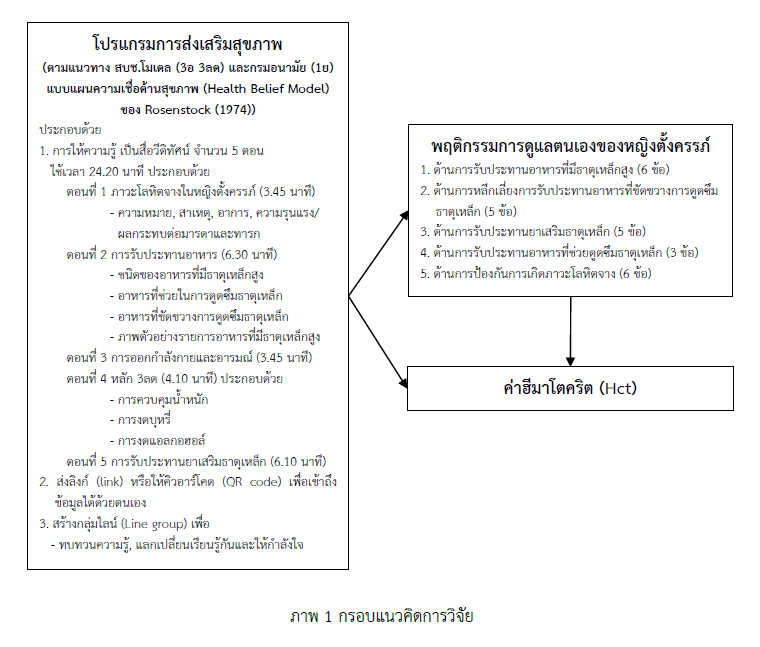
การวิจัยกึ่งทดลองนี้ มีวัตถุประสงค์เพื่อ 1) เปรียบเทียบคะแนนเฉลี่ยพฤติกรรมการดูแลตนเองหญิงตั้งครรภ์ที่มีภาวะโลหิตจางก่อนและหลังได้รับโปรแกรมการส่งเสริมสุขภาพ 2) เปรียบเทียบคะแนนเฉลี่ยพฤติกรรมการดูแลตนเองของหญิงตั้งครรภ์ที่มีภาวะโลหิตจางระหว่างกลุ่มทดลองและกลุ่มควบคุม 3) เปรียบเทียบค่าเฉลี่ยฮีมาโตคริตของหญิงตั้งครรภ์ระหว่างกลุ่มทดลองและกลุ่มควบคุม ตัวอย่าง คือ หญิงตั้งครรภ์ที่มารับบริการที่แผนกฝากครรภ์ โรงพยาบาลพุทธชินราช พิษณุโลกและมีภาวะโลหิตจาง จำนวน 60 ราย ได้มาโดยการคัดเลือกแบบเฉพาะเจาะจง แบ่งเป็นกลุ่มทดลอง 30 คน และกลุ่มควบคุม 30 คน เครื่องมือที่ใช้ในการทดลอง คือ โปรแกรมการส่งเสริมสุขภาพตามแนวทางของ สบช.โมเดล และกรมอนามัย ในรูปแบบสื่อวีดิทัศน์ และเครื่องมือที่ใช้ในการเก็บรวบรวมข้อมูล ได้แก่ 1) แบบสอบถามข้อมูลส่วนบุคคล 2) แบบบันทึกค่าฮีมาโตคริต 3) แบบสอบถามพฤติกรรมการดูแลตนเอง ซึ่งเครื่องมือทั้งหมดได้ผ่านการตรวจสอบความตรงเชิงเนื้อหาจากผู้ทรงคุณวุฒิทางด้านสูติศาสตร์ 3 ท่าน ได้ค่าดัชนีความตรงเชิงเนื้อหาของสื่อวีดิทัศน์ และเครื่องมือที่ใช้เก็บรวบรวมข้อมูล มีค่า IOC เท่ากับ .87 และ 1.00 ตามลำดับ และมีค่าความเชื่อมั่นของแบบสอบถามโดยมีค่าสัมประสิทธิ์แอลฟาครอนบาคเท่ากับ .82 วิเคราะห์ข้อมูลโดยใช้สถิติเชิงพรรณนาและใช้สถิติอนุมาน ได้แก่ สถิติทดสอบทีแบบไม่อิสระจากกันและสถิติทดสอบแมนน์-วิทนีย์ ยู กำหนดนัยสำคัญทางสถิติที่ระดับ .05
ผลการวิจัย พบว่า ภายหลังเข้าร่วมโปรแกรมเป็นระยะเวลา 6 สัปดาห์ ของกลุ่มทดลองมีคะแนนเฉลี่ยพฤติกรรมการดูแลตนเองสูงกว่าก่อนเข้าโปรแกรมอย่างมีนัยสำคัญทางสถิติ (t=11.799, p < .05) และมีคะแนนเฉลี่ยพฤติกรรมการดูแลตนเองสูงกว่ากลุ่มควบคุมอย่างมีนัยสำคัญทางสถิติ (z = -6.600, p < .05) นอกจากนี้ กลุ่มทดลองยังมีค่าเฉลี่ยฮีมาโตคริตสูงกว่ากลุ่มควบคุมอย่างมีนัยสำคัญทางสถิติ (z = -3.971, p < .05)
ผลการวิจัยครั้งนี้แสดงให้เห็นว่า โปรแกรมการส่งเสริมสุขภาพตามแนวทาง สบช. โมเดลและกรมอนามัย ที่ทำออกมาในรูปแบบสื่อวีดิทัศน์สามารถช่วยให้หญิงตั้งครรภ์ที่มีภาวะโลหิตจางมีพฤติกรรมการดูแลตนเองดีขึ้น
Downloads
เอกสารอ้างอิง
Aigner, E., Feldman, A., & Datz, C. (2014). Obesity as an emerging risk factor for iron deficiency. Nutrients, 6(9), 3587-3600. https://doi.org/10.3390/nu6093587
American College of Obstetricians and Gynecologists. (2021). Anemia in pregnancy. Retrieved from https://www.acog.org/clinical/clinical-guidance/practice-bulletin/articles/2021/08/anemia-in-pregnancy
Department of Health. (2023). Health promotion and environmental health information support system (Anemia 2023). Retrieved from https://dashboard.anamai.moph.go.th/dashboard/anemia/index?year=2024
Department of Health. (2024). Health promotion and environmental health information support system (Anemia 2024). Retrieved from https://dashboard.anamai.moph.go.th/dashboard/anemia1549n/index?year=2025
Department of Health, Ministry of Public Health. (2020). Guidelines for maternal and infant care to reduce iron deficiency anemia. Bangkok, Thailand: The War Veterans Organization of Thailand Printing Mill.
Department of Health, Ministry of Public Health. (2013). Manual of guidelines for the control and prevention of iron deficiency anemia. Retrieved from https://rbpho.moph.go.th/upload-file/doc/files/16012023-031738-7690.pdf
Department of Obstetrics and Gynecology,Buddhachinaraj Phitsanulok Hospital. (2023). Medical record statistical data for antenatal care department 2023 (Unpublished internal data). Buddhachinaraj Phitsanulok Hospital, Phitsanulok, Thailand.
Duangsamran, D., Chantapho, A., & Sirisom, J. (2025). The effects of education media on nutritional self-care behaviors and hematocrit levels in pregnant women. Journal of Medical and Public Health Region 4, 15(3), 52-63. Retrieved from https://he01.tci-thaijo.org/index.php/JMPH4/article/view/270187
Hu, M., & Lin, W. (2012). Effects of exercise training on red blood cell production: Implications for anemia. Acta Haematologica, 127(3), 156–164. https://doi.org/10.1159/000335620
International Federation of Gynecology and Obstetrics. (2023). The global voice for women's health: Iron deficiency and anaemia in women and girls. Retrieved from https://www.figo.org/resources/figo-statements/iron-deficiencyand-anaemia-women-and-girls
Jain, R., George, A. B., & Narnoli, S. (2020). Haematological changes in alcohol and substance use disorders- An overview. International Archives of Substance Abuse and Rehabilitation, 2(1), 1-6. http://doi.org/10.23937/2690-263X/1710006
Janz, N. K., & Becker, M. H. (1984). The health belief model: A decade later. Health Education Quarterly, 11(1), 1–47. https://doi.org/10.1177/109019818401100101
Jittrapirom, A., Intarakumhang, U., & Pimthong, S. (2024). Learning management strategies to promote digital health literacy among pregnant women. Journal of The Royal Thai Army Nurses, 25(1), 10–18.
Ministry of Public Health, Health Planning Division. (2023). Strategic issues for health promotion in all age groups: Detailed list of health promotion and environmental health surveillance, Department of Health, B.E. 2566 (2023). Retrieved from https://planning.anamai.moph.go.th/th/template-surveillance/download?id=103104&mid=38071&mkey=m_document&lang=th&did=31567
Nunla-ong, O., Nunla-ong, Y., & Wattana, S. (2024). The Effect of Using Health Behavior Changing Program PBRI’s Model among Village Health Volunteers at Tambon Thiang Thae, Sunkaburi District, Chainat Province. Journal of Environmental Health and Community Health, 9(5), 195–203. Retrieved from https://he03.tci-thaijo.org/index.php/ech/article/view/3347
Obeagu, E. I., Igwe, M. C., & Obeagu, G. U. (2024). Oxidative stress’s impact on red blood cells: Unveiling implications for health and disease. Medicine, 103(9), e37360. https://doi.org/10.1097/MD.0000000000037360
Phitsanulok Provincial Public Health Office. (2024). Annual report 2024. Retrieved from https://plkhealth.moph.go.th
Pliwma, S., & Budsayapanpong, H. (2022). Development of promotive care model for anemic pregnant women at Jainad Narendra Hospital. Singburi Hospital Journal, 31(2), 165–179. Retrieved from https://he01. tci-thaijo.org/index.php/shj/article/view/259635
Polit, D., & Beck, C. (2020). Essentials of nursing research: Appraising evidence for nursing practice. Lippincott Williams & Wilkins.
Prasitwattanaseree, P. (2022). Nursing care for women with medical complications. In Prasitwattanaseree, P. (Ed.), Nursing and midwifery for women with risks and complications (pp. 127-226) (2nd ed.). Chiang Mai, Thailand: Siam Pimnana.
Rhodes, A., Smith, A. D., Chadwick, P., Croker, H., & Llewellyn, C. H. (2020). Exclusively digital health interventions targeting diet, physical activity, and weight gain in pregnant women: Systematic review and meta-analysis. JMIR mHealth and uHealth, 8(7), e18255. https://doi.org/10.2196/18255
Rosenstock, I. M. (1974). Historical origins of the health belief model. Health Education Monographs, 2(4), 328-335. http://doi.org/10.1177/109019817400200403
Royal Thai College of Obstetricians and Gynaecologists. (2025). RTCOG clinical practice guideline: Prevention and treatment of anemia in pregnancy. Retrieved from https://www.rtcog.or.th/files/1754468534_a1313bf4e47ba4bf4499.pdf
Thienthavorn, V., Chuenkongkaew, W., Tanwattanakul, W., Charoensook, S., Janphet, A., & Klinsukon, P. (2024). Thalassemia: Risks, policies, surveillance, control, prevention, and treatment measures. Bangkok, Thailand: NC Concept.
Tongsong, T., & Wanapirak, C. (2021). Hematological diseases in pregnancy. In Tongsong T. (Ed.), Obstetrics (pp. 425-444) (6th ed.). Bangkok: Laxmirung.
Triharini, M., Has, E. M. M., & Nofita, G. (2023). Determinant factors of anemia in pregnancy based on health belief model: A correlational study. Jurnal Ners, 18(1), 24–30. https://doi.org/10.20473/jn.v18i1.4370
Ucharattana, P., Komonwipast, N., & Chaotthong, S. (2022). The development and effectiveness of an interactive electronic book entitled “Female Indwelling Catheterization” for sophomore nursing students at Rangsit University. Journal of Nursing and Health Care, 40(2), 45-54. Retrieved from https://he01.tci-thaijo.org/index.php/jnat-ned/article/view/254996/173666
Vivek, A., Kaushik, R. M., & Kaushik, R. (2022). Tobacco smoking-related risk for iron deficiency anemia: A case-control study. Journal of Addictive Diseases, 41(2), 128-136. https://doi.org/10.1080/10550887.2022.2080627
World Health Organization. (2023). The global health observatory explore a world of health data: Anaemia in women and children. Retrieved from https://www.who.int/data/gho/data/themes/topics/anaemia_in_women_and_children
ดาวน์โหลด
เผยแพร่แล้ว
รูปแบบการอ้างอิง
ฉบับ
ประเภทบทความ
สัญญาอนุญาต
ลิขสิทธิ์ (c) 2026 วารสารพยาบาลตำรวจและวิทยาศาสตร์สุขภาพ

อนุญาตภายใต้เงื่อนไข Creative Commons Attribution-NonCommercial-NoDerivatives 4.0 International License.
ผลงานที่ได้ตีพิมพ์แล้วจะเป็นลิขสิทธิ์ของวารสารพยาบาลตำรวจ