การพัฒนาโปรแกรมพฤติกรรมการดูแลสุขภาพหญิงตั้งครรภ์ที่มีภาวะน้ำตาลในเลือดสูง
คำสำคัญ:
หญิงตั้งครรภ์ที่มีภาวะน้ำตาลในเลือดสูง, การจัดการตนเอง, พฤติกรรมการดูแลสุขภาพบทคัดย่อ
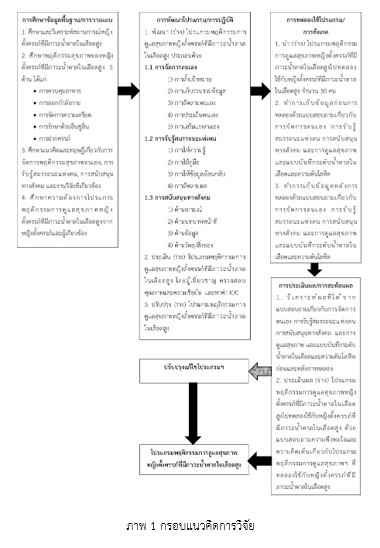
การวิจัยเชิงปฏิบัติการแบบมีส่วนร่วมนี้ ใช้รูปแบบกึ่งทดลองแบบกลุ่มเดียววัดผลก่อนและหลังการทดลอง (one-group pretest-posttest design) มีวัตถุประสงค์เพื่อพัฒนาโปรแกรมพฤติกรรมการดูแลสุขภาพหญิงตั้งครรภ์ที่มีภาวะน้ำตาลในเลือดสูง และเปรียบเทียบค่าเฉลี่ยพฤติกรรมการดูแลสุขภาพและค่าเฉลี่ยระดับน้ำตาลในเลือดก่อนและหลังได้รับโปรแกรม ตัวอย่าง คือ หญิงตั้งครรภ์ที่มีภาวะน้ำตาลในเลือดสูงที่มารับบริการฝากครรภ์ ณ โรงพยาบาลคลองหลวงและโรงพยาบาลธัญบุรี จังหวัดปทุมธานี จำนวน 50 คน ได้มาโดยการเลือกตัวอย่างแบบเจาะจง โปรแกรมพัฒนาขึ้นบนพื้นฐานแนวคิดการจัดการตนเอง การรับรู้สมรรถนะแห่งตน และการสนับสนุนทางสังคม ดำเนินการผ่านกระบวนการ PAOR เป็นเวลา 24 สัปดาห์ ด้วยการประชุมกลุ่ม การเยี่ยมบ้าน และการติดตามทางโทรศัพท์ เครื่องมือที่ใช้ในการวิจัย ได้แก่ โปรแกรมพฤติกรรมการดูแลสุขภาพ คู่มือและสมุดบันทึก แบบประเมินการจัดการตนเอง การรับรู้สมรรถนะแห่งตน และการสนับสนุนทางสังคม แบบสอบถามข้อมูลส่วนบุคคลและด้านสุขภาพ แบบสอบถามพฤติกรรมการดูแลสุขภาพ และแบบบันทึกระดับน้ำตาลในเลือด โดยแบบสอบถามมีค่าสัมประสิทธิ์แอลฟาของครอนบาคระหว่าง .76 – .84 วิเคราะห์ข้อมูลด้วยสถิติเชิงพรรณนาและสถิติทดสอบทีแบบไม่อิสระต่อกัน (dependent t-test)
ผลการวิจัยพบว่า ภายหลังได้รับโปรแกรม ตัวอย่างมีค่าเฉลี่ยพฤติกรรมการดูแลสุขภาพสูงกว่าก่อนได้รับโปรแกรมอย่างมีนัยสำคัญทางสถิติที่ระดับ .05 (M = 4.24, SD = .56 และ M = 2.94, SD = .59 ตามลำดับ; t = -25.92, p < .05) และมีค่าเฉลี่ยระดับน้ำตาลในเลือดลดลงกว่าก่อนได้รับโปรแกรมอย่างมีนัยสำคัญทางสถิติที่ระดับ .05 (M = 118.42 mg/dL, SD = 14.76 และ M = 142.36 mg/dL, SD = 18.52 ตามลำดับ; t = -12.84, p < .05) นอกจากนี้ การจัดการตนเอง การรับรู้สมรรถนะแห่งตน และการสนับสนุนทางสังคม ภายหลังได้รับโปรแกรมเพิ่มขึ้นจากระดับปานกลางสู่ระดับมากอย่างมีนัยสำคัญทางสถิติที่ระดับ .05 ทุกด้าน ดังนั้น โปรแกรมพฤติกรรมการดูแลสุขภาพที่พัฒนาขึ้นตามกระบวนการ PAOR สามารถส่งเสริมพฤติกรรมการดูแลสุขภาพและช่วยควบคุมระดับน้ำตาลในเลือดของหญิงตั้งครรภ์ที่มีภาวะน้ำตาลในเลือดสูงได้ จึงควรนำไปประยุกต์ใช้ในระดับชุมชนและสถานพยาบาล
Downloads
เอกสารอ้างอิง
American Diabetes Association Professional Practice Committee (2022). 2. Classification and Diagnosis of Diabetes: Standards of Medical Care in Diabetes-2022. Diabetes care, 45(Suppl 1), S17–S38. https://doi.org/10.2337/dc22-S002
Bandura, A. (Ed.). (1997). Self-efficacy in changing societies. Cambridge university press.
Churos, S., Kasinang, P., & Kaeokhieo, B. (2023). Pregnancy with gestational diabetes mellitus: Contributing factors and barriers to self-care. Singburi Hospital Journal. 32(2), A1-A16.
Creer, T. L. (2000). Self-management of chronic illness. In Handbook of self-regulation (pp. 601-629). Academic Press.
Ferrara, A. (2020). Translating research on diabetes and obesity in pregnancy into prevention: The 2019 Norbert Freinkel Award Lecture. Diabetes Care, 43(11), 2653-2642. https://doi.org/10.2337/dci19-0040
Gitlin, E. S., Demetres, M., Vaidyanathan, A., Palmer, N., Lee, H., Loureiro, S., Radwan, E., Tuschman, A., Mathad, J., & Chebrolu, P. (2024). The prevalence of gestational diabetes among underweight and normal weight women worldwide: A scoping review. Frontiers in Clinical Diabetes and Healthcare, 5, 1415069. https://doi.org/10.3389/fcdhc.2024.1415069
House, J. S. (1981). Work stress and social support. Reading, MA: Addison-Wesley.
Kanfer, F. H., & Gaelick-Buys, L. (1991). Self-management methods. In F. Kanfer & A. Goldtein (Eds.), Helping people change: A text book of methods (4th ed.). New York, NY: Pergamonpress.
Huang, Y., Li, S., Lu, X., Chen, W., & Zhang, Y. (2024). The effect of self-management on patients with chronic diseases: A systematic review and meta-analysis. Healthcare, 12(21), 2151. https://doi.org/10.3390/healthcare12212151
International Diabetes Federation (IDF). (2024). IDF Diabetes Atlas (11th ed.). Brussels, Belgium: International Diabetes Federation.
McIntyre, H. D., Fuglsang, J., Kampmann, U., Knorr, S., & Ovesen, P. (2022). Hyperglycemia in pregnancy and women’s health in the 21st century. International Journal of Environmental Research and Public Health, 19(24), 16827. https://doi.org/10.3390/ijerph192416827
Medical Service Department, Bangkok Metropolitan. (2025). Number of pregnant women diagnosed with gestational diabetes.
Netimetee, S., & Boobpamala, S. (2022). nursing care for pregnant women with gestational diabetes mellitus during pregnancy. Journal of Health and Nursing Education, 28(1), e256658.
Panmuang, S., Sutthiprapa, A., & Phuakphan, W. (2023). The development of self-care program for pregnant women with gestational diabetes mellitus. Journal of Health Research and Development, Nakhon Ratchasima Provincial Public Health Office, 9(1), 130-144.
Polit, D., & Beck, C. (2020). Essentials of nursing research: Appraising evidence for nursing practice. Lippincott Williams & Wilkins.
Singtan, J. (2022). Factors predicting diabetes prevention behaviors among postpartum women with gestational diabetes mellitus (Master of nursing science program). Faculty of Nursing, Burapha University, Chonburi.
Szekér, L., Gaudiino, M., Van den Broeck, A., Lenaerts, K., Vandekerckhove, S., Vanmarcke, S., . . . Riso, S. (2023). Psychosocial risks to workers' well-being: Lessons from the COVID-19 pandemic. Psychosocial risks to workers' well-being: Lessons from the COVID-19 pandemic, 1-90. Retrieved from https://kuleuven.limo.libis.be/discovery/search?query=any,contains,LIRIAS4123375&tab=LIRIAS&search_scope=lirias_profile&vid=32KUL_KUL:Lirias&offset=0
World Health Organization (WHO). (2016). WHO recommendations on antenatal care for a positive pregnancy experience. Geneva: WHO.
ดาวน์โหลด
เผยแพร่แล้ว
รูปแบบการอ้างอิง
ฉบับ
ประเภทบทความ
สัญญาอนุญาต
ลิขสิทธิ์ (c) 2026 วารสารพยาบาลตำรวจและวิทยาศาสตร์สุขภาพ

อนุญาตภายใต้เงื่อนไข Creative Commons Attribution-NonCommercial-NoDerivatives 4.0 International License.
ผลงานที่ได้ตีพิมพ์แล้วจะเป็นลิขสิทธิ์ของวารสารพยาบาลตำรวจ