FACTORS ASSOCIATED WITH KNOWLEDGE OF STROKE WARNING SIGNS AMONG PATIENTS WITH DIABETES AND HYPERTENSION AT A SUBDISTRICT HEALTH PROMOTING HOSPITAL
Keywords:
stroke warning signs (B.E.F.A.S.T.), diabetes mellitus, hypertension, subdistrict health promoting hospitalAbstract
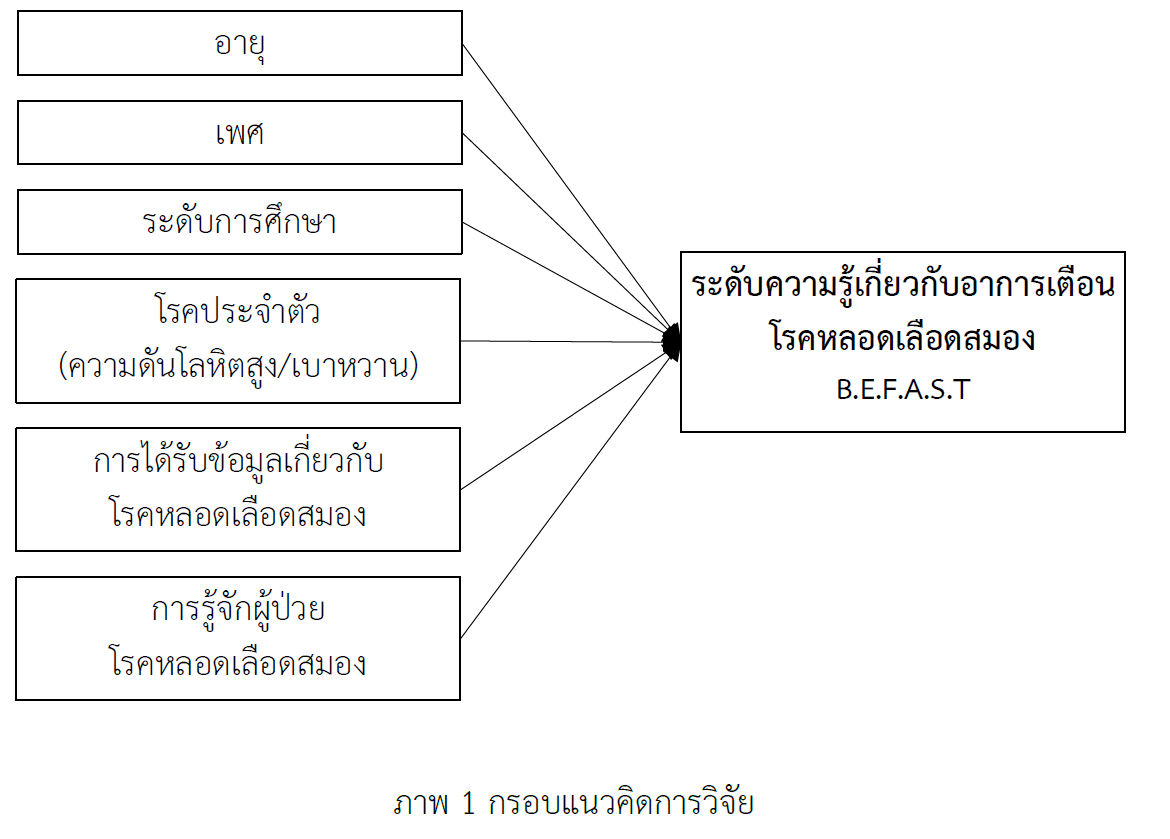
This study aimed to assess the level of knowledge regarding stroke warning signs and to examine the associations between personal factors, including age, gender, education level, comorbidities, receipt of information, and knowing someone with stroke, and knowledge of stroke warning signs among patients with hypertension and/or diabetes attending Bang Cha Long Health Promoting Hospital, Samut Prakan Province. A total of 168 participants completed the study. The research instruments included a personal information questionnaire and a stroke warning signs knowledge test based on the B.E.F.A.S.T. guidelines, which demonstrated content validity index (CVI) was 1.00 and original reliability (KR-20) was .728. Descriptive statistics, Fisher’s Exact test, and logistic regression were used for data analysis.
The findings indicated that participants had moderate to good knowledge of stroke warning signs, particularly for highly observable symptoms such as arm or leg weakness and facial drooping. However, “unknown” responses were reported for other warning signs, especially dizziness and visual disturbances. Among the personal factors examined, receipt of information regarding stroke warning signs was significantly associated with higher knowledge levels both before and after adjustment for confounding variables. Participants who had previously received stroke-related information were more likely to have higher knowledge levels than those who had not (COR = 3.58, 95% CI = 1.89–6.77, p < .05; AOR = 3.03, 95%CI = 1.55 - 5.91, p < .05). In contrast, gender, comorbidities, and knowing someone with stroke were not significantly associated with knowledge levels (p > 0.05). Age (≥60 years) and education level (secondary or higher) showed unclear associations with knowledge of stroke warning signs.
Therefore, efforts should be made to promote the dissemination of information regarding stroke warning signs, particularly for symptoms that are less recognized by the public. Developed a continuous educational program for hypertensive and diabetic patients to enhance their knowledge of stroke warning signs. In addition, healthcare professionals’ competencies in providing appropriate patient education should be developed to enhance the effectiveness of stroke prevention.
Downloads
References
American Heart Association. (2025). Stroke warning sign acronyms drive 911 calls: F.A.S.T. leads in symptom recall for public. Retrieved from https://newsroom.heart.org/news/stroke-warning-sign-acronyms-drive-911-calls-f-a-s-t-leads-in-symptom-recall-for-public
American Stroke Association. (2023). Stroke warning signs and symptoms (FAST/BEFAST). Retrieved from https://www.stroke.org/en/about-stroke/stroke-symptoms
Ananchaisarp, T., & Sa-a, S. (2022). Knowledge and response regarding stroke warning signs among patients with diabetes and hypertension in primary care settings. Journal of Nursing and Health Care, 40(3), 85–96. https://doi.org/10.33192/Smj.2022.10
Best, J. W. (1977). Research in education (3rd ed.). Englewood Cliffs, NJ: Prentice-Hall.
Department of Disease Control, Ministry of Public Health Thailand. (2021). Annual epidemiological surveillance report 2021. Retrieved from https://appsdoe.moph.go.th/boeeng/download/AW_AESR_2564.pdf
Department of Disease Control, Ministry of Public Health Thailand. (2023). Stroke situation report 2023. Nonthaburi: Ministry of Public Health.
Dharmasaroja, P., & Uraisin, P. (2024). Stroke awareness and knowledge in the at-risk population: A community-based study. Cureus, 16(4), e57756. https://doi.org/10.7759/cureus.57756
Feigin, V. L., Stark, B. A., Johnson, C. O., Roth, G. A., Bisignano, C., Abady, G. G., . . . Murray, C. J. L. (2022). Global, regional, and national burden of stroke and its risk factors, 1990–2019: A systematic analysis for the Global Burden of Disease Study 2019. The Lancet Neurology, 21(10), 795–820. https://doi.org/10.1016/S1474-4422(21)00252-0
GBD 2021 Stroke Risk Factor Collaborators. (2024). Global, regional, and national burden of stroke and its risk factors, 1990 - 2021: A systematic analysis for the Global Burden of Disease Study 2021. The Lancet Neurology, 23(10), 973–1003. https://doi.org/10.1016/S1474-4422(24)00369-7
Hollist, M., Morgan, L., Cabatbat, R., Au, K., Kirmani, M. F., & Kirmani, B. F. (2021). Acute stroke management: Overview and recent updates. Aging and Disease, 12(4), 1000–1009. https://doi.org/10.14336/AD.2021.0311
Korjedee, P., Kittiboonthawal, P., Namdej, N., & Chunchum, J. (2022). Predictive factors of knowledge levels regarding stroke risk factors and warning signs among community people in Saraburi Province. Nursing Journal of the Ministry of Public Health, 32(2), 65–74. Retrieved from https://he02.tci-thaijo.org/index.php/tnaph/article/view/259123
Kunyaprasankit, N. (2023). Factors predicting the perception of stroke warning signs and management among patients with diabetes and comorbid hypertension (Master’s thesis). Huachiew Chalermprakiet University, Bangkok.
Kuriakose, D., & Xiao, Z. (2020). Pathophysiology and treatment of stroke: Present status and future perspectives. International Journal of Molecular Sciences, 21(20), 7609. https://doi.org/10.3390/ijms21207609
Lin, X., Xu, Y., Pan, X., Xu, J., Ding, Y., Sun, X., . . . Public Health Study Group. (2020). Global, regional, and national burden and trend of diabetes in 195 countries and territories: An analysis from 1990 to 2025. Scientific Reports, 10(1), 14790. https://doi.org/10.1038/s41598-020-71908-9
National Institute for Emergency Medicine. (2021). Stroke: Knowledge for emergency medical service providers. Nonthaburi: National Institute for Emergency Medicine. Retrieved from https://www.niems.go.th
Nigat, A. B., Abate, M. W., Demelash, A. T., Tibebu, N. S., Tiruneh, C. M., Emiru, T. D., et al. (2021). Knowledge on stroke warning signs and associated factors among hypertensive patients, Northwest Ethiopia: An institution-based cross-sectional study. Vascular Health and Risk Management, 17, 721–728. https://doi.org/10.2147/VHRM.S333394
Pothiban, L., Khampolsiri, T., & Srirat, C. (2018). Knowledge and awareness of stroke impacts among northern Thai population. Pacific Rim International Journal of Nursing Research, 22(3), 212–222. Retrieved from https://he02.tci-thaijo.org/index.php/PRIJNR/article/view/79600
Safwan, J., Abou-Jaoude, R., Harb, H., et al. (2024). Assessing the efficacy of an educational video on stroke knowledge in Lebanon: A single-arm interventional study. BMC Public Health, 24(1), 1213. https://doi.org/10.1186/s12889-024-20552-3
Sathaporn, A. (2021). Thrombolytic therapy in acute ischemic stroke within 4.5 hours. Journal of Thai Stroke Society, 20(2), 15–24.
Tsao, C. W., Aday, A. W., Almarzooq, Z. I., Anderson, C. A. M., Arora, P., Avery, C. L., . . . American Heart Association Council on Epidemiology and Prevention Statistics Committee and Stroke Statistics Subcommittee. (2023). Heart disease and stroke statistics—2023 update: A report from the American Heart Association. Circulation, 147(8), e93–e621. https://doi.org/10.1161/CIR.0000000000001123
Wanichanon, W., Ananchaisarp, T., Buathong, N., & Choomalee, K. (2024). Knowledge and attitude towards stroke among the population of one rural community in southern Thailand: A survey. BMJ Open, 14(2), e080269. https://doi.org/10.1136/bmjopen-2023-080269
Wanna, A., Kimsungnoen, N., & Namchantra, R. (2020). Perceptions and management of warning signs among persons at risk of stroke. APHEIT Journal of Nursing and Health, 2(1), 30–44. Retrieved from https://rsujournals.rsu.ac.th/index.php/ajnh/article/view/1250
World Health Organization. (2023). Noncommunicable diseases country profiles: Thailand. Retrieved from https://www.who.int
World Health Organization. (2025). Health literacy. Retrieved from https://www.who.int/news-room/fact-sheets/detail/health-literacy
World Stroke Organization. (2024). Annual report 2024. Retrieved from https://world-stroke.org
World Stroke Organization. (2025). Global stroke fact sheet 2025. International Journal of Stroke, 20(2), 132–144. https://doi.org/10.1177/17474930241308142
Wu, X., Somdee, T., & Yangyuen, S. (2026). Awareness of stroke warning signs and associated factors among community residents in Huanggang, China: A cross-sectional study. Journal of Public Health and Development, 24(1), 172–186. Retrieved from https://he01.tci-thaijo.org/index.php/AIHD-MU/article/view/274934
Yuan, W., Wu, B., Lou,M., Song, B., Han, X., Sheng, F., & Xu, W. (2022). Identification of risk factors for stroke in China: A meta-analysis of prospective cohort studies. Frontiers in Neurology, 13, 847304. https://doi.org/10.3389/fneur.2022.847304
Downloads
Published
How to Cite
Issue
Section
License
Copyright (c) 2026 JOURNAL OF THE POLICE NURSES AND HEALTH SCIENCE

This work is licensed under a Creative Commons Attribution-NonCommercial-NoDerivatives 4.0 International License.
ผลงานที่ได้ตีพิมพ์แล้วจะเป็นลิขสิทธิ์ของวารสารพยาบาลตำรวจ