THE INFLUENCE OF SELF-ESTEEM AND SELF-CONTROL ON ELECTRONIC CIGARETTE SMOKING AVOIDANCE BEHAVIOR AMONG LOWER SECONDARY SCHOOL STUDENTS IN SONGKHLA MUNICIPALITY
Keywords:
self-esteem, self-control, electronic cigarette smoking avoidance behaviorAbstract
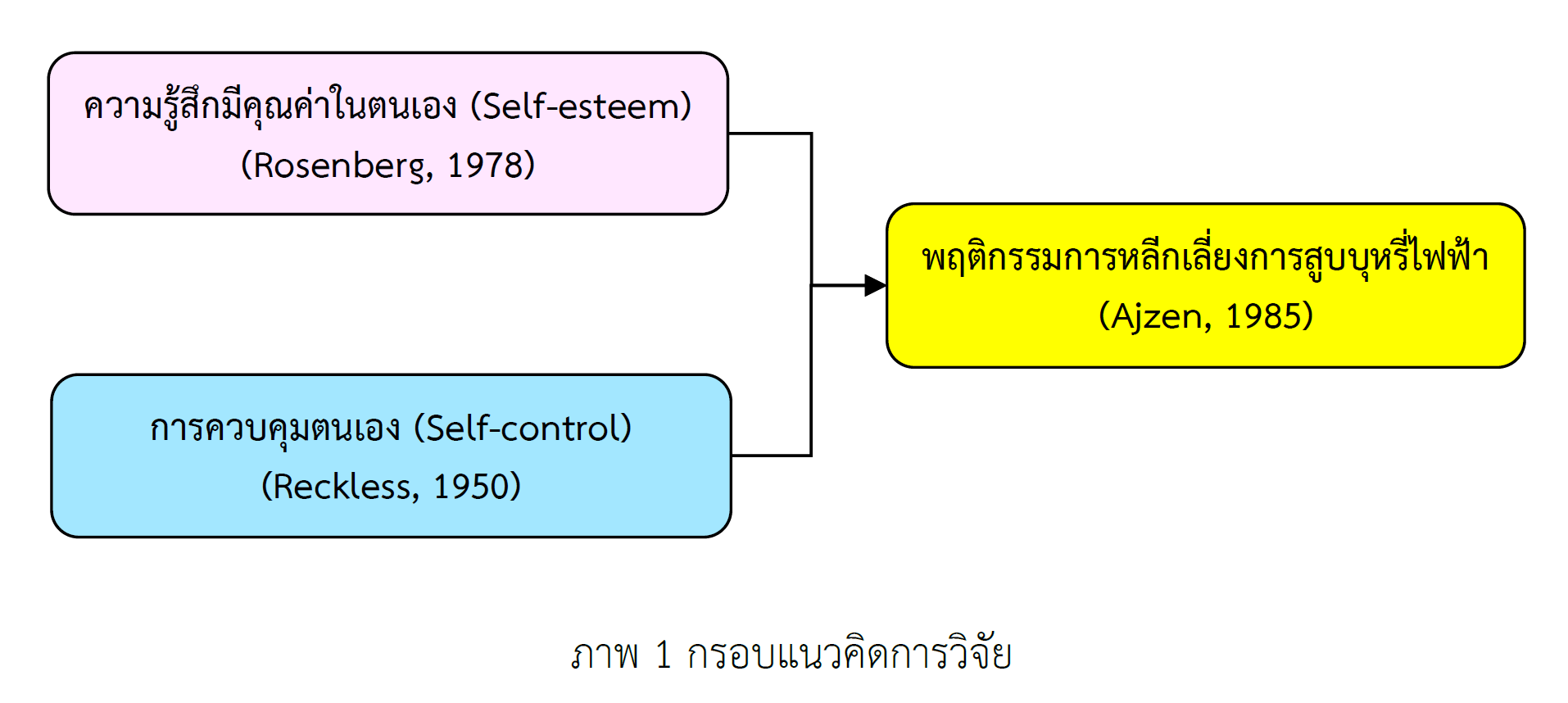
This predictive research aimed to examine the influence of self-esteem and self-control on electronic cigarette smoking avoidance behavior among lower secondary school students. The sample consisted of 443 lower secondary school students from four schools in Songkhla Municipality, selected using a multi-stage sampling method. The research instruments included a self-esteem scale, a self-control scale, and an electronic cigarette smoking avoidance behavior scale. The reliability of the instruments, as measured by Cronbach’s alpha coefficients, was .77, .87, and .98, respectively. Data were analyzed using descriptive statistics and stepwise multiple regression analysis.
The results revealed that students reported high levels of self-esteem (M = 3.26, SD = .40) and self-control (M = 3.37, SD = .39), while electronic cigarette smoking avoidance behavior was at the highest level (M = 3.56, SD = .44). Multiple regression analysis indicated that both self-esteem (Beta = .51) and self-control (Beta = .27) significantly influenced electronic cigarette smoking avoidance behavior at the .05 level. Together, these variables explained 52.0% of the variance in smoking avoidance behavior (R²Adjusted = .52, p = .001).
These findings suggest that self-esteem and self-control are important protective factors in preventing electronic cigarette use among lower secondary school students. The results can be applied to the planning and implementation of life skills enhancement activities that focus on strengthening students’ self-esteem and self-control. Furthermore, the findings provide fundamental evidence for the development of school guidance curricula and preventive measures aimed at reducing the initiation and continuation of electronic cigarette use among adolescents.
Downloads
References
Ajzen, I. (1985). From intentions to actions: A theory of planned behavior. In J. Kuhl & J. Beckmann (Eds.), Action control: From cognition to behavior. Heidelberg: Springer.
Chitradub, S. (2022). "E-cigarettes" are an unusual topic in Thai youth society. Retrieved from https://www.bangkokbiznews.com/lifestyle/judprakai/1036326
Cheng, H. G., Lizhnyak, P. N., & Richter, N. (2023). Mutual pathways between peer and own e-cigarette use among youth in the United States: A cross-lagged model. BMC Public Health, 23, 1609. https://doi.org/10.1186/s12889-023-16470-5
Coleman, M., Donaldson, C. D., Crano, W. D., Pike, J. R., & Stacy, A. W. (2020). Associations between family and peer e-cigarette use with adolescent tobacco and marijuana usage: A longitudinal path analytic approach. Nicotine & Tobacco Research, 23(5), 849–855. https://doi.org/10.1093/ntr/ntaa204
Gardner, L., Rowe, A.-L., Newton, N. C., & Egan, L. (2024). A systematic review and meta-analysis of school-based preventive interventions targeting e-cigarette use among adolescents. Prevention Science, 25(6). https://doi.org/10.1007/s11121-024-01730-6
Grebenau, R. (2020). The impact of self-esteem and peer pressure on adolescent e-cigarette use (Master's thesis). Utica College. Retrieved from https://digitalcommons.utica.edu/theses/123
Hair, F. J., Black, C. W., Babin, J. B., & Anderson, E. R. (2019). Multivariate data analysis (7th ed). Pearson Education.
Homayuni, A., & Hosseini, Z. (2023). The role of social support and self-control in tobacco consumption: A cross-sectional study among tobacco consumers and non-consumers. BMC Psychology, 11, 192. https://doi.org/10.1186/s40359-023-01226-y
Lechner, W. V., Janssen, T., Kahler, C. W., Audrain-McGovern, J., & Leventhal, A. M. (2017). Bi-directional associations of electronic and combustible cigarette use onset patterns with depressive symptoms in adolescents. Preventive Medicine, 96, 73–78. https://doi.org/10.1016/j.ypmed.2016.12.034
Li, C., Fu, P., Wang, M., Xia, Y., Hu, C., Liu, M., Zhang, H., Sheng, X., & Yang, Y. (2023). The role of self-esteem and emotion regulation in the associations between childhood trauma and mental health in adulthood: A moderated mediation model. BMC Psychiatry, 23, 241. https://doi.org/10.1186/s12888-023-04719-7
Lindsey, E. W. (2021). Emotion regulation with parents and friends and adolescent internalizing and externalizing behavior. Children, 8(4), 299. https://doi.org/10.3390/children8040299
Ling, M. Y., Abdul Halim, A. F. N., Ahmad, D., & Ahmad, N. (2023). Prevalence and associated factors of e-cigarette use among adolescents in Southeast Asia: A systematic review. International Journal of Environmental Research and Public Health, 20(5), 3883. https://doi.org/10.3390/ijerph20053883
National Statistical Office. (2024). Health behavior survey of the Thai population, 2021. Bangkok: National Statistical Office. Retrieved from http://www.nso.go.th
Onmoy, P., Buarueang, A., Paponngam, C., Janrun-grueang, T., Lao-noi, N., & Boonrawd, A. (2022). Factors associated with electronic cigarette smoking behaviors of adolescents in Uttaradit province, Thailand. Journal of Public Health, 31(Suppl2), S197–S205.
Orth, U., & Robins, R. W. (2022). The benefits of self-esteem: Reply to Krueger et al. (2022) and Brummelman (2022). American Psychologist, 77(1), 23–25. https://doi.org/10.1037/amp0000969
Patanavanich, R., Vityananan, P., Neelapaichit, N., Chariyalertsak, S., Kessomboon, P., Assanangkornchai, S., . . . Aekplakorn, W. (2022). Association between electronic cigarette use and depression among Thai adolescents: The Thailand National Health Examination Survey 2019–2020. Tobacco Induced Diseases, 20, 103. https://doi.org/10.18332/tid/155333
Reckless, W. C. (1950). The crime problem (3rd ed.). New York, NY: Appleton-Century-Crofts.
Rosenberg, M. (1978). The self-concept: Social product and social force. Malabar, FL: Krieger Publishing Company.
Sakboonyarat, B., Poovieng, J., Jongcherdchootrakul, K., Hempatawee, N., Hatthachote, P., & Rangsin, R. (2025). Emerging trends and determinants of electronic cigarette use among young Thai men, 2022–2024. BMC Public Health, 25(1), 1–12. https://doi.org/10.1186/s12889-025-24962-9
Scharf, M., Shulman, S., & Levi, I. (2024). Emotion regulation styles and adolescent adjustment following a COVID-19 lockdown. Stress and Health, 40(1), 44–53. https://doi.org/10.1002/smi.3274
Srimorakot, P. (1993). The effects of supportive counseling on pain perception, self-esteem, and morale in cervical cancer patients receiving radiation therapy (Doctoral dissertation). Mahidol University, Bangkok.
Srisa-ard, B. (2017). Introduction to research (10th ed.). Suviriyasan.
Sutherland, B. D., Sutherland, M. T., & Trucco, E. M. (2022). Electronic cigarette use intentions mediate the association between low self-control and future use by internalizing symptoms. Substance Use & Misuse, 57(12), 1797-1807. https://doi.org/10.1080/10826084.2022.2115848
Thai Health Promotion Foundation. (2023). Report on youth e-cigarette use trends in Thailand. Bangkok: Thai Health. Retrieved from https://www.thaihealth.or.th
Thai Health Promotion Foundation. (2025). Survey in four southern provinces finds most women and LGBTQIA+ use e-cigarettes, highlighting 306 million baht healthcare burden [Press release]. Retrieved from http://www.thpf.or.th/news/
Turri, A., Neumann, R., & Kiesel, A. (2024). Self-regulatory control processes in youths: A temporal network analysis approach. JCPP Advances, 4(2), e12200. https://doi.org/10.1002/jcv2.12200
Vazsonyi, A. T., & Jiskrova, G. K. (2018). On the development of self-control and deviance from preschool to middle adolescence. Journal of Criminal Justice, 56, 37–49. https://doi.org/10.1016/j.jcrimjus.2017.08.005
Wang, Y., Duan, Z., Weaver, S. R., Self-Brown, S. R., Ashley, D. L., Emery, S. L., & Huang, J. (2022). Association of e-cigarette advertising, parental influence, and peer influence with US adolescent e-cigarette use. JAMA Network Open, 5(9), e2233938. https://doi.org/10.1001/jamanetworkopen.2022.33938
Wills, T. A., Gibbons, F. X., Sargent, J. D., & Schweitzer, R. J. (2016). How is the effect of adolescent e-cigarette use on smoking onset mediated: A longitudinal analysis. Psychology of Addictive Behaviors, 30(8), 876–886. https://doi.org/10.1037/adb0000213
World Health Organization. (2024). Alcohol, e-cigarettes, cannabis: Concerning trends in adolescent substance use – WHO Europe report. Retrieved from https://www.who.int/europe/news-room/25-04-2024-alcohol--e-cigarettes--cannabis--concerning-trends-in-adolescent-substance-use--shows-new-who-europe-report
Yamane, T. (1973). Statistics: An introductory analysis (3rd ed.). New York, NY: Harper and Row.
Yang, F., & Jiang, Y. (2022). Adolescent self-control and individual physical and mental health in adulthood: A Chinese study. Frontiers in Psychology, 13, 850192. https://doi.org/10.3389/fpsyg.2022.850192
Zulkifli, Z., Dewi, N. S., & Andriany, M. (2024). The impact of loneliness on electronic cigarette use among adolescents: A scoping review. Indonesian Journal of Global Health Research, 6(S6), 989-1002. Retrieved from https://jurnal.globalhealthsciencegroup.com/index.php/IJGHR/article/view/4921
Downloads
Published
How to Cite
Issue
Section
License
Copyright (c) 2025 JOURNAL OF THE POLICE NURSES AND HEALTH SCIENCE

This work is licensed under a Creative Commons Attribution-NonCommercial-NoDerivatives 4.0 International License.
ผลงานที่ได้ตีพิมพ์แล้วจะเป็นลิขสิทธิ์ของวารสารพยาบาลตำรวจ