
THE DEVELOPMENT OF AN ENHANCED RECOVERY AFTER SURGERY PROGRAM FOR PATIENTS UNDERGOING HIP INTERNAL FIXATION AT DETUDOM CROWN PRINCE HOSPITAL
Keywords:
enhanced recovery after surgery (ERAS) program, hip internal fixation surgeryAbstract
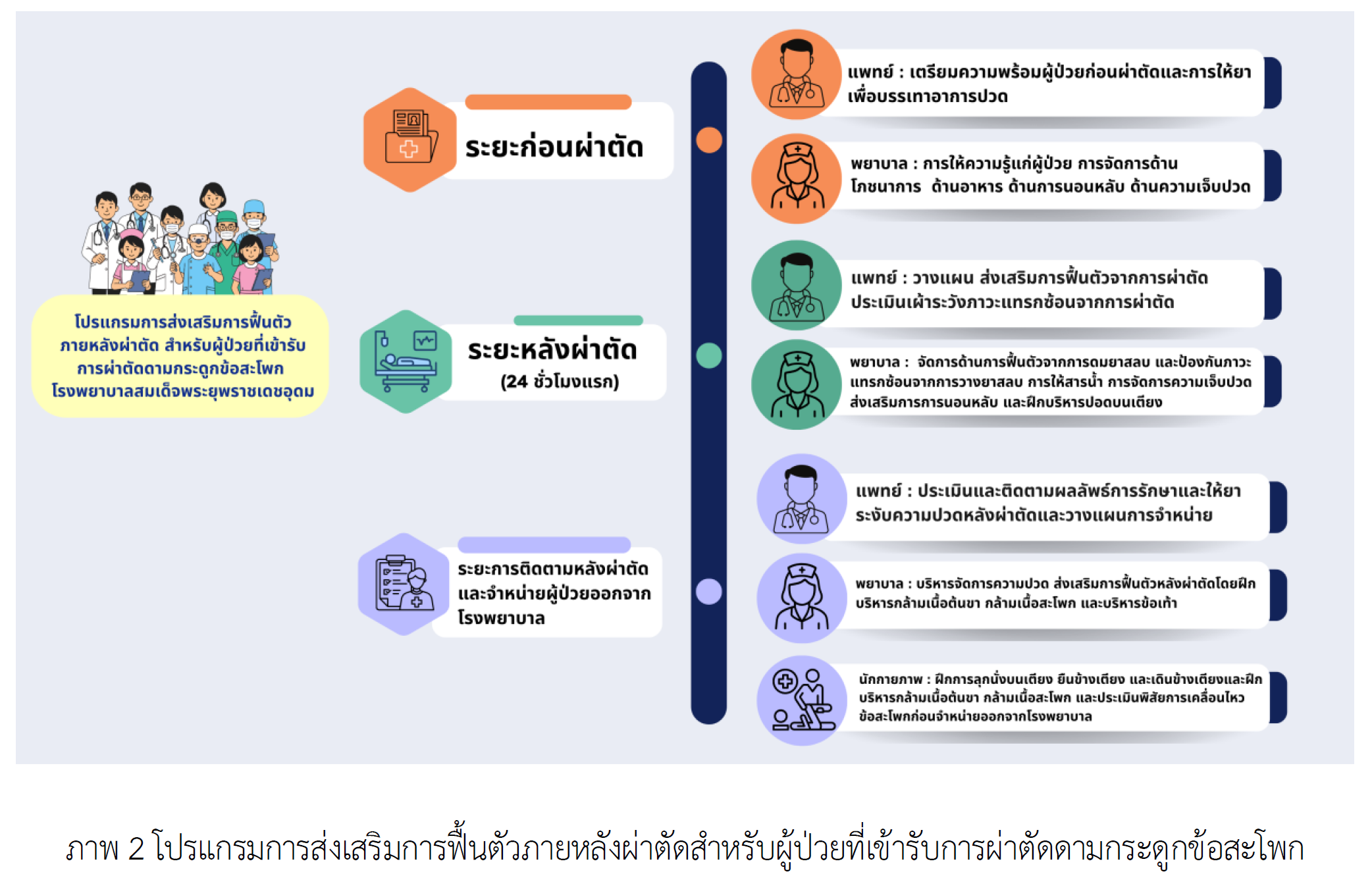
This research and development study aimed to develop an Enhanced Recovery After Surgery (ERAS) program for patients undergoing hip internal fixation and to compare clinical and hospital outcomes between the experimental and control groups. The sample consisted of 62 patients with hip fractures who underwent internal fixation surgery in the orthopedic ward of Detudom Crown Prince Hospital. Participants were purposively selected and divided into two groups: 31 patients in the experimental group who received the ERAS program and 31 patients in the control group who received standard nursing care. Research instruments included the ERAS program for hip internal fixation surgery, a personal and treatment information questionnaire, a pain assessment form, and a hip range of motion (ROM) recording sheet. Data were analyzed using descriptive statistics and the Mann-Whitney U test.
The findings were as follows: 1) The ERAS program for patients undergoing hip internal fixation surgery demonstrated strong content validity, with a content validity index (CVI) ranging from .90 to 1.00, indicating academic soundness and likely safety for implementation. 2) Regarding clinical outcomes, the median pain score at 72 hours postoperatively was significantly lower in the experimental group than in the control group (p < .05). Although pain scores at 24 and 48 postoperative hours differed between groups, the differences were not statistically significant. The experimental group also showed significantly greater hip ROM-flexion, extension, and abduction-compared to the control group (p < .05). 3) In terms of hospital outcomes, the median length of stay and hospitalization costs were significantly lower in the experimental group compared to the control group (p < .05).
Downloads
References
Althans, A. R., Holder-Murray, J., & Tessler, R. A. (2024). The Future of enhanced recovery after surgery-precision vs protocol. JAMA Network Open, 7(6), e2418968. https://doi.org/10.1001/jamanetworkopen.2024.18968
Altman, A. D., Helpman, L., McGee, J., Samouëlian, V., Auclair, M. H., Brar, H., . . . Society of Gynecologic Oncology of Canada’s Communities of Practice in ERAS and Venous Thromboembolism. (2019). Enhanced recovery after surgery: Implementing a new standard of surgical care. Canadian Medical Association Journal, 191(17), E469–E475. https://doi.org/10.1503/cmaj.180635
Cho, M. R., Lee, S., & Song, S. K. (2022). A Review of sarcopenia pathophysiology, diagnosis, treatment and future direction. Journal of Korean Medical Science, 37(18), e146. https://doi.org/10.3346/jkms.2022.37.e146
Chung, J. Y., Kim, S. G., Kim, S. H., & Park, C. H. (2025). Sarcopenia: How to determine and manage. Knee Surgery & Related Research, 37(1), 12. https://doi.org/10.1186/s43019-025-00265-6
Hanucharurnkul, S. (2016). Improvement Science. Thai Journal of Nursing and Midwifery Practice, 3(2), 5-14.
Healthcare Accreditation Institute (Public Organization). (2020). Guidelines for the management of hip fracture surgery in the elderly (Edition November 25, 2020) [Unpublished manuscript]. Healthcare Accreditation Institute (Public Organization).
Jindamart, T. (2024). Reduced length of hospitalization in primary total knee arthroplasty patients using enhanced recovery after surgery. Mahasarakham Hospital Journal, 21(1), 153-162.
Kang, Y., Liu, J., Chen, H., Ding, W., Chen, J., Zhao, B., & Yin, X. (2019). Enhanced recovery after surgery (ERAS) in elective intertrochanteric fracture patients result in reduced length of hospital stay (LOS) without compromising functional outcome. Journal of Orthopaedic Surgery and Research, 14(1), 209. https://doi.org/10.1186/s13018-019-1238-2
Li, L., Bennett-Brown, K., Morgan, C., & Dattani, R. (2020). Hip fractures. British Journal of Hospital Medicine (London, England : 2005), 81(8), 1–10. https://doi.org/10.12968/hmed.2020.0215
Liu, S. Y., Li, C., & Zhang, P. X. (2021). Enhanced recovery after surgery for hip fractures: A systematic review and meta-analysis. Perioperative Medicine, 10(1), 31. https://doi.org/10.1186/s13741-021-00201-8
Morrell, A. T., Kates, S. L., Lahaye, L. A., Layon, D. R., Patel, N. K., Scott, M. J., & Golladay, G. J. (2021). Enhanced recovery after surgery: An orthopedic perspective. Arthroplasty Today, 9, 98–100. https://doi.org/10.1016/j.artd.2021.04.019
Pundee, J., Kliangda, C., & Wannatoop, T. (2022). Range of joint motion in patients with extremity injuries: Assessment and nursing practice. Journal of Thailand Nursing and Midwifery Council, 37(1), 30-41.
Rittharomya, J., Krua-aum, P., & Aree-Ue, S. (2025). Effectiveness of a rehabilitation self-efficacy program on postoperative outcomes in older adults with hip fracture: A randomized controlled trial. Pacific Rim International Journal of Nursing Research, 29(1), 91–107.
Rollins, K. E., Lobo, D. N., & Joshi, G. P. (2021). Enhanced recovery after surgery: Current status and future progress. Best Practice & Research: Clinical Anaesthesiology, 35(4), 479–489. https://doi.org/10.1016/j.bpa.2020.10.001
Sauro, K. M., Smith, C., Ibadin, S., Thomas, A., Ganshorn, H., Bakunda, L., . . . Nelson, G. (2024). Enhanced recovery after surgery guidelines and hospital length of stay, readmission, complications, and mortality: A meta-analysis of randomized clinical trials. JAMA Network Open, 7(6), e2417310. https://doi.org/10.1001/jamanetworkopen.2024.17310
Songpatanasilp, T., Sritara, C., Kittisomprayoonkul, W., Chaiumnuay, S., Nimitphong, H., Charatcharoenwitthaya, N., . . . Taechakraichana, N. (2016). Thai Osteoporosis Foundation (TOPF) position statements on management of osteoporosis. Osteoporosis and Sarcopenia, 2(4), 191-207. https://doi.org/10.1016/j.afos.2016.10.002
Tajai, P., Hengnalen, B., & Sanguanpanich, Y. (2020). Hip fracture in older people: Roles of nurses in preventing complications before and after hip surgery. Christian University Journal, 26(4), 116-128.
Unnanuntana, A., Anusitviwat, C., Lertsiripatarajit, V., Riawraengsattha, P., & Raksakietisak, M. (2024). Early hip fracture surgery within 24 hours did not reduce the mortality rate but resulted in less postoperative opioid use and a shorter length of stay: A retrospective study of 276 patients from a tertiary private hospital in Thailand. Geriatric Orthopaedic Surgery & Rehabilitation, 15, 21514593241250150. https://doi.org/10.1177/21514593241250150
Wongtriratanachai, P., Luevitoonvechkij, S., Songpatanasilp, T., Sribunditkul, S., Leerapun, T., Phadungkiat, S., & Rojanasthien, S. (2013). Increasing incidence of hip fracture in Chiang Mai, Thailand. Journal of Clinical Densitometry, 16(3), 347-352. https://doi.org/10.1016/j.jocd.2012.07.002
World Organization World. (2024). Fragility fractures. Received from https://www.who.int/news-room/fact-sheets/detail/fragility-fractures
Yin, M., Yan, Y., Fan, Z., Fang, N., Wan, H., Mo, W., & Wu, X. (2020). The efficacy of Enhanced Recovery after Surgery (ERAS) for elderly patients with intertrochanteric fractures who received surgery: study protocol for a randomized, blinded, controlled trial. Journal of Orthopaedic Surgery and Research, 15(1), 91. https://doi.org/10.1186/s13018-020-01586-w
Zhu, W., Yan, Y., Sun, Y., Fan, Z., Fang, N., Zhang, Y., . . . Wu, X. (2021). Implementation of Enhanced Recovery After Surgery (ERAS) protocol for elderly patients receiving surgery for intertrochanteric fracture: A propensity score-matched analysis. Journal of Orthopaedic Surgery and Research, 16(1), 469. https://doi.org/10.1186/s13018-021-02599-9
Downloads
Published
How to Cite
Issue
Section
License
Copyright (c) 2025 JOURNAL OF THE POLICE NURSES AND HEALTH SCIENCE

This work is licensed under a Creative Commons Attribution-NonCommercial-NoDerivatives 4.0 International License.
ผลงานที่ได้ตีพิมพ์แล้วจะเป็นลิขสิทธิ์ของวารสารพยาบาลตำรวจ