EFFECTS OF SELF-ESTEEM IMPROVEMENT PROGRAM ON DEPRESSION OF THE ELDERLY WITH CHRONIC DISEASES IN COMMUNITY
Keywords:
depression, self-esteem, elderly individuals, chronic diseasesAbstract
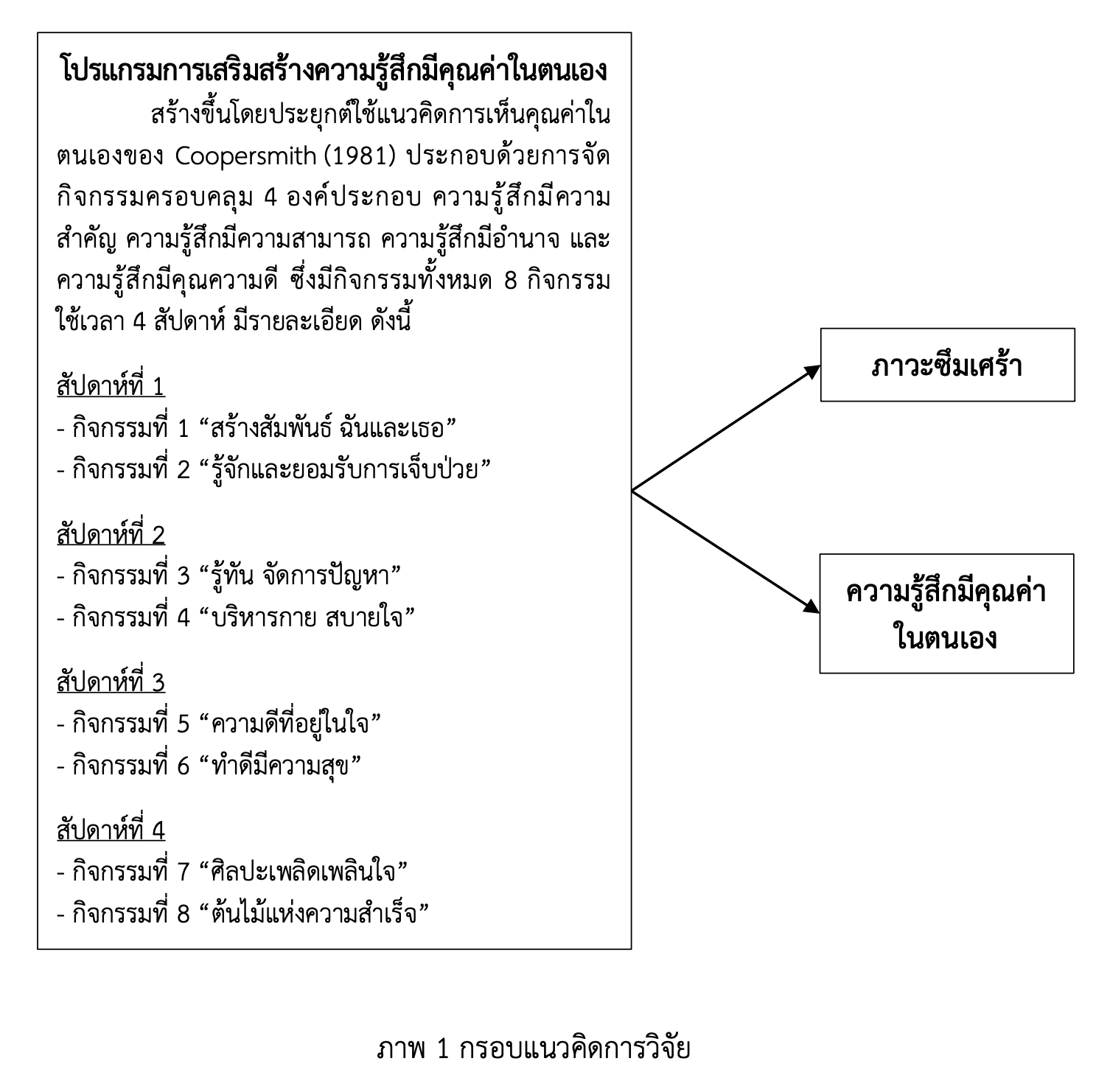
This study employed a quasi-experimental research, two group pretest–posttest with follow-up design. The objectives were to compare the mean self-esteem and depression scores before the intervention, immediately after the intervention, and at a 2-week follow-up, among community-dwelling older adults with chronic diseases. Participants were divided into two groups: one received a self-esteem improvement program in addition to routine care, while the other received routine nursing care only. The sample consisted of elderly individuals aged 60 - 69 years in Nakhon Nayok Province, who had been diagnosed with hypertension and/or diabetes mellitus and exhibited mild to moderate depression. Participants were recruited by simple random sampling into 27 participants per group. The research instrument was the self-esteem improvement program, conducted over a six-week period. Data collection tools included: 1) The Thai Geriatric Depression Scale, with a content validity index (CVI) of .83 and a Kuder-Richardson 20 (KR20) reliability coefficient of .83, and 2) The Self-Esteem Scale, with a CVI of .84 and a KR21 of .77. Data were analyzed using the descriptive statistics, t-test, and repeated measures ANOVA. The level of statistical significance was set at .05.
The results showed that the experimental group had significantly higher mean self-esteem scores across all three time points (pretest, posttest, and follow-up) (p < .05), and significantly higher scores than the comparison group (p < .05). Additionally, their mean depression scores decreased significantly across the same time points (p < .05), and were also significantly lower than those of the comparison group (p < .05).
In conclusion, the self-esteem improvement program can be employed as a mental health promotion strategy for community-dwelling older adults among chronic diseases and depression.
Downloads
References
Aiamanan, M. (2019). Depression in older adults with diabetes mellitus. Thai Journal of Nursing, 68(1), 58-65.
Ali, S. A., Suhail, N., & Ali, S A. (2016). Low self-esteem leads to depression among elderly: Case study of nursing home. Journal of Universal Surgery, 4(2), 145-155.
Bobo, W. V., Grossardt, B. R., Virani, S., St Sauver, J. L., Boyd, C. M., & Rocca, W. A. (2022). Association of depression and anxiety with the accumulation of chronic conditions. JAMA Network Open, 5(5), e229817. https://doi.org/10.1001/jamanetworkopen.2022.9817
Bunloet, A. (2016). Prevalence and factors associated with depression among the elderly community residents with chronic diseases in Samliam Urban Primary Care Unit, Khon Kaen. Srinagarind Medical Journal, 31(1), 25-33.
Coopersmith, S. (1981). The antecedent of self-esteem (2nd ed.). Californai: Consulting Psychologist Press.
Coopersmith, S. (1984). SEI: Self-esteem inventories. Pato Alto, CA: Consulting Psychologist Press.
Department of Health, Ministry of Public Health. (2021). Mini-Cog (S.Borson). Retrieved from https://hpc4.anamai.moph.go.th/th/general-downloads/download?id=86299&mid=22147&mkey=m_document&lang=th&did=30352
Department of Health, Ministry of Public Health. (2022). Department of Health reveals that the elderly are the second most ill with diabetes after high blood pressure. Recommend food-water sugar-exercise. Retrieved from https://multimedia.anamai.moph.go.th/news/141165/
Department of Mental Health, Ministry of Public Health. (2020). Thailand’s steps toward becoming a complete aging society. Retrieved from https://dmh.go.th/news-dmh/view.asp?id=30476
Department of Mental Health, Ministry of Public Health. (2015). Depression assessment (9Q). Retrieved from https://dmh.go.th/test/download/files/2Q%209Q%208Q%20(1).pdf
Kongsri, S. (2004). A relationship between sexual communication and self-esteem on sexual satisfaction in early adult married women (Thesis Master of Science in Human Sexuality (Inter-Department). Graduate School, Chulalongkorn University, Pathumwan. https://doi.org/10.58837/CHULA.THE.2004.1927
Krajangpho, S., Patphol, M., Wongyai, W., & Dudsdeemaytha, J. (2018). Development of the self-esteem enhancement model for older adults with activity-based learning. Royal Thai Navy Medical Journal, 45(2), 349-376.
Li, H., Ge, S., Greene, B., & Dunbar-Jacob, J. (2019). Depression in the context of chronic diseases in the United States and China. International Journal of Nursing Sciences, 6(1), 117–122. https://doi.org/10.1016/j.ijnss.2018.11.007
Nakhon Nayok Provincial Public Health Office. (2023). HDC database. Nakhon Nayok Province. Retrieved from https://nyk.hdc.moph.go.th/hdc/main/index.php
Namwong, A., Laongon, K., Chaijundee, W., & Khampeera, A. (2018). Selected factors related to depressive symptoms among community-dwelling older people with chronic illness. Nursing Public Health and Education Journal, 19(2), 94-105.
Nasif, J. (2015). The emotional impact of chronic illness. Journal of Psychology and Clinical Psychiatry, 3(6), 00177. https://doi.org/10.15406/jpcpy.2015.03.00177
Nualsithonga, N., Phuchongchai, T., Buajan, A., & Phattharasirisomboon, P. (2021). Stress and depression of the elderly with chronic diseases in Na Siew Sub-district, Muang Chaiyaphum District, Chaiyaphum Province. The Public Health Journal of Burapha University, 16(2), 78-89.
Nuchusuk, C., Thapinta, D., & Skulphan, S. (2017). Effect of group problem-solving therapy on depression among older persons with chronic diseases. Journal of Boromarajonani College of Nursing, Bangkok, 33(3), 124-137.
Office of Health Promotion for Specific Population Groups (Office 9). (2025). Complete aging: Summary of the elderly situation in 2024 and how to move forward when ‘children’ are the main income for retired parents. Retrieved from https://section09.thaihealth.or.th/?p=167164
Pumprawai, A., Janejatkarn, B., Kanokwongnuwat, P., Hemchayat, U., & Janchai, N. (2019). Effectiveness of self- esteem promoting program on depression of elder people in Borploy Sub-district, Samkok District, Pathumthani Province. The Journal of Faculty of Nursing Burapha University, 27(1), 33-41.
Sangphrachan, S., Chaisena, D. J., Hengudomsub, P., Pratoomsri, W. (2016). The meaning of self-esteem as perceived by older adults with depression. Nursing Journal of the Ministry of Public Health, 26(2), 76-88.
Sangthong, J. (2017). Aging society (complete aged): The elderly condition of good quality. Rusailae Journal, 38(1), 6-28.
Urairat, M., & Dhammasaccakarn, W. (2024). Effects of the self-esteem program among the elderly in khlong Hae municipality community, Hat Yai District, Songkhla Province. The 13th Hatyai National and International Conference.
Wareewanich, S., & Phatisena, T. (2020). Effect of empowerment and self-esteem promoting program among the elderly with depression in home for the aged. Journal of Nursing and Health Care, 38(2), 111–118.
Wiriya, P., & Nawsuwan, K. (2017). Prevalence of depression in diabetic and hypertension patients in Khlong Hoi Khong District, Songkhla. The Southern College Network Journal of Nursing and Public Health, 4(Supp), 1-18.
Zhou, P., Wang, S., Yan, Y., Lu, Q., Pei, J., Guo, W., Yang, X., & Li, Y. (2023). Association between chronic diseases and depression in the middle-aged and older adult Chinese population-a seven year follow-up study based on CHARLS. Frontiers in Public Health, 11, 1176669. https://doi.org/10.3389/fpubh.2023.1176669
Downloads
Published
How to Cite
Issue
Section
License
Copyright (c) 2025 JOURNAL OF THE POLICE NURSES AND HEALTH SCIENCE

This work is licensed under a Creative Commons Attribution-NonCommercial-NoDerivatives 4.0 International License.
ผลงานที่ได้ตีพิมพ์แล้วจะเป็นลิขสิทธิ์ของวารสารพยาบาลตำรวจ