การศึกษาสมรรถนะพยาบาลหออภิบาลผู้ป่วยหนักรวม ตามบันไดวิชาชีพ โรงพยาบาลระดับทุติยภูมิ M2
คำสำคัญ:
หออภิบาลผู้ป่วยหนักรวม, สมรรถนะพยาบาล, บันไดวิชาชีพ, โรงพยาบาลระดับทุติยภูมิ M2บทคัดย่อ
การวิจัยเชิงพรรณนานี้มีวัตถุประสงค์เพื่อศึกษาสมรรถนะพยาบาลหออภิบาลผู้ป่วยหนักรวมตามบันไดวิชาชีพในโรงพยาบาลระดับทุติยภูมิ M2 โดยใช้เทคนิคการวิจัยแบบเดลฟาย ผู้ให้ข้อมูล คือ ผู้เชี่ยวชาญ จำนวน 23 คน แบ่งเป็น 6 กลุ่ม ได้แก่ กลุ่มแพทย์ผู้เชี่ยวชาญการดูแลผู้ป่วยวิกฤต จำนวน 3 คน กลุ่มผู้เชี่ยวชาญการบริหารหออภิบาลผู้ป่วยหนักรวม จำนวน 3 คน กลุ่มผู้เชี่ยวชาญการบริหารองค์การพยาบาล จำนวน 3 คน กลุ่มผู้เชี่ยวชาญวิชาการ จำนวน 3 คน กลุ่มผู้เชี่ยวชาญการพยาบาลเฉพาะทางผู้ป่วยวิกฤต จำนวน 7 คน และกลุ่มผู้เชี่ยวชาญการปฏิบัติการพยาบาลขั้นสูง จำนวน 4 คน วิธีดำเนินการวิจัย ประกอบด้วยการเก็บข้อมูล 3 รอบ ได้แก่ รอบที่ 1 สัมภาษณ์เกี่ยวกับสมรรถนะพยาบาลตามบันไดวิชาชีพ ประกอบด้วย พยาบาลระดับปฏิบัติการ ชำนาญการ และชำนาญการพิเศษ รอบที่ 2 นำข้อมูลที่ได้สัมภาษณ์มาวิเคราะห์เนื้อหาและสร้างแบบสอบถามเพื่อให้ผู้เชี่ยวชาญประเมินระดับความสำคัญของสมรรถนะพยาบาลหออภิบาลผู้ป่วยหนักรวมแต่ละรายด้าน นำข้อมูลที่ได้มาคำนวณค่ามัธยฐาน ค่าพิสัยระหว่างควอไทล์ และรอบที่ 3 จัดทำแบบสอบถามให้ผู้เชี่ยวชาญยืนยันความคิดเห็น นำข้อมูลมาคำนวณค่ามัธยฐานและค่าพิสัยระหว่างควอไทล์เพื่อสรุปผลการวิจัย
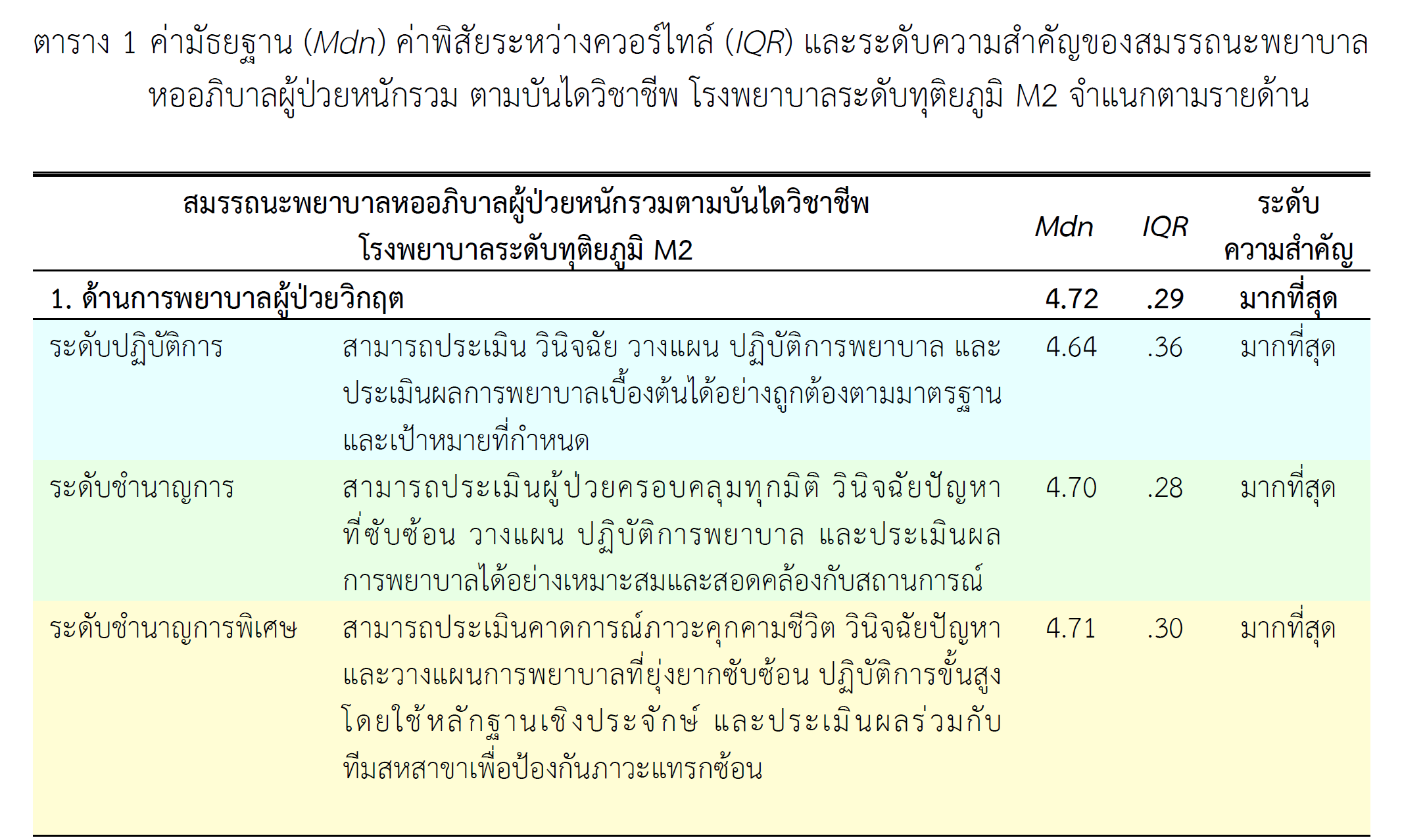
ผลการศึกษาพบว่า สมรรถนะพยาบาลหออภิบาลผู้ป่วยหนักรวม โรงพยาบาลระดับทุติยภูมิ M2 ประกอบด้วย 7 ด้าน ได้แก่ 1) การพยาบาลผู้ป่วยวิกฤต 2) การบริหารยาความเสี่ยงสูง 3) การสื่อสารและประสานงานเพื่อการรักษาพยาบาล 4) การป้องกันและจัดการภาวะแทรกซ้อน 5) การดูแลผู้ป่วยวิกฤตระยะสุดท้าย 6) การใช้อุปกรณ์ทางการแพทย์และเทคโนโลยีสารสนเทศ และ 7) การจัดการและควบคุมคุณภาพการดูแล พยาบาลในหออภิบาลผู้ป่วยหนักรวมทุกระดับมีสมรรถนะทั้ง 7 ด้านเหมือนกัน แต่แตกต่างกันในสมรรถนะย่อย ดังนี้ 1) พยาบาลระดับปฏิบัติการเน้นการพยาบาลพื้นฐานภายใต้การดูแลของพยาบาลพี่เลี้ยงหรือพยาบาลที่มีประสบการณ์มากกว่า 2) พยาบาลระดับชำนาญการสามารถใช้ความรู้เชิงลึกดูแลผู้ป่วยซับซ้อน และทำงานร่วมกับทีมสหสาขาวิชาชีพได้อย่างมีประสิทธิภาพ และ 3) พยาบาลระดับชำนาญการพิเศษ สามารถดูแลผู้ป่วยที่มีภาวะยุ่งยากซับซ้อน แก้ปัญหาเฉพาะหน้า และพัฒนาการพยาบาลจากหลักฐานเชิงประจักษ์ได้
ผลการศึกษานี้สามารถนำไปใช้เป็นกรอบแนวคิดในการพัฒนาแบบประเมินสมรรถนะในการปฏิบัติงานจำแนกตามระดับบันไดอาชีพ และผู้บริหารทางการพยาบาลสามารถนำไปใช้เป็นเกณฑ์ในการวางแผนกำลังคนและมอบหมายงานให้สอดคล้องกับความสามารถของพยาบาลแต่ละระดับได้อย่างเหมาะสม
Downloads
เอกสารอ้างอิง
Abdekhoda, M., & Khezri, H. (2021). Investigating the impact of health informatics literacy on the evidence-based practice of nursing. Online Journal of Nursing Informatics (OJNI), 25(2). Retrieved from https://www.himss.org/resources/investigating-impact-health-informatics-literacy-evidence-based-practice-nursing/
Adams, A., Mannix, T., & Harrington, A. (2017). Nurses' communication with families in the intensive care unit a literature review. Nursing in Critical Care, 22(2), 70–80. https://doi.org/10.1111/nicc.12141
Benner, P. (1984). From novice to expert: Excellence and power in clinical nursing practice. Menlo Park, CA: Addison-Wesley.
Benner, P., Tanner, C., & Chesla, C. (1992). From beginner to expert: Gaining a differentiated clinical world in critical care nursing. Advances in Nursing Science, 14(3), 13–28.
Chapuis, C., Chanoine, S., Colombet, L., Calvino-Gunther, S., Tournegros, C., Terzi, N., . . . Schwebel, C. (2019). Interprofessional safety reporting and review of adverse events and medication errors in critical care. Therapeutics and Clinical Risk Management, 15, 549–556. https://doi.org/10.2147/TCRM.S188185
Chularee, S., Chiaranai, C., Phetrot, S., & Chatphimai, D. (2023). Caring for critically ill patients with hospital-acquired pressure injuries: The role of critical care nurses. Journal of Health and Nursing Education, 29(1), 1–15.
Choodum, N., Lohitthai, S., & Chomket, N. C. (2023). Competencies of professional nurses in the hospital. Journal of The Royal Thai Army Nurses, 24(2), 31–38.
Coombs, M. A., Parker, R., Ranse, K., Endacott, R., & Bloomer, M. J. (2017). An integrative review of how families are prepared for, and supported during withdrawal of life-sustaining treatment in intensive care. Journal of Advanced Nursing, 73(1), 39–55. https://doi.org/10.1111/jan.13097
Department of Public Health Administration, Ministry of Public Health. (2022). Guidelines for the establishment and capacity level adjustment of health service units, fiscal year 2022. Nonthaburi, Thailand: Ministry of Public Health.
Duangnokhon, M. (2016). Development of a competency framework for registered nurses in a surgical intensive care unit, Chiang Rai Prachanukroh Hospital (Master’s thesis). Faculty of Nursing, Chiang Mai University, Chiang Mai.
Endacott, R., Scholes, J., Jones, C., Boulanger, C., Egerod, I., Blot, S., . . . Latour, J. M. (2022). Development of competencies for advanced nursing practice in intensive care units across Europe: A modified e-Delphi study. Intensive and Critical Care Nursing, 71, 103239. https://doi.org/10.1016/j.iccn.2022.103239
Jackson, J., & Cairns, T. (2020). Care of the critically ill patient. Surgery, 39(1), 29–36. https://doi.org/10.1016/j.mpsur.2020.11.002
Khalaila, R., Zbidat, W., Anwar, K., Bayya, A., Linton, D. M., & Sviri, S. (2011). Communication difficulties and psychoemotional distress in patients receiving mechanical ventilation. American Journal of Critical Care, 20(6), 470-479. https://doi.org/10.4037/ajcc2011989
Macmillan, T. T. (1971). The Delphi technique. California, CA: Monterey.
Nadkarni, G. N., & Sakhuja, A. (2023). Clinical informatics in critical care medicine. Yale Journal of Biology and Medicine, 96(3), 397–405. https://doi.org/10.59249/WTTU3055
Nursing Division, Ministry of Public Health. (2008). Nursing standards in hospitals (3rd ed.). Bangkok: WVO Office of Printing Mill.
Nursing Division, Ministry of Public Health. (2017). Guidelines for succession planning in professional nursing positions according to good governance principles. Retrieved from http://www.nursing.go.th/Book_nurse/002/001.pdf
Obi, A. T., Barnes, G. D., Wakefield, T. W., Brown, S., Eliason, J. L., Arndt, E., & Henke, P. K. (2020). Practical diagnosis and treatment of suspected venous thromboembolism during COVID-19 pandemic. Journal of Vascular Surgery: Venous and Lymphatic Disorders, 8(4), 526–534. https://doi.org/10.1016/j.jvsv.2020.04.009
Osman, M., Ibrahim, M., & Diab, G. (2019). Relationship between nurses’ competencies and quality of patient care at intensive care units. Menoufia Nursing Journal, 4(2), 1–14. https://doi.org/10.21608/menj.2019.118373
Petchmadan, N. (2020). Factor analysis of medical critical care nursing competencies in tertiary hospitals, Northeastern Thailand (Master’s thesis). Faculty of Nursing, Khon Kaen University, Khon Kaen.
Sakuramoto, H., Kuribara, T., Ouchi, A., Haruna, J., & Unoki, T. (2023). Clinical practice competencies for standard critical care nursing: Consensus statement based on a systematic review and Delphi survey. BMJ Open, 13(1), e068734. https://doi.org/10.1136/bmjopen-2022-068734
Sawangdee, K. (2017). Crisis of nursing shortage in health service in health service facilities under Office of Permanent Secretary, Ministry of Public Health. Journal of Health Science, 26(2), 456-468.
Subbaiah, M. V., Babu, K. L. P., Manohar, D., Sumalatha, A., Mohammed, P., & Mahitha, B. (2021). Drug utilization evaluation of high alert medications in intensive care units of a tertiary care teaching hospital. Journal of Drug Delivery and Therapeutics, 11(1), 94–101. Retrieved from https://jddtonline.info/index.php/jddt/article/view/4749
Thailand Nursing and Midwifery Council. (2009). Manual for developing specialized nursing curricula. Bangkok: Nursing Council.
Vincent, J. L. (2024). Decision-making in the ICU. ICU Management & Practice, 24(2), 57. https://healthmanagement.org/c/icu/issue/volume-24-issue-2-2024
Wongwanich, S. (2019). Needs assessment research (4th ed.). Bangkok: Chulalongkorn University Press.
ดาวน์โหลด
เผยแพร่แล้ว
รูปแบบการอ้างอิง
ฉบับ
ประเภทบทความ
สัญญาอนุญาต
ลิขสิทธิ์ (c) 2025 วารสารพยาบาลตำรวจและวิทยาศาสตร์สุขภาพ

อนุญาตภายใต้เงื่อนไข Creative Commons Attribution-NonCommercial-NoDerivatives 4.0 International License.
ผลงานที่ได้ตีพิมพ์แล้วจะเป็นลิขสิทธิ์ของวารสารพยาบาลตำรวจ