THE EFFECTS OF LEARNING MANAGEMENT THROUGH MASSIVE OPEN ONLINE COURSES (MOOCs) ON ACADEMIC ACHIEVEMENT IN MATERNAL, NEWBORN, AND MIDWIFERY NURSING AMONG NURSING STUDENTS
Keywords:
Massive Open Online Courses (MOOCs), academic achievement, nursing studentsAbstract
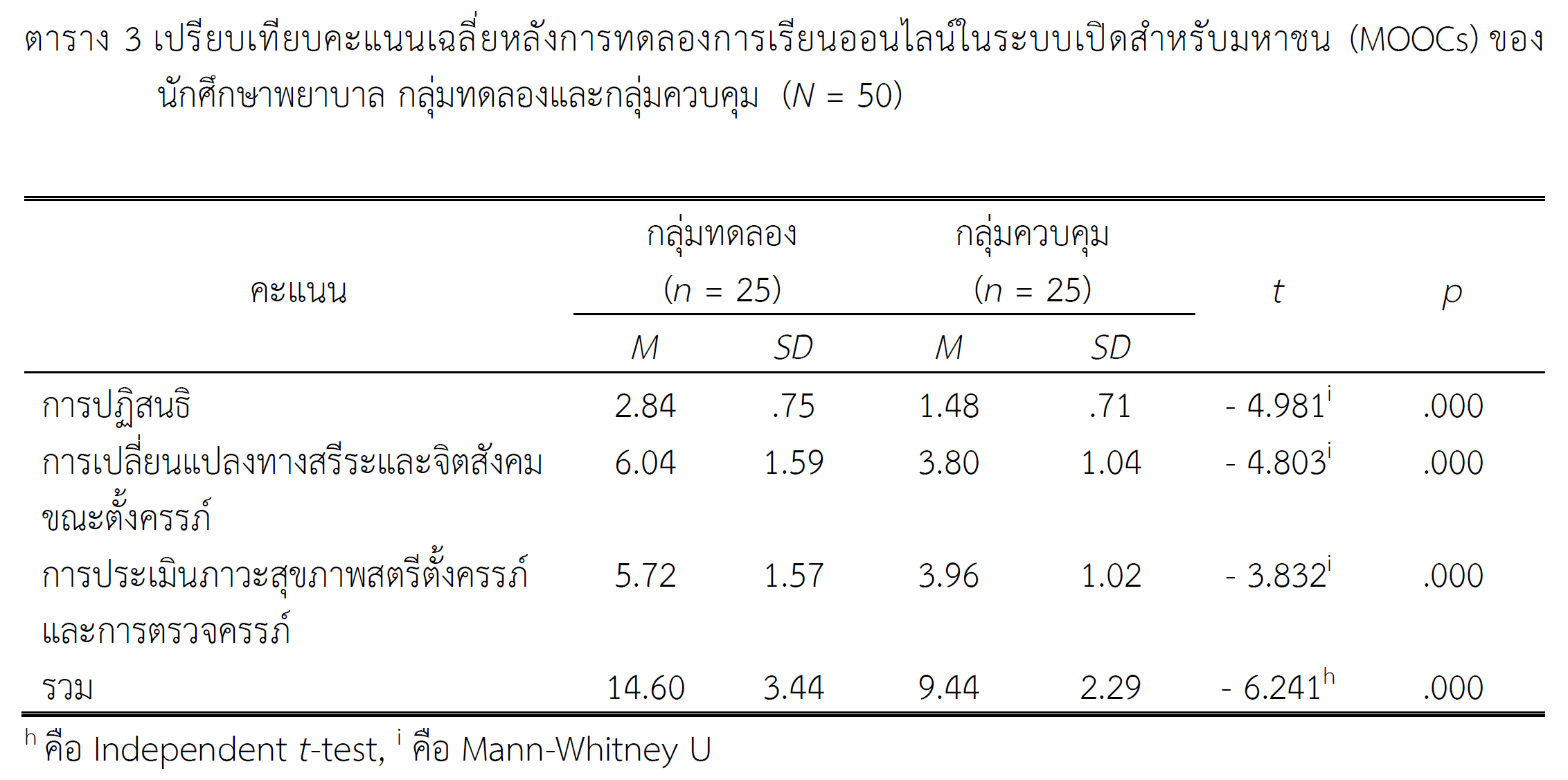
This study was a quasi-experimental research using a two-group pretest-posttest design. The objectives were: 1) to compare students’ average score before and after studying through a Massive Open Online Course (MOOCs), and 2) to compare post-intervention average score between students learning through MOOCs and those receiving traditional classroom instruction. The sample consisted of 50 second-year nursing students, selected through purposive sampling based on specific inclusion criteria. They were divided into an experimental group and a control group, with 25 students in each group. The experimental group received learning management through MOOCs, while the control group participated in traditional classroom learning. The research instruments included: 1) a learning management program using MOOCs, and 2) a knowledge test with an index of item-objective congruence (IOC) of .75 - 1.00. The reliability coefficient for the entire test, analyzed using KR-20, was .80. Data were analyzed using paired samples t-test and independent samples t-test.
The results showed that both the experimental group and the control group had moderate post-test scores (M = 14.60, SD = 3.44 and M = 9.44, SD = 2.29, respectively). The experimental group showed a statistically significant increase in mean score from pre-test to post-test at the .05 level (t = -10.853, p = .000), and the control group also showed a statistically significant improvement at the .05 level (t = -6.225, p = .000). Moreover, the post-test mean score of the experimental group was significantly higher than that of the control group at the .05 level (t = 6.241, p = .000).
In conclusion, learning through MOOCs in maternal, newborn and midwifery nursing led to higher academic achievement in post-intervention than traditional classroom learning. Therefore, the use of MOOCs should be promoted and expanded to other subjects to improve the academic performance of nursing students.
Downloads
References
American Association of Colleges of Nursing. (2021). The essentials: Core competencies for professional nursing education. Retrieved from https://www.aacnnursing.org/Portals/0/PDFs/Publications/Essentials-2021.pdf
ASEAN University Network (AUN). (2020). Guide to AUN-QA assessment at programme level version 4.0. Retrieved from https://www.aunsec.org/application/files/2816/7290/3752/Guide_to_AUN-QA_Assessment_at_Programme_Level_Version_4.0_4.pdf
Leaudnakrob, N., Muangkaew, P., Yottavee, W., Thepthongkam, D., Khrutmuang, W., Muenya, S., & Nualthong, W. (2019). Using massive open online courses (MOOCs) to develop dialogue reflective thinking and deep listening process among nursing students. Boromarajonani College of Nursing, Uttaradit Journal, 11(2), 201-212.
Ministry of Higher Education, Science, Research and Innovation. (2021). Thai MOOCs development progress report. Bangkok: Ministry of Higher Education, Science, Research and Innovation.
National Science and Technology Development Agency. (2022). Thai MOOC: Online learning platform of Thailand. Retrieved from https://thaimooc.org
Pakdeeteva, S. (2021). Development of an online instructional modeltogether with probiem based learning based on MOOC instructional standards and practice to enhance problem solving thinking skill for Sukhothai Thammathirat Open University Students. Education and Communication Technology Journal, 16(20), 92-109.
Poonyatavon, K., Kaosaiyaporn, O., & Kritpracha, C. (2024). Development of a massive open online course (MOOC) by integrating podcasts based on the self-directed learning concept on nursing care for patients with pacemakers to promote nursing students’ learning achievement. Journal of Information and Learning, 35(1), 99-113.
Pungchompoo, W., Suwankruhasn, N., & Saengrut, B. (2017). Developing of innovation in nursing education: A massive open online course (MOOC) in gerontological nursing. Nursing Journal, 44(2), 103-110.
Saiboonsri, U., Kesonsuwan, C., Nantasanee, S., & Deeprasert, A. (2023). The effectiveness of game-based learning for enhancing academic achievement in mental health promotion and psychiatric nursing studies among the third-year nursing students at Faculty of Nursing, Suan Dusit University. Suan Dusit Graduate School Academic Journal, 19(1), 129-145.
Satitpong, P. (2021). MOOC model: Innovative approach of teaching in Thailand 4.0. Academic Journal of Thailand National Sports University, 13(1), 233-246.
Sen-Ngam, K., Limtasopon, D., & leuangkittikong, T. (2021). Academic achievement and students’ satisfaction towards the use of video “medication administration for children” to supplement teaching in nursing laboratory, Ransit University. Journal of Rangsit University: Teaching & Learning, 15(1), 30-48.
Subcommittee on the Development and Enhancement of Education Quality for Excellence, Higher Education Quality Development Division, Office of the Permanent Secretary, Ministry of Higher Education, Science, Research and Innovation. (2024). Education quality standards for excellence implementation 2024-2027. Nonthaburi: Parbpim. Retrieved from http://www.edpex.org
Sullivan, G. M. (2011). A primer on the validity of assessment tools. Journal of Graduate Medical Education, 3(2), 119–120. https://doi.org/10.4300/JGME-D-11-00075.1
The International Confederation of Midwives. (2024). ICM essential competencies for midwifery practice. Hague: International Confederation of Midwives.
Wongtim, S. (2023). The development of massive open online course (MOOC) innovation on “Mental health enhancement of the elder with integrative techniques for elderly caregivers”. Journal of the Royal Thai Army Nurses, 24(3), 223-231.
Wudhiwong, K., Hemavibool, D., & Manmalai, S. (2018). Learning achievements among nursing students through active learning. Journal of Nurses Association of Thailand Northern Office, 24(2), 12-24.
Zhu, M. (2024). Designing and delivering MOOCs to motivate participants for self-directed learning. Open Learning, 39(4), 353–372. https://doi.org/10.1080/02680513.2022.2026213
Downloads
Published
How to Cite
Issue
Section
License
Copyright (c) 2025 JOURNAL OF THE POLICE NURSES AND HEALTH SCIENCE

This work is licensed under a Creative Commons Attribution-NonCommercial-NoDerivatives 4.0 International License.
ผลงานที่ได้ตีพิมพ์แล้วจะเป็นลิขสิทธิ์ของวารสารพยาบาลตำรวจ