FACTORS PREDICTING PERCEIVED SELF-EFFICACY IN EMERGENCY MANAGEMENT AMONG PEOPLE AT RISK OF STROKE IN UBON RATCHATHANI PROVINCE
Keywords:
perceived self-efficacy, emergency management, stroke, health literacy, social supportAbstract
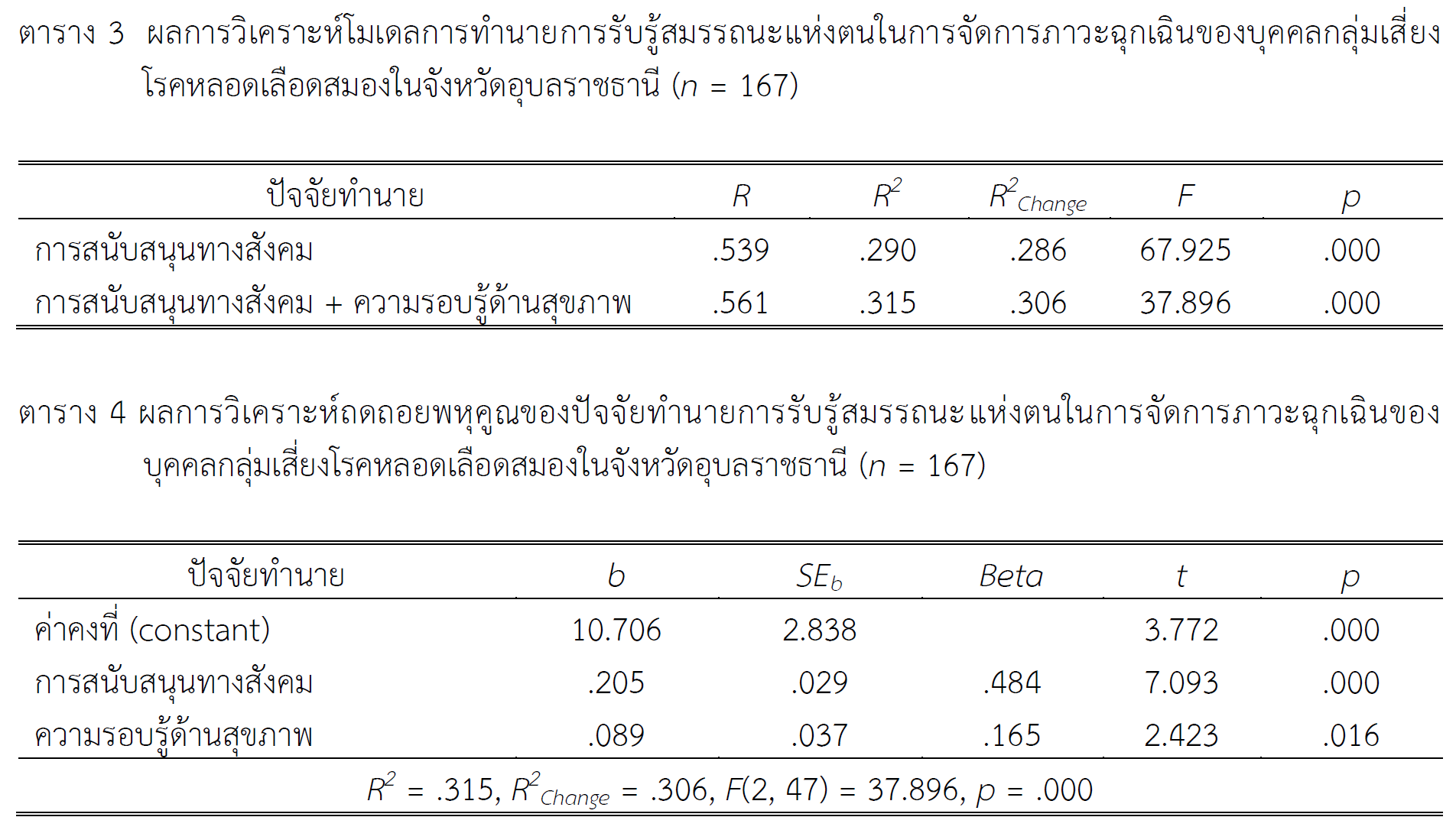
This study aimed to investigate the factors predicting perceived self-efficacy in emergency management among people at risk of stroke. The sample consisted of 167 individuals diagnosed with hypertension, diabetes mellitus, hyperlipidemia, ischemic heart disease, or atrial fibrillation, who received services at subdistrict health-promoting hospitals in Ubon Ratchathani Province. Participants were selected using simple random sampling. The research instruments included questionnaires on self-management, health literacy, social support, stress, and perceived self-efficacy in emergency management. All instruments were reviewed for content validity by a panel of experts. Cronbach’s alpha coefficients were .714, .917, .793, .706, and .805, respectively. Data were analyzed using descriptive statistics, Pearson’s correlation coefficient, and stepwise multiple linear regression analysis.
The results showed that the participants had a moderate level of perceived self-efficacy in emergency management (M = 30.87, SD = 6.08). Social support, health literacy, self-management, and stress were significantly correlated with perceived self-efficacy in emergency management. Among these, only social support and health literacy were significant predictors, together explaining 31.5% of the variance in perceived self-efficacy in emergency management.
Therefore, promoting health literacy and social support among individuals at risk of stroke may help improve their perceived self-efficacy in managing emergencies.
Downloads
References
Abdulsalam, F. I., Somsri, P., Papitak, P., Tussanabunyong, K., Chaveepojnkamjorn, W., & Phoosuwan, N. (2024). Factors associated with quality of life among newly diagnosed acute ischemic stroke patients: A community-based case-control study. PeerJ, 12, e18266. https://doi.org/10.7717/peerj.18266
Amelia, R., Syahrina-binti sahbudin, D. K. N., & Yamamoto, Z. (2020). Stress level and self-concept among type 2 diabetes mellitus patients in Indonesia. Family Medicine & Primary Care Review, 22(2), 111-115. https://doi.org/10.5114/fmpcr.2020.95313
Chiangmai Neurological Hospital. (2024). Stroke risk score card. Retrieved from https://www.cmneuro.go.th/stroke/index.php?page=stroke_matrix
Bakan, G., & Inci, F. H. (2021). Predictor of self-efficacy in individuals with chronic disease: Stress-coping strategies. Journal of clinical nursing, 30(5-6), 874-881.
Bandura, A. (1977). Self-efficacy: Toward a unifying theory of behavioral change. Psychological Review, 84(2), 191-215.
Cohen, J. (1988). Statistical power analysis for the behavioral sciences. Hillsdale, New Jersey, NJ: Lawrence Erlbaum Associates.
Department of Mental Health. (2024). Stress assessment questionnaire (ST5). Retrieved from https://catalog.dmh.go.th/dataset/test-st5.
Fan, J., Li, X., Yu, X., Liu, Z., Jiang, Y., Fang, Y., . . . Xiong, L. (2023). Global burden, risk factor analysis, and prediction study of ischemic stroke, 1990–2030. Neurology, 101(2), e137-e150. https://doi.org/10.1212/WNL.0000000000207387
Jansongdong, S. (2014). Factors affecting self-efficacy among patients with type 2 diabetes: A case study of Ban Na Bua Health Promoting Hospital. Journal of Environmental Education Medical and Health, 9(2), 525-532.
Kaeodumkoeng, K., & Junhasobhaga, J. (2021). A development and testing of health literacy on disease prevention and control assessment form for public health officers. Romphruek Journal, 39(2), 193-220.
Lewin, A., Jöbges, M., & Werheid, K. (2013). The influence of self-efficacy, pre-stroke depression and perceived social support on self-reported depressive symptoms during stroke rehabilitation. Neuropsychological rehabilitation, 23(4), 546-562.
Liu, Q., Jin, Y., Wang, Y., Feng, J., Qiao, X., Ji, L., . . . Wang, C. (2023). Association between self-efficacy and self-management behaviors among individuals at high risk for stroke: Social support acting as a mediator. Journal of clinical nursing, 32(1-2), 71-82.
Lo, S. H., Chau, J. P., Lam, S. K., Saran, R., Choi, K. C., Zhao, J., & Thompson, D. R. (2022). Association between participation self-efficacy and participation in stroke survivors. BMC neurology, 22(1), 361. https://doi.org/10.1186/s12883-022-02883-z
Oluma, A., Abadiga, M., Mosisa, G., Fekadu, G., & Turi, E. (2020). Perceived self-efficacy and associated factors among adult patients with type 2 diabetes mellitus at public hospitals of Western Ethiopia 2020. Patient Preference and Adherence, 14, 1689-1698.
Pemila, U., Sitorus, R., Waluyo, A., & Hastono, S. P. (2020). Self-Efficacy of patients at high risk for stroke in reducing risk factors. Systematic Reviews in Pharmacy, 11(7), 515-518. https://doi.org/10.31838/srp.2020.7.75
Schwarzer, R., & Jerusalem, M. (1995). Generalized Self-Efficacy scale. In J. Weinman, S. Wright, & M. Johnston, Measures in health psychology: A user’s portfolio, causal and control beliefs (pp. 35-37). Windsor, England: NFER-Nelson.
Schunk, D. H., & DiBenedetto, M. K. (2021). Self-efficacy and human motivation. Advances in Motivation Science, 8, 153-179.
Setyawati, R., Astuti, A., Utami, T. P., Adiwijaya, S., & Hasyim, D. M. (2024). The importance of early detection in disease management. Journal of World Future Medicine, Health and Nursing, 2(1), 51-63.
Shany, O., Gurevitch, G., Gilam, G., Dunsky, N., Reznik, B. S., Greental, A., . . . Hendler, T. (2022). A corticostriatal pathway mediating self-efficacy enhancement. NPJ Mental Health Research, 1(6). https://doi.org/10.1038/s44184-022-00006-7
Shen, Z., Ding, S., Shi, S., & Zhong, Z. (2022). Association between social support and medication literacy in older adults with hypertension. Frontiers in Public Health, 10, 1-10. https://doi.org/10.3389/fpubh.2022.987526
Songsrichainun, P., & Tiamkao, S. (2024). Incidence, mortality rate and rate of thrombolytic therapy of acute stroke in Northeastern Thailand from 2017-2022. Journal of The Medical Association of Thailand, 107(1), 16-23.
Tiamkao, S., Ienghong, K., Cheung, L. W., Celebi, I., Suzuki, T., & Apiratwarakul, K. (2022). Stroke incidence, rate of thrombolytic therapy, mortality in Thailand from 2009 to 2021. Open Access Macedonian Journal of Medical Sciences, 10(E), 110–115. https://doi.org/10.3889/oamjms.2022.8051
Tiwari, S., Joshi, A., Rai, N., & Satpathy, P. (2021). Impact of stroke on quality of life of stroke survivors and their caregivers: A qualitative study from India. Journal of Neurosciences in Rural Practice, 12(4), 680–688. https://doi.org/10.1055/s-0041-1735323
Wongpakaran, N., & Wongpakaran, T. (2012). A revised Thai multi-dimensional scale of perceived social support. The Spanish Journal of Psychology, 15(3), 1503-1509.
Yi, X., Chen, H., Wang, Y., Yu, M., Luo, H., Wang, C., . . . Bao, S. (2022). Prevalence and risk factors of high-risk population for stroke: A population-based cross-sectional survey in southwestern China. Frontiers in Neurology, 13, 1-9. https://doi.org/10.3389/fneur.2022.693894
Zimet, G. D., Powell, S. S., Farley, G. K., Werkman, S., & Berkoff, K. A. (1990). Psychometric characteristics of the multidimensional scale of perceived social support. Journal of Personality Assessment, 55(3-4), 610-617.
Downloads
Published
How to Cite
Issue
Section
License
Copyright (c) 2025 JOURNAL OF THE POLICE NURSES AND HEALTH SCIENCE

This work is licensed under a Creative Commons Attribution-NonCommercial-NoDerivatives 4.0 International License.
ผลงานที่ได้ตีพิมพ์แล้วจะเป็นลิขสิทธิ์ของวารสารพยาบาลตำรวจ