
A RESEARCH AND DEVELOPMENT STUDY OF A RESISTANCE EXERCISE PROGRAM WITH ELASTIC BAND COMBINED WITH SOCIAL SUPPORT FOR OLDER ADULTS AFTER TOTAL KNEE ARTHROPLASTY
Keywords:
resistance exercise with rubber chain, social support, knee range of motion, quadriceps muscle strengthAbstract
Abstract
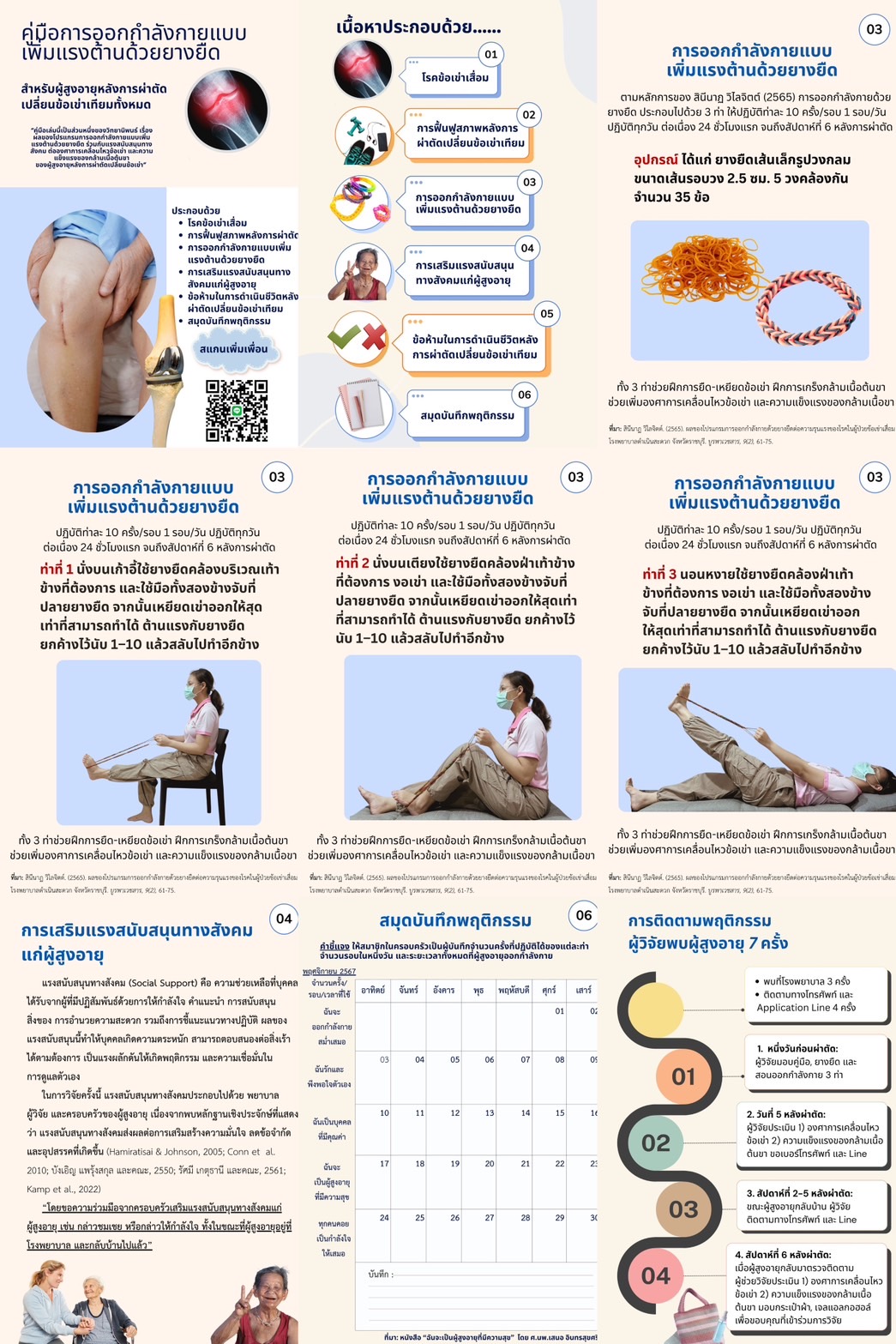
This research and program development is part of a thesis submitted titled "The Effect of Progressive Resistance Exercise with Rubber Chain Program and Social Support on Knee Range of Motion and Quadriceps Muscle Strength in Older Persons After Total Knee Arthroplasty." The objective is to develop and implement a progressive resistance exercise program using rubber chains and social support to improve knee range of motion and quadriceps muscle strength in older persons following total knee arthroplasty.
A developmental approach was used to tailor the program to patients' needs, ensuring effectiveness and feasibility by integrating theoretical and practical elements. The program development process was divided into three phases: 1) problem identification and literature review, 2) program design and development, and 3) program implementation with a sample of ten older persons who had undergone total knee arthroplasty at Police General Hospital. The instruments used included the exercise program (comprising the developed program and teaching media), a knee range of motion measurement tool, a quadriceps muscle strength evaluation form, and a satisfaction questionnaire assessing usability, practicality, safety, and overall satisfaction. The program and teaching media were evaluated by five experts for content validity in terms of appropriateness, continuity, and linguistic accuracy, meeting the standard criteria (CVI ≥ 0.80). Descriptive statistics (percentages, means, and standard deviations) were used for data analysis.
The program's results were well-received, with average scores of 4.73 (±0.45) for participation convenience, 4.87 (±0.35) for practical applicability, 4.60 (±0.49) for safety, and 4.80 (±0.40) for overall satisfaction. These findings underscore the program's capacity to enhance the physical and emotional recovery of older patients, supporting its appropriateness and effectiveness for future large-scale implementation.
Keywords: Progressive resistance exercise, social support, knee range of motion, quadriceps muscle strength.
Downloads
References
Batsis, J. A., Boateng, G. G., Seo, L. M., Petersen, C. L., Fortuna, K. L., Wechsler, E. V., . . . Kotz, D. F. (2019). Development and usability assessment of a connected resistance exercise band application for strength-monitoring. World Academy of Science, Engineering and Technology, 13(5), 340.
Baumeister, R. F., Schmeichel, B. J., & Vohs, K. D. (2007). Self-regulation and the executive function: The self as controlling agent. Social Psychology: Handbook of Basic Principles, 2, 516-539.
Chou, L. N., & Chen, M. L. (2019). Effects of elastic band exercise on lower limb rehabilitation of elderly patients undergoing total knee arthroplasty. Rehabilitation Nurse Journal, 44(1), 60-66.
House, J. S. (1987). Social support and social structure. Sociological Forum, 2(1), 135–146. https://doi.org/10.1007/BF01107897
Jiajaroen, P. (2023). Nursing care for patients undergoing total knee arthroplasty: Two case studies. Journal of Environmental and Community Health, 8(3), 386–392.
Julious, S. A. (2005). Sample size of 12 per group rule of thumb for a pilot study. Pharmaceutical Statistics: The Journal of Applied Statistics in the Pharmaceutical Industry, 4(4), 287-291.
Kamp, T., Stevens, M., Van Beveren, J., Rijk, P. C., Brouwer, R., Bulstra, S., & Brouwer, S. (2022). Influence of social support on return to work after total hip or total knee arthroplasty: A prospective multicentre cohort study. BMJ Open, 12(5), e059225.
Ketetanee, R., Waramit, W., Taiwong, A., & Baothong, K. (2019). The effects of self-efficacy promoting and social support program on knee flexion ability among patients undergoing total knee arthroplasty. Mahasarakham Hospital Journal, 15(2), 133–143.
Liao, C. D., Tsauo, J. Y., Huang, S. W., Ku, J. W., Hsiao, D. J., & Liou, T. H. (2018). Effects of elastic band exercise on lean mass and physical capacity in older women with sarcopenic obesity: A randomized controlled trial. Scientific Reports, 8(1), 2317.
Lockhart, C., & Hunter, I. (2024). Using ‘Health’ to promote older adults’ digital health literacy. Medical Research Archives, 12(6). https://doi.org/10.18103/mra.v12i6.5579
Mathers, C. D. (2020). History of global burden of disease assessment at the World Health Organization. Archives of Public Health, 78, 1-13.
National Statistical Office (NSO) of Thailand. (2023). Thailand population projections 2023. Retrieved from http://www.nso.go.th
Painupong, I., Sae-Sia, W., & Kupantawe, N. (2015). Pain management programme and self-empowerment exercise activity: Their impact on elderly total knee arthroplasty patients’ recovery. The Journal of Thailand Nursing and Midwifery Council, 30(1), 99-111.
Trakarnjan, N., & Yodphithak, P. (2020). Rehabilitation of patients after artificial knee replacement surgery. Regional Health Promotion Center 9 Journal, 14(34), 271–284.
Wilaichit, S. (2022). Effects of an elastic band exercise program on patients with severe osteoarthritis from Damnoensaduak Hospital in Ratchaburi, Thailand. BJM, 9(2), 61-75.
Yodrach, M., & Choowattanapakorn, T. (2014). The effects of a preparation program combined with a rubber chain exercise program on the functional capacity of elderly post total knee arthroplasty. Nursing Journal of The Ministry of Public Health, 23(3), 63-75.
Zaid, M. B., & Vail, T. P. (2021). Total knee arthroplasty. Essentials of Cemented Knee Arthroplasty, 317.
Downloads
Published
How to Cite
Issue
Section
License
Copyright (c) 2025 JOURNAL OF THE POLICE NURSES AND HEALTH SCIENCE

This work is licensed under a Creative Commons Attribution-NonCommercial-NoDerivatives 4.0 International License.
ผลงานที่ได้ตีพิมพ์แล้วจะเป็นลิขสิทธิ์ของวารสารพยาบาลตำรวจ