THE EFFECTIVENESS OF COUNSELING PROGRAM TO HIV PATIENTS FOR INVITE PARTNER TO RECEIVE HEALTH COUNSELING SERVICES CHOMTHONG HOSPITAL
Keywords:
HIV-positive individuals, AIDS, counseling program, partner invitationAbstract
This quasi-experimental study employed a one-group pretest-posttest design with three objectives: 1) to examine the levels of AIDS knowledge and attitudes toward HIV status disclosure to sexual partners among people living with HIV (PLHIV); 2) to compare AIDS knowledge and attitudes toward HIV status disclosure to sexual partners before and after receiving a counseling program for PLHIV to invite partners to health counseling services; and 3) to examine partner-invitation behaviors among PLHIV after receiving the program. The sample consisted of 33 PLHIV receiving antiretroviral therapy at the Antiretroviral Clinic, ChomThong Hospital, Chiang Mai Province, from May to October 2024, who had not yet disclosed their HIV status to their sexual partners and whose partners had never accessed health counseling services. Participants were selected by simple random sampling. Research instruments comprised two components. The first was a counseling program for PLHIV to invite partners to health counseling services, developed in accordance with the guidelines of the Department of Disease Control, Ministry of Public Health, consisting of 10 steps implemented over 4 sessions within 6 weeks. The second was a questionnaire comprising an AIDS knowledge test, an attitude assessment toward HIV status disclosure to sexual partners, and a partner-invitation behavior assessment, with an overall reliability coefficient of .85. Data were analyzed using descriptive statistics and a paired-samples t-test.
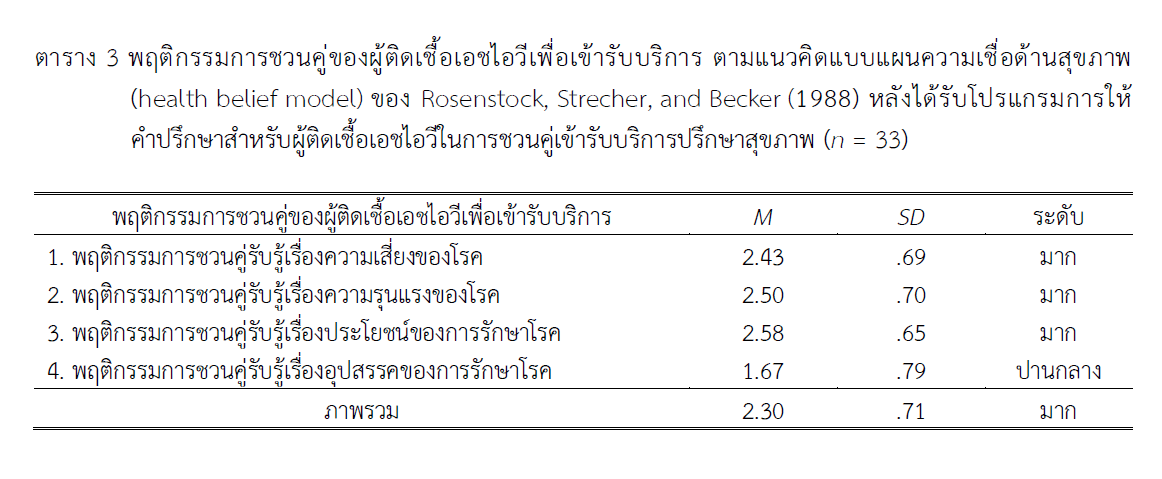
The findings after counseling program revealed that: 1) PLHIV had a high level of AIDS knowledge (78.18%), with the highest correct response being that AIDS is caused by HIV (84.80%), while attitudes toward HIV status disclosure to sexual partners were at a moderate level (M = 1.63, SD = .75); 2) after receiving the counseling program, PLHIV showed statistically significant increases in both AIDS knowledge scores and attitudes toward HIV status disclosure to sexual partners compared to before the program (t = -7.239 and t = -3.104, respectively; p < .05); and 3) partner-invitation behaviors among PLHIV after receiving the program were at a high level (M = 2.30, SD = .71), with perceived benefits of treatment yielding the highest mean score (M = 2.58) and perceived barriers to treatment yielding the lowest (M = 1.67).
In conclusion, the counseling program for PLHIV to invite partners to health counseling services was effective in enhancing AIDS knowledge, promoting positive attitudes toward HIV status disclosure, and supporting partner-invitation behaviors. It is therefore recommended that this program be integrated into antiretroviral clinics and expanded to other health service settings to reduce HIV transmission at the community level.
Downloads
References
AIDS and Sexually Transmitted Diseases Division, Department of Disease Control, Ministry of Public Health. (2022). Thailand national guidelines on HIV/AIDS treatment and prevention 2021/2022. Aksorn Graphic & Design Publishing.
Chanpichit, C., & Tipwareerom, W. (2018). Effects of a health belief model-based program on HIV/AIDS preventive behaviors among out-of-school male youths. Nurse Journal, 45(1), 82–91.
Chokephaibulkit, K., Chotpitayasunondh, T., Puthanakit, T., Lolekha, R., Naiwatanakul, T., Chuenyam, T., Khamduang, W., & Pungkun, W. (2015). Outcomes of a comprehensive youth program for HIV-infected adolescents in Thailand. Journal of the Association of Nurses in AIDS Care, 26(2), 164–176. https://doi.org/10.1016/j.jana.2015.08.005
ChomThong Hospital. (2022). Statistics of HIV/AIDS patients 2020-2022. Information and Medical Records Department.
Department of Disease Control, Ministry of Public Health. (2019). Annual Report 2019. Bureau of Strategy and Planning.
Department of Disease Control, Ministry of Public Health, Thailand. (2023). HIV/AIDS situation in Thailand. Retrieved from https://www.ddc.moph.go.th
Department of Disease Control, Ministry of Public Health, Thailand. (2025). Global HIV/AIDS situation in Thailand. Retrieved from https://www.ddc.moph.go.th.
Division of AIDS and STIs, Department of Disease Control. (2021). Thailand index partner testing guideline 2021. Nonthaburi: Department of disease Control (TH). Retrieved from https://ddc.moph.go.th/uploads/publish/1190120211027044240.pdf
Jaikasem, K., & Chainan, K. (2025). Effectiveness of a knowledge program for service providers in the care and treatment of HIV-infected individuals and AIDS patients in an antiretroviral clinic, Nong Muang Khai Hospital, Phrae Province. Chiang Rai Provincial Public Health Office Journal, 2(1), 1-20.
Khawcharoenporn, T. (2020). Educational interventions improved knowledge, attitude, and practice to prevent HIV infection among HIV-negative heterosexual partners of HIV-infected persons. Journal of the International Association of Providers of AIDS Care, 19. https://doi.org/10.1177/2325958219899532
Lolekha, R., Boon-Yasidhi, V., Leowsrisook, P., Naiwatanakul, T., Durier, Y., Nuchanard, W., Tarugsa, J., Punpanich, W., Pattanasin, S., & Chokephaibulkit, K. (2015). Knowledge, attitudes, and practices regarding antiretroviral management, reproductive health, sexually transmitted infections, and sexual risk behavior among perinatally HIV-infected youth in Thailand. AIDS Care, 27(5), 618–628. https://doi.org/10.1080/09540121.2014.986046
Mitkhunthot, C. (2019). Disease knowledge of people living with HIV/AIDS: A case study of Ta Khli Hospital, Nakhon Sawan. Journal of AIDS, 31(2), 85-99.
National Institutes of Health. (2025). HIV Overview. Retrieved from https://hivinfo.nih.gov/understanding-hiv/fact-sheets/stages-hiv-infection
Pumphuang, P., & Chusuwan, R. (2018). Factors affecting HIV serostatus disclosure among men who have sex with men (MSM) in Phichit Province. Journal of Public Health, 28(2), 288–299.
Rosenstock, I. M., Strecher, V. J., & Becker, M. H. (1988). Social learning theory and the health belief model. Health Education Quarterly, 15(2), 175-183. https://doi.org/10.1177/109019818801500203
Supyen, P. (2021). The Effect of Using Health Education Programs to Promote Health Literacy and Health Behavior 3E 2S in AIDS Patients at Antiretroviral Clinic, Banpong Hospital Journal of Research for Health Improvement and Quality of Life, 2(1), 1-12.
Thailand-U.S. Collaboration Center for Public Health, Department of Disease Control, Ministry of Public Health. (2021). Thailand Index Partner Testing Guideline 2021. Aksorn Graphic & Design Publishing House.
UNAIDS. (2023). Global HIV & AIDS statistics. Retrieved from https://www.unaids.org
Weerakul, K., Prasertchai, A., & Praditbatuka, S. (2021). Factors affecting treatment behavior of people living with HIV/AIDS in the antiretroviral project, Thung Tako Hospital, Chumphon Province. In Proceedings of the 2nd Sukhothai Thammathiraj Open University Graduate Research Conference. Nonthaburi: Sukhothai Thammathiraj Open University.
World Health Organization. (2021). Consolidated guidelines on HIV prevention, testing, treatment, service delivery and monitoring: Recommendations for a public health approach. World Health Organization. Retrieved from https://www.ncbi.nlm.nih.gov/books/NBK572729/pdf/Bookshelf_NBK572729.pdf
Downloads
Published
How to Cite
Issue
Section
License
Copyright (c) 2026 JOURNAL OF THE POLICE NURSES AND HEALTH SCIENCE

This work is licensed under a Creative Commons Attribution-NonCommercial-NoDerivatives 4.0 International License.
ผลงานที่ได้ตีพิมพ์แล้วจะเป็นลิขสิทธิ์ของวารสารพยาบาลตำรวจ