
THE EFFECT OF ISOMETRIC HANDGRIP EXERCISE ON BLOOD PRESSURE IN THE ELDERLY WITH HYPERTENSION LEVEL 1
Keywords:
handgrip exercise, elderly, grade 1 hypertensionAbstract
This study was a randomized controlled trial that aimed to compare changes in mean blood pressure levels among elderly patients with grade 1 hypertension between a group that performed handgrip exercises using resistance equivalent to 30% of their maximum voluntary contraction (MVC) and a group that used a rubber ball for resistance. The sample consisted of 105 elderly patients with grade 1 hypertension from the outpatient department of the Phor Por Ror Building, King Chulalongkorn Memorial Hospital, Thai Red Cross Society. Participants were randomly assigned to 3 groups: 2 experimental groups and 1 control group. The first experimental group held the contraction for 2 minutes, followed by a 1-minute rest, repeated 4 times per session, twice a day, 3 days per week. The second experimental group held the contraction for 1 minute, followed by a 1-minute rest, repeated 4 times per session, twice a day, 5 days per week. The control group received routine care. Data were collected using handgrip strength measurements and daily blood pressure logs. The data were analyzed using one-sample t-tests and ANCOVA.
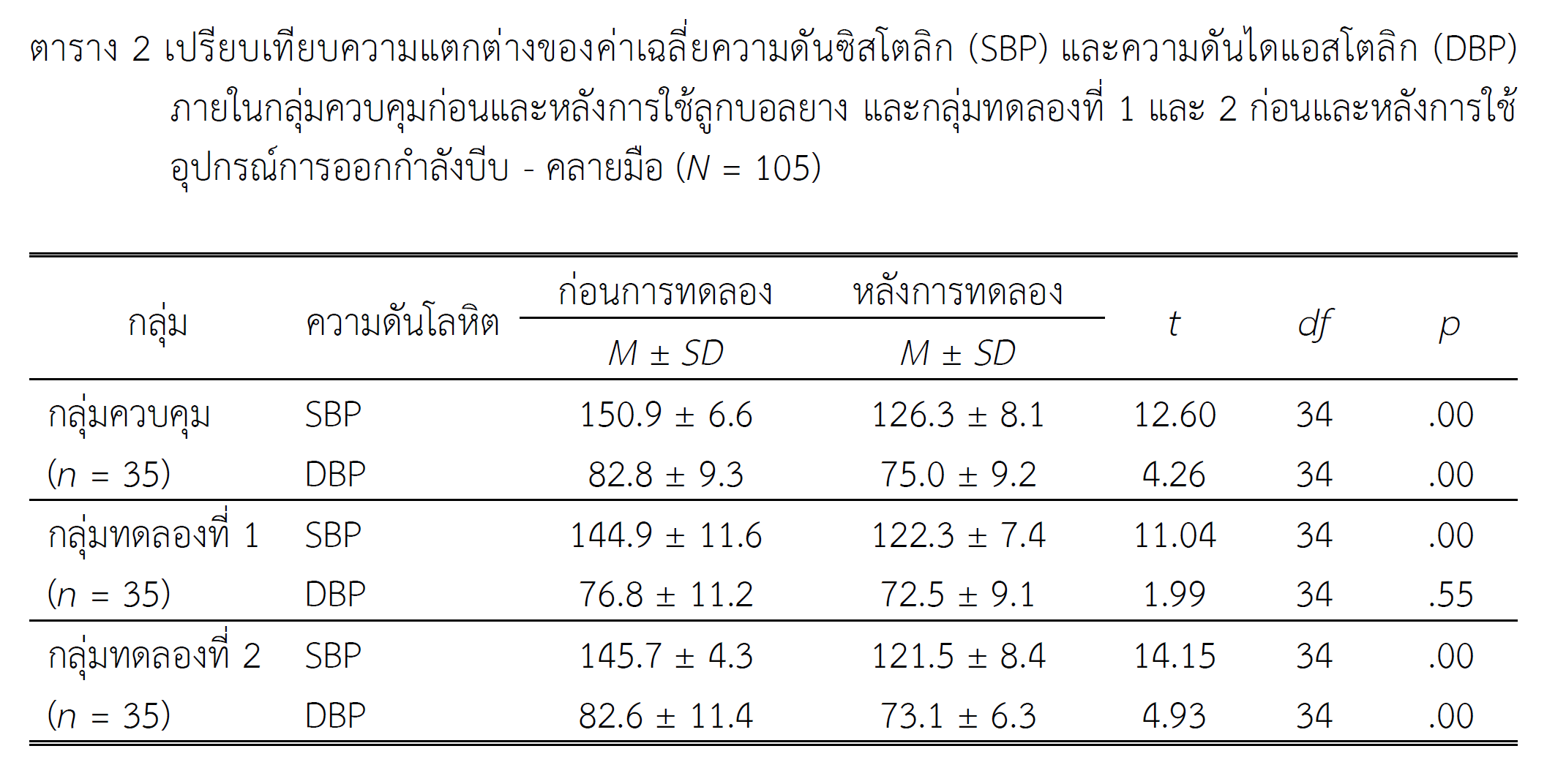
The findings revealed that the mean systolic blood pressure in experimental group 1 decreased significantly after the intervention (p < .05). However, the mean diastolic blood pressure showed only a slight reduction compared to pre-intervention, with no statistical significance (p > .05). In experimental group 2, both the mean systolic and diastolic blood pressure levels significantly decreased after the intervention (p < .05). Similarly, the control group exhibited a significant reduction in both mean systolic and diastolic blood pressure (p < .05). When controlling for the influence of gender on mean blood pressure across the three study groups, it was found that gender significantly affected the reduction in mean systolic blood pressure in both experimental groups compared to the control group (p < .05). However, gender had no significant effect on mean diastolic blood pressure (p > .05).
In conclusion, the 8-week exercise program utilizing the MANUGRIP handgrip exercise device at 30% of MVC effectively reduced systolic blood pressure levels in elderly patients with grade 1 hypertension.
Downloads
References
Almeida, J. P. A. D. S., Bessa, M., Lopes, L. T. P., Gonçalves, A., Roever, L., & Zanetti, H. R. (2021). Isometric handgrip exercise training reduces resting systolic blood pressure but does not interfere with diastolic blood pressure and heart rate variability in hypertensive subjects: A systematic review and meta-analysis of randomized clinical trials. Hypertension Research, 45(5), 1205-1212.
Carlson, D. J., Dieberg, G., Hess, N. C., Millar, P. J., & Smart, N. A. (2014). Isometric exercise training for blood pressure management: A systematic review and meta-analysis. Mayo Clinic Proceedings, 89(3), 327-334.
Department of Disease Control Ministry of Public Health. (2021). NCD annual report 2021. Retrieved from https://ddc.moph.go.th/dncd/journal_detail.php?publish=12470
Foundation of the Thai Elderly Research and Development Institute (TERIDI). (2021). Situation of the Thai elderly 2020. Nakhon Pathom: Institute for Population and Social Research, Mahidol University.
Garatachea, N., García-López, D., Bernal, A., Almar, M., & Gonzalez-Gallego, J. (2012). Oxidative stress response to isometric exercise in women: Effect of age and exercise intensity. International Sportmed Journal, 13(3), 85-95.
Kamiya, A., Iwase, S., Michikamia, D., Fua, Q., & Mano, T. (2000). Muscle sympathetic nerve activity during handgrip and post-handgrip muscle ischemia after exposure to simulated microgravity in humans. Neuroscience Letters, 280(1), 49-52.
Loaiza-Betancur, A. F., & Chulvi-Medrano, I. (2020). Is low-intensity isometric handgrip exercises an efficient alternative in lifestyle blood pressure management? A systematic review. Sports Health, 12(5), 470-477.
McGowan, C. L., Levy, A. S., Millar, P. J., Guzman, J. C., Morillo, C. A., McCartney, N., & MacDonald, M. J. (2006). Acute vascular responses to isometric handgrip exercise and effects of training in persons medicated for hypertension. American Journal of Physiology-Heart and Circulatory Physiology, 291(4), H1797-H1802.
Oliveira, P. C., Silva, M. R., Lehnen, A. M., & Waclawovsky, G. (2023). Isometric handgrip training, but not a single session, reduces blood pressure in individuals with hypertension: A systematic review and meta-analysis. Journal of Human Hypertension, 37(9), 844-853. https://doi.org/10.1038/s41371-022-00778-7
Punia, S., & Kulandaivelan, S. (2020). Home-based isometric handgrip training on RBP in hypertensive adults-partial preliminary findings from RCT. Physiotherapy Research International, 25(1), e1806. https://doi.org/10.1002/pri.1806
Smart, N. A., Way, D., Carlson, D., Millar, P., McGowan, C., Swaine, I., . . . Bleile, B. (2019). Effects of isometric resistance training on resting blood pressure: Individual participant data meta-analysis. Journal of Hypertension, 37(10), 1927-1938.
Souza, L. R., Vicente, J. B., Melo, G. R., Moraes, V. C., Olher, R. R., Sousa, I. C., . . . Moraes, M. R. (2018). Acute hypotension after moderate-intensity handgrip exercise in hypertensive elderly people. The Journal of Strength and Conditioning Research, 32(10), 2971-2977.
Worachet, S., & Nakmareong, S. (2017). Effect of isometric handgrip exercise on blood pressure in pre-hypertensive women. Journal of Associated Medical Sciences, 50(2), 197-207.
Downloads
Published
How to Cite
Issue
Section
License
Copyright (c) 2024 JOURNAL OF THE POLICE NURSES AND HEALTH SCIENCE

This work is licensed under a Creative Commons Attribution-NonCommercial-NoDerivatives 4.0 International License.
ผลงานที่ได้ตีพิมพ์แล้วจะเป็นลิขสิทธิ์ของวารสารพยาบาลตำรวจ