THE EFFECTS OF A SELF-REGULATION MINDFULNESS-BASED COGNITIVE PROGRAM ON DEPRESSION IN GERIATRIC PATIENTS WITH CHRONIC DISEASES
Keywords:
self-regulation, mindfulness-based cognitive program, depression, geriatric patients with chronic diseasesAbstract
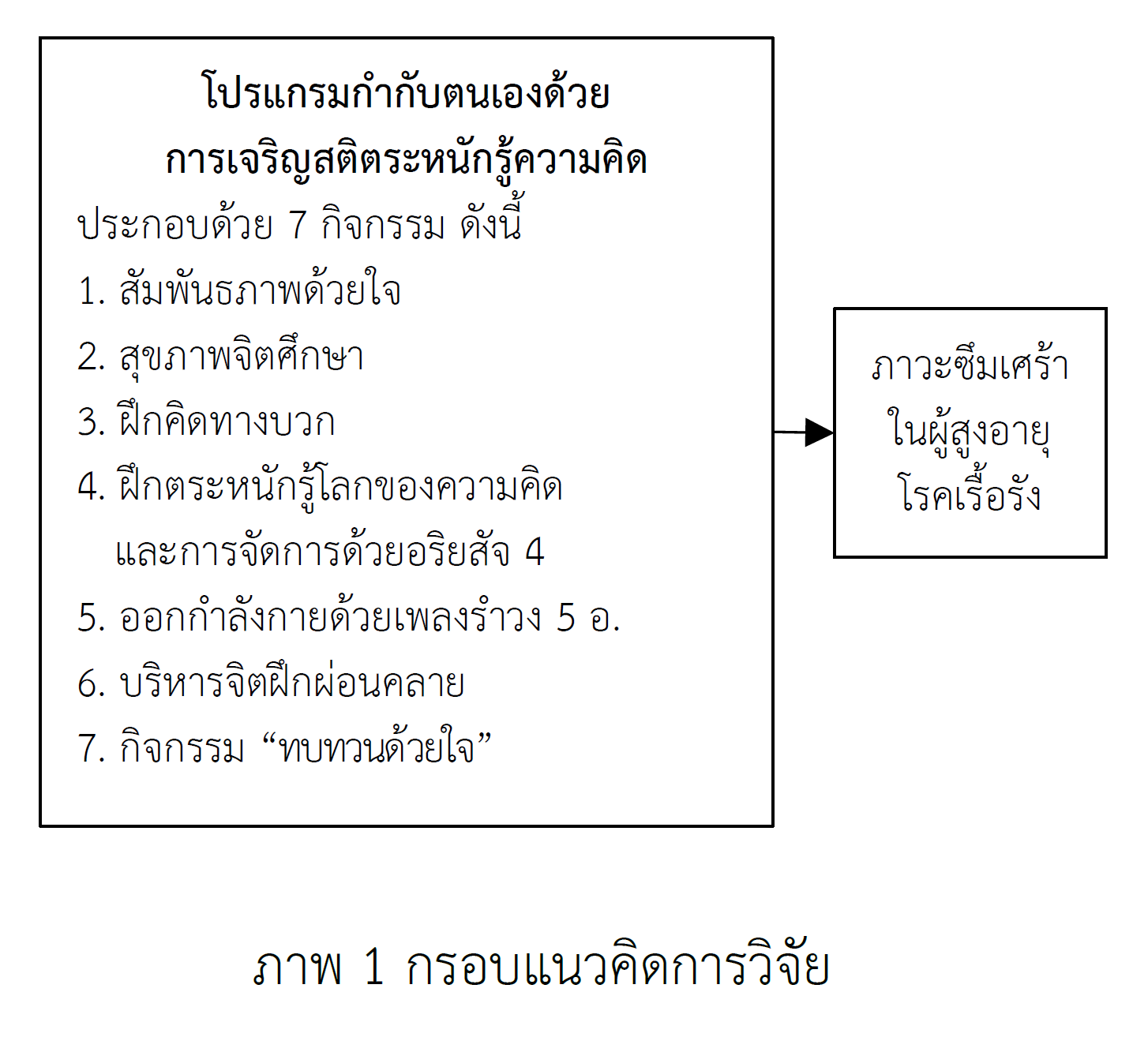
This study employs a quasi-experimental research design with a pretest-posttest control group to 1) compare the average depression scores of geriatric patients with chronic diseases in the experimental group before and after participating in the self-regulation mindfulness-based cognitive program, and 2) compare the average depression scores between the experimental and control groups before and after the intervention The sample consisted of sixty geriatric patients with chronic diseases, selected using purposive sampling. The research instruments included a self-regulation mindfulness-based cognitive program conducted weekly and the 7-color ball depression assessment form (11Q). Data analysis was performed using descriptive statistics, including frequency, percentage, mean, standard deviation, and t-tests to compare means.
The result revealed that 1) the experimental group exhibited significantly lower average depression scores after the intervention compared to before (M = 13.53, SD = 2.39 and M = 4.87, SD = 1.63; t = 3.32, p = .000) and 2) the experimental group had significantly lower depression scores after the intervention compared to the control group (M = 4.87, SD = 1.63 and M = 13.47, SD = 2.11; t = 3.14, p = .000).
The findings suggest that healthcare professionals should implement this program to reduce depression among geriatric patients with chronic diseases.
Downloads
References
Bandura, A. (1986). Social foundations of thought and action: A social cognitive theory. Englewood Cliffs, New Jersey, NJ: Prentice Hall.
Biesheuvel-Leliefeld, K. E. M., Bosmans, J. E., Dijkstra-Kersten, S. M. A., Smit, F., Bockting, C. L. H., van Schaik, D. J. F., van der Horst, H. E. (2018). A supported self-help for recurrent depression in primary care; An economic evaluation alongside a multi-center randomised controlled trial. PLOS ONE, 13(12), 1-18.
Chainat Municipal Public Health Service Center 1. (2019). Annual report 2019. Chainat.
Charoensuk, S. (2024). Modification of the PBRI model for primary care. Suphanburi: Boromarajonani College of Nursing, Suphanburi.
Cheaplamp, S., Dangdomyouth, P., & Malai, C. (2019). Remedy for people with depression by Dharma: Nature according to the buddhist way. The Journal of Psychiatric Nursing and Mental Health, 33(3), 1-13.
Choompubut, P., Kenbubpha, K., Sukhawaha, S., Leejongpermpoon, J., & Saima-in, H. (2022). Development and the effect of self-management with mindfulness-based cognitive therapy program for preventing relapse among people with major depressive disorder. The Journal of Psychiatric Nursing and Mental Health, 36(3), 117-140.
Duggal, H. S. (2019). Self-management of depression: Beyond the medical model. The Permanente Journal, 23, 218-295.
Health Data Center. (2024). Screening for depression (2Q) in patients with chronic diseases, Health Region 3, fiscal year 2024. Retrieved from https://hdcservice.moph.go.th/hdc/reports/page.php?cat_id=574437c29aff8d1709da55677abc4b03
Hagerty, B. M., Bathish, M. A., & Kuchman, E. (2018). Development and testing of a self-regulation model for recurrent depression. Journal of Health Psychology, 25(10-11), 1732–1742.
Kansri, J., Soonthornchaiya, R., & Somprasert, C. (2018). The effects of the cognitive rehabilitation program on depression among older adults with cognitive impairment. The Journal of Boromarajonani College of Nursing, Bangkok, 34(1), 35-46.
Kenbubpha, K., Pianthong, K., Saguanrum, K., & Sukhawaha, S. (2023). Mindfulness-based cognitive therapy for depressive disorder in Thailand: Testing efficacy of the program. The Journal of Psychiatric Nursing and Mental Health, 37(3), 31-52.
Losatiankij, P. (2015). Mindfulness psychotherapy in depression. Journal of Somdet Chaopraya Institute of Psychiatry, 9(1), 47-56.
Musaa, Z. A., Lam, S. K., Mukhtar, F. B. M., Yan, S. K., Olalekan, O. T., & Geok, S. K. (2020). Effectiveness of mindfulness-based cognitive therapy on the management of depressive disorder: Systematic review. International Journal of Africa Nursing Sciences, 12, 1-7.
Pantong, K., & Dangdomyouth, P. (2018). The effective of resilience quotient emphasizing mindfulness-based program on depression in older persons with major depressive disorder. Kuakarun Journal of Nursing, 25(2), 105-118.
Phukhothin, U., Pratoomkaew, S., & Inthawee, P. (2022). Management stress by using the 4 Noble Truths in the organizational management. Journal of Buddhist Philosophy Evolved, 6(2), 650-661.
Ratchabut, N., Chantamungkhun, J., & Saehor, J. (2017) The study social cultural program for mental health promotion and depressive prevention in the elders Donmon sub-district, Satuek district, Burirum province. HCU Journal, 20(40), 115-125.
Segal, Z. V., Williams, J. M. G., & Teasdale, J. D. (2003). Mindfulness-based cognitive therapy for depression: A new approach to preventing relapse. New York, NY: Guilford Press.
Sermthongtip, S., Hengudomsub, P., Vatanasin, D., & Pratoomsri, W. (2017). The effect of mindfulness-based cognitive therapy program on depression among persons with diabetes. The Journal of Faculty of Nursing Burapha University, 25(3), 66-75.
Siribhuddo (Triviseassri), P. (2020). Prevention of depression to solve life problems in the situation of COVID-19 according to the Noble Truth 4. The Journal of Sirindhornparidhat, 21(2), 134-146.
Thitasaro, P. S., Katapunyo, P. T., & Senphunga, P. (2019). Local wisdom and buddhist beliefs. Journal of Graduate Saket Review, 4(1), 12-20.
World Health Organization. (2021). Depression. Retrieved from https://www.who.int/news-room/factsheets/detail/depression
Downloads
Published
How to Cite
Issue
Section
License
Copyright (c) 2024 JOURNAL OF THE POLICE NURSES AND HEALTH SCIENCE

This work is licensed under a Creative Commons Attribution-NonCommercial-NoDerivatives 4.0 International License.
ผลงานที่ได้ตีพิมพ์แล้วจะเป็นลิขสิทธิ์ของวารสารพยาบาลตำรวจ