
ผลของโปรแกรมกระตุ้นการขับถ่ายสามรูปแบบต่อภาวะท้องผูกในผู้สูงอายุกระดูกสะโพกหักที่ได้รับการผ่าตัด
คำสำคัญ:
ภาวะท้องผูก, ผู้สูงอายุ, กระดูกสะโพกหักบทคัดย่อ
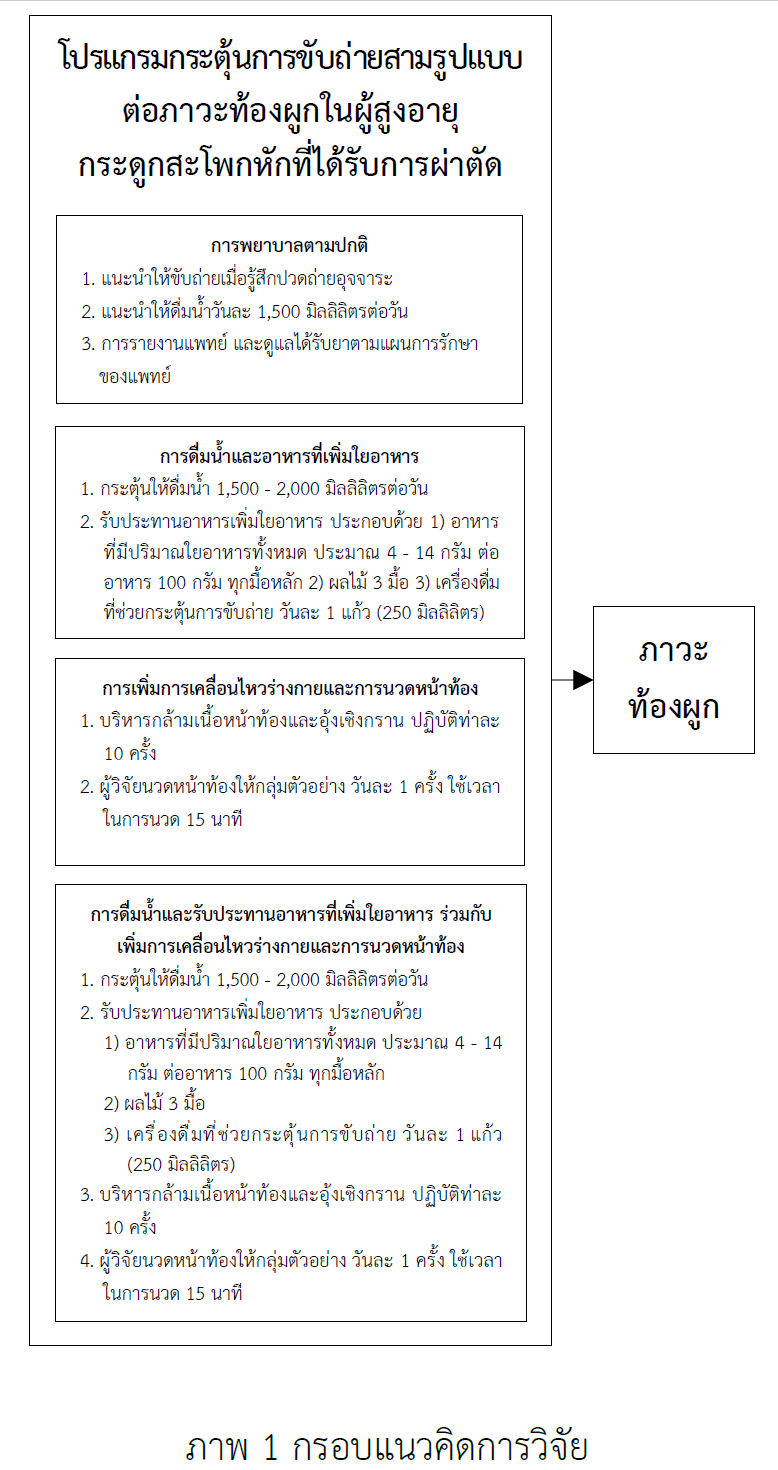
การวิจัยครั้งนี้เป็นการวิจัยกึ่งทดลองมีวัตถุประสงค์เพื่อเปรียบเทียบภาวะท้องผูกในผู้สูงอายุกระดูกสะโพกหักที่ได้รับการผ่าตัด ระหว่างกลุ่มที่ได้รับการดื่มน้ำและรับประทานอาหารที่เพิ่มใยอาหาร กลุ่มที่ได้รับการเพิ่มการเคลื่อนไหวร่างกายและการนวดหน้าท้อง กลุ่มที่ได้รับการดื่มน้ำและรับประทานอาหารที่เพิ่มใยอาหารร่วมกับการเพิ่มการเคลื่อนไหวร่างกายและนวดหน้าท้อง และกลุ่มที่ได้รับการพยาบาลตามปกติ ตัวอย่างเป็นผู้สูงอายุกระดูกสะโพกหักที่ได้รับการผ่าตัด จำนวน 160 ราย แบ่งเป็น 4 กลุ่ม กลุ่มละ 40 ราย ด้วยวิธีเลือกแบบเฉพาะเจาะจงตามคุณสมบัติเกณฑ์การคัดเข้า และจับคู่คุณลักษณะที่คล้ายคลึงกัน ดำเนินการวิจัยเป็นระยะเวลา 3 เดือน เครื่องมือที่ใช้ในการดำเนินการวิจัย ได้แก่ โปรแกรมกระตุ้นการขับถ่ายสามรูปแบบ และแบบบันทึกการปฏิบัติตามแนวทางกระตุ้นการขับถ่าย เครื่องมือที่ใช้ในการเก็บรวบรวมข้อมูล ได้แก่ แบบบันทึกข้อมูลส่วนบุคคล และแบบบันทึกการถ่ายอุจจาระ วิเคราะห์ข้อมูลโดยใช้สถิติเชิงพรรณนา การทดสอบไคสแควร์ การวิเคราะห์ความแปรปรวนทางเดียว และกำหนดนัยสำคัญทางสถิติที่ระดับ .05
ผลการวิจัยพบว่า ภาวะท้องผูกในผู้สูงอายุกระดูกสะโพกหักที่ได้รับการผ่าตัดทั้ง 4 กลุ่ม มีความแตกต่างกันอย่างมีนัยสำคัญทางสถิติที่ระดับ .05 และกลุ่มที่ได้รับการเพิ่มการเคลื่อนไหวร่างกายและการนวดหน้าท้อง กับกลุ่มที่ได้รับการดื่มน้ำและรับอาหารที่เพิ่มใยอาหารร่วมกับการเพิ่มการเคลื่อนไหวร่างกายและการนวดหน้าท้อง มีจำนวนวันเฉลี่ยของการถ่ายอุจจาระครั้งแรกน้อยที่สุดและใกล้เคียงกัน (M = 2.20, SD = .46 และ M = 2.25,
SD = .59 ตามลำดับ, F = .594, p = .553)
ดังนั้น พยาบาลวิชาชีพสามารถใช้การเพิ่มการเคลื่อนไหวร่างกายและการนวดหน้าท้อง หรือใช้การดื่มน้ำและรับประทานอาหารที่เพิ่มใยอาหารร่วมกับการเพิ่มการเคลื่อนไหวร่างกายและการนวดหน้าท้อง ได้ตามความเหมาะสมกับพยาธิสภาพของผู้สูงอายุกระดูกสะโพกหักที่ได้รับการผ่าตัดแต่ละราย
Downloads
เอกสารอ้างอิง
Agachan, F., Chen, T., Pfeifer, J., Reissman, P., & Wexner, S. D. (1996). A constipation scoring system to simplify evaluation and management of constipated patients. Diseases of the Colon and Rectum, 39(6), 681-685.
Berg, U., Berg, M., Rolfson, O., & Erichsen-Andersson, A. (2019). Fast-track program of elective joint replacement in hip and knee patients experiences of the clinical pathway and care process. Journal of Orthopaedic Surgery and Research, 14, 1-8.
Borson, S., Scanlan, J., Brush, M., Vitaliano, P., & Dokmak, A. (2000). The mini‐cog: A cognitive ‘vital signs’ measure for dementia screening in multi-lingual elderly. International Journal of Geriatric Psychiatry, 15(11), 1021-1027.
Celik, B., & Bilik, Ö. (2022). Postoperative constipation incidence and effects of selected risk factors on constipation development in elderly patients with hip fracture. Orthopaedic Nursing, 41(6), 397-405.
Chaloemphonphong, N. (2002). Effects of drinking water in the morning for stimulate the bowel movement in orthopedic patients with constipation (Master of nursing science program, adult nursing). Faculty of Nursing, Mahidol University, Nakhon Pathom, Phuttamonthon.
Cheskin, L. J., Kamal, N., Crowell, M. D., Schuster, M. M., & Whitehead, W. E. (1995). Mechanisms of constipation in older persons and effects of fiber compared with placebo. Journal the American Geritrics Society, 43(6), 666-669.
Chiangrai Prachanukroh Hospital. (2022). Health data center. Retrieved from https://www.crhospital.org/home/main.php
Guyton, A. C. & Hall, J. E. (2006). Textbook of medical physiology (11th ed.). Philadelphia, PA: W. B. Saunders.
Harrington, K. L., & Haskvitz, E. M. (2006). Managing a patient's constipation with physical therapy. Physical Therapy, 86(11), 1511-1519.
Kittinouvarat, S. (2009). Constipation. Thai Red Cross Nursing Journal, 2(1-3), 12-22.
Lacy, B. E., Mearin, F., Chang, L., Chey, W. D., Lembo, A. J., Simren, M., & Spiller, R. (2016). Bowel Disorders. Gastroenterology, 150(6), 1393-1407.
Lamas, K., Lindholm, L., Stenlund, H., Engstrom, B., & Jacobsson, C. (2009). Effects of abdominal massage in management of constipation a randomized controlled trial. International Journal of Nursing Studies, 46(6), 759-767.
Mamom, J. (2019). Orthopedics nursing problem. Bangkok: Thammasat University Press.
Monmai, P. (2009). The effects of a constipation prevention program on incidence and severity of constipation in hospitalized elderly undergoing hip surgery. Journal of Nursing Science, 29(4), 10-17.
Norton, C. (2006). Constipation in older patients: Effects on quality of life. British Journal of Nursing, 15(4), 188-192.
Pattamapornpong, O., Juktong, S., & Klawklar, J. (2023). The effectiveness of constipation prevention program among spine patients at Phrae hospital. (PMJCS) Phrae Medical Journal and Clinical Sciences, 31(2), 118-132.
Pattamawilai, W. (2014). The Effect of Nursing Process with Abdominal Massage on Constipation in Stroke Patients (Master of nursing science program, adult nursing). Faculty of Nursing, Chulalongkorn University, Bangkok, Pathumwan.
Putwatana, P., Sanrung, P., & Budpanya, W. (2012). Constipation, management, and clinical outcomes in critically ill surgical patients. Thai Journal of Nursing, 61(3), 60-68.
Saleesongsom, P., Wangsrikhun, S., & Sukonthasarn, A. (2022). Effect of the constipation prevention program on constipation occurrence in immobilized patients. Boromarajonani College of Nursing, Uttaradit Journal, 14(1), 16-30.
Sinclair, M. (2011). The use of abdominal massage to treat chronic constipation. Journal of Bodywork and Movement Therapies, 15(4), 436-445.
Trads, M., & Pedersen, P. U. (2015). Constipation and defecation pattern the first 30 days after hip fracture. International Journal of Nursing Practice, 21(5), 598-604.
Trongsakul, S., Lambert, R., Clark, A., Wongpakaran, N., & Cross, J. (2015). Development of the Thai version of mini‐cog, a brief cognitive screening test. Geriatrics and Gerontology International, 15(5), 594-600.
Wittbrodt, E. T., Gan, T. J., Datto, C., McLeskey, C., & Sinha, M. (2018). Resource use and costs associated with opioid-induced constipation following total hip or total knee replacement surgery. Journal of Pain Research, 11, 1017-1025.
Wongworapitak, C. (2016). 1-Year mortality in aged hip fracture patients after conservative treatment. Region 11 Medical Journal, 30(4), 345-355.
ดาวน์โหลด
เผยแพร่แล้ว
รูปแบบการอ้างอิง
ฉบับ
ประเภทบทความ
สัญญาอนุญาต
ลิขสิทธิ์ (c) 2024 วารสารพยาบาลตำรวจและวิทยาศาสตร์สุขภาพ

อนุญาตภายใต้เงื่อนไข Creative Commons Attribution-NonCommercial-NoDerivatives 4.0 International License.
ผลงานที่ได้ตีพิมพ์แล้วจะเป็นลิขสิทธิ์ของวารสารพยาบาลตำรวจ