FACTORS PREDICTING RISK MANAGEMENT COMPETENCY IN DRUG ADMINISTRATION AMONG REGISTERED NURSES IN SECONDARY HOSPITALS
Keywords:
risk management, drug administration, drug administration competencyAbstract
This study aimed to 1) examine the risk management competency in drug administration among registered nurses and 2) evaluate the predictive power of nursing work experience, attitudes towards risk management in drug administration, and the nursing practice environment on risk management competency in drug administration among registered nurses at secondary hospitals. A simple random sampling technique was used to recruit 146 participants. Data were collected using questionnaires on demographic information, nursing work experience, attitudes towards risk management in drug administration, the nursing practice environment, and risk management competency in drug administration. The instruments demonstrated high reliability, with Cronbach's alpha coefficients of .96, .97, and .97, respectively. Data were analyzed using stepwise multiple regression analysis.
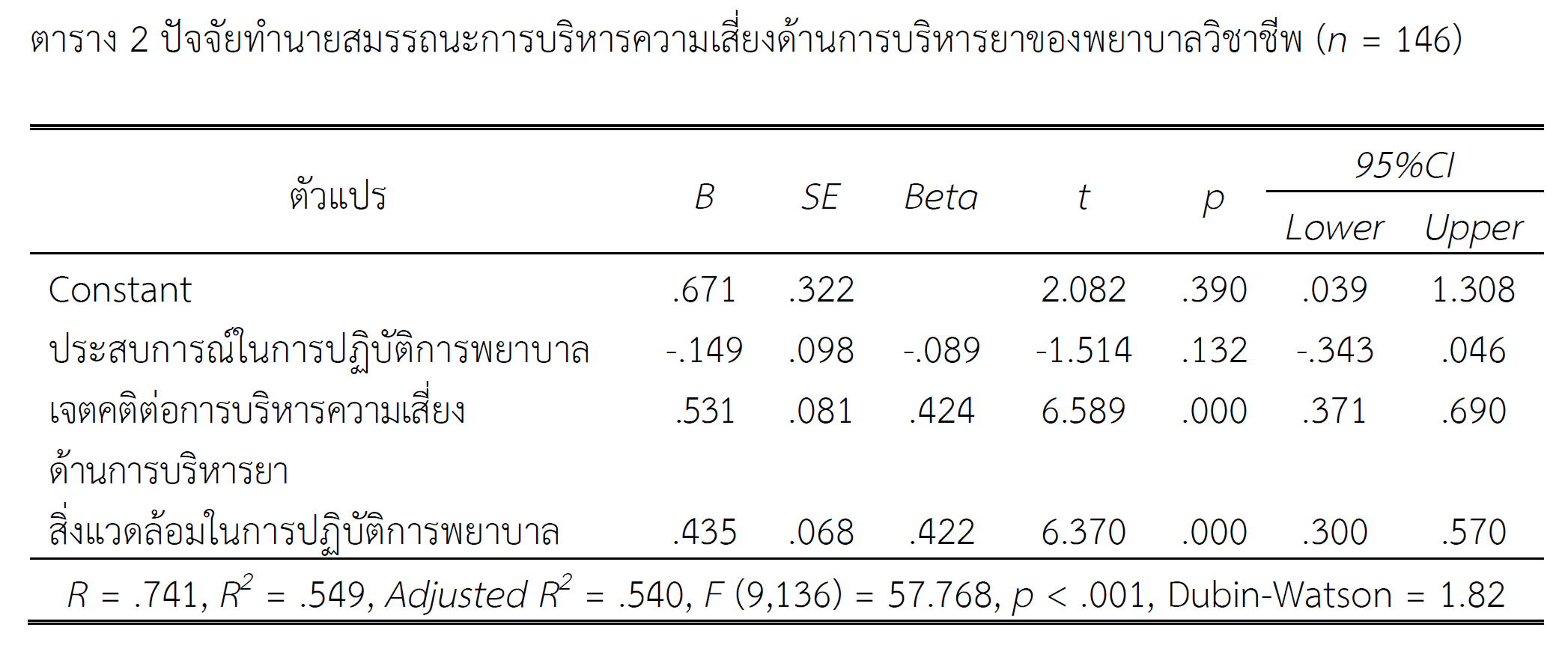
The results showed that participants had an average age of 43.43 years (SD = 9.44) and demonstrated a high level of risk management competency in drug administration (M = 4.16, SD = .65). Attitude towards risk management in drug administration was the strongest predictor of competency (Beta = .424, p = .000). Only two factors – attitude towards risk management in drug administration and the nursing practice environment – significantly predicted risk management competency in drug administration, explaining 54.9% with statistical significance at .05 (R2 = .549, p = .000).
The findings indicated that nurse administrators should develop training programs to enhance positive attitudes towards risk management in drug administration and ensure adequate resources for nursing practices to improve risk management competency in drug administration.
Downloads
References
Alandajani, A., Khalid, B., Ng, Y. G., & Banakhar, M. (2022). Knowledge and attitudes regarding medication errors among nurses: A cross-sectional study in Major Jeddah Hospitals. Nursing Reports, 12(4), 1023-1039. https://doi.org/10.3390/nursrep12040098
Al-ghraiybah, T., Sim, J., & Lago, L. (2021). The relationship between the nursing practice environment and five nursing-sensitive patient outcomes in acute care hospitals: A systematic review. Nursing Open, 8(5), 2262-2271. https://doi.org/10.1002/nop2.828
Alsulami, S. L., Sardidi, H. O., Almuzaini, R. S., Alsaif, M. A., Almuzaini, H. S., Moukaddem, A. K., & Kharal, M. S. (2019). Knowledge, attitude and practice on medication error reporting among health practitioners in a tertiary care setting in Saudi Arabia. Saudi Medical Journal, 40(3), 246-251. https://doi.org/10.15537/smj.2019.3.23960
Cheevakasemsook, A. (2020). New clinical nursing supervision with 2P safety: Concept and application. Journal of The Royal Thai Army Nurses, 21(2), 9-17.
Cheragi, M. A., Manoocheri, H., Mohammadnejad, E., & Ehsani, S. R. (2013). Types and causes of medication errors from nurse's viewpoint. Iranian Journal of Nursing and Midwifery Research, 18(3), 228-231.
Dos Santos Alves, D. F., da Silva, D., & de Brito Guirardello, E. (2017). Nursing practice environment, job outcomes and safety climate: A structural equation modelling analysis. Journal of Nursing Management, 25(1), 46-55. https://doi.org/10.1111/jonm.12427
Flynn, L., Liang, Y., Dickson, G. L., Xi, M., & Suh, D. C. (2012). Nurses' practice environments, error interception practices, and inpatient medication errors. Journal of Nursing Scholarship: An Official Publication of Sigma Theta Tau International Honor Society of Nursing, 44(2), 180-186. https://doi.org/10.1111/j.1547-5069.2012.01443.x
Kaewfu, J. (2011). Factors affecting risk management of medication errors by professional nurses at regional hospitals in the Northern Region, Thailand (Master of nursing science program, adult nursing). School of Nursing Sukhothai Thammathirat Open University.
Khampanya, N., & Srijakkot, J. (2016). Factors influencing the clinical nursing risk management of professional nurses in the delivery room at the community hospitals, District 7, Ministry of Public Health. Journal of Nursing and Health Care, 37(3), 154-163.
Khemtong, S. (2016). Factors related to the risk management of medication error of professional nurses in a hospital. Chonburi Hospital Journal, 41(2), 129-134.
Klaisuban, P. (2012). Risk management behaviors/attitudes Toward risk management/communication skill (Master of nursing science program, adult nursing). School of Nursing, Christian University of Thailand, Bangkok.
Labrague, L. J. (2022). Linking nurse practice environment, safety climate and job dimensions to missed nursing care. International Nursing Review, 69(3), 350-358. https://doi.org/10.1111/inr.12736
Lake, E. T. (2002). Development of the practice environment scale of the nursing work index. Research in Nursing & Health, 25(3), 176-188. https://doi.org/10.1002/nur.10032
Lake, E. T., Riman, K. A., & Sloane, D. M. (2020). Improved work environments and staffing lead to less missed nursing care: A panel study. Journal of Nursing Management, 28(8), 2157-2165. https://doi.org/10.1111/jonm.12970
McClelland, D. C. (1970). Test for competency rather than intelligence. American Psychologists, 17, 57-83.
Nantsupawat, A., Nantsupawat, R., & Kunaviktikul, W. (2014). The relationship between nurses’ practice environment and patient and nurse outcomes in community hospital, Thailand. Nursing Journal, 41(1), 37-49.
Office of the Public Sector Development Commission, Thailand. (2005). Risk management. Retrieved from https://www.opdc.go.th/content/NTY0
Phongkwan, S. (2017). The factors influencing the risk management of professional nurses at Phutthamonthon hospital in Nakhonpathom province. Journal of Boromarajonani College of Nursing, Bangkok, 33(1), 130-140.
Rodkhem, J., Kaewsarn, P., & Siritarungsri, B. (2022). The effects of a program to develop competency in drug administration for registered nurses in acommunity hospital, Phrae province. Journal of The Royal Thai Army Nurses, 23(2), 169-178.
Sangmanee, W., Watanasit, Y., & Kaewvichit, N. (2018). Knowledge, attitude and practice perceived by nurses toward incident reporting in Songklanagarind hospital. Princess of Naradhiwas University Journal, 10(3), 94-102.
Shahrokhi, A., Ebrahimpour, F., & Ghodousi, A. (2013). Factors effective on medication errors: A nursing view. Journal of Research in Pharmacy Practice, 2(1), 18-23. https://doi.org/10.4103/2279-042X.114084
The Royal Pharmaceutical society. (2016). A competency framework for all prescribers. Retrieved from https://www.rpharms.com/resources/frameworks/prescribing-competencyframework/competency-framework
Tingle, J., & Wilson, J. (1998). Clinical risk modification: A route to clinical governance? New York, NY: Elsevier Health Sciences.
Vaismoradi, M., Tella, S., Logan, A., Khakurel, P., & Vizcaya-Moreno, F. (2020). Nurses’ adherence to patient safety principles: A systematic review. International Journal of Environmental Research and Public Health, 17(6), 20-28.
World Health Organization. (2016). Medication without harm. Retrieved from https://www.who.int/initiatives/medication-without-harm
Downloads
Published
How to Cite
Issue
Section
License
Copyright (c) 2024 JOURNAL OF THE POLICE NURSES AND HEALTH SCIENCE

This work is licensed under a Creative Commons Attribution-NonCommercial-NoDerivatives 4.0 International License.
ผลงานที่ได้ตีพิมพ์แล้วจะเป็นลิขสิทธิ์ของวารสารพยาบาลตำรวจ