
ปัจจัยที่มีอิทธิพลต่อภาระการดูแลของผู้ดูแลเด็กสมาธิสั้นในสถานการณ์การระบาดของโรคโควิด 19
คำสำคัญ:
ภาระการดูแล, ผู้ดูแลเด็กสมาธิสั้น, สถานการณ์การระบาดของโรคโควิด 19บทคัดย่อ
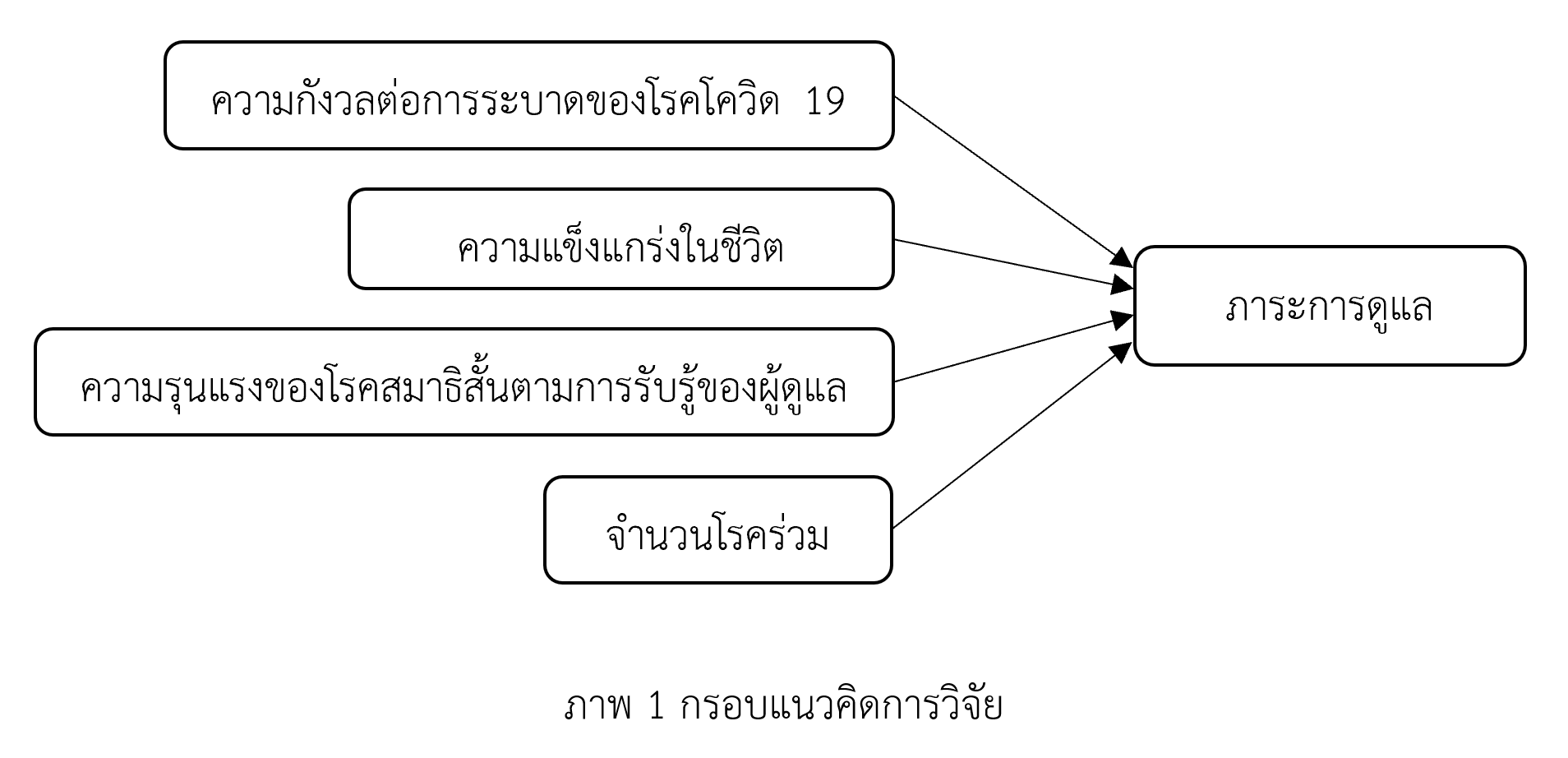
การวิจัยเชิงทำนายนี้มีวัตถุประสงค์เพื่อศึกษา 1) ความสัมพันธ์ระหว่างความกังวลต่อการระบาดของโรคโควิด 19 ความแข็งแกร่งในชีวิต ความรุนแรงของโรคสมาธิสั้นตามการรับรู้ของผู้ดูแล และจำนวนโรคร่วมกับภาระการดูแลเด็กสมาธิสั้น และ 2) ความสามารถในการทำนายของปัจจัยต่อภาระการดูแลเด็กสมาธิสั้นในสถานการณ์การระบาดของโรคโควิด 19 ตัวอย่าง คือ ผู้ดูแลเด็กของสมาธิสั้นที่เข้ารับบริการในแผนกผู้ป่วยนอกของโรงพยาบาลขนาดตติยภูมิแห่งหนึ่งในกรุงเทพมหานคร จำนวน 204 ราย เครื่องมือที่ใช้ในการวิจัย ประกอบด้วย แบบวัดภาระการดูแลแบบประเมินความกังวลต่อการระบาดของโรคโควิด 19 แบบประเมินความแข็งแกร่งในชีวิต และแบบประเมินโรคสมาธิสั้น มีค่าสัมประสิทธิ์แอลฟาของครอนบาคเท่ากับ .93, .93, .93 และ .94 ตามลำดับ วิเคราะห์ข้อมูลโดยใช้สถิติบรรยาย สัมประสิทธิ์สหสัมพันธ์ของเพียร์สัน สัมประสิทธิ์สหสัมพันธ์ของสเปียร์แมน และการวิเคราะห์ถดถอยพหุคูณแบบเชิงชั้น
ผลการวิจัยพบว่า ผู้ดูแลเด็กของสมาธิสั้นมีภาระการดูแลระดับปานกลางถึงมาก ร้อยละ 34.8 ความกังวลต่อการระบาดของโรคโควิด 19 และความรุนแรงของโรคสมาธิสั้นตามการรับรู้ของผู้ดูแลมีความสัมพันธ์ทางบวกกับภาระการดูแลอย่างมีนัยสำคัญทางสถิติ ส่วนความแข็งแกร่งในชีวิตมีความสัมพันธ์ทางลบกับภาระการดูแลอย่างมีนัยสำคัญทางสถิติ ซึ่งความกังวลต่อการระบาดของโรคโควิด 19 ความรุนแรงของโรคสมาธิสั้นตามการรับรู้ของผู้ดูแล ความแข็งแกร่งในชีวิต และจำนวนโรคร่วม สามารถร่วมกันอธิบายความแปรปรวนของภาระการดูแลได้ร้อยละ 27.6 อย่างมีนัยสำคัญทางสถิติ โดยความกังวลต่อการระบาดของโรคโควิด 19 มีอิทธิพลมากที่สุดต่อภาระการดูแล (Beta = .310, p = .000) รองลงมา คือ ความรุนแรงของโรคสมาธิสั้นตามการรับรู้ของผู้ดูแล (Beta = .300, p = .000) และความแข็งแกร่งในชีวิต (Beta = -.192, p = .002) ในขณะที่ จำนวนโรคร่วมไม่มีความสัมพันธ์กับภาระการดูแล (r = .133, p >.05) และไม่มีอิทธิพลต่อภาระการดูแลของผู้ดูแลเด็กของสมาธิสั้น (Beta = .108, p > .05)
ผลการศึกษาครั้งนี้จะเป็นข้อมูลพื้นฐานในการพัฒนาแนวทางการดูแลเด็กสมาธิสั้นเพื่อช่วยป้องกันหรือลดภาระการดูแลของผู้ดูแลเด็กสมาธิสั้นต่อไป
Downloads
เอกสารอ้างอิง
Able, S. L., Johnston, J. A., Adler, L. A., & Swindle, R. W. (2007). Functional and psychosocial impairment in adults with undiagnosed ADHD. Psychological Medicine, 37(1), 97-107.
Al-Balushi, N., Al-Alawi, M., Al Shekaili, M., Al-Balushi, M., Mirza, H., Al-Huseini, S., & Al-Adawi, S. (2019). Predictors of burden of care among caregivers of drug-naive children and adolescents with ADHD: A cross-sectional correlative study Muscat, Oman. Journal of Attention Disorders, 23(5), 517-526.
American Psychiatric Association. (2013). Diagnostic and statistical manual of mental disorders (DSM-V) (5th ed.). Arlington, VA: American Psychiatric Publishing.
Baweja, R., Waschbusch, D. A., & Mayes, S. D. (2023). Physical aggression toward others and self: Correlates in autism, attention-deficit/ hyperactivity disorder, and population-based child samples. JAACAP Open, 1(4), 274-283.
Boon-yasidhi, V. (2012). Attention deficit hyperactivity disorder: Diagnosis and management. Journal of the Psychiatric Association of Thailand, 57(4), 373-386.
Cadman, T., Eklund, H., Howley, D., Hayward, H., Clarke, H., Findon, J., & Glaser, K. (2012). Caregiver burden as people with autism spectrum disorder and attention-deficit/hyperactivity disorder transition into adolescence and adulthood in the United Kingdom. Journal of the American Academy of Child & Adolescent, 51(9), 879-888.
Carey, P. J., Oberst, M. T., McCubbin, M. A., & Hughes, S. H. (1991). Appraisal and caregiving burden in family members caring for patients receiving chemotherapy. Oncology Nursing Forum, 18, 1341–1348.
Department of Disease Control. (2020). Coronavirus disease 2019 (COVID-19). Retrieved from https://www.ddc.moph.go.th/viralpneumonia/file/g_km/handout001_12032020.pdf
Eakes, G. G. (1995). Chronic sorrow: The lived experience of parents of chronically mentally III individuals. Archives of Psychiatric Nursing, 9(2), 77-84.
Fianco, A., Sartori, R. D., Negri, L., Lorini, S., Valle, G., & Delle Fave, A. (2015). The relationship between burden and well-being among caregivers of Italian people diagnosed with severe neuromotor and cognitive disorders. Research in Developmental Disabilities, 39, 43–54.
Fridman, M., Banaschewski, T., Sikirica, V., Quintero, J., Erder, M. H., & Chen, K. S. (2017). Factors associated with caregiver burden among pharmacotherapy-treated children/adolescents with ADHD in the caregiver perspective on pediatric ADHD survey in Europe. Neuropsychiatric Disease and Treatment, 13, 373–386.
Grotberg, E. H. (1995). The internacional resilience project: Promoting resilience in children. Retrieved from https://files.eric.ed.gov/ fulltext/ED383424.pdf
Grotberg, E. H. (1997). The international resilience project: Findings the research and the effectiveness of Interventions. Retrieved from https://files.eric.ed.gov/fulltext/ED419584.pdf
Health Systems Research Institute. (2017). Get to know attention deficit hyperactivity disorder. Retrieved from https://www.hsri.or.th/ people/media/infographic/detail/9128
Iamyingpanich, R. (1996). Burden of care and well-being in families of mothers with mentally retarded children (Master’s thesis). Mahidol University.
Juntratip, P., Pongjaturawit, Y., & Chaimongkol, N., (2020). Factors influencing burden of child caregivers of children with delayed development. The Journal of Faculty of Nursing Burapha University, 28(2), 52-63.
Mohler-Kuo, M., Dzemaili, S., Foster, S., Werlen, L., & Walitza, S. (2021). Stress and mental health among children/adolescents, their parents, and young adults during the first COVID-19 lockdown in Switzerland. International Journal of Environmental Research and Public Health, 18(9), 4668.
Montirosso, R., Mascheroni, E., Guida, E., Piazza, C., Sali, M. E., Molteni, M., & Reni, G. (2021). Stress symptoms and resilience factors in children with neurodevelopmental disabilities and their parents during the COVID-19 pandemic. Health Psychology: Official Journal of the Division of Health Psychology, American Psychological Association, 40(7), 428–438.
Mutluer, T., Doenyas, C., & Aslan Genc, H. (2020). Behavioral implications of the COVID-19 process for autism spectrum disorder, and individuals' comprehension of and reactions to the pandemic conditions. Frontiers in Psychiatry, 11, 561882.
Nintachan, P., Sangon, S., Sumdaengrit, B., Deesamer, S., Kulvirogesopon, V., Boonchuay, N., . . . Gumphun, S. (2023). The mediating effect of resilience in the relationships between psychosocial factors and mental health problems of village health volunteers in Thailand during the third year of COVID-19 pandemic. Research report, Ramathibodi School of Nursing, Faculty of Medicine Ramathibodi Hospital, Mahidol University.
Nintachan, P., Sangon, S., & Thaweekoon, T. (2010). Development of a resilience assessment: Research report Thai population potential development project. Faculty of Medicine Ramathibodi Hospital, Mahidol University.
Oberst, M. T. (1991). Appraisal of caregiving scale. Madison, WI: University of Wisconsin.
Oberst, M. T., Thomas, S. E., Gass, K. A., & Ward, S. E. (1989). Caregiving demands and appraisal of stress among family caregivers. Cancer Nursing, 12(4), 209-215.
Ohlmeier, M. D., Peters, K., Te Wildt, B. T., Zedler, M., Ziegenbein, M., Wiese, B., Emrich, H. M., & Schneider, U. (2008). Comorbidity of alcohol and substance dependence with attention-deficit/hyperactivity disorder (ADHD). Alcohol and Alcoholism (Oxford, Oxfordshire), 43(3), 300–304.
Orapiriyakul, R., Benjakul, W., & Kwunkaew, S. (2014). Predictors of burden of care in primary family caregivers of children with autism in the West-Coast Southern Thailand. Songklanagarind Journal of Nursing, 34(3), 39-58.
Panda, P. K., Gupta, J., Chowdhury, S. R., Kumar, R., Meena, A. K., Madaan, P., Sharawat, I. K., & Gulati, S. (2021). Psychological and behavioral impact of lockdown and quarantine measures for COVID-19 pandemic on children, adolescents and caregivers: A systematic review and meta-analysis. Journal of Tropical Pediatrics, 67(1), 1-13. , 1-13. https://doi.org/10.1093/tropej/fmaa122
Peasgood, T., Bhardwaj, A., Brazier, J. E., Biggs, K., Coghill, D., Daley, D., & Sonuga-Barke, E. J. S. (2021). What is the health and well-being burden for parents living with a child with ADHD in the United Kingdom? Journal of Attention Disorders, 25(14), 1962-1976.
Pitakbud, N. (2007). The influences of family relationship and burden on child care behaviors of mothers having autistic children (Master’s thesis). Prince of Songkla University, Songkla.
Pityaratstian, N., Booranasuksakul, T., Juengsiragulwit, D., & Benyakorn, S. (2014). ADHD screening properties of the Thai version of Swanson, Nolan, and Pelham IV scale (SNAP-IV) and strengths and difficulties questionnaire (SDQ). Journal of the Psychiatrist Association of Thailand, 59(2), 97–110.
Pornnoppadol, C. (Ed.). (2018). ADHD: Attention deficit hyperactivity disorder. Ideol Digital Print.
Ronis, S. D., Baldwin, C. D., Blumkin, A., Kuhlthau, K., & Szilagyi, P. G. (2015). Patient-centered medical home and family burden in attention-deficit hyperactivity disorder. Journal of Developmental and Behavioral Pediatrics: JDBP, 36(6), 417–425.
Russell, B. S., Hutchison, M., Tambling, R., Tomkunas, A. J., & Horton, A. L. (2020). Initial challenges of caregiving during COVID-19: Caregiver burden, mental health, and the parent-child relationship. Child Psychiatry and Human Development, 51(5), 671–682.
Russell, B. S., Tomkunas, A. J., Hutchison, M., Tambling, R. R., & Horton, A. L. (2021). The protective role of parent resilience on mental health and the parent-child relationship during COVID-19. Child Psychiatry and Human Development, 53(1), 183-196.
Sideropoulos, V., Dukes, D., Hanley, M., Palikara, O., Rhodes, S., Riby, D. M., . . . Van Herwegen, J. (2021). The impact of COVID-19 on anxiety and worries for families of individuals with special education needs and disabilities in the UK. Journal of Autism and Developmental Disorders, 52(6), 2656-2669.
Thongphet, O. (2002). Caregiving burden among mothers of autistic children (Master’s thesis). Chiang Mai University, Chiang Mai.
Wacharasin, C. (2017). Nursing interventions for families experiencing chronic illness (2nd ed.). Chonburi Printing.
ดาวน์โหลด
เผยแพร่แล้ว
รูปแบบการอ้างอิง
ฉบับ
ประเภทบทความ
สัญญาอนุญาต
ลิขสิทธิ์ (c) 2024 วารสารพยาบาลตำรวจและวิทยาศาสตร์สุขภาพ

อนุญาตภายใต้เงื่อนไข Creative Commons Attribution-NonCommercial-NoDerivatives 4.0 International License.
ผลงานที่ได้ตีพิมพ์แล้วจะเป็นลิขสิทธิ์ของวารสารพยาบาลตำรวจ