
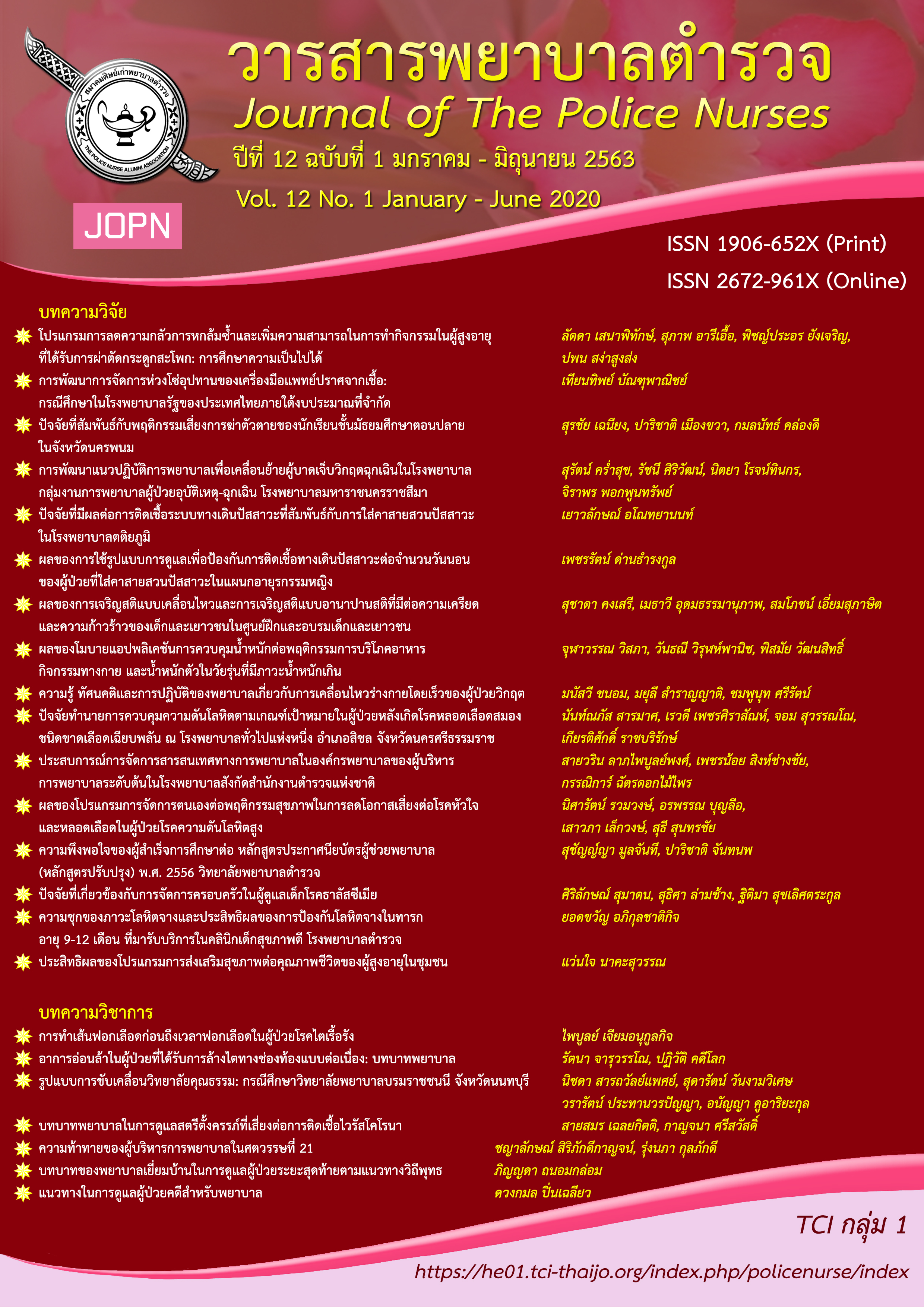
ปัจจัยที่มีผลต่อการติดเชื้อระบบทางเดินปัสสาวะที่สัมพันธ์กับการใส่คาสายสวนปัสสาวะในโรงพยาบาลตติยภูมิ
คำสำคัญ:
การติดเชื้อระบบทางเดินปัสสาวะ, การใส่คาสายสวนปัสสาวะ, ปัจจัยที่มีผลต่อการติดเชื้อบทคัดย่อ
การวิจัยครั้งนี้เป็นการวิจัยเชิงวิเคราะห์แบบย้อนหลังเพื่อศึกษาปัจจัยที่มีผลต่อการติดเชื้อระบบทางเดินปัสสาวะที่สัมพันธ์กับการใส่คาสายสวนปัสสาวะ หอผู้ป่วยใน โรงพยาบาลตำรวจ เก็บข้อมูลย้อนหลังจากเวชระเบียนผู้ป่วยในที่ได้รับการใส่คาสายสวนปัสสาวะทั้งที่เกิดและไม่เกิด CAUTI(catheter-associated urinary tract infection) จำนวน 200 ราย ระหว่างเดือน มกราคม ถึง ธันวาคม พ.ศ. 2561 เครื่องมือวิจัย คือ แบบบันทึกข้อมูลที่ผู้วิจัยสร้างขึ้น มีค่าดัชนีความตรงตามเนื้อหาเท่ากับ .94 วิเคราะห์ข้อมูลทั่วไปด้วยสถิติบรรยาย ได้แก่ ความถี่ ร้อยละ ค่าเฉลี่ย และส่วนเบี่ยงเบนมาตรฐาน วิเคราะห์ปัจจัยที่สัมพันธ์กับการเกิด CAUTI ด้วย Chi-square และวิเคราะห์ปัจจัยที่มีผลต่อการติดเชื้อด้วย Binary Logistic Regression
ผลการศึกษาพบว่า อัตราการเกิด CAUTI เท่ากับ 23.32 ครั้งต่อ 1,000 วันที่ใส่คาสายสวนปัสสาวะ ปัจจัยที่มีผลต่อการเกิด CAUTI มี 3 ปัจจัย ได้แก่ โรคร่วมทางไต เบาหวาน และจำนวนวันใส่คาสายสวนปัสสาวะ โดยสามารถร่วมกันทำนายการเกิด CAUTI ได้ร้อยละ 70.50 โดยผู้ป่วยที่มีโรคร่วมทางไตมีโอกาสเกิด CAUTI เป็น 2.95 เท่าของผู้ป่วยที่ไม่มีโรคร่วมทางไต (OR = 2.95, 95% CI = 1.49 - 5.85, p = .00) ผู้ป่วยที่มีโรคร่วมเบาหวานมีโอกาสเกิด CAUTI เป็น 2.46 เท่าของผู้ป่วยที่ไม่มีโรคร่วมเบาหวาน (OR = 2.46, 95% CI 1.28 - 4.71, p = 0.01) และจำนวนวันใส่คาสายสวนปัสสาวะเพิ่มขึ้น 1 สัปดาห์ มีโอกาสเกิด CAUTI เป็น 1.30 เท่า หรือร้อยละ 29.8 (OR = 1.30, 95% CI = 1.15 - 1.47, p = .00)
ข้อเสนอแนะ บุคลากรทางการแพทย์ต้องให้ความสำคัญกับการดูแลผู้ป่วยโรคไตและโรคเบาหวาน เนื่องจากมีโอกาสเกิด CAUTI สูงกว่าผู้ป่วยโรคอื่น การปฏิบัติตามแนวทาง CAUTI Bundle อย่างเคร่งครัดและการลดจำนวนวันใส่คาสายสวนปัสสาวะเป็นวิธีหนึ่งที่สามารถลดการติดเชื้อได้
Downloads
เอกสารอ้างอิง
Allison, S. L., Hojjat, S., David, K. V., Brett, E. Y., Robert, A. G., Yoko, F., David, P. C., & Rimma, P. (2019). Identifying the risk factors for catheter-associated urinary tract infections: A large cross-sectional study of six hospitals. British Medical Journal, 9(2), 1-13.
Armbruster, C. E., Prenovost, K., Mobley, H. L., & Mody, L. (2017). How often do clinically diagnosed catheter-associated urinary tract infections in nursing homes meet standardized criteria?. Journal of the American Geriatrics Society, 65(2), 395-401.
Conover, M. S., Flores-Mireles, A. L., Hibbing, M. E., Dodson, K., & Hultgren, S. J. (2015). Establishment and characterization of UTI and CAUTI in a mouse model. Journal of Visualized Experiments, 100, e52892.
Fei, L., Meixuan, S., Linxia, X., Bo, D., Shiqin, Z., & Xianrong, L. (2019). Risk factors for catheter-associated urinary tract infections among hospitalized patients: A systematic review and meta-analysis of observational studies. Journal of Advanced Nursing, 75(3), 517-527.
Girard, R., Gaujard, S., Pergay, V., Pornon, P., Martin-Gaujard, G., Bourguignon, L., & UTIC Group. (2017). Risk factors for urinary tract infections in geriatric hospitals. Journal of Hospital Infection, 97(1), 74-78.
Henry, M. (2018). Evaluation of evidence-based practice of catheter associated urinary tract infections prevention in a critical care setting: An integrative review. Journal of Nursing Education and Practice, 8(7), 22-30.
Isariyapong, K., & Romanee, C. (2018). Epidemiology of catheter-associated urinary tract infections at Maharaj Nakorn Chiang Mai hospital, Northern Thailand. Southeast Asian Journal of Tropical Medicine and Public Health, 49(1), 113-122.
Kelly, R., Daniels, P., Grace, C. L., & Christropher, R. F. (2014). Trends in catheter-associated urinary tract infections among a national cohort of hospitalized adults 2001-2010. American Journal of Infection control, 42, 17-22.
Khan, Y., Venkateshwarhu, C., Sreenivas, G., & Rahul, P. (2016). Study of incidence and risk factors of urinary tract infection in catheterized patients admitted at tertiary care hospital, Nizamabad, Telangana state, India. International Archives of Integrated Medicine, 3(8), 83-92.
Leelakrishna, P., & Karthik Rao, B. (2018). A study of risk factors for catheter associated urinary tract infection. International Journal of Advances in Medicine, 5(2), 334-339.
Leelakrishna, P., & Karthik, R. B. (2018). A study of risk factors for catheter associated urinary tract Infection. International Journal of Advances in Medicine, 5(2), 334-339.
Leithauser, D. (2005). Urinary tract infections. In R. Carrico, L. Adam, K. Aurden, & L. Fauerbach (Eds.), APIC text of infection control and epidemiology (2nd ed.). Association for Professional in Infection Control and Epidemiology. Washington, DC, USA.
Lo, E., Nicolle, L. E., Coffin, S. E., Gould, C., Maragakis, L. L., Medding, J., . . . Yokoe, D. S. (2014). Strategies to prevent catheter-associated urinary tract infections in acute care hospitals. Infection Control and Hospital Epidemiology, 35(5), 1-17.
Malathum, K. (2015). Infection control guidebook. Retrieved from https://med.mahidol.ac.th/ic/sites/default/files/public/pdf/IC%20book.pdf
Mangukiya, J. D., Patel, K., & Vegad, M. (2015). Study of incidence and risk factors of urinary tract infection in catheterised patients admitted at tertiary care hospital. International Journal of Research in Medical Sciences, 3(12), 3808-11.
Maria, J. L., & Paulo, S. (2017). Hospital-acquired urinary tract infections: Results of a cohort study performed in an internal medicine department. ACTA Medica Portuguesa, 30(9), 608-614.
National Healthcare Safety Network (NSHN). (2020). Urinary tract infection (catheter-associated urinary tract infection [CAUTI] and non-catheter-associated urinary tract infection [UTI]) Events. In Patient Safety Component Manual (pp. 106-125). Retrieved From https://www.cdc.gov/nhsn/pdfs/pscmanual/pcsmanual_current.pdf
Thungklin, B., Khiewkhern, O., & Phitakaramwong, P. (2017). Factor that affecting catheter-associated urinary tract infection among retained urinary catheter patient, inpatients department, Pichit hospital. Pichit Hospital Journal, 32(2), 31-41.
Unahalekhaka, A. (2013). Epidemiology an evidence-based practice guideline in prevention of hospital-associated infections. Chiang Mai: Mingmuang.
Vincitorio, D., Barbadoro, P., Pennacchietti, L., Pellegrini, L., David, S., & Ponzio, E. (2014). Risk factors for catheter-associated urinary tract infection in Italian elderly. American Journal of Infection Control, 45(8), 898-901.
Zhao, X., Wang, L., Wei, N., Zhang, J., Ma, W., Zhao, H., & Han, X. (2019). Risk factors of health care-associated infection in elderly patients: A retrospective cohort study performed at a tertiary hospital in China. BMC Geriatrics, 19, 1-6.
ดาวน์โหลด
เผยแพร่แล้ว
รูปแบบการอ้างอิง
ฉบับ
ประเภทบทความ
สัญญาอนุญาต
ผลงานที่ได้ตีพิมพ์แล้วจะเป็นลิขสิทธิ์ของวารสารพยาบาลตำรวจ