
ประสบการณ์ของพยาบาลวิชาชีพในการมีส่วนร่วมการวางแผนการดูแลล่วงหน้า
คำสำคัญ:
การวางแผนการดูแลล่วงหน้า, พยาบาลวิชาชีพ, การดูแลแบบประคับประคองบทคัดย่อ
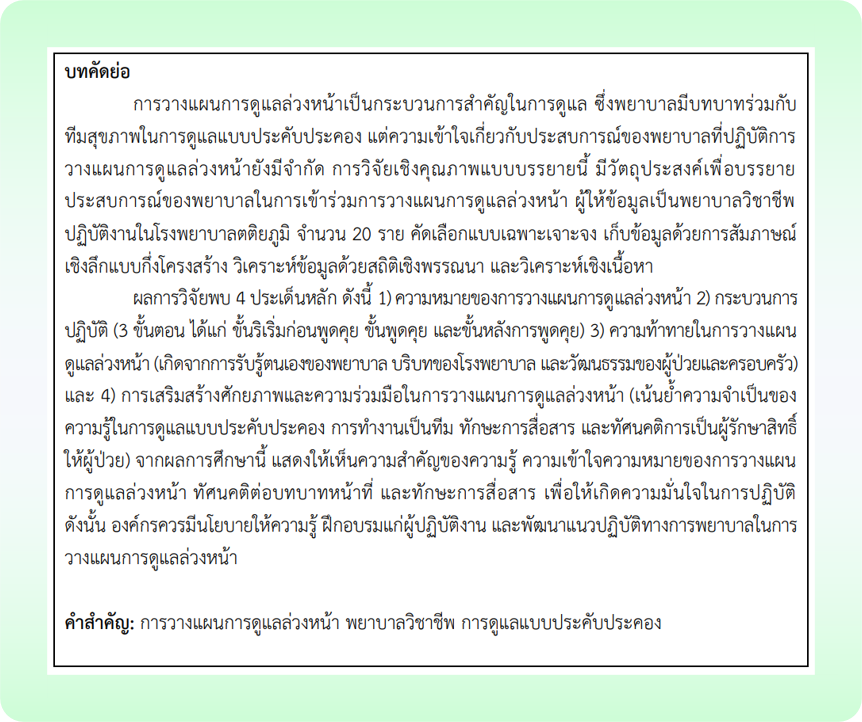
การวางแผนการดูแลล่วงหน้าเป็นกระบวนการสำคัญในการดูแล ซึ่งพยาบาลมีบทบาทร่วมกับทีมสุขภาพในการดูแลแบบประคับประคอง แต่ความเข้าใจเกี่ยวกับประสบการณ์ของพยาบาลที่ปฏิบัติการวางแผนการดูแลล่วงหน้ายังมีจำกัด การวิจัยเชิงคุณภาพแบบบรรยายนี้ มีวัตถุประสงค์เพื่อบรรยายประสบการณ์ของพยาบาลในการเข้าร่วมการวางแผนการดูแลล่วงหน้า ผู้ให้ข้อมูลเป็นพยาบาลวิชาชีพ ปฏิบัติงานในโรงพยาบาลตติยภูมิ จำนวน 20 ราย คัดเลือกแบบเฉพาะเจาะจง เก็บข้อมูลด้วยการสัมภาษณ์เชิงลึกแบบกึ่งโครงสร้าง วิเคราะห์ข้อมูลด้วยสถิติเชิงพรรณนา และวิเคราะห์เชิงเนื้อหา
ผลการวิจัยพบ 4 ประเด็นหลัก ดังนี้ 1) ความหมายของการวางแผนการดูแลล่วงหน้า 2) กระบวนการปฏิบัติ (3 ขั้นตอน ได้แก่ ขั้นริเริ่มก่อนพูดคุย ขั้นพูดคุย และขั้นหลังการพูดคุย) 3) ความท้าทายในการวางแผนดูแลล่วงหน้า (เกิดจากการรับรู้ตนเองของพยาบาล บริบทของโรงพยาบาล และวัฒนธรรมของผู้ป่วยและครอบครัว) และ 4) การเสริมสร้างศักยภาพและความร่วมมือในการวางแผนการดูแลล่วงหน้า (เน้นย้ำความจำเป็นของความรู้ในการดูแลแบบประคับประคอง การทำงานเป็นทีม ทักษะการสื่อสาร และทัศนคติการเป็นผู้รักษาสิทธิ์ให้ผู้ป่วย) จากผลการศึกษานี้ แสดงให้เห็นความสำคัญของความรู้ ความเข้าใจความหมายของการวางแผนการดูแลล่วงหน้า ทัศนคติต่อบทบาทหน้าที่ และทักษะการสื่อสาร เพื่อให้เกิดความมั่นใจในการปฏิบัติ ดังนั้น องค์กรควรมีนโยบายให้ความรู้ ฝึกอบรมแก่ผู้ปฏิบัติงาน และพัฒนาแนวปฏิบัติทางการพยาบาลในการวางแผนการดูแลล่วงหน้า
เอกสารอ้างอิง
Hawley PH. The bow tie model of 21st century palliative care. Journal of Pain and Symptom Management 2014;47(1):e2-5. doi: 10.1016/j.jpainsymman.2013.10.009.
Kim YS. Experiences of life-sustaining treatment decisions among patients with terminal cancer. Journal of Hospice and Palliative Care 2021;24(2):97-108. doi: 10.14475/jhpc.2021.24.2.97.
Walker W, Efstathiou N, Jones J, Collins P, Jennens H. Family experiences of in-hospital end-of-life care for adults: a systematic review of qualitative evidence. Journal of Clinical Nursing 2022;32(9-10):2252-69. doi: 10.1111/jocn.16268.
National Health Commission Office. Operational definition on palliative care for Thais 2020 [Internet]. 2021 [cited 2024 Dec 1]. Available from: https://old.nationalhealth.or.th/sites/default/files/upload_files/Operational_definition_Palliative_care.pdf (in Thai)
Sudore RL, Heyland DK, Lum HD, Rietjens JAC, Korfage IJ, Ritchie CS, et al. Outcomes that define successful advance care planning: a delphi panel consensus. Journal of Pain and Symptom Management 2018;55(2):245-255.e8. doi: 10.1016/j.jpainsymman.2017.08.025.
Sritharathikun P, Nethipoomkun S. Impact of advance care planning on the end-of-life care in Maesot palliative care clinic, Tak province, Thailand. Journal of Primary Care and Family Medicine 2021;4(1):97-111. (in Thai)
Cooper A, Dains JE. Advanced care planning and end-of-life outcomes in hematopoietic stem cell transplant patients. American Journal of Hospice and Palliative Medicine 2021;38(8):995-1003. doi: 10.1177/1049909120971566.
Goswami P. Impact of advance care planning and end-of-life conversations on patients with cancer: an integrative review of literature. Journal of Nursing Scholarship 2023;55(1):272-90. doi: 10.1111/jnu.12804.
Miller H, Tan J, Clayton JM, Meller A, Hermiz O, Zwar N, et al. Patient experiences of nurse-facilitated advance care planning in a general practice setting: a qualitative study. BioMed Central Palliative Care 2019;18(1):25. doi: 10.1186/s12904-019-0411-z.
Khairuddin NNB, Lau ST, Ang WHD, Tan PH, Goh ZWD, Ang NKE, et al. Implementing advance care planning: a qualitative exploration of nurses’ perceived benefits and challenges. Journal of Nursing Management 2020;28(5):1080-7. doi: 10.1111/jonm.13056.
Blackwood DH, Walker D, Mythen MG, Taylor RM, Vindrola-Padros C. Barriers to advance care planning with patients as perceived by nurses and other healthcare professionals: a systematic review. Journal of Clinical Nursing 2019;28(23-24):4276-97. doi: 10.1111/jocn.15049.
Zhu N, Yang L, Wang X, Tuo J, Chen L, Deng R, et al. Experiences and perspectives of healthcare professionals implementing advance care planning for people suffering from life-limiting illness: a systematic review and meta-synthesis of qualitative studies. BioMed Central Palliative Care 2023;22(1):55. doi: 10.1186/s12904-023-01176-7.
Nagarajan SV, Lewis V, Halcomb E, Rhee J, Morton RL, Mitchell GK, et al. Barriers and facilitators to nurse-led advance care planning and palliative care practice change in primary healthcare: a qualitative study. Australian Journal of Primary Health 2022;28(2):151-7. doi: 10.1071/PY21081.
Gazarian PK, Cronin J, Baker KM, Friel BJ. Patient and nurse perspectives on advance care planning in acute care. Applied Nursing Research 2019;50:151203. doi: 10.1016/j.apnr.2019.151203.
Rotpenpian P, Bunnug P, Tengrunsun S. Knowledge, experiences and barriers in advance care plan for terminal cancer patients of family medicine residents. Srinagarind Medical Journal 2021;36(4):460-8. (in Thai)
Lincoln Y, Guba E. Naturalistic Inquiry. Newbury Park, CA: Sage Publications; 1985.
Miles MB, Huberman AM. Qualitative data analysis: an expanded sourcebook. 2nd ed. Thousand Oaks, CA: Sage Publications; 1994.
Kumar V, Sarkhel S. Clinical practice guidelines on breaking bad news. Indian Journal of Psychiatry 2023;65(2):238-44. doi: 10.4103/indianjpsychiatry.indianjpsychiatry_498_22.
Saracino RM, Rosenfeld B, Breitbart W, Chochinov HM. Psychotherapy at the end of life. The American Journal of Bioethics 2019;19(12):19-28. doi: 10.1080/15265161.2019.1674552.
Baile WF, Buckman R, Lenzi R, Glober G, Beale EA, Kudelka AP. SPIKES-A six-step protocol for delivering bad news: application to the patient with cancer. The Oncologist 2000;5(4):302-11. doi: 10.1634/theoncologist.5-4-302.
Fahner JC, Beunders AJM, van der Heide A, Rietjens JAC, Vanderschuren MM, van Delden JJM, et al. Interventions guiding advance care planning conversations: a systematic review. Journal of the American Medical Directors Association 2019;20(3):227-48. doi: 10.1016/j.jamda.2018.09.014.
Ke LS, Huang X, O’Connor M, Lee S. Nurses’ views regarding implementing advance care planning for older people: a systematic review and synthesis of qualitative studies. Journal of Clinical Nursing 2015;24(15-16):2057-73. doi: 10.1111/jocn.12853.
Whitehead P, Frechman E, Johnstone-Petty M, Kates J, Tay DL, DeSanto K, et al. A scoping review of nurse-led advance care planning. Nursing Outlook 2022;70(1):96-118. doi: 10.1016/j.outlook.2021.08.002.
Pairojkul S, Raksasataya A, Sorasit C, Horatanaruang D, Jarusomboon W. Thailand’s experience in advance care planning. Zeitschrift für Evidenz, Fortbildung und Qualität im Gesundheitswesen 2023;180:85-9. doi: 10.1016/j.zefq.2023.05.010.
Sahaworapan T, Nilmanat K, Thasaneesuwan S. Competency of nurse practitioners in advance care planning (ACP) for patients with renal replacement therapy and related factors. The Southern College Network Journal of Nursing and Public Health 2023;10(3):e258128. (in Thai)
Rogers J, Goldsmith C, Sinclair C, Auret K. The advance care planning nurse facilitator: describing the role and identifying factors associated with successful implementation. Australian Journal of Primary Health 2019;25(6):564-9. doi: 10.1071/PY19010.
Tsuruwaka M, Ikeguchi Y, Nakamura M. When do physicians and nurses start communication about advance care planning? A qualitative study at an acute care hospital in Japan. Asian Bioethics Review 2020;12(3):289-305. doi: 10.1007/s41649-020-00135-1.
ดาวน์โหลด
เผยแพร่แล้ว
รูปแบบการอ้างอิง
ฉบับ
ประเภทบทความ
สัญญาอนุญาต
ลิขสิทธิ์ (c) 2025 วารสารพยาบาลเกื้อการุณย์

อนุญาตภายใต้เงื่อนไข Creative Commons Attribution-NonCommercial-NoDerivatives 4.0 International License.