
การพัฒนาแนวทางการดูแลผู้ป่วยความดันโลหิตสูงเพื่อป้องกันโรคไตเรื้อรัง
คำสำคัญ:
โรคความดันโลหิตสูง, ไตเรื้อรัง, การดูแลผู้ป่วยโรคเรื้อรัง, การมีส่วนร่วมจากชุมชนบทคัดย่อ
การวิจัยเชิงปฏิบัติการแบบมีส่วนร่วม มุ่งพัฒนาแนวทางการดูแลความดันโลหิตสูงตามแนวขยายเกี่ยวกับโรคเรื้อรัง ประกอบด้วย สามระยะ ได้แก่ 1) ศึกษาสถานการณ์เพื่อวางแผน 2) ปฏิบัติตามแผน และสังเกตการณ์ และ 3) สะท้อนผลการปฏิบัติงาน กลุ่มตัวอย่าง คือ บุคลากรสาธารณสุข จำนวน 10 ราย และผู้ป่วยความดันโลหิตสูงระยะไตเรื้อรัง 2 และ 3 จำนวน 218 ราย เครื่องมือวิจัย ประกอบด้วย แบบสอบถามพฤติกรรมสุขภาพ (index of item objective congruence: IOC อยู่ระหว่าง .63 - 1.00, สัมประสิทธิ์แอลฟา = .87) และแบบสัมภาษณ์กลุ่ม (IOC อยู่ระหว่าง .63 - 1.00) วิเคราะห์ข้อมูลเชิงคุณภาพด้วยการวิเคราะห์เนื้อหา และวิเคราะห์ข้อมูลเชิงปริมาณด้วยสถิติ t-test และ สถิติ Repeated Measurement ANCOVA
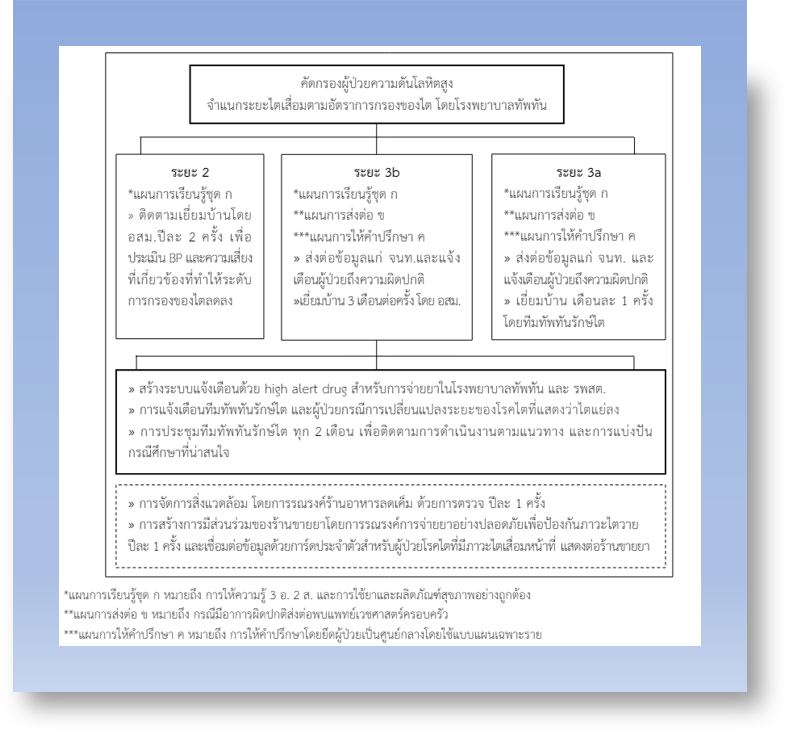
ผลการวิจัย พบว่า แนวทางการดูแลผู้ป่วยความดันโลหิตสูงเพื่อป้องกันโรคไตเรื้อรัง ทำให้อัตราการกรองของไตในผู้ป่วยดีขึ้น ร้อยละ 43.60 และคงเดิม ร้อยละ 49.50 แนวทางประกอบด้วย 3 องค์ประกอบ ได้แก่ 1) สร้างการมีส่วนร่วมของชุมชน 2) การบริการสุขภาพแบบบูรณาการ และเน้นผู้ป่วยเป็นศูนย์กลาง และ 3) การติดตามผลการรักษาผ่านระบบฐานข้อมูลผลลัพธ์ทางพฤติกรรมสุขภาพ และระดับอัตราการกรองของไต แนวทางการดูแลผู้ป่วยที่มีประสิทธิภาพ ควรมีการเชื่อมต่อข้อมูลเพื่อให้ผู้เกี่ยวข้องได้รับทราบข้อมูล โดยนำข้อมูลไปดูแลสุขภาพผู้ป่วยรายบุคคล และทีมสุขภาพที่เชี่ยวชาญ รวมถึงควรติดตาม และดูแลผู้ป่วยอย่างต่อเนื่อง
เอกสารอ้างอิง
Department of Disease Control, Ministry of Public Health. Epidemiology and review of measures to prevent chronic kidney disease [Internet]. 2023 [cite 2023 Mar 6]. Available from: https://ddc.moph.go.th/uploads/publish/1308820220905025852.pdf (in Thai)
World Health Organization (WHO). Global report on hypertension [Internet]. 2023 [cited 2023 Feb 20]. Available from: https://www.who.int/teams/noncommunicable-diseases/hypertension-report
Division of Non Communicable Diseases, Department of Disease Control, Ministry of Public Health. Annual report 2019: Division of Non Communicable Diseases. Bangkok: Aksorn Graphic and Design; 2020 (in Thai)
Ministry of Public Health. Health data center (HDC) chronic kidney disease [Internet]. 2023 [cited 2023 Feb 20]. Available from: https://cbi.hdc.moph.go.th/hdc/reports/report_kpi.php?flag_kpi_level=9&flag_kpi_year=2023&source=kpi/kpi_ckd2.php&id=0f6df79c2f8887f50d7879b5fe91c080 (in Thai)
Diabetes Association of Thailand under The Patronage of Her Royal Highness Princess Maha Chakri Sirindhorn (DAT). Clinical practice guideline for diabetes 2017. Pathum Thani: Romyen Media; 2017. (in Thai)
Kantachuvessiri S, Chancharoenthana W, Kiatsoonthorn K, Khanchasenee P, Chailymphamontree W, Trakanwanich T, editors. A textbook of chronic kidney disease. Bangkok: Text and Journal Publication; 2016. (in Thai)
Ingsathit A, Shayakul C, Chaiprasert A, Thirakhupt P, Sirivongs D, Sangthawan P, et al. Progression and outcomes of CKD in Thai SEEK population [Internet]. 2017 [cite 2023 Feb 20]. Available from: https://kb.hsri.or.th/dspace/handle/11228/4768?locale-attribute=en (in Thai)
Ritchie J, Chongkham-ang S, LeSeure P. Care map development for control of chronic kidney disease in persons with diabetes and hypertension: a case study at a health promoting hospital. Journal of The Royal Thai Army Nurses 2018;19 Suppl 1:230-8. (in Thai)
Theeranut A, Lertsinudom S, Methakanjanasak N, Surit P, Srina C, Wuttanachot W, et al. The synthesis of political suggestion for the development of health service system to delay kidney failure: a case study at Chumphae hospital [Internet]. 2018 [cited 2023 Feb 20]. Available from: https://kb.hsri.or.th/dspace/handle/11228/5262?show=full (in Thai)
Gerald B. Modification of diet in renal disease (V4) [Dataset]. NIDDK Central Repository 2023. doi: 10.58020/h754-eg50.
Carriazo S, Sarafidis P, Ferro CJ, Ortiz A. Blood pressure targets in CKD 2021: the never-ending guidelines debacle. Clinical Kidney Journal 2022;15(5):845-51. doi: 10.1093/ckj/sfac014.
Barr VJ, Robinson S, Marin-Link B, Underhill L, Dotts A, Ravensdale D, et al. The expanded chronic care model: an integration of concepts and strategies from population health promotion and the chronic care model. Hospital Quarterly 2003;7(1):73-82. doi: 10.12927/hcq.2003.16763.
Kemmis S, McTaggart R. Participatory action research: strategies of qualitative inquiry. 3rd ed. Thousand Oaks, CA: Sage; 2007.
Kalantar-Zadeh KT, Li PK, Tantisattamo E, Kumaraswami L, Liakopoulos V, Lui SF, et al. Living well with kidney disease by patient and care-partner empowerment: kidney health for everyone everywhere. Kidney Diseases (Basel) 2021;7(4):247-53. doi: 10.1159/000516604.
Kalantar-Zadeh K, Bellizzi V, Piccoli GB, Shi Y, Lim SK, Riaz S, et al. Caring for patients with advanced chronic kidney disease: dietary options and conservative care instead of maintenance dialysis. Journal of Renal Nutrition 2023;33(4):508-19. doi: 10.1053/j.jrn.2023.02.002.
Whaley-Connell A, Nistala R, Chaudhary K. The importance of early identification of chronic kidney disease. Missouri Medicine 2011;108(1):25-8.
Grill AK, Brimble S. Approach to the detection and management of chronic kidney disease: what primary care providers need to know. Canadian Family Physician 2018;64(10):728-35.
Haldane V, Chuah FLH, Srivastava A, Singh SR, Koh GCH, Seng CK, et al. Community participation in health services development, implementation, and evaluation: a systematic review of empowerment, health, community, and process outcomes. PloS One 2019;14(5):e0216112. doi: 10.1371/journal.pone.0216112.
Evangelidis N, Craig J, Bauman A, Manera K, Saglimbene V, Tong A. Lifestyle behaviour change for preventing the progression of chronic kidney disease: a systematic review. BMJ Open 2019;9(10):e031625. doi: 10.1136/bmjopen-2019-031625.
Li PKT, Garcia-Garcia G, Lui SF, Andreoli S, Fung WWS, Hradsky A, et al. Kidney health for everyone everywhere - from prevention to detection and equitable access to care. Indian Journal of Nephrology 2020;30(2):63-71. doi: 10.4103/ijn.IJN_50_20.
Lin CC, Hwang SJ. Patient-centered self-management in patients with chronic kidney disease: challenges and implications. International Journal of Environmental Research and Public Health 2020;17(24):9443. doi: 10.3390/ijerph17249443.
Kalantar-Zadeh K, Lockwood MB, Rhee CM, Tantisattamo E, Andreoli S, Balducci A, et al. Patient-centred approaches for the management of unpleasant symptoms in kidney disease. Nature Reviews. Nephrology 2022;18(3):185-98. doi: 10.1038/s41581-021-00518-z.
Teng HL, Yen M, Fetzer S, Sung JM, Hung SY. Tailoring health-promoting programs for patients with chronic kidney disease: randomized controlled trial. Western Journal of Nursing Research 2021;43(2):138-50. doi: 10.1177/0193945920942487.
Dineen-Griffin S, Garcia-Cardenas V, Williams K, Benrimoj SI. Helping patients help themselves: a systematic review of self-management support strategies in primary health care practice. PLoS One 2019;14(8):e0220116. doi: 10.1371/journal.pone.0220116.
Samal L, Fu HN, Camara DS, Wang J, Bierman AS, Dorr DA. Health information technology to improve care for people with multiple chronic conditions. Health Services Research 2021;56 Suppl 1:1006-36. doi: 10.1111/1475-6773.13860.
ดาวน์โหลด
เผยแพร่แล้ว
รูปแบบการอ้างอิง
ฉบับ
ประเภทบทความ
สัญญาอนุญาต
ลิขสิทธิ์ (c) 2024 วารสารเกื้อการุณย์

อนุญาตภายใต้เงื่อนไข Creative Commons Attribution-NonCommercial-NoDerivatives 4.0 International License.