
ผลของโปรแกรมสนับสนุนการจัดการตนเองต่อพฤติกรรมการจัดการตนเองเพื่อชะลอความเสื่อมของไตในผู้ป่วยโรคไตเรื้อรังระยะที่ 1 - 2
คำสำคัญ:
โปรแกรมสนับสนุนการจัดการตนเอง , ชะลอความเสื่อมของไต, ผู้ป่วยโรคไตเรื้อรังระยะเริ่มต้นบทคัดย่อ
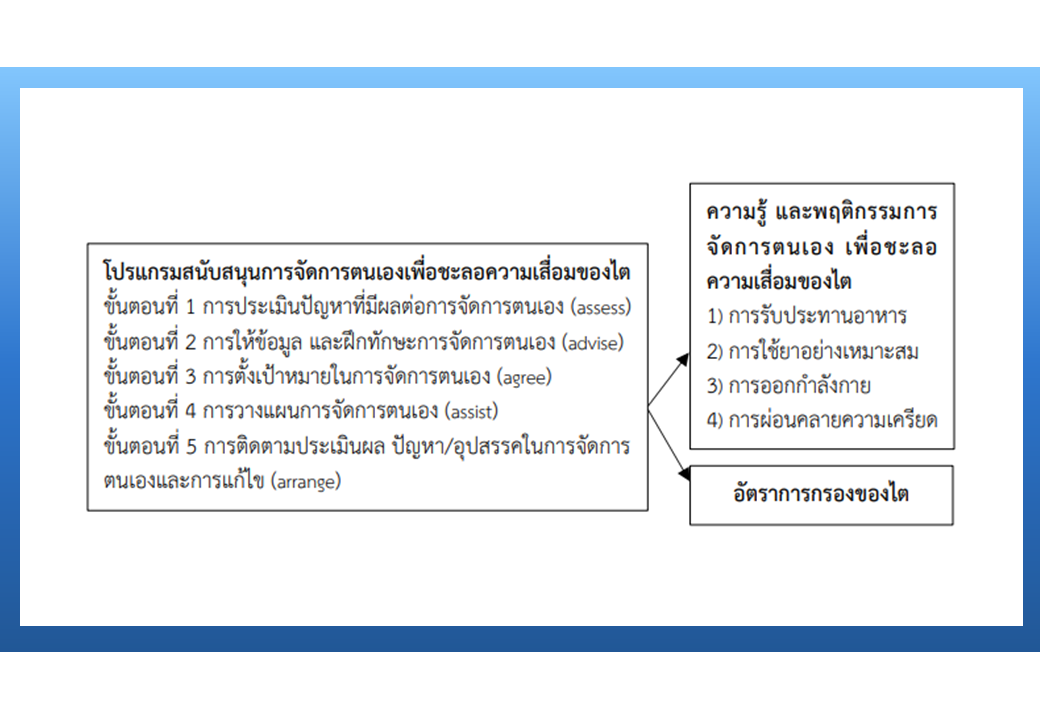
การวิจัยในครั้งนี้ เป็นการศึกษาแบบกลุ่มเดียววัดก่อน และหลังการทดลอง มีวัตถุประสงค์เพื่อศึกษาผลของโปรแกรมสนับสนุนการจัดการตนเองต่อพฤติกรรมการจัดการตนเอง เพื่อชะลอความเสื่อมของไตในผู้ป่วยโรคไตเรื้อรังระยะที่ 1 และ 2 โรงพยาบาลส่งเสริมสุขภาพตำบลนิบงบารู สุ่มกลุ่มตัวอย่างโดยจัดสรรตามสัดส่วน จำนวน 27 ราย เครื่องมือที่ใช้ในการทดลอง คือ โปรแกรมสนับสนุนการจัดการตนเองเพื่อชะลอความเสื่อมของไตในโรคไตเรื้อรังระยะที่ 1 และ 2 เครื่องมือที่ใช้ในการรวบรวมข้อมูล ได้แก่ คู่มือ แบบประเมินความรู้เรื่องโรคไตเรื้อรัง และแบบประเมินพฤติกรรมการจัดการตนเอง ค่าความตรงตามเนื้อหา เท่ากับ 1.00, 1.00 และ .75 ตามลำดับ ค่าความเชื่อมั่นแบบประเมินความรู้เรื่องโรคไตเรื้อรัง โดยวิธี KR-20 เท่ากับ .83 และแบบประเมินพฤติกรรมการจัดการตนเอง ค่าสัมประสิทธิ์แอลฟาครอนบาค เท่ากับ .86 วิเคราะห์ข้อมูลโดยใช้สถิติ ร้อยละ ค่าเฉลี่ย ส่วนเบี่ยงเบนมาตรฐาน และสถิติทีคู่
ผลการวิจัย พบว่า คะแนนเฉลี่ยความรู้ พฤติกรรมการจัดการตนเอง และอัตราการกรองของไตของกลุ่มตัวอย่างหลังได้รับโปรแกรมสูงกว่าก่อนได้รับโปรแกรมอย่างมีนัยสำคัญทางสถิติที่ระดับ .05 (t = 5.25, 4.51 และ 2.56 ตามลำดับ) ดังนั้น บุคลากรทางสุขภาพควรนำโปรแกรมนี้ไปใช้ในการดูแลกลุ่มผู้ป่วยโรคไตเรื้อรังระยะที่ 1 - 2 เพื่อชะลอความเสื่อมของไต ป้องกันการเกิดภาวะแทรกซ้อน และเพิ่มคุณภาพชีวิต
เอกสารอ้างอิง
Division of Non Communicable Diseases, Ministry of Public Health. Epidemiology and review of preventive measures for chronic kidney disease [Internet]. 2022 [cited 8 Oct 2021]. Avalilable from: https://ddc.moph.go.th/uploads/publish/1308820220905025852.pdf (in Thai)
Department of Disease Control, Ministry of Public Health. Operational manual for reducing chronic kidney disease CKD in diabetic patients and hypertension [Internet]. 2015 [cited 8 Oct 2021]. Avalilable from: http://thaincd.com/document/file/download/knowledge/คู่มือปฏิบัติการเพื่อลดโรคไตเรื้อรัง (CKD).pdf (in Thai)
Radhika D, Lorraine SW. Application of the content expert process to develop a clinically useful low-literacy chronic kidney disease self-management knowledge tool (CKD-SMKT). Research in Social Administrative Pharmacy 2023;9(5):633-9. doi: 10.1016/j.sapharm.2012.09.006.
Srisawat N, Pisitkul T, Tungsanga S, Komolpis K, Peerapornratana S. Total solution for early screening of chronic kidney disease using albuminuria test kits in primary care [Internet]. 2022 [cited 8 Oct 2021]. Avalilable from: https://kb.hsri.or.th/dspace/handle/11228/5706?locale-attribute=th (in Thai)
The Nephrology Society of Thailand. Clinical practice recommendation for the evaluation and management of chronic Kidney disease in adults 2022 [Internet]. 2022 [cited 6 Oct 2021]. Avalilable from: https://www.nephrothai.org/wp-content/uploads/2023/03/CKD-guideline-2565-revised-edition.pdf (in Thai)
Thanakitjaru P. Current situation of chronic kidney disease in Thailand. Journal of the Department of Medical Services 2015;(5):5-17. (in Thai)
The Nephrology Society of Thailand. Thailand renal replacement therapy: year 2016 - 2019 [Internet]. 2015 [cited 9 Oct 2021]. Avalilable from: https://www.nephrothai.org/wpcontent/uploads/2021/01/1.TRT-Annual-report-2016-2019.pdf (in Thai)
Avihingsanon Y, Kittisakulnam P. Kidney disease: a complete guide to the prevention and care of kidney disease patients. Bankok: Amarin Health; 2018. (in Thai)
Glasgow RE, Emont S, Miller DC. Assessing delivery of the five ‘As’ for patient-centered counseling. Health Promotion International 2016;21(3):245-55. doi: 10.1093/heapro/dal017.
Sonjai W, Junprasert S, Krungkripetch N. The effects of self-management on health behaviors and kidney function of chronic illness patients with chronic kidney injury stage 2. Journal of Health Science Research 2018;12(2)88-97. (in Thai)
Thungtong S, Chinnawong T, Thaniwattananon P. Effects of self-management support program for delayed progression of diabetic nephropathy on self-management behaviors and clinical outcomes in patients with un-controlled type 2 diabetes mellitus. Songklanagarind Journal of Nursing 2015;35(1):67-84. (in Thai)
Chosivasaku K, Piaseu N. Effects of a programme integrating multidisciplinary approach and self-management on chronic kidney disease patients with complications. Thai Journal of Nursing Council 2017;32(4)79-99. (in Thai)
Taweebut P, Kerdmongko P, Amnatsatsue K. The effect of a supportive-educative nursing program for chronic disease patients with early stage kidney disease. Journal of Public Health Nursing 2017;31(1):129-45. (in Thai)
Hanpaiboon K, Pratoomsoot C. Factors influencing patient health behaviors for delaying the progress in stage 3 - 4 chronic kidney disease patients at Khlongkhlung hospital, Khampangphet province. Thai Pharmaceutical and Health Science Journal 2019;14(2):53-61. (in Thai)
Suwanpukdee S, Wangwonsin A. Factors affecting self-care behavior for delaying the deterioration of chronic kidney disease among type 2 diabetic patients, Plak Raet sub-district, Bang Rakam district, Phitsanulok province. Disease Control Journal 2021;47(1):655-63. (in Thai)
Chaiwong N, Duangpaeng S, Masingboon K. Factors influencing self-management behaviors among acute myocardial infarction patients. Thai Pharmaceutical and Health Science Journal 2014;9(3):112-9. (in Thai)
Cohen J. Statistical Power Analysis for Behavioral Sciences. New York: Lawrence Erlbaum Associates Publishers; 1988.
Bloom BS. Taxonomy of Education Objectives, Handbook 1: Cognitive Domain [Internet]. 1956 [cited 6 Oct 2021]. Avalilable from: https://eclass.uoa.gr/modules/document/file.php/PPP242/Benjamin%20S.%20Bloom%20%20Taxonomy%20of%20Educational%20Objectives%2C%20Handbook%201_%20Cognitive%20Domain-Addison%20Wesley%20Publishing%20Company%20%281956%29.pdf
Sanee A. Self-management program in chronic diseases. Journal of The Royal Thai Army Nurses 2014;15(2):129-34. (in Thai)
Prasongwattana S, Suksuwan A, Umbangthalud D. Effects of development for type II diabetes care model in preventing and delaying the progression of diabetic kidney disease Bang Pa-in hospital. Journal of Preventive Medicine Association of Thailand 2017;7(1):65-76. (in Thai)
ดาวน์โหลด
เผยแพร่แล้ว
รูปแบบการอ้างอิง
ฉบับ
ประเภทบทความ
สัญญาอนุญาต
ลิขสิทธิ์ (c) 2023 วารสารเกื้อการุณย์

อนุญาตภายใต้เงื่อนไข Creative Commons Attribution-NonCommercial-NoDerivatives 4.0 International License.