
ปัจจัยที่มีอิทธิพลต่อการเปิดเผยตัวของผู้ติดเชื้อเอชไอวีและผู้ป่วยเอดส์จังหวัดแห่งหนึ่งในภาคเหนือตอนล่าง
คำสำคัญ:
การเปิดเผยตัว, ผู้ติดเชื้อเอชไอวีและผู้ป่วยเอดส์, การเห็นคุณค่าในตนเอง, การยอมรับของครอบครัวและสังคม, การเข้าถึงบริการสุขภาพบทคัดย่อ
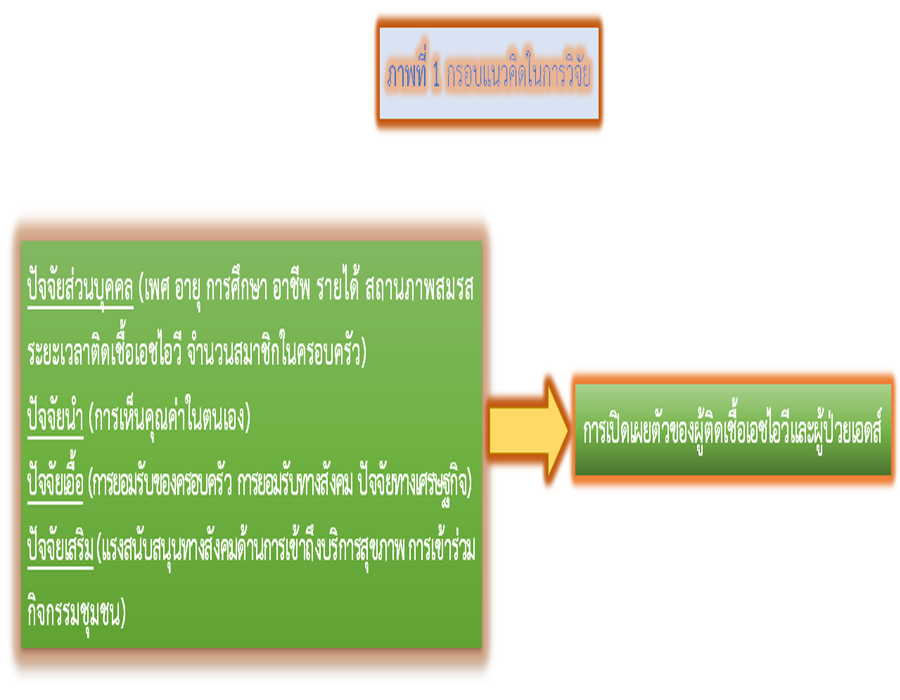
การวิจัยแบบภาคตัดขวางเชิงวิเคราะห์นี้ มีวัตถุประสงค์เพื่อศึกษาปัจจัยที่มีอิทธิพลต่อการเปิดเผยตัวของผู้ติดเชื้อเอชไอวีและผู้ป่วยเอดส์จังหวัดแห่งหนึ่งในภาคเหนือตอนล่าง กลุ่มตัวอย่างคือ ผู้ติดเชื้อเอชไอวีและผู้ป่วยเอดส์ที่มารับบริการคลินิกยาต้านไวรัส ณ โรงพยาบาลชุมชนจังหวัดพิจิตร จำนวน 333 คน เครื่องมือที่ใช้คือ แบบสอบถามด้านต่าง ๆ ดังนี้ ข้อมูลส่วนบุคคล การเห็นคุณค่าในตนเอง การยอมรับของครอบครัว การยอมรับทางสังคม ปัจจัยทางเศรษฐกิจ การเข้าถึงบริการสุขภาพ การเข้าร่วมกิจกรรมชุมชน และการเปิดเผยตัว มีค่าดัชนีความตรงเชิงเนื้อหา (Content validity index: CVI) เท่ากับ .95 ค่าความเชื่อมั่น เท่ากับ .90, .85, .76, .80, .87, .96 และ .80 ตามลำดับ วิเคราะห์ข้อมูลโดยใช้สถิติการวิเคราะห์การถดถอยพหุคูณ
ผลการวิจัย พบว่า กลุ่มตัวอย่างมีการเปิดเผยตัวอยู่ในระดับต่ำ ปัจจัยที่มีอิทธิพลต่อการเปิดเผยตัวประกอบด้วย การยอมรับของครอบครัว ปัจจัยทางเศรษฐกิจ การยอมรับทางสังคม และการเข้าถึงบริการสุขภาพ สามารถร่วมกันทำนายการเปิดเผยตัวของผู้ติดเชื้อเอชไอวีและผู้ป่วยเอดส์ได้ ร้อยละ 29.00 อย่างมีนัยสำคัญทางสถิติที่ระดับ .05 ข้อเสนอแนะจากการศึกษา ควรพิจารณากำหนดนโยบายสร้างการยอมรับของครอบครัวและสังคม การสนับสนุนทางเศรษฐกิจและโอกาสในการเข้าถึงบริการ สร้างภาคีเครือข่ายทุกภาคส่วน สื่อสารประชาสัมพันธ์ลดการตีตราแบบมีส่วนร่วม ทั้งภาครัฐ เอกชน และภาคประชาสังคม
เอกสารอ้างอิง
Damrongkwan K. AIDS, the beginning of learning from Bamras hospital in the past. 1st ed. Nonthaburi: PNS Creation Limited Partnership; 2018. (in Thai)
National Committee for the Prevention and Response to AIDS. Thailand National Strategy to end AIDS 2017-2030. Bangkok: NC Concept Company Limited; 2017. (in Thai)
National Health Security Office (NHSO). Information services for HIV-infected people [Internet]. 2019 [cited 2019 Aug 30]. Available from: http://napdl.nhso.go.th/NAPWebReport/LoginServlet (in Thai)
Adam BD, Corriveau P, Elliott R, Globerman J, English K, Rourke S. HIV disclosure as practice and public policy. Critical Public Health 2015;25(4):386-97.
Laothong K, Chayachinda C, Pongprasobchai S, Thanyatul P, Nooma P, Chalermchockcharoenkit A, et al. Factors influencing HIV serostatus disclosure among Thai women. Siriraj Medical Bulletin 2018;11(1):2-8. (in Thai)
Infectious Diseases and Vectors Information Center. Basic knowledge of AIDS [Internet]. 2019 [cited 2019 Aug 30]. Available from: http://webdb.dmsc.moph.go.th/ifc_nih/a_nih_1_001c.asp?info_id=901 (in Thai)
Sermrittirong S, Thanyakittikul P, Poladech S. A literature systematic review: the effects of stigma on people affected by leprosy, tuberculosis and HIV/AIDS. Disease Control Journal 2018;44(1):19-29. (in Thai)
Senanoi R, Virasiri S. Stress and adaptation among families living with HIV/AIDS persons: case analysis by family resiliency theory. Songklanagarind Journal of Nursing 2019;39(4):120-28. (in Thai)
Evangeli M, Wroe AL. HIV disclosure anxiety: a systematic review and theoretical synthesis. AIDS and Behavior 2017;21(1):1-11.
Chaiponbal S, Visudtibhan PJ, Arpanantikun M. Relationships between selected factors and HIV disclosure of Thai women to their partners. Nursing Journal of the Ministry of Public Health 2018;28(2):80-93. (in Thai)
Kalichman SC, Kalichman MO, Cherry C, Grebler T. HIV disclosure and transmission risks to sex partners among HIV-positive men. AIDS Patient Care and STDs 2016;30(5):221-8.
Spangler SA, Abuogi LL, Akama E, Bukusi EA, Odeny TA, Onono M, et al. From 'half-dead' to being 'free': resistance to HIV stigma, self-disclosure and support for PMTCT/HIV care among couples living with HIV in Kenya. Culture, Health and Sexuality 2018;20(5):489-503.
Muangma N, Lalitanantpong D. Resilience and social support in HIV/AIDS clients at the HIV Netherlands Australia Thailand Research Collaboration, Thai Red Cross AIDS Research Centre. Chulalongkorn Medical Journal 2018;62(6):947-63. (in Thai)
Dessalegn NG, Sawleshwarkar S, Hailemichael RG, Shewa-Amare A, Lodebo B, Amberbir A, et al. HIV disclosure: HIV-positive status disclosure to sexual partners among individuals receiving HIV care in Addis Ababa, Ethiopia. PLoS ONE 2019;14(2):e0211967.
Madiba S, Mokgatle M. Perceptions and experiences about self-disclosure of HIV status among adolescents with perinatal acquired HIV in poor-resourced communities in South Africa. AIDS Research and Treatment 2016;2016:2607249.
National AIDS Prevention and Solution Committee. National Strategy on ending AIDS problems 2017 - 2030. Bangkok: NC Concept Company Limited; 2019. (in Thai)
Sullivan KM. Sample size for a proportion or descriptive study [Internet]. 2019 [cited 2020 Aug 30]. Available from: https://www.openepi.com/SampleSize/SSPropor.htm
National Statistical Office. Household income [Internet]. 2019 [cited 2020 Aug 30]. Available from: http://statbbi.nso.go.th/staticreport/page/sector/th/08.aspx (in Thai)
Thailand HIV Information Center, Department of Disease Control, Ministry of Public Health. The stigma and discrimination situation [Internet]. 2019 [cited 2019 Aug 29]. Available from: https://hivhub.ddc.moph.go.th/epidemic.php (in Thai)
Go VF, Latkin C, Minh NL, Frangakis C, Ha TV, Sripaipan T, et al. Variations in the role of social support on disclosure among newly diagnosed HIV-infected people who inject drugs in Vietnam. AIDS and Behavior 2016;20(1):155-64.
Nöstlinger C, Bakeera-Kitaka S, Buyze J, Loos J, Buvé A. Factors influencing social self-disclosure among adolescents living with HIV in Eastern Africa. AIDS Care 2015;27 Suppl 1:36-46.
Sittikan S, Jongudomkarn D. Barriers to access of primary healthcare by people with low income in urban communities: a qualitative study. Journal of Nursing Science and Health 2020;43(1):19-29. (in Thai)
ดาวน์โหลด
เผยแพร่แล้ว
รูปแบบการอ้างอิง
ฉบับ
ประเภทบทความ
สัญญาอนุญาต
ลิขสิทธิ์ (c) 2022 วารสารเกื้อการุณย์

อนุญาตภายใต้เงื่อนไข Creative Commons Attribution-NonCommercial-NoDerivatives 4.0 International License.