
Iron-polyphenol complexes in cancer theranostics: Coordination chemistry, therapeutic mechanisms, and molecular imaging
Article Sidebar
Main Article Content
Abstract
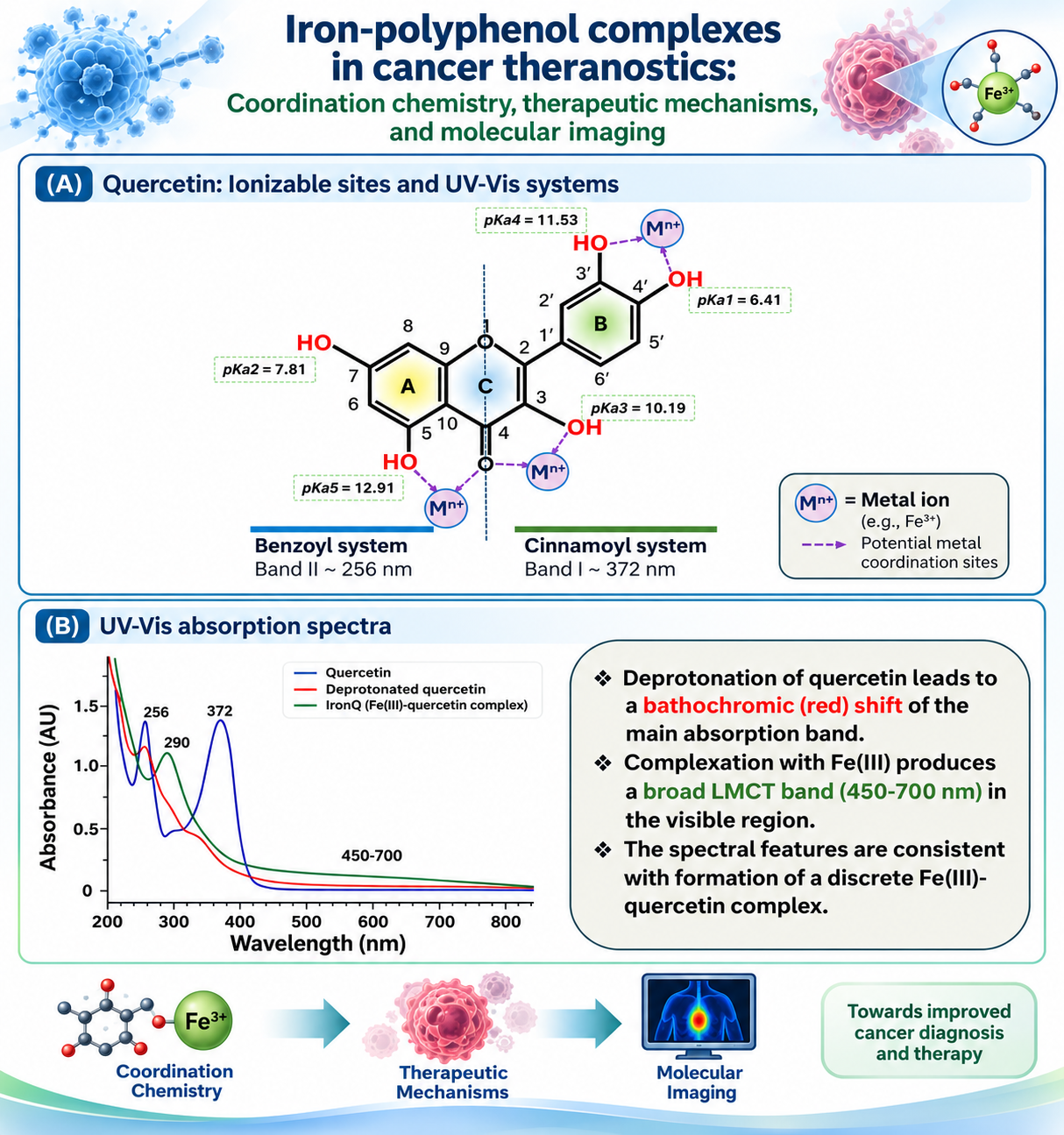
Background: Iron-polyphenol complexes have emerged as promising theranostic platforms by integrating the biological activity of polyphenols with the redox and coordination properties of iron. Their ability to form discrete molecular complexes and metal-phenolic networks (MPNs) provides tunable control over iron stability, redox activity, cargo delivery, and imaging performance. Since cancer cells exhibit altered iron metabolism and increased dependence on iron availability, these systems offer opportunities for exploiting tumor-specific vulnerabilities through ferroptosis, chemodynamic therapy, and multifunctional molecular imaging.
Objectives: This review aims to summarize recent advances in iron-polyphenol systems for cancer theranostics, focusing on the relationship between coordination chemistry, therapeutic mechanisms, and imaging applications. Particular emphasis is placed on discrete Fe-polyphenol complexes, metal-phenolic networks, coordination polymers, and iron-containing hybrid nanoplatforms, including their structural characteristics, anticancer mechanisms, imaging capabilities, biological limitations, and translational challenges.
Materials and methods: A structured literature search was conducted using PubMed, Scopus, and Web of Science from database inception to August 2026. Studies related to Fe(II)/Fe(III)-polyphenol coordination systems, including polyphenolic ligands such as catechol, tannic acid, gallic acid, quercetin, and related architectures, were evaluated. Eligible studies included original research investigating coordination chemistry, cancer therapy, molecular imaging, biodistribution, pharmacokinetics, safety, or translational aspects. Non-iron metal-polyphenol systems, iron materials lacking polyphenolic coordination, and unrelated applications were excluded.
Results: Iron-polyphenol platforms demonstrate diverse anticancer activities through coordination-controlled mechanisms, including ferroptosis induction, Fe-mediated chemodynamic therapy, photothermal therapy, drug delivery, and immune modulation. The therapeutic and imaging behavior of these systems is strongly influenced by ligand identity, Fe oxidation state, coordination stoichiometry, pH responsiveness, and supramolecular architecture. Iron-polyphenol complexes and MPNs also show potential as gadolinium-free MRI contrast agents, photoacoustic imaging platforms, and immune-cell tracking probes. However, clinical translation remains limited by structural heterogeneity, biological barriers such as protein corona formation and reticuloendothelial system uptake, incomplete biodistribution understanding, long-term iron toxicity concerns, and challenges in scalable manufacturing and quality control.
Conclusion: Iron-polyphenol complexes represent a versatile class of theranostic materials that bridge natural product chemistry, redox-regulated cancer therapy, and molecular imaging. Their tunable coordination chemistry enables rational development of multifunctional platforms; however, successful clinical translation requires improved structural standardization, reproducible manufacturing, comprehensive safety evaluation, and quality-controlled production strategies. Continued investigation into coordination-structure-function relationships will be essential for advancing iron-polyphenol systems toward clinically relevant precision cancer theranostics.
Article Details

This work is licensed under a Creative Commons Attribution-NonCommercial-NoDerivatives 4.0 International License.
Personal views expressed by the contributors in their articles are not necessarily those of the Journal of Associated Medical Sciences, Faculty of Associated Medical Sciences, Chiang Mai University.
References
Waldron KJ, Rutherford JC, Ford D, Robinson NJ. Metalloproteins and metal sensing. Nature. 2009;460(7257):823-30.
Andreini C, Bertini I, Cavallaro G, Holliday GL, Thornton JM. Metal ions in biological catalysis: from enzyme databases to general principles. JBIC Journal of Biological Inorganic Chemistry. 2008;13(8):1205-18.
Crans DC, Kostenkova K. Open questions on the biological roles of first-row transition metals. Communications Chemistry. 2020;3(1):104.
Solomon EI, Heppner DE, Johnston EM, Ginsbach JW, Cirera J, Qayyum M, et al. Copper active sites in biology. Chemical reviews. 2014;114(7):3659-853.
Dai J, Mumper RJ. Plant phenolics: extraction, analysis and their antioxidant and anticancer properties. Molecules. 2010;15(10):7313-52.
Perron NR, Brumaghim JL. A review of the antioxidant mechanisms of polyphenol compounds related to iron binding. Cell biochemistry and biophysics. 2009;53(2):75-100.
Leopoldini M, Russo N, Toscano M. The molecular basis of working mechanism of natural polyphenolic antioxidants. Food chemistry. 2011;125(2):288-306.
Hider RC, Kong X. Iron speciation in the cytosol: an overview. Dalton Transactions. 2013;42(9):3220-9.
Heim KE, Tagliaferro AR, Bobilya DJ. Flavonoid antioxidants: chemistry, metabolism and structure-activity relationships. The Journal of nutritional biochemistry. 2002;13(10):572-84.
Guo J, Ping Y, Ejima H, Alt K, Meissner M, Richardson JJ, et al. Engineering multifunctional capsules through the assembly of metal-phenolic networks. Angewandte Chemie International Edition. 2014;53(22):5546-51.
Ejima H, Richardson JJ, Liang K, Best JP, van Koeverden MP, Such GK, et al. One-step assembly of coordination complexes for versatile film and particle engineering. Science. 2013; 341(6142):154-7.
Rahim MA, Kristufek SL, Pan S, Richardson JJ, Caruso F. Phenolic building blocks for the assembly of functional materials. Angewandte Chemie International Edition. 2019;58(7):1904-27.
Zhang Y, Hao F, Liu Y, Yang M, Zhang B, Bai Z, et al. Recent advances of copper-based metal phenolic networks in biomedical applications. Colloids and Surfaces B: Biointerfaces. 2024;244:114163.
Lelièvre P, Sancey L, Coll JL, Deniaud A, Busser B. Iron Dysregulation in Human Cancer: Altered Metabolism, Biomarkers for Diagnosis, Prognosis, Monitoring and Rationale for Therapy. Cancers (Basel). 2020;12(12).
Ciscar M, Rodríguez-Santana C, Santana-Codina N. Iron and metabolic rewiring in cancer. Oncogenesis. 2026;15(1):1.
Anghileri LJ, Thouvenot P. Natural polyphenols-iron interaction: its biological importance. Biological Trace Element Research. 2000;73(3):251-8.
Khokhar S, Apenten RKO. Iron binding characteristics of phenolic compounds: some tentative structure-activity relations. Food Chemistry. 2003;81(1):133-40.
Malacaria L, Corrente GA, Beneduci A, Furia E, Marino T, Mazzone G. A review on coordination properties of Al (III) and Fe (III) toward natural antioxidant molecules: Experimental and theoretical insights. Molecules. 2021;26(9):2603.
Sever MJ, Wilker JJ. Visible absorption spectra of metal-catecholate and metal–tironate complexes. Dalton transactions. 2004(7):1061-72.
Lin Z, Liu H, Richardson JJ, Xu W, Chen J, Zhou J, et al. Metal–phenolic network composites: from fundamentals to applications. Chemical Society Reviews. 2024;53(22):10800-26.
Geng H, Zhong Q-Z, Li J, Lin Z, Cui J, Caruso F, et al. Metal ion-directed functional metal-phenolic materials. Chemical Reviews. 2022;122(13):11432-73.
Zhou J, Lin Z, Ju Y, Rahim MA, Richardson JJ, Caruso F. Polyphenol-mediated assembly for particle engineering. Accounts of chemical research. 2020;53(7):1269-78.
Bijlsma J, de Bruijn W, Hageman J, Goos P, Velikov K, Vincken J-P. Revealing the main factors and two-way interactions contributing to food discolouration caused by iron-catechol complexation. Scientific Reports. 2020;10.
Liu X-L, Wang H-C, Yang T, Yue X-Z, Yi S-S. Functions of metal-phenolic networks and polyphenol derivatives in photo (electro) catalysis. Chemical Communications. 2023;59(92):13690-702.
Fu Z, Chen R. Study of complexes of tannic acid with Fe (III) and Fe (II). Journal of analytical methods in chemistry. 2019;2019(1):3894571.
Sarza RMO, Villarino CBJ, Gregorio CGC. based Device for the Detection and Quantification of Total Polyphenols in Plant-based Beverages for Potential Use in Quality Assurance Purposes. Philippine Journal of Science. 2022;151(1):193-204.
Papan P, Kantapan J, Sangthong P, Meepowpan P, Dechsupa N. Iron (III)‐quercetin complex: Synthesis, physicochemical characterization, and MRI cell tracking toward potential applications in regenerative medicine. Contrast media & molecular imaging. 2020;2020(1):8877862.
Perron NR, Hodges JN, Jenkins M, Brumaghim JL. Predicting how polyphenol antioxidants prevent DNA damage by binding to iron. Inorganic Chemistry. 2008;47(14):6153-61.
Winterbourn CC. Reconciling the chemistry and biology of reactive oxygen species. Nature chemical biology. 2008;4(5):278-86.
Dixon SJ, Stockwell BR. The role of iron and reactive oxygen species in cell death. Nature chemical biology. 2014;10(1):9-17.
Liang C, Zhang X, Yang M, Dong X. Recent progress in ferroptosis inducers for cancer therapy. Advanced materials. 2019;31(51):1904197.
Caravan P, Ellison JJ, McMurry TJ, Lauffer RB. Gadolinium (III) chelates as MRI contrast agents: structure, dynamics, and applications. Chemical reviews. 1999;99(9):2293-352.
Frešer F, Hostnik G, Tošović J, Bren U. Dependence of the Fe (II)-gallic acid coordination compound formation constant on the pH. Foods. 2021; 10(11):2689.
Dechsupa N, Kosintarajit P, Kamkan K, Khanjina T, Sirikul C, Innuan P, et al. Iron (III)-quercetin complexes’ safety for MRI cell tracking in cell therapy applications: cytotoxic and genotoxic assessment. Nanomaterials. 2022;12(16):2776.
San Yeoh B, Olvera RA, Singh V, Xiao X, Kennett MJ, Joe B, et al. Epigallocatechin-3-gallate inhibition of myeloperoxidase and its counter-regulation by dietary iron and lipocalin 2 in murine model of gut inflammation. The American journal of pathology. 2016;186(4):912-26.
Tian Q, Cai Y, Li N, Liu Q, Gu B, Chen Z-G, et al. Ellagic acid–Fe nanoscale coordination polymer with higher longitudinal relaxivity for dual-modality T1-weighted magnetic resonance and photoacoustic tumor imaging. Nanomedicine: Nanotechnology, Biology and Medicine. 2020;28:102219.
Szwed M, Poczta-Krawczyk A, Bukowski K, Marczak A. Nanoparticle-Mediated Ferroptosis for Cancer Therapy: Mechanisms and Therapeutic Strategies. Nanotechnol Sci Appl. 2025;18:445-70.
Wang S, Bai X, Wang X, Wang J, Tao W, Gao Y, et al. Metal Polyphenol Nanoparticle-Based Chemo/Ferroptosis Synergistic Therapy for the Treatment of Oral Squamous Cell Carcinoma. Bioconjugate Chemistry. 2024;35(11):1835-42.
Liu T, Zhang M, Liu W, Zeng X, Song X, Yang X, et al. Metal Ion/Tannic Acid Assembly as a Versatile Photothermal Platform in Engineering Multimodal Nanotheranostics for Advanced Applications. ACS Nano. 2018;12(4):3917-27.
Jin Q, Zhu W, Jiang D, Zhang R, Kutyreff CJ, Engle JW, et al. Ultra-small iron-gallic acid coordination polymer nanoparticles for chelator-free labeling of 64Cu and multimodal imaging-guided photothermal therapy. Nanoscale. 2017;9(34):12609-17.
Saowalak K, Titipun T, Somchai T, Chalermchai P. Iron (III)-tannic molecular nanoparticles enhance autophagy effect and T1 MRI contrast in liver cell lines. Scientific reports. 2018;8(1):6647.
Yin W, Chang J, Sun J, Zhang T, Zhao Y, Li Y, et al. Nanomedicine-mediated ferroptosis targeting strategies for synergistic cancer therapy. Journal of Materials Chemistry B. 2023;11(6):1171-90.
Wei R, Fu G, Li Z, Liu Y, Xue M. Engineering Iron-Based Nanomaterials for Breast Cancer Therapy Associated with Ferroptosis. Nanomedicine. 2024;19(6):537-55.
Li L, Pan J, Huang M, Sun J, Wang C, Xu H. Metal-Phenolic Networks: A Promising Frontier in Cancer Theranostics. International Journal of Nanomedicine. 2024;19(null):11379-95.
Chen F, Yang B, Xu L, Yang J, Li J. A CaO(2) @Tannic Acid-Fe(III) Nanoconjugate for Enhanced Chemodynamic Tumor Therapy. ChemMedChem. 2021;16(14):2278-86.
Liu P-Y, Miao Z-H, Li K, Yang H, Zhen L, Xu C-Y. Biocompatible Fe3+–TA coordination complex with high photothermal conversion efficiency for ablation of cancer cells. Colloids and Surfaces B: Biointerfaces. 2018;167:183-90.
Sang W, Xie L, Wang G, Li J, Zhang Z, Li B, et al. Oxygen‐enriched metal‐phenolic X‐ray nanoprocessor for cancer radio‐radiodynamic therapy in combination with checkpoint blockade immunotherapy. Advanced Science. 2021;8(4):2003338.
Xie L, Li J, Wang G, Sang W, Xu M, Li W, et al. Phototheranostic metal-phenolic networks with antiexosomal PD-L1 enhanced ferroptosis for synergistic immunotherapy. Journal of the American Chemical Society. 2022;144(2):787-97.
Zhang D, Zhang J, Bian X, Zhang P, Wu W, Zuo X. Iron Oxide Nanoparticle-Based T1 Contrast Agents for Magnetic Resonance Imaging: A Review. Nanomaterials. 2025;15(1):33.
Wu J-R, Wang Y-R, Du J-Y, Liu X-Y, Zhang X-L, Kang Y-F. pH-Responsive Metal-Phenolic Network Nanoparticles for Synergistic Chemo-Photodynamic Antibacterial Therapy. ACS Applied Nano Materials. 2024;7:28408-18.
Chen Z, Yu D, Wang S, Zhang N, Ma C, Lu Z. Biocompatible Nanocomplexes for Molecular Targeted MRI Contrast Agent. Nanoscale Res Lett. 2009;4(7):618-26.
Qin J, Guo N, Yang J, Chen Y. Recent advances of metal–polyphenol coordination polymers for biomedical applications. Biosensors. 2023;13(8):776.
Wan Y, An L, Zhu Z, Tian Q, Lin J, Yang S. Iron-polyphenol dendritic complexes for regulating amplification of phenolic hydroxyl groups to improve magnetic resonance imaging. Chemical Engineering Journal. 2023;458:141322.
Gupta A, Caravan P, Price WS, Platas-Iglesias C, Gale EM. Applications for transition-metal chemistry in contrast-enhanced magnetic resonance imaging. Inorganic chemistry. 2020;59(10):6648-78.
Zhao Y-D, Muhetaerjiang M, An H-W, Fang X, Zhao Y, Wang H. Nanomedicine enables spatiotemporally regulating macrophage-based cancer immunotherapy. Biomaterials. 2021;268:120552.
Ahrens ET, Bulte JW. Tracking immune cells in vivo using magnetic resonance imaging. Nat Rev Immunol. 2013;13(10):755-63.
Shi J, Kantoff PW, Wooster R, Farokhzad OC. Cancer nanomedicine: progress, challenges and opportunities. Nat Rev Cancer. 2017;17(1):20-37.
Milligan JJ, Saha S. A Nanoparticle’s Journey to the Tumor: Strategies to Overcome First-Pass Metabolism and Their Limitations. Cancers (Basel). 2022;14(7).
Xu W, Lin Z, Pan S, Chen J, Wang T, Cortez-Jugo C, et al. Direct Assembly of Metal-Phenolic Network Nanoparticles for Biomedical Applications. Angew Chem Int Ed Engl. 2023;62(45):e202312925.
Diao J, Jia Y, Dai E, Liu J, Kang R, Tang D, et al. Ferroptotic therapy in cancer: benefits, side effects, and risks. Mol Cancer. 2024;23(1):89.
Feng Q, Liu Y, Huang J, Chen K, Huang J, Xiao K. Uptake, distribution, clearance, and toxicity of iron oxide nanoparticles with different sizes and coatings. Sci Rep. 2018;8(1):2082.
Arami H, Khandhar A, Liggitt D, Krishnan KM. In vivo delivery, pharmacokinetics, biodistribution and toxicity of iron oxide nanoparticles. Chem Soc Rev. 2015;44(23):8576-607.
Đorđević S, Gonzalez MM, Conejos-Sánchez I, Carreira B, Pozzi S, Acúrcio RC, et al. Current hurdles to the translation of nanomedicines from bench to the clinic. Drug Deliv Transl Res. 2022;12(3):500-25.
Dri DA, Rinaldi F, Carafa M, Marianecci C. Nanomedicines and nanocarriers in clinical trials: surfing through regulatory requirements and physico-chemical critical quality attributes. Drug Deliv Transl Res. 2023;13(3):757-69.
Chen W, Liu M, Yang H, Nezamzadeh-Ejhieh A, Lu C, Pan Y, et al. Recent Advances of Fe(III)/Fe(II)-MPNs in Biomedical Applications. Pharmaceutics. 2023;15(5).
