
Prevalence and patterns of abnormal urinalysis findings among undergraduate students in a screening context
Article Sidebar
Main Article Content
Abstract
Background: Urinalysis is widely used as a simple and inexpensive screening tool. However, the overall prevalence of "abnormal" findings in asymptomatic populations may be difficult to interpret when clinically relevant findings are combined with nonspecific changes in urine concentration or appearance.
Objectives: To determine the prevalence and patterns of abnormal urinalysis findings among undergraduate students, distinguish clinical findings from those related to urine concentration and appearance, and examine their associations with water and beverage consumption and urinary health awareness.
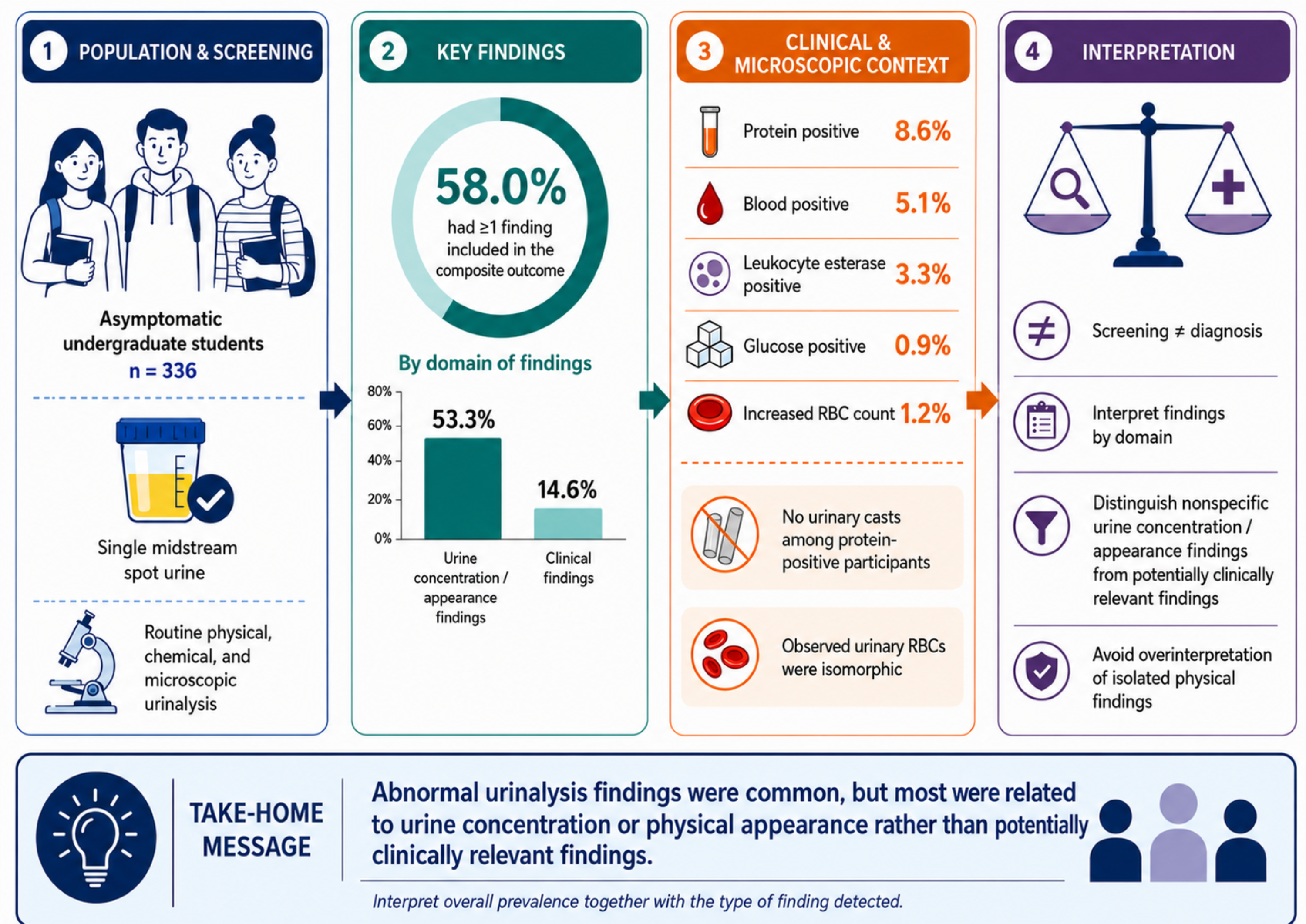
Materials and methods: This cross-sectional study included 336 undergraduate students. A single midstream spot urine specimen was collected from each participant and evaluated by physical, chemical, and microscopic examination. The primary outcome was the presence of at least one abnormal urinalysis finding according to prespecified criteria. Clinical findings were summarized separately from findings related to urine concentration and appearance. Associations with plain water intake, beverage consumption, and urinary health awareness were examined using Poisson regression with robust variance estimation, with adjustment for age and gender.
Results: Overall, 58.0% of participants had at least one abnormal urinalysis finding. However, most findings involved urine concentration or appearance (53.3%), whereas clinical findings were observed in only 14.6%. High urinary health awareness was associated with a higher prevalence of the composite urinalysis outcome (adjusted prevalence ratio 1.32; 95% confidence interval 1.04-1.68). Consumption of more than seven glasses of milk-added brewed beverages per week was also associated with the composite outcome, whereas plain water intake and other beverage categories were not significantly associated.
Conclusion: The high overall prevalence of abnormal urinalysis findings was driven mainly by findings related to urine concentration and appearance rather than by clinical findings. Reporting only the composite prevalence may therefore suggest a greater burden of clinically relevant abnormalities than was actually observed. Separating clinical findings from those related to urine concentration or appearance provides a clearer and more appropriate framework for interpreting screening urinalysis.
Article Details

This work is licensed under a Creative Commons Attribution-NonCommercial-NoDerivatives 4.0 International License.
Personal views expressed by the contributors in their articles are not necessarily those of the Journal of Associated Medical Sciences, Faculty of Associated Medical Sciences, Chiang Mai University.
References
Simerville JA, Maxted WC, Pahira JJ. Urinalysis: a comprehensive review. Am Fam Physician. 2005; 71(6): 1153-62.
Delanghe J, Speeckaert M. Preanalytical requirements of urinalysis. Biochem Med (Zagreb). 2014; 24(1): 89-104. doi: 10.11613/BM.2014.011.
World Health Organization. Screening programmes: a short guide. Increase effectiveness, maximize benefits and minimize harm. Copenhagen: WHO Regional Office for Europe; 2020.
Armstrong LE, Johnson EC, McKenzie AL, Muñoz CX. Interpreting common hydration biomarkers on the basis of solute and water excretion. Eur J Clin Nutr. 2013; 67(3): 249-53. doi: 10.1038/ejcn.2012.214.
Perrier E, Rondeau P, Poupin M, Le Bellego L, Armstrong LE, Lang F, et al. Relation between urinary hydration biomarkers and total fluid intake in healthy adults. Eur J Clin Nutr. 2013; 67(9): 939-43. doi: 10.1038/ejcn.2013.93.
Feng Y, Fang G, Qu C, Cui S, Geng X, Zou L, et al. Validation of urine colour Lab* parameters for assessing hydration status among athletes. Front Nutr. 2022; 9: 997189. doi: 10.3389/fnut.2022.997189.
Cheuvront SN, Kenefick RW, Zambraski EJ. Spot urine concentrations should not be used for hydration assessment: a methodology review. Int J Sport Nutr Exerc Metab. 2015; 25(3): 293-7. doi: 10.1123/ijsnem.2014-0138.
Islam MA, Al-Karasneh AF, Bin Hussain A, Muhanna A, Albu-Hulayqah T, Naqvi AA, et al. Assessment of beverage consumption by young adults in Saudi Arabia. Saudi Pharm J. 2020; 28(12): 1635-47. doi: 10.1016/j.jsps.2020.10.010.
Popkin BM, D‘Anci KE, Rosenberg IH. Water, hydration, and health. Nutr Rev. 2010; 68(8): 439-58. doi: 10.1111/j.1753-4887.2010.00304.x.
Zhang N, Du S, Tang Z, Zheng M, Yan R, Zhu Y, et al. Hydration, fluid intake, and related urine biomarkers among male college students in Cangzhou, China: a cross-sectional study: applications for assessing fluid intake and adequate water intake. Int J Environ Res Public Health. 2017; 14(5): 513. doi: 10.3390/ijerph14050513.
Topham PS, Jethwa A, Watkins M, Rees Y, Feehally J. The value of urine screening in a young adult population. Fam Pract. 2004; 21(1): 18-21. doi: 10.1093/fampra/cmh105.
Nutbeam D. Health literacy as a public health goal: 25 years on. Health Promot Int. 2025; 40(4): daaf119. doi: 10.1093/heapro/daaf119.
Sørensen K, Van den Broucke S, Fullam J, Doyle G, Pelikan J, Slonska Z, et al. Health literacy and public health: a systematic review and integration of definitions and models. BMC Public Health. 2012; 12: 80. doi: 10.1186/1471-2458-12-80.
Armstrong LE. Assessing hydration status: the elusive gold standard. J Am Coll Nutr. 2007; 26(5 Suppl): 575S-84S. doi: 10.1080/07315724.2007.10719661.
Cheuvront SN, Muñoz CX, Kenefick RW. The void in using urine concentration to assess population fluid intake adequacy or hydration status. Am J Clin Nutr. 2016; 104(3): 553-6. doi: 10.3945/ajcn.115.129858.
Kouri TT, Hofmann W, Falbo R, Oyaert M, Schubert S, Gertsen JB, et al. The EFLM European Urinalysis Guideline 2023. Clin Chem Lab Med. 2024; 62(9): 1653-786. doi: 10.1515/cclm-2024-0070.
