Genotyping-based prediction of Diego blood group phenotypes: Implications for Thai blood donors
Article Sidebar
Main Article Content
Abstract
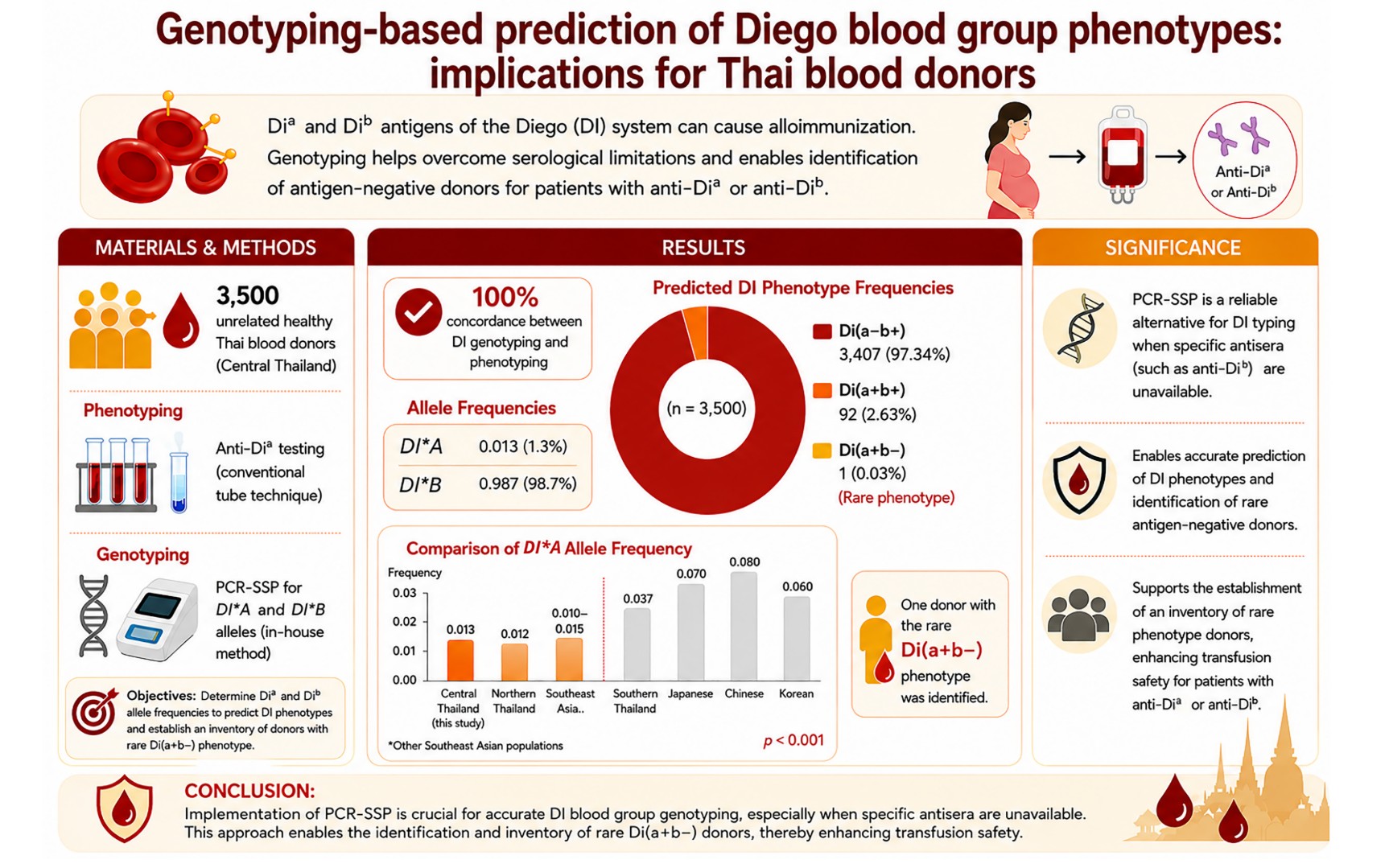
Background: The Dia and Dib antigens of the Diego (DI) blood group system can cause alloimmunization following transfusion or pregnancy. Although the Di(a-b+) phenotype predominates, the Di(a+) antigen is relatively common in Asian populations. Due to serological limitations, particularly the lack of anti-Dib, genotyping is increasingly used to predict DI phenotypes and facilitate identifying antigen-negative blood donors for patients with anti-Dia or anti-Dib.
Objectives: The study aimed to determine the frequencies of DI*A and D*B alleles to predict DI phenotypes and establish an inventory of Thai blood donors with the rare Di(a+b-) phenotype.
Materials and methods: A total of 3,500 blood samples from unrelated healthy Thai blood donors were included. All samples were tested with anti-Dia using the conventional tube technique and genotyped for DI*A and DI*B alleles by in-house polymerase chain reaction with sequence-specific primer technique. The DI allele frequencies were calculated to estimate the risk of alloimmunization.
Results: The DI genotyping and phenotyping results showed 100% concordance. Among 3,500 Central Thai blood donors, predicted phenotypes were ranked as Di(a-b+), 3,407 (97.34%), followed by Di(a+b+), 92 (2.63%), and Di(a+b-), 1 (0.03%). The DI*A and DI*B allele frequencies were 0.013 and 0.987. The DI*A and DI*B frequencies are consistent with those observed in Central and Northern Thai populations and in other Southeast Asian populations, but differ significantly from those observed in Southern Thai, Japanese, Chinese, and Korean populations (p<0.001). Notably, one donor with the rare Di(a+b-) phenotype was observed in this study; this likely reflects the greater likelihood of detecting rare phenotypes when screening a much larger sample size than in related Thai studies.
Conclusion: The implementation of the PCR-SSP technique plays a crucial role in identifying DI blood group antigens, particularly in situations where specific antisera are unavailable. This approach also contributes to establishing an inventory of donors with rare blood phenotypes, thereby enhancing transfusion safety.
Article Details

This work is licensed under a Creative Commons Attribution-NonCommercial-NoDerivatives 4.0 International License.
Personal views expressed by the contributors in their articles are not necessarily those of the Journal of Associated Medical Sciences, Faculty of Associated Medical Sciences, Chiang Mai University.
References
Hyland CA, Castilho L, Chen Q, Clausen FB, Denomme GA, Fichou Y, et al. International Society of Blood Transfusion Working Party on Red Cell Immunogenetics and Blood Group Terminology report of Gothenburg, Barcelona and four virtual business meetings: Update on blood group systems. Vox Sang. 2026; 121(2): 202-12. doi: 10.1111/vox.70148.
Figueroa D. The Diego blood group system: A review. Immunohematology. 2013; 29(2): 73-81. PMID: 24094240.
Daniels G. Human blood groups. 3rd Ed. Malden, MA: Blackwell Science; 2013.
Reid ME, Lomas-Francis C, Olsson M. The blood group antigen factsbook. 3rd Ed. New York: Academic Press; 2012.
Nathalang O, Panichrum P, Intharanut K, Thattanon P, Nathalang S. Distribution of DI*A and DI*B allele frequencies and comparisons among central Thai and other populations. PloS One. 2016; 11(10): e0165134. doi: 10.1371/journal.pone.0165134.
Wongkaewpotong C, Pattanapeechai S, Leetrakool N, Nathalang O. Prevalence of DI*A and DI*B alleles in northern Thai blood donors. J Hematol Transfus Med. 2017; 27(1): 19-26.
Simtong P, Jumnainsong A, Leelayuwat C. Genetic profile of RHCE, Kell, Duffy, Kidd, Diego and MNS hybrid glycophorins blood groups in ethnic northeastern Thais: Alleles, genotypes and risk of alloimmunization. Transfus Med. 2024; 34(4): 287-97. doi: 10.1111/tme.13055.
Chesor M, Mitundee S, Nathalang S, Thattanon P, Intharanut K, Tobunluepop P, et al. DI*A and DI*B allele frequencies among Southern Thai blood donors. Indian J Hematol Blood Transfus. 2018; 34(3): 506-9. doi: 10.1007/s12288-017-0886-9.
Wei CT, Al-Hassan FM, Naim N, Knight A, Joshi SR. Prevalence of Diego blood group antigen and the antibody in three ethnic population groups in Klang valley of Malaysia. Asian J Transfus Sci. 2013; 7(1): 26-8. doi: 10.4103/0973-6247.106725.
Delaney M, Harris S, Haile A, Johnsen J, Teramura G, Nelson K. Red blood cell antigen genotype analysis for 9087 Asian, Asian American, and Native American blood donors. Transfusion. 2015; 55(10): 2369-75. doi: 10.1111/trf.13163.
Belsito A, Costa D, Fiorito C, De Iorio G, Casamassimi A, Perrotta S, et al. Erythrocyte genotyping for transfusion-dependent patients at the Azienda Universitaria Policlinico of Naples. Transfus Apher Sci. 2015; 52(1): 72-7. doi: 10.1016/j.transci.2014.12.006.
Nathalang O, Khumsuk P, Intharanut K, Choychimplee T, Sasikarn W. Extended blood group genotyping among Thai patients with repeated transfusions. Clin Lab. 2025; 71(8): 1549-55. doi: 10.7754/Clin.Lab.2025.250134.
Novaretti MC, Ruiz AS, Dorlhiac-Llacer PE, Chamone DA. Application of real-time PCR and melting curve analysis in rapid Diego blood group genotyping. Immunohematology. 2010; 26(2): 66-70. PMID: 20932077.
Nathalang O, Intharanut K, Chidtrakoon S. Highresolution melting curve analysis to predict extended blood group phenotypes among Thai donors and patients. Transfus Med Hemother. 2021; 49(3): 163-71. doi: 10.1159/000520713.
Fongsarun J, Nuchprayoon I, Yod-in S, Kupatawintu P, Kidprasirt C. Blood groups in Thai blood donors. [in Thai]. Thai J Hematol Transf Med. 2002; 12(4): 277-86.
Chiewsilp P, Bejrachandra S, Thongthaisin A. Standards for blood banks and transfusion services. [in Thai]. 5th Ed. Bangkok: Udomsuksa; 2026.
Ye L, Zhang J, Wang C, Yang Q, Han S, Zhu Z. Performance of a microarray-based genotyping system for red cell and platelet antigens in China. Blood Transfus. 2015; 13(4): 690-3. doi: 10.2450/2015.0301-14.
Wu GG, Su YQ, Yu Q, Jin SZ, Zhao TM. Development of a DNA-based genotyping method for the Diego blood group system. Transfusion. 2002; 42(12): 1553-6. doi: 10.1046/j.1537-2995.2002. 00248.x.
Gong T, Hong Y, Wang N, Fu X, Zhou C. Validation of a blood group genotyping method based on high-resolution melting curve analysis. Immunohematology. 2014; 30(4): 161-5. PMID: 25831264.
Nathalang O, Ang RM, Kurin B, Limprasert S, Mitundee S, Leetrakool N, et al. Predicted S and s phenotypes from genotyping results among Thai populations to prevent transfusion-induced alloimmunization risks. Transfus Apher Sci. 2018; 57: 582-6. doi: 10.1016/j.transci.2018.07.019.
Kupatawintu P, Emthip M, Sungnoon D, O-vataga P, Manahul V, Limtamaporn S, et al. Unexpected antibodies of patients, blood samples sent for testing at NBC. TRCS. [in Thai]. J Hematol Transfus Med. 2010; 20(4): 255-62.
Hatano Y, Otsuka S, Chousa M, Saito S, Nollet KE, Ohto H, et al. Fatal delayed hemolytic transfusion reaction associated with anti-Di(b) and anti-E. Transfus Apher Sci. 2012; 47(3): 263-8. doi: 10.1016/j.transci.2012.07.020.
Mochizuki K, Ohto H, Hirai S, Ujiie N, Amanuma F, Kikuta A, et al. Hemolytic disease of the newborn due to anti-Di: A case study and review of the literature. Transfusion. 2006; 46(3): 454-60. doi: 10.111/j.1537-2995.2006.00743.x.
Kerdkaewngam K, Tingtong U. A study of the Dia and Dib antigen frequencies in blood donors of National Blood Centre, Thai Red Cross Society. [in Thai]. J Hematol Transfus Med. 2021; 31(4): 309-14.
