A development of a conceptual model of occupational patterns promoting alcohol abstinence among northeastern Thais with alcohol use disorder
Article Sidebar
Main Article Content
Abstract
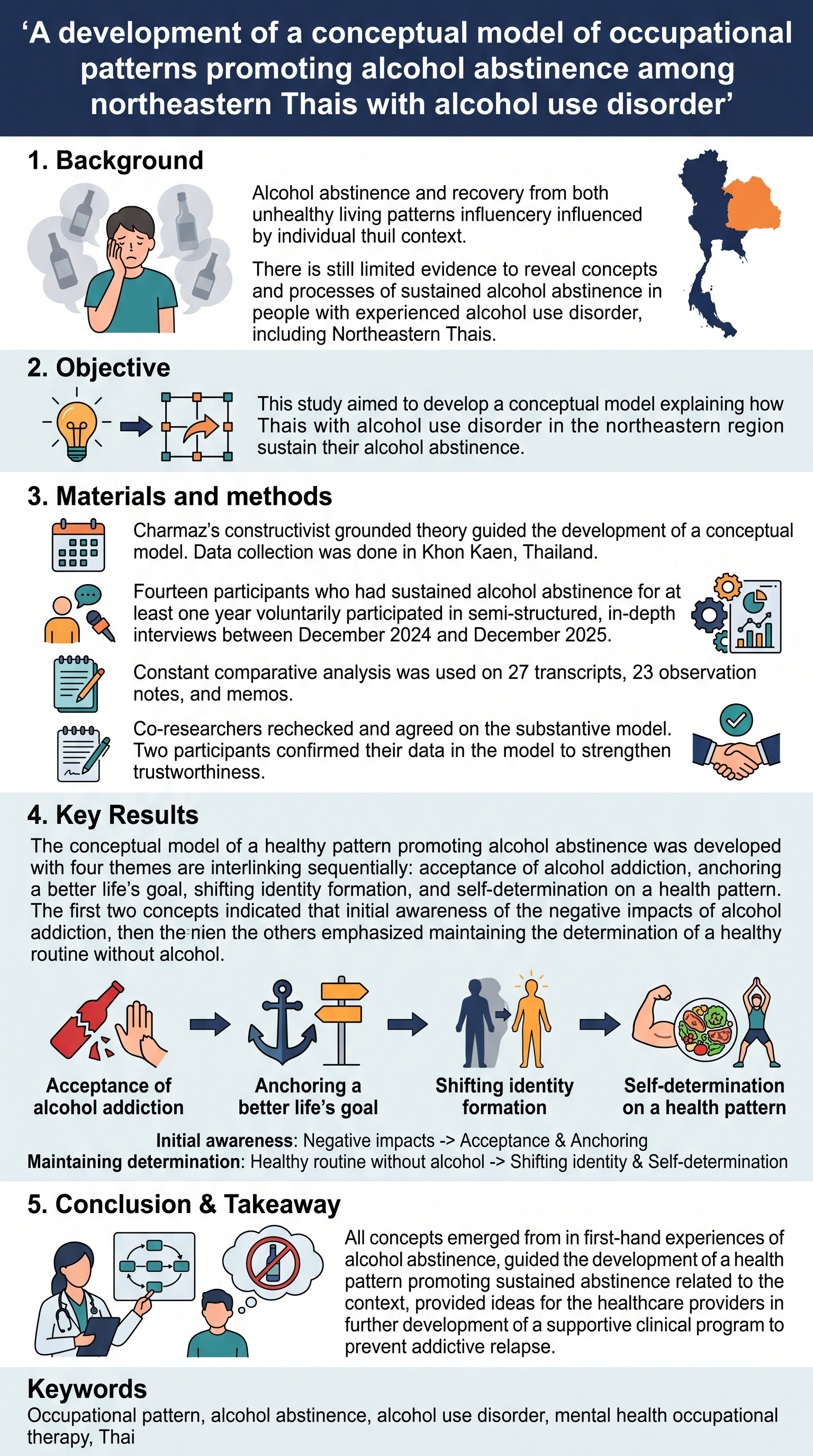
Background: The difficulty of alcohol abstinence and recovery from unhealthy living patterns is influenced by individual context. There is still limited evidence to reveal concepts and processes of sustained alcohol abstinence in people with experienced alcohol use disorder, including Northeastern Thais.
Objectives: This study aimed to develop a conceptual model explaining how Thais with alcohol use disorder in the northeastern region sustain their alcohol abstinence.
Materials and methods: Charmaz’s constructivist grounded theory guided the development of a conceptual model. Data collection was done in Khon Kaen, Thailand. Fourteen participants who had sustained alcohol abstinence for at least one year voluntarily participated in semi-structured, in-depth interviews between December 2024 and December 2025. Constant comparative analysis was used on 27 transcripts, 23 observation notes, and memos. Co-researchers rechecked and agreed on the substantive model, and two participants confirmed their data in the model to strengthen trustworthiness.
Results: The conceptual model of a healthy pattern promoting alcohol abstinence was developed with four themes interlinking sequentially: acceptance of alcohol addiction, anchoring a better life’s goal, shifting identity formation, and self-determination on a health pattern. The first two concepts indicated initial awareness of the negative impacts of alcohol addiction, then the others emphasized maintaining the determination of a healthy routine without alcohol.
Conclusion: All concepts emerged from the first-hand experiences of alcohol abstinence, guided the development of a health pattern promoting sustained abstinence related to the context, and provided ideas for the healthcare providers in further development of a supportive clinical program to prevent addictive relapse.
Article Details

This work is licensed under a Creative Commons Attribution-NonCommercial-NoDerivatives 4.0 International License.
Personal views expressed by the contributors in their articles are not necessarily those of the Journal of Associated Medical Sciences, Faculty of Associated Medical Sciences, Chiang Mai University.
References
Tanaree A, Vichitkunakorn P. Alcohol drinking and provincial alcohol problem index (PAPI) in Thailand: the 2017 survey (in Thai). J Health Sci Res. 2019; 13(4): 353-67.
Center for Alcohol Studies. Alcohol consumption in Thailand 2021 (in Thai). Bangkok: Sahamitr Pattanakarn Printing; 2022.
Thanyarak Khon Kaen Hospital. Annual statistical report 2021-2024 (in Thai). Khon Kaen: Thanyarak Khon Kaen Hospital; 2024. Unpublished report.
Pumpaisalchai W, Ruengorn C. Economic burden of alcohol dependence at a hospital and national level (in Thai). J Ment Health Thai. 2020; 28(2): 150-60.
Moolasart J, Chirawatkul S. Drinking culture in the Thai-Isaan context of northeast Thailand. Southeast Asian J Trop Med Public Health. 2012; 43(3): 795-807.
Prasit N, Laohasiriwong W, Phimha S, Bouphan P, Senahad N, Yotha N, et al. Evaluation of binge drinking behavior among working-age populations in Thailand using GIS: a national survey in 2017. J Public Health Dev. 2023; 21(2): 140-51. doi.org/10.55131/jphd/2023/210212. DOI: https://doi.org/10.55131/jphd/2023/210212
Khon Kaen University Arts and Culture Center. Heet 12 klong 14 databases (in Thai) [Internet]. Khon Kaen: Khon Kaen University; 2025 [cited 2026 Apr 10]. Available from: https://cac.kku.ac.th.
Duangkhamchan J. Isan rod hae: the concert truck across cultural borders (in Thai) [master’s thesis]. Bangkok: Thammasat University; 2021.
Sontate KV, Rahim Kamaluddin M, Naina Mohamed I, Mohamed RMP, Shaikh MF, Kamal H, et al. Alcohol, aggression, and violence: from public health to neuroscience. Front Psychol. 2021; 12: 699726. doi.org/10.3389/fpsyg.2021.699726. DOI: https://doi.org/10.3389/fpsyg.2021.699726
Bacharach SB, Bamberger P, Biron M. Alcohol consumption and workplace absenteeism: the moderating effect of social support. J Appl Psychol. 2010; 95(2): 334-48. doi.org/10.1037/a0018018. DOI: https://doi.org/10.1037/a0018018
Chusri W, Prommintree J, Boonrotepong B, U-senyang S. The impacts on families from alcohol drinking among alcoholic patients who received treatment from hospitals in Songkhla province (in Thai). PNU J Humanit Soc Sci. 2021; 8(2): 69-83.
Wasmuth S, Pritchard K, Kaneshiro K. Occupation-based intervention for addictive disorders: a systematic review. J Subst Abuse Treat. 2016; 62: 1-9. doi.org/10.1016/j.jsat.2015.11.011. DOI: https://doi.org/10.1016/j.jsat.2015.11.011
Baker AL, Hiles SA, Thornton LK, Hides L, Lubman DI. A systematic review of psychological interventions for excessive alcohol consumption among people with psychotic disorders. Acta Psychiatr Scand. 2012; 126(4): 243-55. doi.org/10.1111/j.1600-0447.2012.01885.x. DOI: https://doi.org/10.1111/j.1600-0447.2012.01885.x
Doğu SE, Özkan E. The role of occupational therapy in substance use. Nordisk Alkohol Nark. 2023; 40(4): 406-13. doi.org/10.1177/14550725221149472. DOI: https://doi.org/10.1177/14550725221149472
Bendixen HJ, Kroksmark U, Magnus E, Jakobsen K, Alsaker S, Nordell K. Occupational pattern: a renewed definition of the concept. J Occup Sci. 2006; 13(1): 3-10. doi.org/10.1080/14427591.2006.9686565. DOI: https://doi.org/10.1080/14427591.2006.9686565
Wasmuth S, Crabtree JL, Scott PJ. Exploring addiction-as-occupation. Br J Occup Ther. 2014; 77(12): 605-13. doi.org/10.4276/030802214x14176260335264. DOI: https://doi.org/10.4276/030802214X14176260335264
Ghosh A, Morgan N, Calvey T, Scheibein F, Angelakis I, Panagioti M, et al. Effectiveness of psychosocial interventions for alcohol use disorder: a systematic review and meta-analysis update. Am J Drug Alcohol Abuse. 2024; 50(4): 442-54. doi.org/10.1080/09687637.2024.2350056. DOI: https://doi.org/10.1080/00952990.2024.2350056
Stoffel VC, Moyers PA. An evidence-based and occupational perspective of interventions for persons with substance-use disorders. Am J Occup Ther. 2004; 58(5): 570-86. doi.org/10.5014/ajot.58.5.570. DOI: https://doi.org/10.5014/ajot.58.5.570
Narain N, Liu WN, Mahmood Z, Duncan A. Women’s perspectives related to occupational performance following participation in substance use recovery programs. Occup Ther Ment Health. 2018; 34(1): 61-74. doi.org/10.1080/0164212X.2017.1395309. DOI: https://doi.org/10.1080/0164212X.2017.1395309
Charmaz K. Constructing grounded theory: a practical guide through qualitative analysis. 2nd ed. London: SAGE Publications; 2014.
Valmari EG, Andersson J, Johansson A, Nygren U. Defining the complexities of an occupational pattern- a concept analysis and theoretical validation. Scand J Occup Ther. 2024; 31(1): 2362840. doi.org/10.1080/11038128.2024.2362840. DOI: https://doi.org/10.1080/11038128.2024.2362840
Aas EM, Havnes IA, Raveen RR, Lystad JU, Arnevik EA, Rognli EB. ‘I am somebody now’-exploring meanings and experiences of gaining employment among people in substance use disorder treatment. Drugs Educ Prev Policy. 2026; 33(3): 247-61. doi.org/10.1080/09687637.2025.2527640. DOI: https://doi.org/10.1080/09687637.2025.2527640
Vegeris EL, Brooks R. Occupational live in sustained recovery from alcohol dependency: an interpretive phenomenological analysis. OTJR (Thorofare N J). 2022; 42(1): 22-9. doi.org/10.1177/15394492211042265. DOI: https://doi.org/10.1177/15394492211042265
Klingemann H. Successes and failures in treatment of substance abuse: treatment system perspectives and lessons from the European continent. Nordisk Alkohol Nark. 2020; 37(4): 323-37. doi.org/10.1177/1455072520941977. DOI: https://doi.org/10.1177/1455072520941977
Kitzinger RH, Gardner JA, Moran M, Celkos C, Fasano N, Linares E, et al. Habits and routines of adults in early recovery from substance use disorder: clinical and research implications from a mixed methodology exploratory study. Subst Abuse Res Treat. 2023; 17: 11782218231153843. doi.org/10.1177/11782218231153843. DOI: https://doi.org/10.1177/11782218231153843
Wakabayashi M, McKetin R, Banwell C, Yiengprugsawan V, Kelly M, Seubsman SA, et al. Alcohol consumption patterns in Thailand and their relationship with non-communicable disease. BMC Public Health. 2015; 15: 1297. doi.org/10.1186/s12889-015-2662-9. DOI: https://doi.org/10.1186/s12889-015-2662-9
Saengow U. Drinking abstinence during a 3-month abstinence campaign in Thailand: weighted analysis of a national representative survey. BMC Public Health. 2019; 19: 1688. doi.org/10.1186/s12889-019-8051-z. DOI: https://doi.org/10.1186/s12889-019-8051-z
Kielhofner G. Model of human occupation: theory and application. 4th ed. Philadelphia: Lippincott Williams & Wilkins; 2008.
Office of the Secretary of National Addiction Treatment and Rehabilitation Committee, Ministry of Public Health. The strategic development plan for treatment and rehabilitation in substance addiction 2023-2027 (in Thai) [Internet]. Bangkok: Printing Office, Veterans Welfare Organization; 2022 [cited 2026 Apr 10]. Available from: https://ncmc.moph.go.th/home/upload/web_download/1doxcsiqctdwos4w4g.pdf.
