Trends and patterns of laboratory utilization in a community hospital: A 10-year retrospective study for rational laboratory utilization development
Article Sidebar
Main Article Content
Abstract
Background: Irrational use of laboratory services directly impacts hospital resources and financial management, particularly in community hospitals with limited resources. Analyzing long-term trends is a crucial first step in developing strategic policies for Rational Laboratory Utilization (RLU).
Objectives: To investigate trends in laboratory testing frequency and expenditure at Khok Pho Hospital and to analyze utilization patterns over a decade (2013-2022).
Materials and methods: A retrospective descriptive study using aggregate secondary data from the laboratory information system (LIS). Data were analyzed using descriptive statistics, Pareto analysis, simple linear regression for trend analysis, and the Pearson correlation coefficient to examine the relationship between the number of patients and test volume and cost.
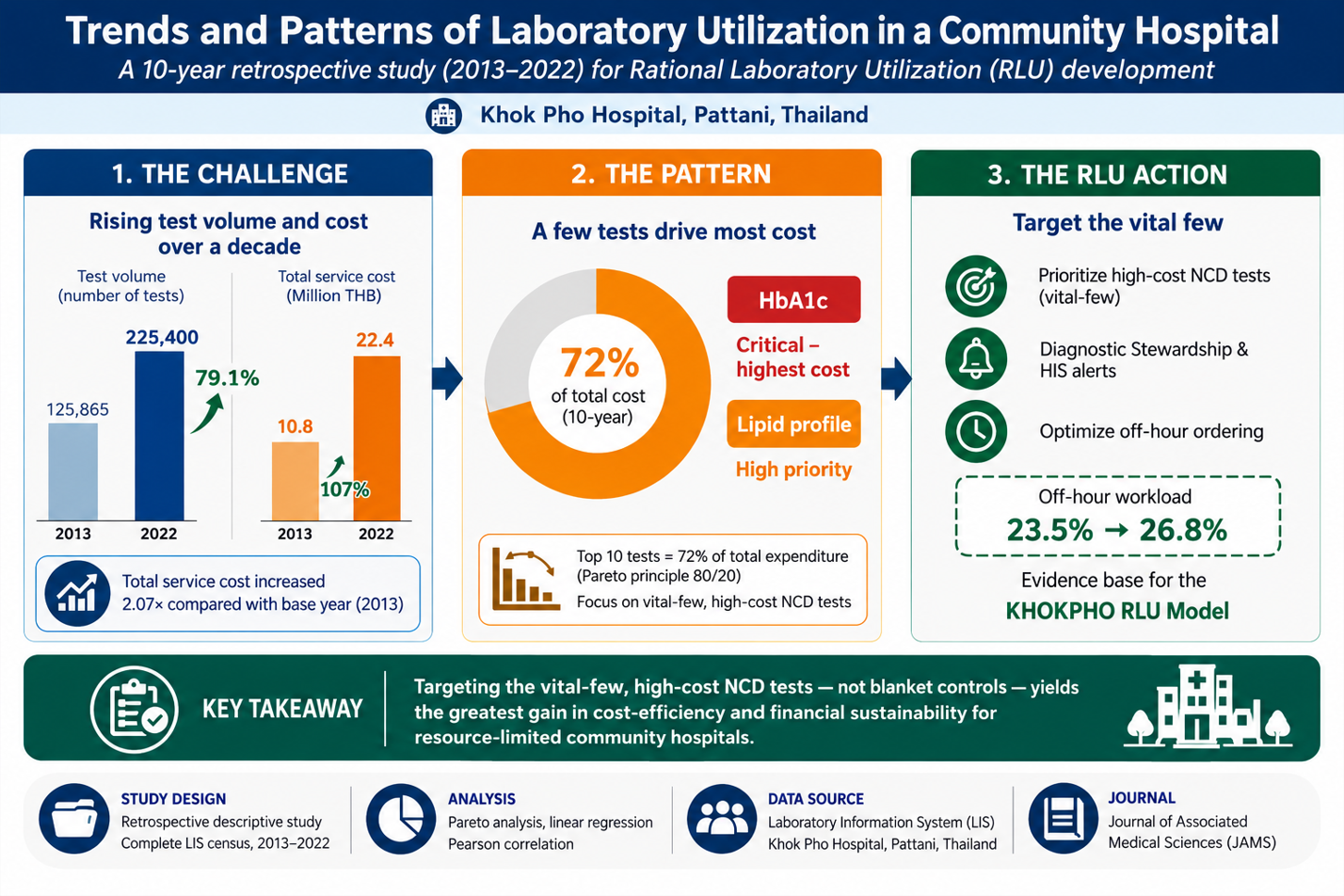
Results: Over the ten years, total laboratory test volume increased by 79.1%, rising from 125,865 tests in 2013 to 225,400 tests in 2022. Total laboratory service costs increased 2.07-fold compared with the base year. Linear regression demonstrated significant increasing trends in both test volume (β=12,083 tests/year, R²=0.829, p<0.001) and total expenditure (β=1.32 million THB/year, R²=0.918, p<0.001). After test volume peaked in 2021 due to the expansion of COVID-19 screening, volume declined in 2022 to 225,400 tests, reflecting post-pandemic normalization. Pareto analysis showed that a small number of tests accounted for most total expenditure, particularly HbA1c and lipid profile testing. The number of patients tested correlated strongly with both test volume (r=0.90) and total cost (r=0.95, both p<0.001), indicating that growth in service users was a key driver of rising laboratory costs. The proportion of off-hour workload increased from 23.5% to 26.8%.
Conclusion: Laboratory utilization has grown steadily, driven by the prevalence of chronic diseases and the impact of COVID-19. These findings support implementing Rational Laboratory Utilization policies that focus on high-cost tests and optimize off-hour ordering to improve cost efficiency in community hospitals.
Article Details

This work is licensed under a Creative Commons Attribution-NonCommercial-NoDerivatives 4.0 International License.
Personal views expressed by the contributors in their articles are not necessarily those of the Journal of Associated Medical Sciences, Faculty of Associated Medical Sciences, Chiang Mai University.
References
Rohr UP, Binder C, Dieterle T, Giusti F, Messina CG, Toerien E, et al. The value of in vitro diagnostic testing in medical practice: a status report. PLoS One. 2016; 11(3): e0149856. doi: 10.1371/journal.pone.0149856.
Porter ME. What is value in health care? N Engl J Med. 2010; 363(26): 2477-81. doi: 10.1056/NEJMp1011024.
Zhi M, Ding EL, Theisen-Toupal J, Whelan J, Arnaout R. The landscape of inappropriate laboratory testing: a 15-year meta-analysis. PLoS One. 2013; 8(11): e78962. doi: 10.1371/journal.pone.0078962.
Fryer AA, Smellie WS. Managing demand for laboratory tests: a laboratory toolkit. J Clin Pathol. 2013; 66(1): 62-72. doi: 10.1136/jclinpath-2011-200524.
Baird G. The laboratory test utilization management toolbox. Biochem Med (Zagreb). 2014; 24(2): 223-34. doi: 10.11613/BM.2014.025.
National Health Security Office. Annual report 2021 (in Thai). Bangkok: National Health Security Office; 2022.
Department of Medical Sciences, Ministry of Public Health. Rational laboratory use guideline (in Thai). 3rd ed. Nonthaburi: Department of Medical Sciences; 2023.
Intaniwet T. Development of rational laboratory use system according to Lamphun Hospital RLU policies (in Thai). Bull Dept Med Sci. 2024; 66(3): 338-55.
Morgan DJ, Malani P, Diekema DJ. Diagnostic stewardship-leveraging the laboratory to improve antimicrobial use. JAMA. 2017; 318(7): 607-8. doi: 10.1001/jama.2017.8531.
von Elm E, Altman DG, Egger M, Pocock SJ, Gøtzsche PC, Vandenbroucke JP. The Strengthening the Reporting of Observational Studies in Epidemiology (STROBE) statement: guidelines for reporting observational studies. Lancet. 2007; 370(9596): 1453-7. doi: 10.1016/S0140-6736(07)61602-X.
Comptroller General’s Department, Ministry of Finance. Health service rates for reimbursement of medical treatment costs in government health facilities (in Thai). Bangkok: Comptroller General’s Department; 2004.
Comptroller General’s Department, Ministry of Finance. Circular No. Kor Kor 0416.2/Wor 393: health service rates for reimbursement of medical treatment costs in government health facilities, category 6 (blood and blood component services) and category 7 (medical technology and pathology diagnostic tests) (in Thai). Bangkok: Comptroller General’s Department; 2017.
Health Administration Division, Ministry of Public Health. Health service rates for health service units under the Ministry of Public Health for Thai patients, 2019 (in Thai). Nonthaburi: Health Administration Division; 2019.
Health Administration Division, Ministry of Public Health. Health service rates for health service units under the Ministry of Public Health for Thai patients, 2025 (in Thai). Nonthaburi: Health Administration Division; 2025.
Naoum V, Kyriopoulos D, Charonis A, Athanasakis K, Kyriopoulos J. The Pareto principle (“80-20 rule”) in healthcare services in Greece. Value Health. 2016; 19(7): A618. doi: 10.1016/j.jval.2016.09.1563.
Huck A, Lewandrowski K. Utilization management in the clinical laboratory: an introduction and overview of the literature. Clin Chim Acta. 2014; 427: 111-7. doi: 10.1016/j.cca.2013.09.021.
Department of Medical Sciences, Ministry of Public Health. Rational laboratory use hospital accreditation guidelines (in Thai). Nonthaburi: Department of Medical Sciences; 2024. [18] Bindraban RS, ten Berg MJ, Naaktgeboren CA, Kramer MH, van Solinge WW, Nanayakkara PW. Reducing test utilization in hospital settings: a narrative review. Ann Lab Med. 2018; 38(5): 402-12. doi: 10.3343/alm.2018.38.5.402.
Dickerson JA, Fletcher AH, Procop G, Keren DF, Singh IR, Garcia JJ, et al. Transforming laboratory utilization review into laboratory stewardship: guidelines by the PLUGS National Committee for Laboratory Stewardship. J Appl Lab Med. 2017; 2(2): 259-68. doi: 10.1373/jalm.2017.023606.
Clinical and Laboratory Standards Institute. Laboratory stewardship: information to reduce diagnostic errors; a guide. 1st ed. CLSI guideline QMS23. Wayne (PA): CLSI; 2021. Available from: clsi.org/.
Price CP. Evidence-based laboratory medicine: supporting decision-making. Clin Chem. 2000; 46(8): 1041-50. doi: 10.1093/clinchem/46.8.1041.
Srisuk N, Poolsawat U, Pongsiri N, Amataviyanon L. Developing laboratory service models towards international standards ISO 15189:2012 and ISO 15190:2003: a case study of Khok Pho Hospital, Pattani (in Thai). Bull Dept Med Sci. 2024; 66(3): 394-404.
Srisuk N, Rattanakul W. A development of service models and laboratory standards in primary care units: a case study of the border area in Khok Pho District, Pattani Province (in Thai). J Environ Educ Med Health. 2025; 10(2): 883-91.
