A comparison of aerobic and anaerobic capacities in different positional roles of basketball players aged 13-16 years
Article Sidebar
Main Article Content
Abstract
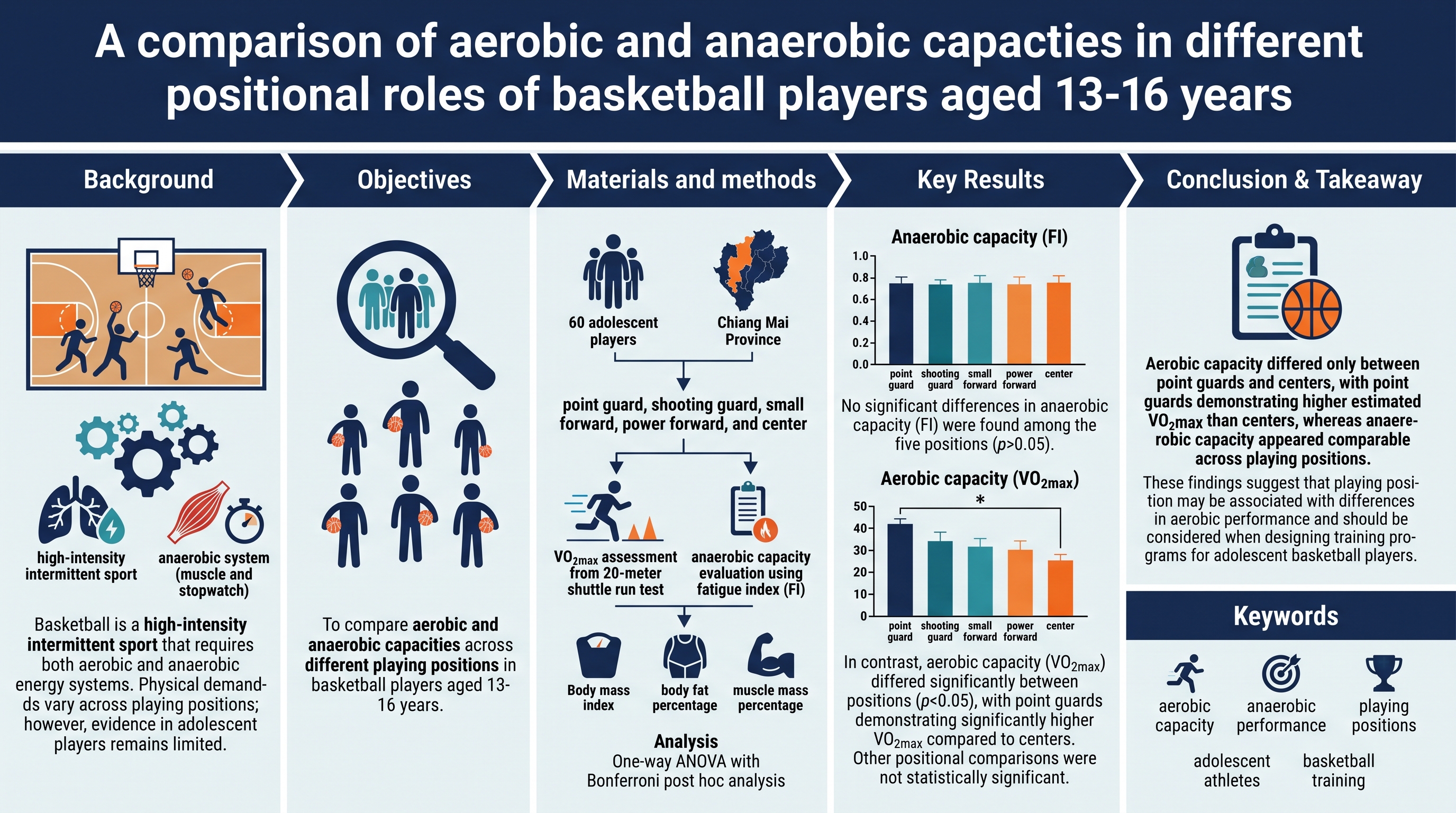
Background: Basketball is a high-intensity intermittent sport that requires both aerobic and anaerobic energy systems. Physical demands vary across playing positions; however, evidence in adolescent players remains limited.
Objectives: To compare aerobic and anaerobic capacities across different playing positions in basketball players aged 13-16 years
Materials and methods: This cross-sectional study included 60 adolescent basketball players in Chiang Mai Province. Participants were categorized into five positional roles: point guard, shooting guard, small forward, power forward, and center. Aerobic capacity was assessed using estimated maximal oxygen consumption (VO₂max) from the 20-meter shuttle run test, while anaerobic capacity was evaluated using fatigue index (FI). The body composition variables were recorded, including body mass index, body fat percentage, and muscle mass percentage. Differences among groups were analyzed using one-way ANOVA with Bonferroni post hoc analysis.
Results: No significant differences in anaerobic capacity (FI) were found among the five positions (p>0.05). In contrast, aerobic capacity (VO₂max) differed significantly between positions (p<0.05), with point guards demonstrating significantly higher VO₂max compared to centers. Other positional comparisons were not statistically significant.
Conclusion: Aerobic capacity differed only between point guards and centers, with point guards demonstrating higher estimated VO₂max than centers, whereas anaerobic capacity appeared comparable across playing positions. These findings suggest that playing position may be associated with differences in aerobic performance and should be considered when designing training programs for adolescent basketball players.
Article Details

This work is licensed under a Creative Commons Attribution-NonCommercial-NoDerivatives 4.0 International License.
Personal views expressed by the contributors in their articles are not necessarily those of the Journal of Associated Medical Sciences, Faculty of Associated Medical Sciences, Chiang Mai University.
References
FIBA. Official Basketball Rules 2022 [Internet]. 2022 [cited 2026 Jan 1]. Available from: https://www.fiba.basketball.
American College of Sports Medicine. ACSM’s Guidelines for Exercise Testing and Prescription. 11th ed. Philadelphia: Wolters Kluwer; 2021.
Morrison M, Martin DT, Talpey S, Scanlan AT, Delaney J, Halson SL, et al. A Systematic Review on Fitness Testing in Adult Male Basketball Players: Tests Adopted, Characteristics Reported and Recommendations for Practice. Sports Med. 2022 Jul; 52(7): 1491-1532. doi: 10.1007/s40279-021-01626-3.
Delextrat A, Badiella A, Saavedra V, Matthew D, Schelling X, Torres-Ronda L. Match activity demands of elite basketball players. Front Psychol. 2015; 6: 1486. doi: 10.3389/fpsyg.2015.01486.
Péndola-Reinecke MI, Jiménez-Sáiz S, Mochales Cuesta I, Bustamante-Sánchez Á. Exploring new dimensions in the classification of basketball player positions. Appl Sci. 2025; 15(11): 6159. doi: 10.3390/app15116159.
Ivanović J, Kukić F, Greco G, Koropanovski N, Jakovljević S, Dopsaj M. Specific Physical Ability Prediction in Youth Basketball Players According to Playing Position. Int J Environ Res Public Health. 2022 Jan 16; 19(2): 977. doi: 10.3390/ijerph19020977.
Stojmenović D, Trunić N, Stojmenović T. A comparative study of aerobic capacity among elite basketball players according to five different positions in the team. J Phys Educ Sport. 2022; 22(10): 2522–9. doi: 10.7752/jpes.2022.10320.
Kyle UG, Bosaeus I, De Lorenzo AD, Deurenberg P, Elia M, Gómez JM, et al. Bioelectrical impedance analysis--part I: review of principles and methods. Clin Nutr. 2004 Oct; 23(5): 1226-43. doi: 10.1016/j.clnu.2004.06.004.
Léger LA, Mercier D, Gadoury C, Lambert J. The multistage 20 metre shuttle run test for aerobic fitness. J Sports Sci. 1988 Summer; 6(2): 93-101. doi: 10.1080/02640418808729800.
Zagatto AM, Beck WR, Gobatto CA. Validity of the running anaerobic sprint test for assessing anaerobic power and predicting short-distance performances. J Strength Cond Res. 2009 Sep; 23(6): 1820-7. doi: 10.1519/JSC.0b013e3181b3df32.
McInnes SE, Carlson JS, Jones CJ, McKenna MJ. The physiological load imposed on basketball players during competition. J Sports Sci. 1995 Oct; 13(5): 387-97. doi: 10.1080/02640419508732254.
Ben Abdelkrim N, El Fazaa S, El Ati J. Time-motion analysis and physiological data of elite under-19-year-old basketball players during competition. Br J Sports Med. 2007 Feb; 41(2): 69-75; discussion75. doi: 10.1136/bjsm.2006.032318.
Castagna C, Impellizzeri FM, Rampinini E, D’Ottavio S, Manzi V. The Yo-Yo intermittent recovery test in basketball players. J Sci Med Sport. 2008 Apr; 11(2): 202-8. doi: 10.1016/j.jsams.2007.02.013.
Bredt SGT, Torres JO, Diniz LBF, Praça GM, Andrade AGP, Morales JCP, et al. Physical and physiological demands of basketball small-sided games: the influence of defensive and time pressures. Biol Sport. 2020 Jun; 37(2): 131-138. doi: 10.5114/biolsport.2020.93038.
Bassett DR Jr, Howley ET. Limiting factors for maximum oxygen uptake and determinants of endurance performance. Med Sci Sports Exerc. 2000 Jan; 32(1): 70-84. doi: 10.1097/00005768-200001000-00012.
MacInnis MJ, Gibala MJ. Physiological adaptations to interval training and the role of exercise intensity. J Physiol. 2017 May 1; 595(9): 2915-2930. doi: 10.1113/JP273196.
Poole DC, Jones AM. Oxygen uptake kinetics. Compr Physiol. 2012 Apr; 2(2): 933-96. doi: 10.1002/cphy.c100072.
Gottlieb R, Shalom A, Calleja-Gonzalez J. Physiology of Basketball - Field Tests. Review Article. J Hum Kinet. 2021 Jan 30; 77: 159-167. doi: 10.2478/hukin-2021-0018.
Rowland TW. Children’s Exercise Physiology. 2nd ed. Champaign (IL): Human Kinetics; 2005.
Prasertpong P, Nantakool S, Chuatrakoon B. Association of aerobic and anaerobic capacities with body composition in basketball players aged 13-16 years in Chiang Mai Province. J Assoc Med Sci. 2026; 59(2): 280–285. doi: 10.66285/JAMS.2026.059.
Moran JJ, Sandercock GR, Ramírez-Campillo R, Meylan CM, Collison JA, Parry DA. Age-Related Variation in Male Youth Athletes’ Countermovement Jump After Plyometric Training: A Meta-Analysis of Controlled Trials. J Strength Cond Res. 2017 Feb; 31(2): 552-565. doi: 10.1519/JSC.0000000000001444.
Armstrong N, Barker AR. Endurance training and elite young athletes. Med Sport Sci. 2011; 56: 59- 83. doi: 10.1159/000320633.
Spencer M, Bishop D, Dawson B, Goodman C. Physiological and metabolic responses of repeatedsprint activities:specific to field-based team sports. Sports Med. 2005; 35(12): 1025-44. doi: 10.2165/00007256-200535120-00003.
Buchheit M, Laursen PB. High-intensity interval training, solutions to the programming puzzle: Part I: cardiopulmonary emphasis. Sports Med. 2013 May; 43(5): 313-38. doi: 10.1007/s40279-013-0029-x.
Girard O, Mendez-Villanueva A, Bishop D. Repeatedsprint ability - part I: factors contributing to fatigue. Sports Med. 2011 Aug 1; 41(8): 673-94. doi: 10.2165/11590550-000000000-00000.
