Avocado juice (Persea americana) with an abundance of bioactive substances on coupling with probiotics revealed potential health benefits
Article Sidebar
Main Article Content
Abstract
Background: The rising trend in consumption of plant-based functional beverages has spurred research into alternative carriers for probiotics other than dairy products. Avocado (Persea americana) is rich in bioactive compounds, antioxidants, vitamins, and healthy lipids, making it suitable for use as a substrate in probiotic fermentation. Adding probiotic Lactobacillus strains to avocado juice can make it more nutritious and therapeutic.
Objectives: This research assessed the efficacy of Persea americana (avocado) juice as a non-dairy medium for probiotic Lactobacillus strains.
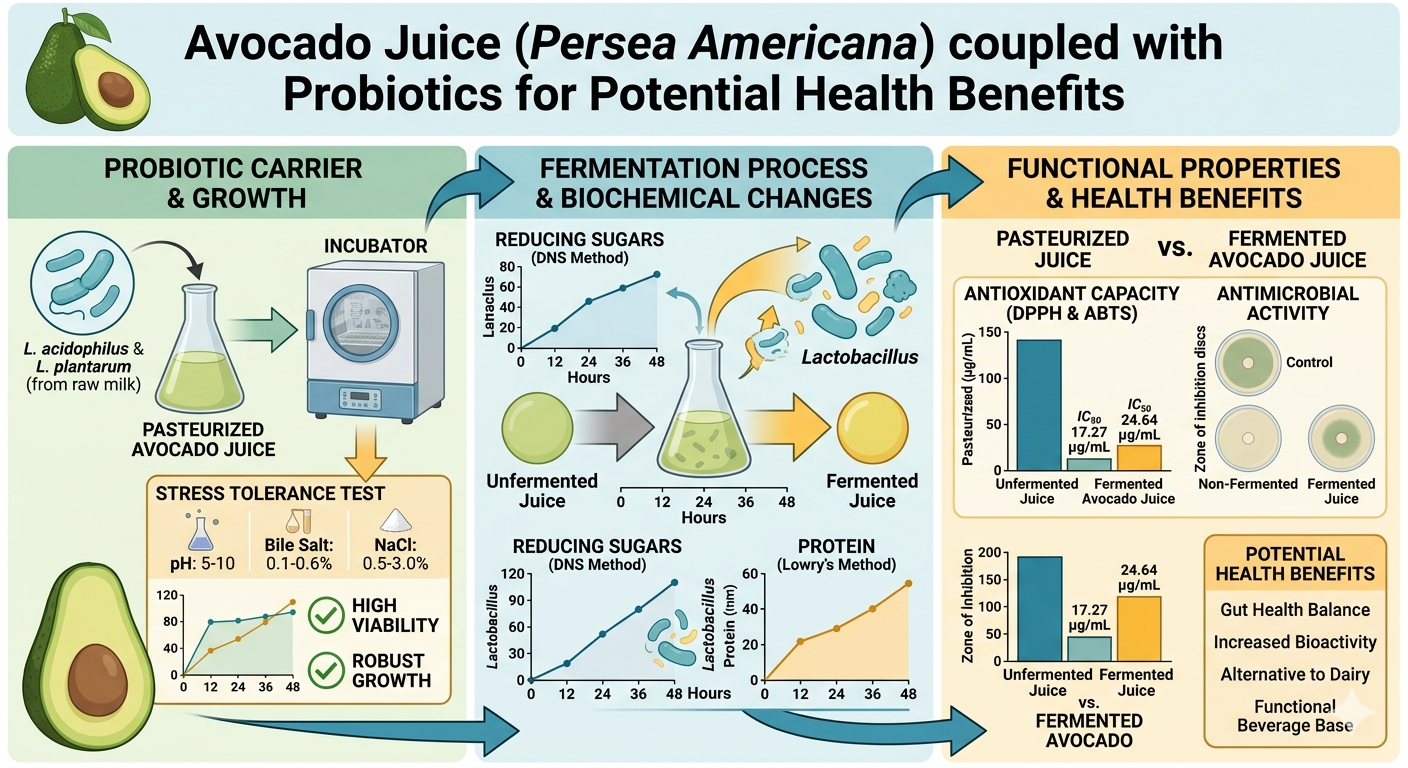
Materials and methods: The strains (L. acidophilus and L. plantarum) were added to pasteurized juice and evaluated for their ability to withstand stress conditions, including varying pH levels, bile salt concentrations (0.1-0.6%), and NaCl concentrations (0.5-3%).
Results: The resulting fermented juice exhibited improved functional characteristics when compared to non-fermented juice. The antioxidant activity in the fermented juice was significantly elevated, with lower IC₅₀ values recorded in both ABTS (17.27 μg/mL) and DPPH (24.64 μg/mL) assays, in contrast to pasteurized juice (31.46 μg/mL and 51.95 μg/mL, respectively), and was found to be comparable to gallic acid standards. Biochemical assessments indicated elevated reducing sugar (683.36 mg/mL) and protein levels, suggesting active microbial metabolism during fermentation. Additionally, the fermented juice exhibited moderate antimicrobial activity against selected pathogenic strains, though lower than that of the standard antibiotic control.
Conclusion: These results imply that avocado juice not only supports the viability of probiotics but also enhances bioactive properties through the fermentation process. In conclusion, this study highlights the potential of avocado juice as a plant-based carrier for probiotics, presenting a promising alternative to dairy-based functional beverages and offering additional nutritional and health benefits.
Article Details

This work is licensed under a Creative Commons Attribution-NonCommercial-NoDerivatives 4.0 International License.
Personal views expressed by the contributors in their articles are not necessarily those of the Journal of Associated Medical Sciences, Faculty of Associated Medical Sciences, Chiang Mai University.
References
Oliveira A, Amaro AL, Pintado M. Impact of food matrix components on nutritional and functional properties of fruit-based products. Curr Opin Food Sci. 2018; 22: 153-9. doi: 10.1016/j.cofs.2018.02.002.
Padilla-Camberos E, Martínez-Velázquez M, Flores-Fernández JM, Villanueva-Rodríguez S. Acute toxicity and genotoxic activity of avocado seed extract (Persea americana Mill., c.v. Hass). Sci World J. 2013; 2013: 245828. doi: 10.1155/2013/245828.
Araújo RG, Rodriguez-Jasso RM, Ruiz HA, Pintado MME, Aguilar CN. Avocado by-products: Nutritional and functional properties. Trends Food Sci Technol. 2018;80:51-60. doi: 10.1016/j.tifs.2018.07.027.
Abubakar ANF, Achmadi SS, Suparto IH. Triterpenoid of avocado (Persea americana) seed and its cytotoxic activity toward breast MCF-7 and liver HepG2 cancer cells. Asian Pac J Trop Biomed. 2017; 7(5): 397-400. doi: 10.1016/j.apjtb.2017.01.012.
Jan T, Negi R, Sharma B, Kour D, Kumar S, Rai AK, et al. Diversity, distribution and role of probiotics for human health: Current research and future challenges. Biocatal Agric Biotechnol. 2023; 52: 102889. doi: 10.1016/j.bcab.2023.102889.
Behrooz AB, Mohammad N. An investigation into the probiotic, anti-bacterial, anti-biofilm, and safety properties of Lactococcus lactis NJ414. LWT. 2024; 201: 116251. doi: 10.1016/j.lwt.2024.116251.
Mantzourani I, Plessas S, Odatzidou M, Alexopoulos A, Galanis A, Bezirtzoglou E, et al. Effect of a novel Lactobacillus paracasei starter on sourdough bread quality. Food Chem. 2019; 271: 259-65. doi: 10.1016/j.foodchem.2018.07.183.
Wong WY, Chan BD, Leung TW, Chen M, Tai WCS. Beneficial and anti-inflammatory effects of formulated prebiotics, probiotics, and synbiotics in normal and acute colitis mice. J Funct Foods. 2022; 88: 104871. doi: 10.1016/j.jff.2021.104871.
James A, Wang Y. Characterization, health benefits and applications of fruits and vegetable probiotics. CyTA J Food. 2019; 17(1): 770-80. doi: 10.1080/19476337.2019.1652693.
Vitali B, Minervini G, Rizzello CG, Spisni E, Maccaferri S, Brigidi P, et al. Novel probiotic candidates for humans isolated from raw fruits and vegetables. Food Microbiol. 2012; 31(1): 116-25. doi: 10.1016/j.fm.2011.12.027.
Kandylis P, Pissaridi K, Bekatorou A, Kanellaki M, Koutinas AA. Dairy and non-dairy probiotic beverages. Curr Opin Food Sci. 2016; 7: 58-63. doi: 10.1016/j.cofs.2015.11.012.
Ranadheera CS, Vidanarachchi JK, Rocha RS, Cruz AG, Ajlouni S. Probiotic delivery through fermentation: Dairy vs. non-dairy beverages. Fermentation. 2017; 3(4): 67. doi: 10.3390/fermentation3040067.
Ephrem E, Najjar A, Charcosset C, Greige-Gerges H. Encapsulation of natural active compounds, enzymes, and probiotics for fruit juice fortification, preservation, and processing: An overview. J Funct Foods. 2018; 48: 65-84. doi: 10.1016/j.jff.2018.06.010.
Horáčková Š, Rokytová K, Bialasová K, Klojdová I, Sluková M. Fruit juices with probiotics – new type of functional foods. Czech J Food Sci. 2018; 36(4): 284-8. doi: 10.17221/413/2017-CJFS.
Durmaz Y, Kilicli M, Toker OS, Konar N, Palabiyik I, Tamturk F. Using spray-dried microalgae in ice cream formulation as a natural colorant: Effect on physicochemical and functional properties. Algal Res. 2020; 47: 101811. doi: 10.1016/j.algal.2020.101811.
Perricone M, Bevilacqua A, Altieri C, Sinigaglia M, Corbo MR. Challenges for the production of probiotic fruit juices. Beverages. 2015; 1(2): 95-103. doi: 10.3390/beverages1020095.
Mantzourani I, Terpou A, Alexopoulos A, Bezirtzoglou E, Bekatorou A, Plessas S. Production of a potentially synbiotic fermented cornelian cherry (Cornus mas L.) beverage using Lactobacillus paracasei K5 immobilized on wheat bran. Biocatal Agric Biotechnol. 2019; 17: 347-51. doi: 10.1016/j.bcab.2018.12.012.
Anekella K, Orsat V. Optimization of micro encapsulation of probiotics in raspberry juice by spray drying. LWT. 2013; 50(1): 17-24. doi: 10.1016/j.lwt.2012.08.003.
Plaza-Diaz J, Ruiz-Ojeda FJ, Gil-Campos M, Gil A. Mechanisms of action of probiotics. Adv Nutr. 2019; 10(Suppl 1): S49-66. doi: 10.1093/advances/nmy063.
Naseem Z, Mir SA, Wani SM, Rouf MA, Bashir I, Zehra A. Probiotic-fortified fruit juices: Health benefits, challenges, and future perspective. Nutrition. 2023; 115: 112154. doi: 10.1016/j.nut.2023.112154.
Alireza V, Behrooz AB, Farideh TY, Seyed AM, Hamid N. Diversity and probiotic potential of lactic acid bacteria isolated from Horreh, a traditional Iranian fermented food. Probiotics Antimicrob Proteins. 2017; 10(2): 258-68. doi: 10.1007/s12602-017-9282-x.
Nagpal R, Kumar A, Kumar M. Fortification and fermentation of fruit juices with probiotic lactobacilli. Ann Microbiol. 2012; 62: 1573-8. doi: 10.1007/s13213-012-0412-5.
Meilgaard M, Civille GV, Carr BT. Sensory evaluation techniques. 5th ed. Boca Raton: CRC Press; 2016. doi: 10.1201/b19493.
Yang E, Fan L, Yan J, Jiang Y, Doucette C, Fillmore S. Antimicrobial activity of bacteriocin-producing Lactobacillus paracasei HD1-7 in Chinese fermented milk. Food Control. 2012; 23(2): 338-44. doi: 10.1016/j.foodcont.2011.07.031.
Lowry OH, Rosebrough NJ, Farr AL, Randall RJ. Protein measurement with the Folin phenol reagent. J Biol Chem. 1951; 193(1): 265-75. doi: 10.1016/S0021-9258(19)52451-6.
Brand-Williams W, Cuvelier ME, Berset C. Use of a free radical method to evaluate antioxidant activity. LWT. 1995; 28(1): 25-30. doi: 10.1016/S0023-6438(95)80008-5.
Panghal A, Sharma P, Chhikara N, Gat Y. Development of probiotic beverages: A review on the technology, recent trends, and advancements. Nutrire. 2017; 42: 1-12. doi: 10.1186/s41110-017-0021-5.
Bujna E, Nikoletta AF, Anh MT, Mai SD, Quang DN. Lactic acid fermentation of apricot juice by monoand mixed cultures of probiotic Lactobacillus and Bifidobacterium strains. Food Sci Biotechnol. 2018; 27: 547-55. doi: 10.1007/s10068-017-0291-y.
Miller GL. Use of dinitrosalicylic acid reagent for determination of reducing sugar. Anal Chem. 1959; 31(3): 426-8. doi: 10.1021/ac60147a030.
Jain A, Jain R, Jain S. Quantitative analysis of reducing sugars by 3, 5-dinitrosalicylic acid (DNSA method). In: Basic Techniques in Biochemistry, Microbiology and Molecular Biology. New York: Humana; 2020: pp 181-3. doi: 10.1007/978-1-4939-9861-6_20.
Wilson K, Walker J. Principles and techniques of practical biochemistry. 7th Ed. Cambridge: Cambridge University Press; 2010. doi: 10.1017/CBO9780511841477.
Castro-López C, Bautista-Hernández I, González-Hernández MD, Martínez-Ávila GCG, Rojas R, Gutiérrez-Díez A, et al. Polyphenolic profile and antioxidant activity of leaf purified hydroalcoholic extracts from seven Mexican Persea americana cultivars. Molecules. 2019; 24(1): 173. doi: 10.3390/molecules24010173.
Melgar B, Dias MI, Ciric A, Sokovic M, Garcia- Castello EM, Rodriguez-Lopez AD, et al. Bioactive characterization of Persea americana Mill. by-products: A rich source of inherent antioxidants. Ind Crops Prod. 2018; 111: 212-8. doi: 10.1016/j.indcrop.2017.10.027.
Fouad MT, Moustafa A, Hussein L, Romeilah R, Gouda M. In-vitro antioxidant and antimicrobial activities of selected fruit and vegetable juices and fermented dairy products commonly consumed in Egypt. Res J Pharm Biol Chem Sci. 2015; 6(2): 541-50.
Panghal A, Janghu S, Virkar K, Gat Y, Kumar V, Chhikara N. Potential non-dairy probiotic products – A healthy approach. Food Biosci. 2017; 21: doi: 10.1016/j.fbio.2017.12.003.
Lee HM, Lee YA. A differential medium for lactic acid producing bacteria in a mixed culture. Lett Appl Microbiol. 2008; 46(6): 676-81. doi: 10.1111/j.1472-765X.2008.02371.x.
Khan A, Goutam S, Rajat KP. An approach for reduction of false predictions in reverse engineering of gene regulatory networks. J Theor Biol. 2018; 445: 9-30. doi: 10.1016/j.jtbi.2018.02.015.
Martin LJ, Matar C. Increase of antioxidant capacity of the lowbush blueberry (Vaccinium angustifolium) during fermentation by a novel bacterium from the fruit microflora. J Sci Food Agric. 2005; 85(9): 1477-84. doi: 10.1002/jsfa.2142.
Food and Agriculture Organization and World Health Organization. Evaluation of health and nutritional properties of powder milk and live lactic acid bacteria [Internet]. Córdoba: FAO/WHO; 2001 [cited 2005 Sep 8]. Available from: ftp://ftp.fao.org/es/esn/food/probio_report_en.pdf
Mostafa RJ, Behrooz AB, Morteza T, Mohammad Ali H, Omer ST. Evaluation of the probiotic, anti-microbial, anti-biofilm, and safety properties of Levilactobacillus brevis Lb13H. LWT. 2024; 207: 116636. doi: 10.1016/j.lwt.2024.116636.
Shah N, Prajapati JB. Effect of carbon dioxide on sensory attributes, physico-chemical parameters and viability of probiotic L. helveticus MTCC 5463 in fermented milk. J Food Sci Technol. 2013; 51(12): 3886-93. doi: 10.1007/s13197-013-0941-6.
Sivudu SN, Umamahesh K, Reddy OVS. A comparative study on probiotication of mixed watermelon and tomato juice by using probiotic strains of lactobacilli. Int J Curr Microbiol Appl Sci. 2014; 3(11): 977-84.
Anthony F, Edmond R. Perspective: Reductionist nutrition research has meaning only within the framework of holistic and ethical thinking. Adv Nutr. 2018; 9(6): 655-70. doi: 10.1093/advances/nmy044.
Gueimonde M, Margolles A, de los Reyes-Gavilán CG, Salminen S. Competitive exclusion of enteropathogens from human intestinal mucus by Bifidobacterium strains with acquired resistance to bile-a preliminary study. Int J Food Microbiol. 2004; 91(3): 253-60. doi: 10.1016/S0168-1605(03)00371-1.
Shaghayegh E, Mohammad N, Behrooz AB, Salam AI. Assessment of the probiotic, anti-bacterial, and anti-biofilm characteristics of Lacticaseibacillus rhamnosus CWKu-12, along with its potential impact on the expression of virulence genes in Listeria monocytogenes ATCC 19115. LWT. 2024; 210: 116815. doi: 10.1016/j.lwt.2024.116815.
