
Diagnostic potential of circulating Meteorin-like protein in Graves’ disease with subclinical hyperthyroidism subgroup analysis
Article Sidebar
Main Article Content
Abstract
Background: Meteorin-like protein (Metrnl) is an adipokine mostly produced and secreted by adipose tissue. Metrnl is an adipokine that enhances insulin sensitivity, promotes the browning of adipose tissue, and increases energy expenditure.
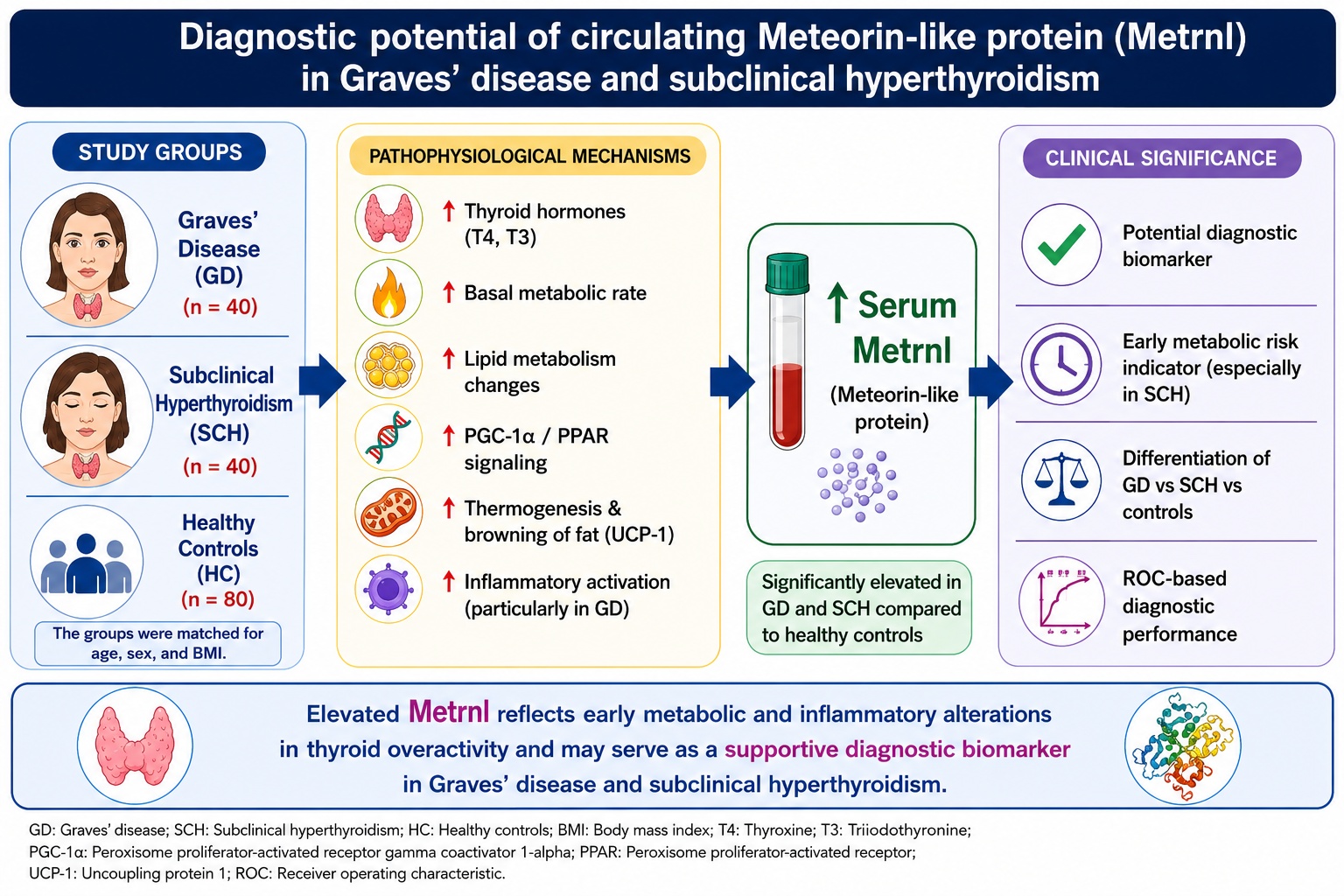
Objectives: This study aimed to investigate alterations in serum Metrnl levels in patients with Graves’ disease (GD) and subclinical hyperthyroidism (SCH), with the objective of assessing its potential as a diagnostic biomarker.
Materials and methods: This case-control study was matched for age, sex, and BMI and included 40 patients with GD, 40 with SCH, and 80 controls. The average ages of the participants ranged from 22 to 59 years. Samples were obtained from July 2025 to January 2026. Metrnl levels were measured using a sandwich enzyme-linked immunosorbent assay. T4 and TSH levels were evaluated using the VIDAS system (bioMérieux), whereas thyroid-stimulating hormone receptor antibodies (TRAb) were detected using the Roche Cobas e411 Analyzer. The Roche Cobas c111 Analyzer was employed to evaluate lipid profiles.
Results: The mean serum Metrnl levels in the control group were 11.7±1.9 ng/mL. In contrast, patients with GD had a significantly elevated mean Metrnl level of 22.1±2.3 ng/mL (p<0.001). The SCH group had a markedly elevated mean concentration of 22.4±2.8 ng/mL (p<0.001) compared to the control group. Serum concentrations of TSH, total cholesterol, triglycerides, LDL, and VLDL were markedly reduced in both GD and SCH relative to controls (p<0.001). T4 and TRAb levels were significantly elevated in GD and SCH compared with controls (p<0.001).
Conclusion: Elevated levels of Metrnl in Graves’ disease suggest its potential as a new biomarker for diagnosis and evaluation of metabolic risks, alongside conventional thyroid function tests.
Article Details

This work is licensed under a Creative Commons Attribution-NonCommercial-NoDerivatives 4.0 International License.
Personal views expressed by the contributors in their articles are not necessarily those of the Journal of Associated Medical Sciences, Faculty of Associated Medical Sciences, Chiang Mai University.
References
Salman AG, Mahdi IA-J, Mukhlef AK, abd alsattar Mohammad R, Zaghir MSH, muatez Wadaa’a N. Physiological aspects of thyroid disorders: Anatomy, hormones, diagnosis and management. Current Clinical and Medical Education. 2024; 2(5): 17-32. doi: 10.5455/ccme.2024.04.001.
Phagoora J, Bakilwal S, Hamzehpour A, et al. Graves disease-A comprehensive review. Physician’s Journal of Medicine. 2024; 3(1). doi: 10.59585/pjm.v3i1.341.
Antonelli A, Ferrari SM, Ragusa F, et al. Graves’ disease: Epidemiology, genetic and environmental risk factors and viruses. Best Pract Res Clin Endocrinol Metab. 2020; 34(1): 101387. doi: 10.1016/j.beem.2020.101387.
Tsai K, Leung AM. Subclinical hyperthyroidism: A review of the clinical literature. Endocr Pract. 2021; 27(3): 254-6. doi: 10.1016/j.eprac.2021.02.007.
Li Z, Gao Z, Sun T, et al. Meteorin-like/Metrnl, a novel secreted protein implicated in inflammation, immunology, and metabolism: A comprehensive review of preclinical and clinical studies. Front Immunol. 2023; 14: 1098570. doi: 10.3389/fimmu.2023.1098570.
Garcia-Beltran C, Navarro-Gascon A, Lopez-Bermejo A, et al. Meteorin-like levels are associated with active brown adipose tissue in early infancy. Front Endocrinol (Lausanne). 2023; 14: 1136245. doi: 10.3389/fendo.2023.1136245.
Walczak K, Sieminska L. Obesity and thyroid axis. Int J Environ Res Public Health. 2021; 18(18): 9434. doi: 10.3390/ijerph18189434.
Seifert J, Chen Y, Schöning W, et al. Hepatic energy metabolism under the local control of the thyroid hormone system. Int J Mol Sci. 2023; 24(5): 4861. doi: 10.3390/ijms24054861.
Machado SA, Pasquarelli-do-Nascimento G, Da Silva DS, et al. Browning of the white adipose tissue regulation: New insights into nutritional and metabolic relevance in health and diseases. Nutr Metab (Lond). 2022; 19(1): 61. doi: 10.1186/s12986-022-00694-x.
Alizadeh H. Myokine-mediated exercise effects: The role of myokine meteorin-like hormone (Metrnl). Growth Factors. 2021; 39(1-6): 71-8. doi: 10.1080/08977194.2021.1989417.
Satheesan A, Kumar J, Leela KV, et al. The multifaceted regulation of white adipose tissue browning and their therapeutic potential. J Physiol Biochem. 2025: 1-23. doi: 10.1007/s13105-025-01050-1.
Tayebi SM, Golmohammadi M, Eslami R, Shakiba N, Costa PB. The effects of eight weeks of circuit resistance training on serum METRNL levels and insulin resistance in individuals with type 2 diabetes. J Diabetes Metab Disord. 2023; 22(2): 1151-8. doi: 10.1007/s40200-023-01239-0.
Wen X, Ding X, Chang X, et al. Elevated serum Meteorin-like levels in patients with hyperthyroidism. BMC Endocr Disord. 2022; 22(1): 304. doi: 10.1186/s12902-022-01231-6.
Ibrahim AY, Neamah NF. Serum Meteorin-Like (Metrnl) as a potential biomarker of obesity-related dyslipidemia and insulin resistance. Biomed Pharmacol J. 2025; 18(3): 2407-18. doi: 10.13005/bpj/3104.
Alizadeh H. Meteorin-like protein (Metrnl): A metabolic syndrome biomarker and an exercise mediator. Cytokine. 2022; 157: 155952. doi: 10.1016/j.cyto.2022.155952.
Townsend LK, Steinberg GR. AMPK and the endocrine control of metabolism. Endocr Rev. 2023; 44(5): 910-33. doi: 10.1210/endrev/bnad012.
Faul F, Erdfelder E, Buchner A, Lang A-G. Statistical power analyses using G*Power 3.1: Tests for correlation and regression analyses. Behav Res Methods. 2009; 41(4): 1149-60. doi: 10.3758/BRM.41.4.1149.
Cohen J. Statistical power analysis for the behavioral sciences. Lawrence Erlbaum Associates; 1988. doi: 10.4324/9780203771587.
World Health Organization. Body mass index (BMI) classification. Web report / Guideline. WHO; 2022.
Dong W-s, Hu C, Hu M, et al. Metrnl: A promising biomarker and therapeutic target for cardiovascular and metabolic diseases. Cell Commun Signal. 2024; 22(1): 389. doi: 10.1186/s12964-024-01768-4.
Gong L, Huang G, Weng L, et al. Decreased serum interleukin‐41/Metrnl levels in patients with Graves’ disease. J Clin Lab Anal. 2022; 36(10): e24676. doi: 10.1002/jcla.24676.
