Prevalence of self-stigma and psychological distress among parents of children with autism spectrum disorder: A cross-sectional study
Article Sidebar
Main Article Content
Abstract
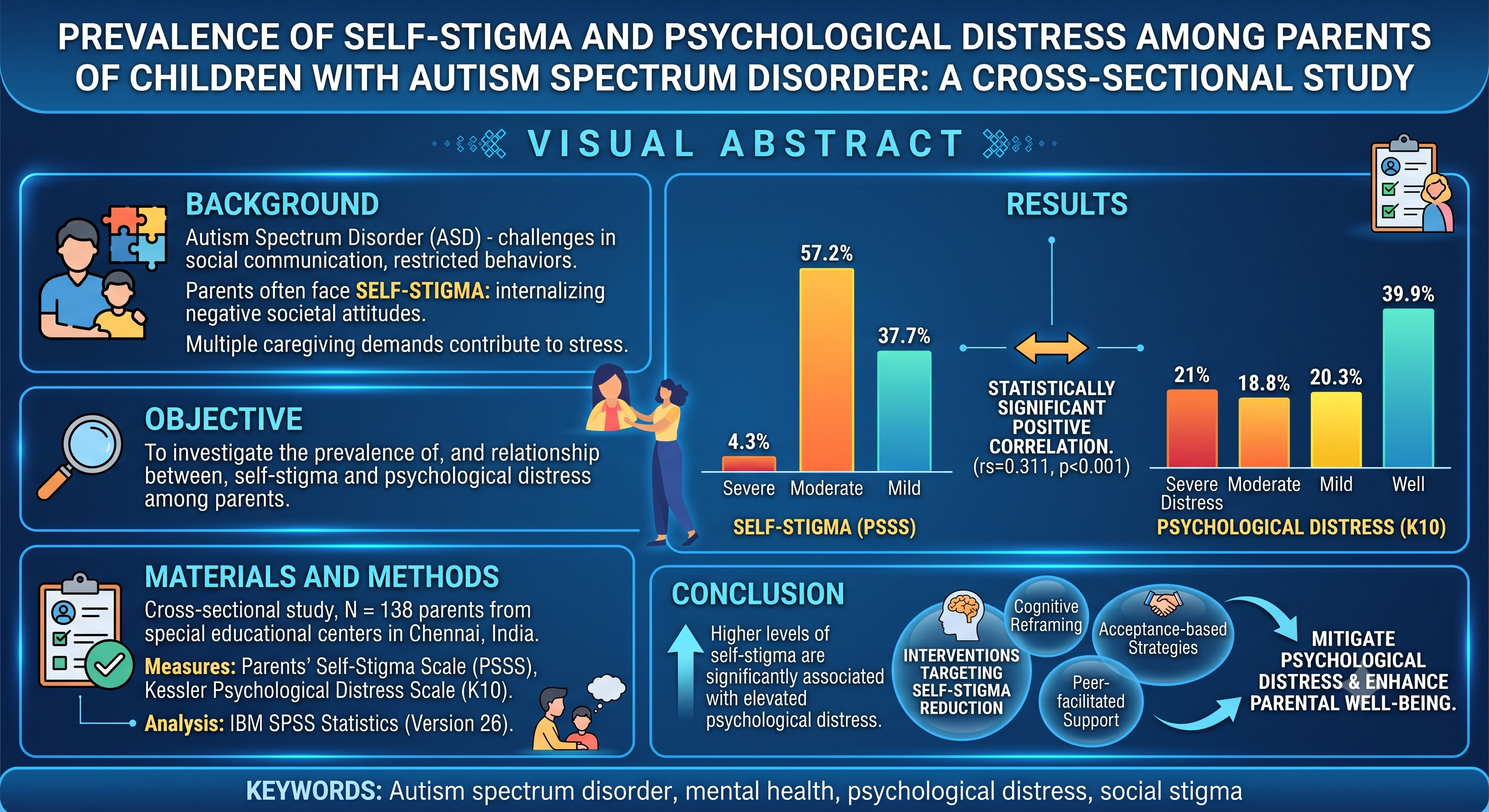
Background: Autism Spectrum Disorder (ASD) is a lifelong neurodevelopmental disorder characterized by challenges in social communication and restricted behaviors. Parents of children with ASD often face self-stigma-the internalization of negative societal attitudes which contributes to psychological distress. Given the multifaceted caregiving demands associated with ASD, these parents are particularly vulnerable to stress and psychological burden across the developmental course of their child.
Objectives: To investigate the prevalence of, and relationship between, selfstigma and psychological distress among parents of children diagnosed with ASD.
Materials and methods: A cross-sectional study was conducted among 138 parents recruited from special educational centers in Chennai, India. Data were collected using the Parents’ Self-Stigma Scale (PSSS) and the Kessler Psychological Distress Scale (K10) and analyzed using IBM SPSS Statistics (Version 26).
Results: Among the parents, 4.3% reported severe self-stigma, 57.2% moderate, and 37.7% mild. Regarding psychological distress, 21% exhibited severe distress, 18.8% moderate, 20.3% mild, and 39.9% were classified as ‘well’. A statistically significant positive correlation was observed between self-stigma and psychological distress (rs=0.311, p<0.001).
Conclusion: Higher levels of self-stigma among parents are significantly associated with elevated psychological distress. Interventions targeting selfstigma reduction, including cognitive reframing, acceptance-based therapeutic strategies, and peer-facilitated support, could mitigate psychological distress and enhance parental well-being.
Article Details

This work is licensed under a Creative Commons Attribution-NonCommercial-NoDerivatives 4.0 International License.
Personal views expressed by the contributors in their articles are not necessarily those of the Journal of Associated Medical Sciences, Faculty of Associated Medical Sciences, Chiang Mai University.
References
American Psychiatric Association. Diagnostic and statistical manual of mental disorders. 5th ed. Arlington, VA: APA; 2013. doi: 10.1176/appi.books.9780890425596.
Chawarska K, Shic F, Macari S, Campbell DJ, Brian J, Landa R, et al. 18-month predictors of later outcomes in younger siblings of children with autism spectrum disorder: A baby siblings research consortium study. J Am Acad Child Adolesc Psychiatry. 2014; 53(12): 1317-27. doi: 10.1016/j.jaac.2014.09.015.
Centers for Disease Control and Prevention. Signs and symptoms of autism spectrum disorder. Atlanta, GA: CDC; 2023. Available from: https://www.cdc.gov/autism/signs-symptoms/index.html
Cardon T, editor. Autism navigator: A collection of web-based courses and tools for families and professionals. Tallahassee: Florida State University; 2017. Available from: https://autismnavigator.learnercommunity.com
Botha M, Dibb B, Frost DM. “Autism is me”: An investigation of how autistic individuals make sense of autism and stigma. Disabil Soc. 2022; 37(3): 427-53. doi: 10.1080/09687599.2020.1822782.
Zeidan J, Fombonne E, Scorah J, Ibrahim A, Durkin MS, Saxena S, et al. Global prevalence of autism: A systematic review update. Autism Res. 2022; 15(5): 778-90. doi: 10.1002/aur.2696.
Chauhan A, Sahu JK, Jaiswal N, Kumar K, Agarwal A, Kaur J, et al. Prevalence of autism spectrum disorder in Indian children: A systematic review and meta-analysis. Neurol Sci. 2019; 40(7): 1337-47. doi: 10.4103/0028-3886.253970.
Goffman E. Stigma: Notes on the management of spoiled identity. New York: Simon and Schuster Publishers Ltd; 2009.
Farrugia D. Exploring stigma: Medical knowledge and the stigmatisation of parents of children diagnosed with autism spectrum disorder. Sociol Health Illn. 2009; 31(7): 1011-27. doi: 10.1111/j.1467-9566.2009.01174.x.
Gill J, Liamputtong P. Being the mother of a child with Asperger’s syndrome: Women’s experiences of stigma. Health Care Women Int. 2011; 32(8): 708-22. doi: 10.1080/07399332.2011.555830.
Kinnear SH, Link BG, Ballan MS, Fischbach RL. Understanding the experience of stigma for parents of children with autism spectrum disorder and the role stigma plays in families’ lives. J Autism Dev Disord. 2016; 46(3): 942-53. doi: 10.1007/s10803-015-2637-9.
Neely-Barnes SL, Hall HR, Roberts RJ, Graff JC. Parenting a child with an autism spectrum disorder: Public perceptions and parental conceptualizations. J Fam Soc Work. 2011; 14(3): 208-25. doi: 10.1080/10522158.2011.571539.
Woodgate RL, Ateah C, Secco L. Living in a world of our own: The experience of parents who have a child with autism. Qual Health Res. 2008; 18(8): 1075-83. doi: 10.1177/1049732308320112.
Mak WW, Kwok YT. Internalization of stigma for parents of children with autism spectrum disorder in Hong Kong. Soc Sci Med. 2010; 70(12): 2045-51. doi: 10.1016/j.socscimed.2010.02.023.
Bristol AA. A developmental perspective on stress and coping in families of autistic children. Severely Handicapped Young Children and Their Families. 1984: 91-141.
Hall HR, Graff JC. The relationships among adaptive behaviors of children with autism, family support, parenting stress, and coping. Issues Comprehensive Pediatr Nurs. 2011; 34(1): 4-25. doi: 10.3109/01460862.2011.555270.
Behr SK, Murphy DL. Research progress and promise: The role of perceptions in cognitive adaptation to disability. In: Turnbull AP, Patterson JM, Behr SK, Murphy DL, Marquis JG, Blue-Banning MJ, editors. Cognitive coping, families, and disability. Baltimore: Paul H Brookes; 1993. p.151-63.
Osborne LA, McHugh L, Saunders J, Reed P. Parenting stress reduces the effectiveness of early teaching interventions for autistic spectrum disorders. J Autism Dev Disord. 2008; 38(6): 1092-10. doi: 10.1007/s10803-007-0497-7.
Karst JS, Van Hecke AV. Parent and family impact of autism spectrum disorders: A review and proposed model for intervention evaluation. Clin Child Fam Psychol Rev. 2012; 15(3): 247-77. doi: 10.1007/s10567-012-0119-6.
Hayes SA, Watson SL. The impact of parenting stress: A meta-analysis of studies comparing the experience of parenting stress in parents of children with and without autism spectrum disorder. J Autism Dev Disord. 2013; 43(3): 629-42. doi: 10.1007/s10803-012-1604-y.
Corrigan PW, Larson JE, Ruesch N. Self-stigma and the ‘why try’ effect: Impact on life goals and evidence-based practices. World Psychiatry. 2009; 8(2): 75-81.
Hoffman J, Cossie Q, Ametaj AA, Kim HH, James R, Stroud RE, et al. Construct validity and factor structure of the Kessler-10 in South Africa. BMC Psychol. 2022; 10(1): 177. doi: 10.1186/s40359-022-00883-9.
Mittal D, Sullivan G, Chekuri L, Allee E, Corrigan PW. Empirical studies of self-stigma reduction strategies: A critical review of the literature. Psychiatr Serv. 2012; 63(10): 974-81. doi: 10.1176/appi.ps.201100459.
Gray DE. Gender and coping: The parents of children with high functioning autism. Soc Sci Med. 2003; 56(3): 631-42. doi: 10.1016/s0277-9536(02)00059-x.
Srinivasan SM, Bhat AN. A review of “music and movement” therapies for children with autism: Embodied interventions for multisystem development. Front Integr Neurosci. 2013; 7: 22. doi: 10.3389/ fnint.2013.00022.
Eaton K, Ohan JL, Stritzke WG, Corrigan PW. Failing to meet the good parent ideal: Self-stigma in parents of children with mental health disorders. J Child Fam Stud. 2016; 25(10): 3109-23.
Werner S, Shulman C. Subjective well-being among family caregivers of individuals with developmental disabilities: The role of affiliate stigma and psychosocial moderating variables. Res Dev Disabil. 2013; 34(11): 4103-14. doi: 10.1016/j.ridd.2013.08.029.
Lazarus RS, Folkman S. Stress, appraisal, and coping. New York: Springer Publishing Company; 1984.
Corrigan PW, Druss BG, Perlick DA. The impact of mental illness stigma on seeking and participating in mental health care. Psychol Sci Public Interest. 2014; 15(2): 37-70. doi: 10.1177/1529100614531398.
Kuhlthau CC, Heinström J, Todd RJ. The ‘information search process’ revisited: Is the model still useful. Inf Res. 2008; 13(4): 13-4.
Gutman SA, Schindler VP. The neurological basis of occupation. Occup Ther Int. 2007; 14(2): 71-85. doi: 10.1002/oti.225.
Rodger S, Umaibalan V. The routines and rituals of families of typically developing children compared with families of children with autism spectrum disorder: An exploratory study. Br J Occup Ther. 2011; 74(1): 20-6. doi: 10.4276/030802211X12947686093567.
Neff KD, Faso DJ. Self-compassion and well-being in parents of children with autism. Mindfulness. 2015; 6(4): 938-47. doi: 10.1007/s12671-014-0359-2.
Eaton K, Ohan JL, Stritzke WG, Courtauld HM, Corrigan PW. Mothers’ decisions to disclose or conceal their child’s mental health disorder. Qual Health Res. 2017; 27(11): 1628-39. doi: 10.1177/1049732317697096.
