
A review article: DIRFloortime® on improving social communication skills in Thai children with autism spectrum disorder
Article Sidebar
Main Article Content
Abstract
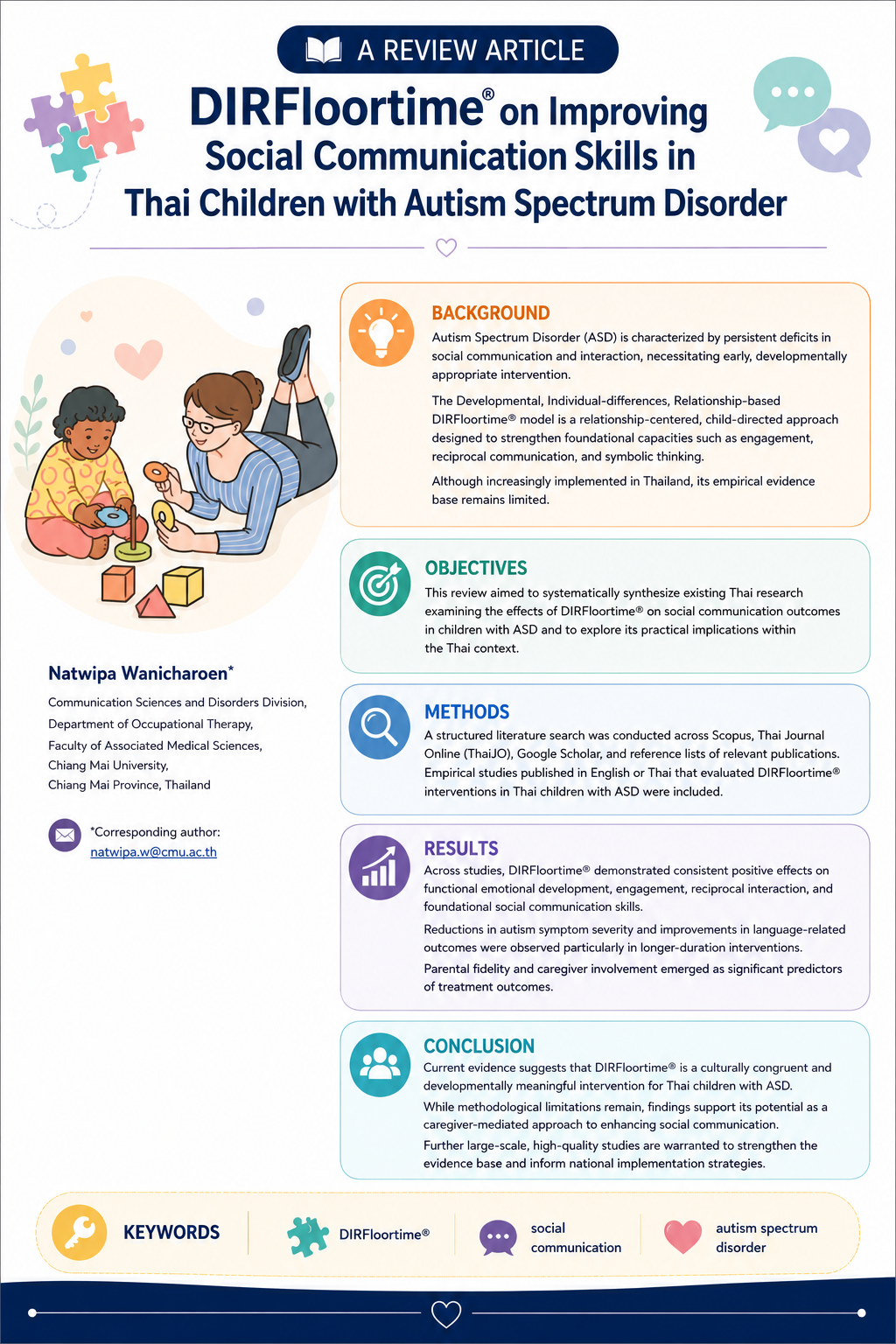
Background: Autism Spectrum Disorder (ASD) is characterized by persistent deficits in social communication and interaction, necessitating early, developmentally appropriate intervention. The Developmental, Individualdifferences, Relationship-based model (DIRFloortime®) is a relationship-centered, child-directed approach designed to strengthen foundational capacities such as engagement, reciprocal communication, and symbolic thinking. Although increasingly implemented in Thailand, its empirical evidence base remains limited.
Objectives: This review aimed to systematically synthesize existing Thai research examining the effects of DIRFloortime® on social communication outcomes in children with ASD and to explore its practical implications within the Thai context.
Materials and methods: A structured literature search was conducted across Scopus, Thai Journal Online (ThaiJO), Google Scholar, and reference lists of relevant publications. Empirical studies published in English or Thai that evaluated DIRFloortime® interventions in Thai children with ASD were included.
Results: Across studies, DIRFloortime® demonstrated consistent positive effects on functional emotional development, engagement, reciprocal interaction, and foundational social communication skills. Reductions in autism symptom severity and improvements in language-related outcomes were observed particularly in longer-duration interventions. Parental fidelity and caregiver involvement emerged as significant predictors of treatment outcomes.
Conclusion: Current evidence suggests that DIRFloortime® is a culturally congruent and developmentally meaningful intervention for Thai children with ASD. While methodological limitations remain, findings support its potential as a caregiver-mediated approach to enhancing social communication. Further large-scale, high-quality studies are warranted to strengthen the evidence base and inform national implementation strategies.
Article Details

This work is licensed under a Creative Commons Attribution-NonCommercial-NoDerivatives 4.0 International License.
Personal views expressed by the contributors in their articles are not necessarily those of the Journal of Associated Medical Sciences, Faculty of Associated Medical Sciences, Chiang Mai University.
References
American Psychiatric Association. Diagnostic and statistical manual of mental disorders: DSM-5. 5th ed. Washington (DC): American Psychiatric Association; 2013.
Mundy P, Sigman M, Ungerer J, Sherman T. Defining the social deficits of autism: the contribution of non-verbal communication measures. J Child Psychol Psychiatry. 1986; 27(5): 657-69. doi: 10.1111/j.1469-7610.1986.tb00190.x.
Koegel RL, Koegel LK, Surratt A. Language intervention and disruptive behavior in preschool children with autism. J Autism Dev Disord. 1992; 22(2): 141-53. doi: 10.1007/bf01058147.
Bauminger N, Kasari C. Loneliness and friendship in high-functioning children with autism. Child Dev. 2000; 71(2): 447-56. doi: 10.1111/1467-8624.00156.
Corsello CM. Early intervention in autism. Infants Young Child. 2005; 18(2): 74-85. doi: 10.1097/00001163-200504000-00002.
Piaget J. Play, dreams and imitation in childhood. London: Routledge; 2013.
Piaget J, Inhelder B. The psychology of the child. New York: Basic Books; 2008.
Vygotsky LS. Mind in society: the development of higher psychological processes. Cambridge (MA): Harvard University Press; 1978.
Sandbank M, Bottema-Beutel K, Crowley S, Cassidy M, Dunham K, Feldman JI, et al. Project AIM: autism intervention meta-analysis for studies of young children. Psychol Bull. 2020; 146(1): 1-29. doi: 10.1037/bul0000215.
Greenspan SI, Wieder S. Developmental patterns and outcomes in infants and children with disorders in relating and communicating. J Dev Learn Disord. 1997; 1: 87-142.
Pajareya K, Nopmaneejumruslers K. A pilot randomized controlled trial of DIR/Floortime™ parent training intervention for pre-school children with autistic spectrum disorders. Autism. 2011; 15(5): 563-77. doi: 10.1177/1362361310386502.
Pajareya K, Nopmaneejumruslers K. A one-year prospective follow-up study of a DIR/Floortime™ parent training intervention for preschool children with autistic spectrum disorders. J Med Assoc Thai. 2012; 95(9): 1184-93.
Yuwapoom W, Nopmaneejumruslers K, Jiawiwatkul A, Kleebpung N. A study of the holistic approach to child development according to the DIRFloortime concept: Banlat Hospital, Phetchaburi (in Thai). Int J Child Dev Ment Health. 2017; 5(1): 43-54.
Singsathorn D, Suksong W, Permsirivanich W. Effects of development promotion based on DIRFloortime techniques in autistic children, Queen Savang Vadhana Memorial Hospital (in Thai). J Phrapokklao Nurs Coll. 2016; 27(1): 104-22.
Issac A, Halemani K, Shetty A, Thimmappa L, Vijay VR, Koni K, et al. The global prevalence of autism spectrum disorder in children: a systematic review and meta-analysis. Osong Public Health Res Perspect. 2025; 16(1): 3-15. doi: 10.24171/j.phrp.2024.0286.
Health Data Center, Ministry of Public Health (TH). Percentage of autistic patients accessing services. 2023 [cited 2026 Feb 13]. Available from: hdcservice. moph.go.th.
Aldred C, Green J, Adams C. A new social communication intervention for children with autism: pilot randomised controlled treatment study suggesting effectiveness. J Child Psychol Psychiatry. 2004; 45(8): 1420-30. doi: 10.1111/j.1469-7610.2004.00848.x.
Wieder S, Greenspan SI. Climbing the symbolic ladder in the DIR model through floor time/interactive play. Autism. 2003; 7(4): 425-35. doi: 10.1177/1362361303007004008.
Greenspan SI. DIRFloortime model. 2008. Available from: www.stanleygreenspan.com.
de Boer SR, Griswold DE, Myles BS, Byrd SE, Ganz JB, Cook KT, et al. Autism spectrum disorders: interventions and treatments for children and youth. Thousand Oaks (CA): Corwin Press; 2004.
Greenspan SI, Wieder S. Engaging autism: using the floortime approach to help children relate, communicate, and think. Cambridge (MA): Da Capo Lifelong Books; 2006.
Dwidjantoro MI, Sukinah S. Effectiveness of DIRFloortime intervention on communication skills development in elementary school students with autism spectrum disorder. J Innov Res Prim Educ. 2025; 4(4): 2547-58. doi: 10.56916/jirpe.v4i4. 2365.
Divya KY, Begum F, John SE, Francis F. DIR Floortime in engaging autism: a systematic review. Iran J Nurs Midwifery Res. 2023; 28(2): 132-8. doi: 10.4103/ijnmr.ijnmr_272_21.
Pacheco P, Pacheco M, Molini-Avejonas D. Study of 18 months of follow-up DIRFloortime intervention in preschool children with autism spectrum disorder. Eur Psychiatry. 2021; 64(S1): S503. doi: 10.1192/j.eurpsy.2021.1346.
Liao ST, Hwang YS, Chen YJ, Lee P, Chen SJ, Lin LY. Home-based DIR/Floortime™ intervention program for preschool children with autism spectrum disorders: preliminary findings. Phys Occup Ther Pediatr. 2014; 34(4): 356-67. doi: 10.3109/01942638.2014.918074.
Birkland MF. The effect of the DIRFloortime model on communication in children with autism [dissertation]. Pullman (WA): Washington State University; 2010.
