Robusta peaberry coffee attenuates inflammation, regulates apoptosis, and improves testicular cell integrity in diabetic rats
Article Sidebar
Main Article Content
Abstract
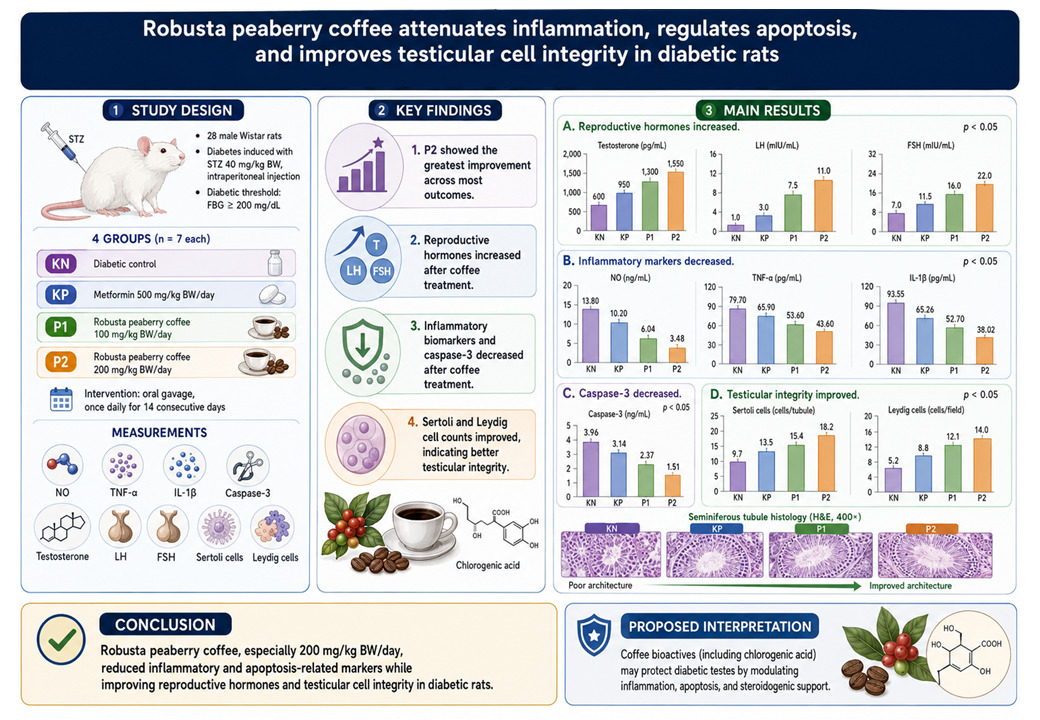
Background: Diabetes mellitus (DM) is a chronic metabolic disorder that can impair male reproductive function through oxidative stress, inflammation, and apoptosis. Robusta peaberry coffee contains chlorogenic acid (CGA) and other polyphenols with antioxidant and anti-inflammatory properties that may protect against diabetes-related testicular injury.
Objectives: This study aimed to evaluate the effects of robusta peaberry coffee on inflammation, apoptosis-related markers, reproductive hormones, and testicular cell integrity in streptozotocin (STZ)-induced diabetic male rats.
Materials and methods: Male Wistar rats (N=28) were randomly assigned to four groups: diabetic control (KN), diabetic rats treated with metformin (KP; 500 mg/kg body weight [BW]/day), diabetic rats treated with robusta peaberry coffee at 100 mg/kg BW/day (P1), and diabetic rats treated with robusta peaberry coffee at 200 mg/kg BW/day (P2). Experimental diabetic rats were induced by a single intraperitoneal injection of STZ (40 mg/kg BW). Rats with fasting blood glucose (FBG) ≥200 mg/dL were included. Treatments were administered orally for 14 consecutive days. At the end of the intervention, serum nitric oxide (NO), tumor necrosis factor-alpha (TNF-α), interleukin-1 beta (IL-1β), caspase-3, testosterone, luteinizing hormone (LH), follicle-stimulating hormone (FSH), and the numbers of Sertoli and Leydig cells were evaluated.
Results: Testosterone, LH, FSH, Sertoli cell count, and Leydig cell count were significantly lower in the KN group than in the KP, P1, and P2 groups (p<0.05). In contrast, NO, TNF-α, IL-1β, and caspase-3 were significantly higher in the KN group than in the treatment groups (p<0.05). The P2 group showed the greatest improvement, with higher reproductive hormone levels and testicular cell counts and lower inflammatory and apoptosis-related markers than P1 (p<0.05).
Conclusion: Robusta peaberry coffee attenuates inflammation, modulates apoptosis-related responses, and improves testicular cell integrity in diabetic rats. These findings suggest that robusta peaberry coffee may serve as a promising complementary natural intervention for mitigating diabetesinduced male reproductive dysfunction.
Article Details

This work is licensed under a Creative Commons Attribution-NonCommercial-NoDerivatives 4.0 International License.
Personal views expressed by the contributors in their articles are not necessarily those of the Journal of Associated Medical Sciences, Faculty of Associated Medical Sciences, Chiang Mai University.
References
Setyoadi S, Yusuf A, Kristianingrum ND, Hayati YS, Noviyanti LW, Syafiky NF. The correlation between family support and health status in patients with diabetes mellitus. Healthc Low-Resour Settings. 2023; 11(s1): 11212. doi:10.4081/hls.2023.11212.
Sofyanita EN, Herlina EC, Juniarto AZ. Chlorogenic acid ameliorates testicular damage and hormonal imbalance in diabetic male Wistar rats. Trends Sci. 2026; 23(7): 12673. doi:10.48048/tis.2026.12673.
Rong J, Leng X, Jiang K, Tan J, Dong M, Tan J. Systemic impacts of diabetes on spermatogenesis and intervention strategies: multilayered mechanism analysis and cutting-edge therapeutic approaches. Reprod Biol Endocrinol. 2025; 23(1): 122. doi: 10.1186/s12958-025-01454-4.
Sofyanita EN, Suwondo A, Nugroho H, Afifah DN, Suhartono S, Juniarto AZ. Chlorogenic acid enhanced testosterone-mediated libido through improved glycemic control and redox homeostasis in diabetic male rats. Trends Sci. 2026; 23(8): 13191. doi:10.48048/tis.2026.13191.
Kim H, Kim SR, Jung UJ. Coffee and its major polyphenols in the prevention and management of type 2 diabetes: A comprehensive review. Int J Mol Sci. 2025; 26(12): 5544. doi:10.3390/ijms26125544.
Al-Megrin WAI, El-Khadragy MF, Hussein MH, Mahgoub S, Abdel-Mohsen DM, Taha H, et al. Green Coffea arabica extract ameliorates testicular injury in high-fat diet/streptozotocin-induced diabetes in rats. J Diabetes Res. 2020; 2020: 6762709. doi:10.1155/2020/6762709.
Mohamed AI, Erukainure OL, Salau VF, Islam MS. Impact of coffee and its bioactive compounds on the risks of type 2 diabetes and its complications: A comprehensive review. Diabetes Metab Syndr. 2024; 18(7): 103075. doi:10.1016/j.dsx.2024.103075.
Huang R, Chen J, Guo B, Jiang C, Sun W. Diabetesinduced male infertility: potential mechanisms and treatment options. Mol Med. 2024; 30(1): 11.doi:10.1186/s10020-023-00771-x.
Zhang W, Tong L, Jin B, Sun D. Diabetic testicular dysfunction and spermatogenesis impairment: mechanisms and therapeutic prospects. Front Endocrinol (Lausanne). 2025; 16: 1653975. doi:10.3389/fendo.2025.1653975.
Schwarzmann ET, Washington MP, Rao NZ. Physicochemical analysis of cold brew and hot brew peaberry coffee. Processes. 2022; 10(10): 1989. Doi:10.3390/pr10101989.
Fu X, Li G, Hu F, Huang J, Lou Y, Li Y, et al. Comparative transcriptome analysis in peaberry and regular bean coffee to identify bean quality associated genes. BMC Genomic Data. 2023; 24(1): 12. doi:10.1186/s12863-022-01098-y.
Purwoko T, Suranto, Setyaningsih R, Marliyana SD. Chlorogenic acid and caffeine content of fermented robusta bean. Biodiversitas. 2022; 23(2): 902-6. doi:10.13057/biodiv/d230231.
Awwad S, Issa R, Alnsour L, Albals D, Al-Momani I. Quantification of caffeine and chlorogenic acid in green and roasted coffee samples using HPLCDAD and evaluation of the effect of degree of roasting on their levels. Molecules. 2021; 26(24): 7502. doi:10.3390/molecules26247502.
Dąbrowska I, Grzędzicka J, Niedzielska A, Witkowska-Piłaszewicz O. Impact of chlorogenic acid on peripheral blood mononuclear cell proliferation, oxidative stress, and inflammatory responses in racehorses during exercise. Antioxidants. 2023; 12(11): 1924. doi:10.3390/antiox12111924.
Nna VU, Abu Bakar AB, Ahmad A, Eleazu CO, Mohamed M. Oxidative stress, NF-κB-mediated inflammation and apoptosis in the testes of streptozotocin-induced diabetic rats: Combined protective effects of Malaysian propolis and metformin. Antioxidants. 2019; 8(10): 465. doi:10.3390/antiox8100465.
Mohamed AI, Olofinsan KA, Salau VF, Erukainure OL, Islam MS. Ethiopian coffee (Coffea arabica) improves glucose uptake and modulates metabolic enzyme activities linked to hyperglycemiainduced infertility in isolated rats’ testes. Food Prod Process Nutr. 2024; 6(1): 47. doi:10.1186/s43014-024-00247-3.
Sofyanita E, Juniarto A, Suwondo A, Nugroho H. The effect of chlorogenic acid content in coffee can reduce malondialdehyde (MDA) and increase testosterone hormone levels in DM conditions. Gema Lingkung Kesehat. 2025; 23(1): 20-6. doi:10.36568/gelinkes.v23i1.163.
Hasanuddin R, Jasmiadi J, Abdillah N. The analysis of the chlorogenic acid in the ethanol fraction of Robusta coffee beans and its effect on glucose levels in Wistar rats. Dis Prev Public Health J. 2021; 15(2): 118. doi:10.12928/dpphj.v15i2.4705.
AlAmri OD, Albeltagy RS, Akabawy AMA, Mahgoub S, Abdel-Mohsen DM, Abdel Moneim AE, et al. Investigation of antioxidant and anti-inflammatory activities as well as the renal protective potential of green coffee extract in high fat-diet/streptozotocin-induced diabetes in male albino rats. J Funct Foods. 2020; 71: 103996. doi:10.1016/j.jff.2020.103996.
Soliman GA, Abdel-Rahman RF, Ogaly HA, Althurwi HN, Abd-Elsalam RM, Albaqami FF, et al. Momordica charantia extract protects against diabetes-related spermatogenic dysfunction in male rats: Molecular and biochemical study. Molecules. 2020; 25(22): 5255. doi:10.3390/molecules25225255.
Mou J. The mitochondrial basis of aging and related diseases. E3S Web Conf. 2021; 271: 03033. doi:10.1051/e3sconf/202127103033.
Bisht S, Sisodia SS, Juyal A. Exploring the therapeutic potential of Coffea arabica: Pharmacological evaluation of extracts, fractions, and isolated compounds to treat diabetesassociated hepatic dysfunction and dyslipidemia in rats. Nat Prod Res. 2026 40(10): 2676-2684. doi: 10.1080/14786419.2024.2437026.
Lee R, Lee W, Kim DW, Park HJ. Diazinon induces testicular dysfunction and testicular cell damage through increased reactive oxygen species production in mouse. Cell Death Discov. 2025; 11(1): 113. doi:10.1038/s41420-025-02399-8.
Ahriyasna R, Primal D. The effect of Kawa Daun (Coffea canephora) decoction on blood glucose levels and pancreatic β-cells regeneration in rats with diabetes. Potravinarstvo Slovak J Food Sci. 2023; 17: 122-31. doi: 10.5219/1830.
İrkin LC. Investigation of apoptotic and inflammatory activity in liver tissue of rats fed with clam (Pecten maximus, Linnaeus 1758). Rev Rom Med Lab. 2021; 29: 189-200. doi:10.2478/rrlm-2021-0013.
Zhang W, Lei X, Tu Y, Ma T, Wen T, Yang T, et al. Coffee and the risk of osteoarthritis: A two-sample, two-step multivariable Mendelian randomization study. Front Genet. 2024; 15: 1340044. doi:10.3389/fgene.2024.1340044.
Matsuyama S, DeFalco T. Steroid hormone signaling: multifaceted support of testicular function. Front Cell Dev Biol. 2024; 11: 1339385. doi:10.3389/fcell.2023.1339385.
Hao Y. Inflammation-mediated effects of diabetes mellitus on male fertility: A systematic review and meta-analysis. Front Endocrinol (Lausanne). 2025; 16: 1600565. doi:10.3389/fendo.2025.1600565.
Xing DY, Jin Y, Jin B. A narrative review on inflammaging and late-onset hypogonadism. Front Endocrinol (Lausanne). 2024; 15: 1291389. doi:10.3389/fendo.2024.1291389.
Yalçın T, Kaya S, Yiğin A, Ağca CA, Özdemir D, Kuloğlu T, et al. The effect of thymoquinone on the TNF-α/OTULIN/NF-κB axis against cisplatininduced testicular tissue damage. Reprod Sci. 2024; 31(8): 2433-46. doi: 10.1007/s43032-024-01567-y.
Fu X, Shen X, Yin X, Zhang YH, Wang X, Han Z, et al. Antioxidant and pro-apoptosis activities of coffee husk (Coffea arabica) anthocyanins. Int Food Res J. 2021; 28: 1187-95. doi:10.47836/ifrj.28.6.10
Sofyanita EN, Maulana MR, Auliya QA, Setyowatiningsih L, Swastyaputri AP. Pengaruh pemberian kopi robusta (Coffea canephora) terhadap penurunan kadar glukosa darah pada tikus Rattus norvegicus dengan kondisi diabetes melitus. Arter J Ilmu Kesehat. 2024; 5(3): 33-9. doi:10.37148/arteri.v5i3.439.
Maulana MR. Proteksi biji kopi dalam memperbaiki morfologi sperma pada tikus yang diinduksi streptozotocin. J Lab Khatulistiwa. 2024; 7(2): 128-32. doi:10.30602/jlk.v7i2.1421.
Marcolino E, Salavarria D, Silva LGM, Almeida A, Silva FMO, Ribeiro CAAS, et al. Valorization of baobab seeds (Adansonia digitata) as a coffee-like beverage: Evaluation of roasting time on bioactive compounds. J Food Sci Technol. 2023; 61(4): 727-33. doi:10.1007/s13197-023-05873-2.
Saad EA, Hassan HA, Ghoneum M, El-Dein MA. Edible wild plants, chicory and purslane, alleviated diabetic testicular dysfunction and insulin resistance via suppression of 8OHdG and oxidative stress in rats. PLoS One. 2024; 19(4): e0301454. doi:10.1371/journal.pone.0301454.
