
Prevalence and factors associated with microalbuminuria: A structured narrative literature review
Article Sidebar
Main Article Content
Abstract
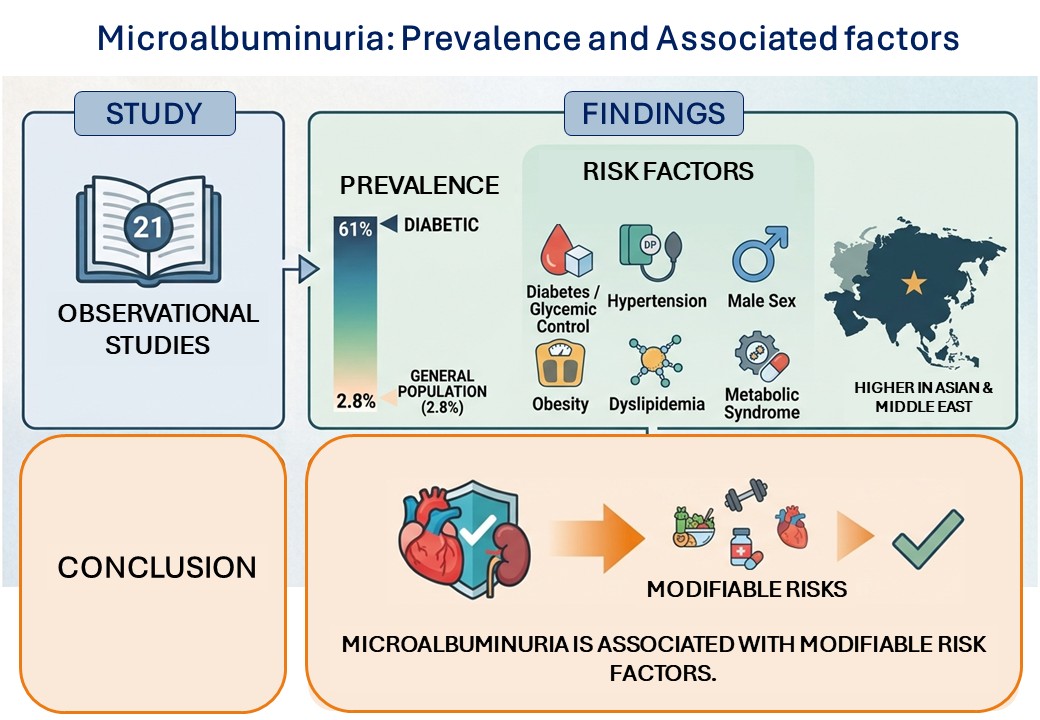
Background: Microalbuminuria, defined as urinary albumin excretion of 30-300 mg/day, is an early marker of renal injury and an established predictor of cardiovascular disease. Its reported prevalence varies widely across populations, and determinants differ by clinical and demographic context.
Objectives: To provide a broad synthesis of the available literature rather than a systematic review or meta-analysis, formal risk-of-bias assessment, quality scoring, and quantitative meta-analysis were not performed.
Materials and methods: A structured narrative literature review was conducted, synthesizing data from 21 observational studies across diverse geographic regions and adult populations. Studies reporting the prevalence of microalbuminuria and/or associated factors using recognized diagnostic criteria were included.
Results: The prevalence of microalbuminuria ranged from 2.8% in normotensive, normoglycemic adults to 61% in diabetic populations. Higher prevalence was frequently associated with diabetes, hypertension, poor glycemic control, older age, obesity, and other cardiometabolic risk factors, although associations varied across populations. Substantial geographic variation was observed, reflecting differences in population characteristics and cardiometabolic risk profiles.
Conclusion: Microalbuminuria is common in high-risk cardiometabolic populations and is consistently associated with multiple modifiable risk factors. These findings are consistent with current clinical guidelines supporting screening in high-risk individuals and highlight the importance of early risk assessment and evidence-based management to reduce renal and cardiovascular complications.
Article Details

This work is licensed under a Creative Commons Attribution-NonCommercial-NoDerivatives 4.0 International License.
Personal views expressed by the contributors in their articles are not necessarily those of the Journal of Associated Medical Sciences, Faculty of Associated Medical Sciences, Chiang Mai University.
References
KDIGO 2012 clinical practice guideline for the evaluation and management of chronic kidney disease: chapter 1: definition and classification of CKD. Kidney Int Suppl (2011). 2013; 3(1): 19-62. doi: 10.1038/kisup.2012.64.
Cöl M, Ocaktan E, Ozdemir O, Yalcin A, Tunçbilek A. Microalbuminuria: prevalence in hypertensives and diabetics. Acta Med Austriaca. 2004; 31(1): 23-9.
Choi HS, Sung KC, Lee KB. The prevalence and risk factors of microalbuminuria in normoglycemic, normotensive adults. Clin Nephrol. 2006; 65(4): 256-61. doi: 10.5414/cnp65256.
Wu AY, Kong NC, de Leon FA, Pan CY, Tai TY, Yeung VT, et al. An alarmingly high prevalence of diabetic nephropathy in Asian type 2 diabetic patients: the Microalbuminuria Prevalence (MAP) study. Diabetologia. 2005; 48(1): 17-26. doi: 10.1007/s00125-004-1599-9.
Al-Maskari F, El-Sadig M, Obineche E. Prevalence and determinants of microalbuminuria among diabetic patients in the United Arab Emirates. BMC Nephrol. 2008; 9: 1. doi: 10.1186/1471-2369-9-1.
Böhm M, Thoenes M, Danchin N, Bramlage P, La Puerta P, Volpe M. Association of cardiovascular risk factors with microalbuminuria in hypertensive individuals: the i-SEARCH global study. J Hypertens. 2007; 25(11): 2317-24. doi: 10.1097/HJH.0b013e3282ef1c5f. [7] Yan L, Ma J, Guo X, Tang J, Zhang J, Lu Z, et al. Urinary albumin excretion and prevalence of microalbuminuria in a general Chinese population: a cross-sectional study. BMC Nephrol. 2014; 15: 165. doi: 10.1186/1471-2369-15-165.
Gouda Z, Mashaal G, Bello AK, El Attar A, El Kemmry T, El Reweny A, et al. Egypt Information, Prevention, and Treatment of Chronic Kidney Disease (EGIPTCKD) programme: prevalence and risk factors for microalbuminuria among the relatives of patients with CKD in Egypt. Saudi J Kidney Dis Transpl. 2011; 22(5): 1055-63.
Varghese A, Deepa R, Rema M, Mohan V. Prevalence of microalbuminuria in type 2 diabetes mellitus at a diabetes centre in southern India. Postgrad Med J. 2001; 77(908): 399-402. doi: 10.1136/pmj.77.908.399.
Jatoi NA, Said AH, Al-Ghamdi MS, Al-Abdulmhsin MF, Bin-Jaban RA, Al-Tayeb JA, et al. Prevalence of microalbuminuria and cardiovascular risk factors in patients with diabetes mellitus type-II in Al- Khobar, Kingdom of Saudi Arabia. Cureus. 2022; 14(10): e29808. doi: 10.7759/cureus.29808.
Bruno G, Cavallo-Perin P, Bargero G, Borra M, Calvi V, D’Errico N, et al. Prevalence and risk factors for micro- and macroalbuminuria in an Italian population-based cohort of NIDDM subjects. Diabetes Care. 1996; 19(1): 43-7. doi: 10.2337/diacare.19.1.43.
Sivanantham P, Sahoo JP, Lakshminarayanan S, Bobby Z, Loganathan V, Kar SS. Prevalence and the factors associated with microalbuminuria among patients with type 2 diabetes mellitus and/or hypertension in the urban areas of Puducherry district: a cross-sectional study. Fam Pract. 2024; 41(1): 18-24. doi.org/10.1093/fampra/cmad124.
Abdelwahid HA, Dahlan HM, Mojemamy GM, Darraj GH. Predictors of microalbuminuria and its relationship with glycemic control among type 2 diabetic patients of Jazan Armed Forces Hospital, southwestern Saudi Arabia. BMC Endocr Disord. 2022; 22(1): 307. doi: 10.1186/s12902-022-01232-y.
Pontremoli R, Sofia A, Ravera M, Nicolella C, Viazzi F, Tirotta A, et al. Prevalence and clinical correlates of microalbuminuria in essential hypertension: the MAGIC study. Microalbuminuria: A Genoa Investigation on Complications. Hypertension. 1997; 30(5): 1135-43. doi: 10.1161/01.hyp.30.5.1135.
Kim YS, Kim HS, Oh HY, Lee MK, Kim CH, Kim YS, et al. Prevalence of microalbuminuria and associated risk factors among adult Korean hypertensive patients in a primary care setting. Hypertens Res. 2013; 36(9): 807-23. doi: 10.1038/hr.2013.44.
Tebbe U, Bramlage P, Thoenes M, Paar WD, Danchin N, Volpe M, et al. Prevalence of microalbuminuria and its associated cardiovascular risk: German and Swiss results of the recent global i-SEARCH survey. Swiss Med Wkly. 2009; 139(33-34): 473-80.
Mather HM, Chaturvedi N, Kehely AM. Comparison of prevalence and risk factors for microalbuminuria in South Asians and Europeans with type 2 diabetes mellitus. Diabet Med. 1998; 15(8): 672-7. doi: 10.1002/(SICI)1096-9136(199808)15:8<672::AID-DIA 648>3.0.CO;2-3.
Ren Q, Ma C, Wang J, Guo X, Ji L. Prevalence of albuminuria in cardiology and endocrinology departments and its influencing factors: a multicenter, real-world evidence study in China. Int J Hypertens. 2020; 2020: 1231593. doi: 10.1155/2020/1231593.
Gaeini Z, Bahadoran Z, Mirmiran P, Norouzirad R, Ghasemi A, Azizi F. Spot urinary microalbumin concentration, metabolic syndrome and type 2 diabetes: Tehran lipid and glucose study. BMC Endocr Disord. 2022; 22(1): 59. doi: 10.1186/s12902-022-00976-x.
Kittikunnathum S, Nanthawong P, Bunpo P. Prevalence and risk factors of elevated urinary albumin-to-creatinine ratio in a Thai academic population. J Assoc Med Sci. 2026; 59(2): 15-23. doi: 10.12982/JAMS.2026.033.
Chen F, Yang W, Weng J, Jia W, Ji L, Xiao J, et al. Albuminuria: prevalence, associated risk factors and relationship with cardiovascular disease. J Diabetes Investig. 2014; 5(4): 464-71. doi: 10.1111/jdi.12172.
Mykkänen L, Haffner SM, Kuusisto J, Pyörälä K, Laakso M. Microalbuminuria precedes the development of NIDDM. Diabetes. 1994; 43(4): 552-7. doi: 10.2337/diab.43.4.552.
Tanintheerakul C, Peerakam R, Nanthawong P, Kittikunnathum S, Bunpo P. Association between dipstick hematuria and elevated albuminuria in a hospital-based population with diverse chronic conditions. Diagnostics (Basel). 2026; 16(11): 1678. doi: 10.3390/diagnostics16111678.
Mutelo L, Simutanda C, Muchaili L, Mweene BC, Liweleya S, Mulamfu S, et al. Prevalence and correlates of microalbuminuria in high-risk persons with hypertension, diabetes, or HIV at a tertiary hospital in Zambia. PLoS One. 2025; 20(7): e032 8529. doi: 10.1371/journal.pone.0328529.
Lamsal L, Joshi R, Bhattarai M, Parajuli B, Timilsina S, Kunwor B, et al. Prevalence and clinical correlates of microalbuminuria among patients of essential hypertension in tertiary care center of Nepal: a cross-sectional study. Medicine (Baltimore). 2025; 104(26): e43075. doi: 10.1097/MD.0000000000043075.
Mohammed O, Alemayehu E, Bisetegn H, DebashH, Gedefie A, Ebrahim H, et al. Prevalence of microalbuminuria among diabetes patients in Africa: a systematic review and meta-analysis. Diabetes Metab Syndr Obes. 2023; 16: 2089-103. doi: 10.2147/DMSO.S409483.
Bae ES, Hur JY, Jang HS, Kim JS, Kang HS. Risk factors of microalbuminuria among patients with type 2 diabetes mellitus in Korea: a cross-sectional study based on 2019-2020 Korea National Health and Nutrition Examination Survey data. Int J Environ Res Public Health. 2023; 20(5): 4169. doi.org/10.3390/ijerph20054169.
Lavens A, De Block C, Oriot P, Philips JC, Vandenbroucke M, Crenier L, et al. Impact of the era of diabetes onset in a national care system on the prevalence of retinopathy and microalbuminuria in people living with type 1 diabetes 15 years post-diagnosis: a cross-sectional, real-world observational study. Diabetes Obes Metab. 2025; 27(11): 6499-506. doi: 10.1111/dom.70049.
