
Urban-rural disparities in metabolic syndrome prevalence and risk factors among industrial workers in central Thailand: A cross-sectional comparative study
Article Sidebar
Main Article Content
Abstract
Background: Metabolic syndrome (MetS) prevalence varies substantially between urban and rural settings, reflecting differences in access to healthcare services, food environments, and lifestyle patterns. Industrial workers in Thailand face distinct metabolic health challenges shaped by the geographical location of their workplaces and the associated policy contexts.
Objectives: To compare MetS prevalence, anthropometric profiles and metabolic risk factors between industrial workers in urban and rural areas of central Thailand, and to examine the influence of geographical location on MetS risk after adjustment for individual-level factors.
Materials and methods: This cross-sectional comparative study used stratified multistage random sampling to enroll 480 industrial workers (240 urban, 240 rural; 93.8% participation among eligible workers) aged 25-59 years from industrial estates in Health Service Region 4, Thailand, during December 2025, following institutional ethical approval granted on 28 November 2025. Data were collected using a validated mobile application and a LINE Official Account for appointment scheduling and information gathering. Anthropometric measurements, each taken in duplicate and averaged, included body mass index, waist circumference, torso-to-head ratio and umbilical waist circumference. Biochemical assessment comprised fasting plasma glucose, lipid profile and duplicate blood pressure measurements. MetS was diagnosed using the harmonized criteria. Logistic regression identified crude and adjusted predictors of MetS, adjusting for sociodemographic, lifestyle and occupational factors, including alcohol use, sleep duration, perceived stress, working hours, medication use, family history of cardiovascular disease, employment duration and occupational class.
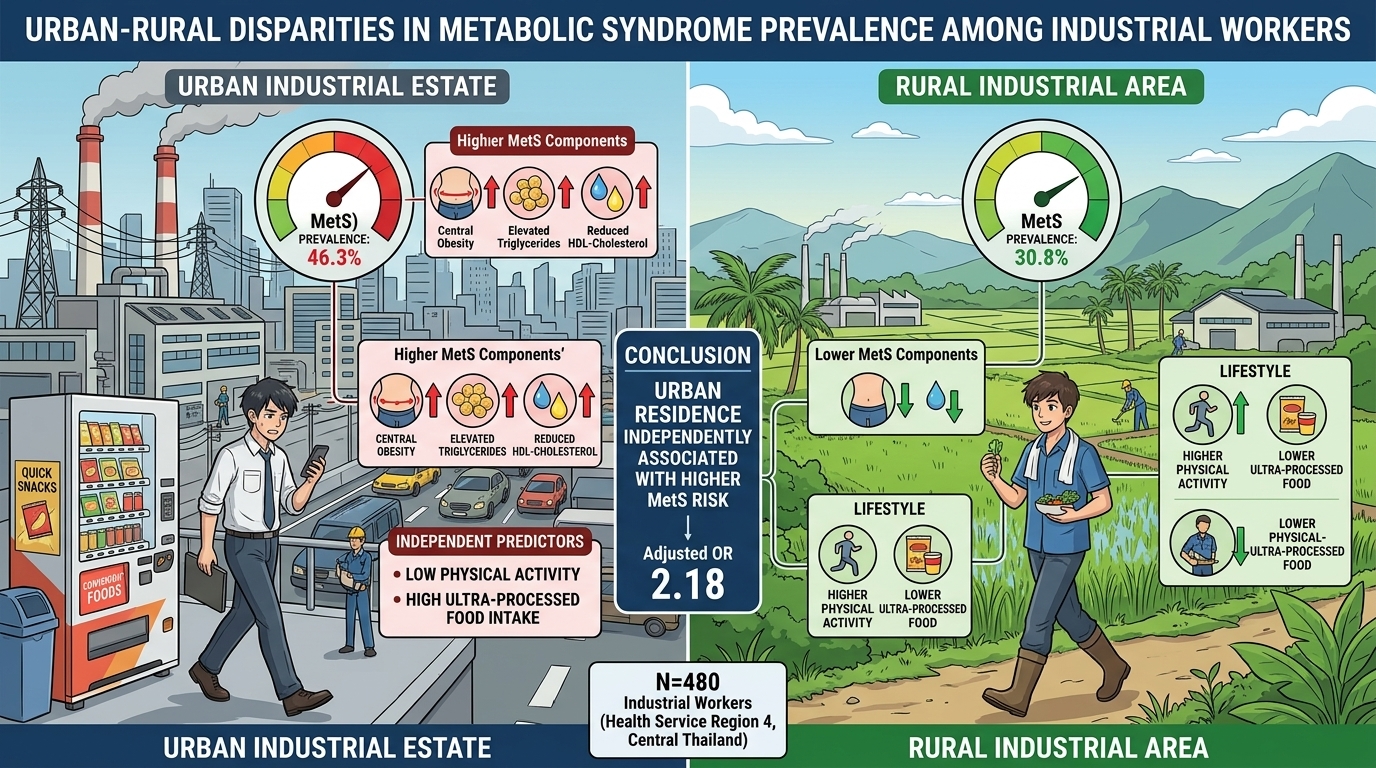
Results: Overall MetS prevalence was 38.5% (N=185) and was significantly higher in urban workers (46.3%, 111/240) than in rural workers (30.8%, 74/240, p<0.001); both estimates exceeded the 28% national prevalence reported in the 6th Thai National Health Examination Survey. Urban workers had significantly higher mean body mass index (27.2±3.8 vs 25.1±3.2 kg/m², p<0.001), waist circumference (89.4±9.2 vs 84.6±8.5 cm, p<0.001), and prevalence of central obesity (58.3% vs 42.5%, p=0.001). After adjustment for age, sex, education, income, smoking, physical activity, dietary pattern, and additional occupational and psychosocial covariates, urban residence remained independently associated with MetS (adjusted OR 2.18, 95% CI 1.42-3.35, p<0.001, crude OR 1.93, 95% CI 1.33-2.81). Stratified analysis showed that urban workers had a higher prevalence of elevated triglycerides (51.7% vs 38.3%, p=0.004) and reduced HDL-cholesterol (44.2% vs 32.1%, p=0.008).
Conclusion: Substantial urban–rural disparities in MetS prevalence exist among industrial workers in central Thailand, with urban residence associated with higher metabolic risk independently of the individual characteristics measured. These findings highlight the need for geographically tailored workplace health interventions addressing area-specific food environments and physical activity infrastructure.
Article Details

This work is licensed under a Creative Commons Attribution-NonCommercial-NoDerivatives 4.0 International License.
Personal views expressed by the contributors in their articles are not necessarily those of the Journal of Associated Medical Sciences, Faculty of Associated Medical Sciences, Chiang Mai University.
References
Miranda JJ, Barrientos-Gutiérrez T, Corvalan C, Hyder AA, Lazo-Porras M, Oni T, et al. Understanding the rise of cardiometabolic diseases in low- and middle-income countries. Nat Med. 2019; 25(11): 1667-79.
Boakye K, Bovbjerg M, Schuna J, Branscum A, Varma RP, Ismail R, et al. Urbanization and physical activity in the global prospective urban and rural epidemiology study. Sci Rep. 2023; 13(1): 290. doi: 10.1038/s41598-022-26406-5.
Alberti KG, Eckel RH, Grundy SM, Zimmet PZ, Cleeman JI, Donato KA, et al. Harmonizing the metabolic syndrome: a joint interim statement. Circulation. 2009; 120(16): 1640-5. doi: 10.1161/CIRCULATIONAHA.109.192644.
Noubiap JJ, Nansseu JR, Nyaga UF, Ndoadoumgue AL, Ngouo AT, Tounouga DN, et al. Worldwide trends in metabolic syndrome from 2000 to 2023: a systematic review and modelling analysis. Nat Commun. 2025; 17: 573. doi: 10.1038/s41467-025-67268-5.
Noubiap JJ, Nansseu JR, Lontchi-Yimagou E, Nkeck JR, Nyaga UF, Ngouo AT, et al. Geographic distribution of metabolic syndrome and its components in the general adult population: a meta-analysis of global data from 28 million individuals. Diabetes Res Clin Pract. 2022; 188: 109924. doi: 10.1016/j.diabres.2022.109924.
Patwary MM, Zare Sakhvidi MJ, Ashraf S, Dadvand P, Browning MH, Alam MA, et al. Impact of green space and built environment on metabolic syndrome: a systematic review with meta-analysis. Sci Total Environ. 2024; 923: 170977. doi: 10.1016/j. scitotenv.2024.170977.
National Statistical Office Thailand. Population and housing census 2020. Bangkok: National Statistical Office; 2021. (in Thai).
Beckmann A, Strassner C, Kwanbunjan K. Thailand - how far are we from achieving a healthy and sustainable diet? A longitudinal ecological study. Lancet Reg Health Southeast Asia. 2024; 29: 100478. doi: 10.1016/j.lansea.2024.100478.
Jaacks LM, Vandevijvere S, Pan A, McGowan CJ, Wallace C, Imamura F, et al. The obesity transition: stages of the global epidemic. Lancet Diabetes Endocrinol. 2019; 7(3): 231-40. doi: 10.1016/S2213-8587(19)30026-9.
Office of Industrial Economics. Thailand industrial outlook 2024-2026. Bangkok: Ministry of Industry; 2024. (in Thai).
Bidhu RP, Muraleedharan A, Daniel RA, Surya BN. Prevalence and determinants of metabolic syndrome among adults (18-60 years) in urban and rural South India: a community-based cross-sectional study. Cureus. 2025; 17(5): e84384. doi: 10.7759/cureus.84384.
Gafirita J, Musarurwa C, Ntaganda E, Uwimana M, Hirwa AD, Mukahigiro M, et al. Prevalence of metabolic syndrome and its components among rural and urban populations at a provincial hospital in Northern Rwanda: a cross-sectional study. Pan Afr Med J. 2025; 50: 43. doi: 10.11604/pamj. 2025.50.43.44307.
Ranzani OT, Kalra A, Di Girolamo C, Curto A, Valerio F, Halonen JI, et al. Urban-rural differences in hypertension prevalence in low-income and middleincome countries, 1990-2020: a systematic review and meta-analysis. PLoS Med. 2022; 19(8): e1004079. doi: 10.1371/journal.pmed.1004079.
Aekplakorn W, Kessomboon P, Sangthong R, Chariyalertsak S, Putwatana P, Inthawong R, et al. Urban and rural variation in clustering of metabolic syndrome components in the Thai population. BMC Public Health. 2011; 11: 854. doi: 10.1186/1471- 2458-11-854.
Sakboonyarat B, Rangsin R, Mittleman MA. Incidence and risk factors of metabolic syndrome among Royal Thai Army personnel. Sci Rep. 2022; 12(1): 15692. doi: 10.1038/s41598-022-19024-8.
Strauss M, Lavie CJ, Lippi G, Brzęk A, Vollenberg R, Sanchis-Gomar F, et al. A systematic review of prevalence of metabolic syndrome in occupational groups - does occupation matter in the global epidemic of metabolic syndrome? Prog Cardiovasc Dis. 2022; 75: 69-77. doi: 10.1016/j.pcad.2022.09.003.
Aekplakorn W, editor. Report of the 6th Thai National Health Examination Survey (NHES VI), 2019-2020. Nonthaburi: Health Systems Research Institute; 2021. (in Thai).
Kang D, Lee ES, Kim TK, Kim YJ, Lee S, Lee W, et al. Association with combined occupational hazards exposure and risk of metabolic syndrome: a workers’ health examination cohort 2012-2021. Saf Health Work. 2023; 14(3): 279-86. doi: 10.1016/j.shaw.2023.08.006.
Wye Group. Handbook on rural households’ livelihood and well-being: statistics on rural development and agriculture household income. New York: United Nations; 2007.
World Health Organization. WHO guidelines on physical activity and sedentary behaviour. Geneva: World Health Organization; 2020.
Monteiro CA, Cannon G, Levy RB, Moubarac JC, Louzada ML, Rauber F, et al. Ultra-processed foods: what they are and how to identify them. Public Health Nutr. 2019; 22(5): 936-41. doi: 10.1017/S1368980018003762.
Somdee T, Yangyuen S, Mungvongsa A, Khiewkhern S, Puapittayathorn T. Screening tools for metabolic syndrome based on anthropometric cut-off values among Thai working adults: a community-based study. Ann Saudi Med. 2023; 43(5): 291-7. doi: 10.5144/0256-4947.2023.291.
Mungvongsa A, Potivichayanon S, Dechsukhum C, Somdee T, Paenngoen S. Efficacy of anthropometric indicators as risk predictors of metabolic syndrome among academic staff: a gender-specific, crosssectional study. J Med Assoc Thai. 2025; 108(4): 321-9.
Shu L, Zhang X, Zhou J, Zhu Q, Si C. Ultra-processed food consumption and increased risk of metabolic syndrome: a systematic review and meta-analysis of observational studies. Front Nutr. 2023; 10: 1211797. doi: 10.3389/fnut.2023.1211797.
Canhada SL, Vigo Á, Luft VC, Levy RB, Matos SMA, Molina MDC, et al. Ultra-processed food consumption and increased risk of metabolic syndrome in adults: the ELSA-Brasil. Diabetes Care. 2023; 46(2): 369-76. doi: 10.2337/dc22-1628.
Pan F, Wang Z, Wang H, Zhang J, Su C, Jia X, et al. Association between ultra-processed food consumption and metabolic syndrome among adults in China - results from the China Health and Nutrition Survey. Nutrients. 2023; 15(3): 752. doi: 10.3390/nu15030752.
Chomiuk T, Niezgoda N, Mamcarz A, Śliż D. Physical activity in metabolic syndrome. Front Physiol. 2024; 15: 1365761. doi: 10.3389/fphys.2024.1365761.
Wang Y, Yu L, Gao Y, Jiang L, Yuan L, Wang P, et al. Association between shift work or long working hours with metabolic syndrome: a systematic review and dose-response meta-analysis of observational studies. Chronobiol Int. 2021; 38(3): 318-33. doi: 10.1080/07420528.2020.1797763.
Sooriyaarachchi P, Jayawardena R, Pavey T, King NA. Shift work and the risk for metabolic syndrome among healthcare workers: a systematic review and meta-analysis. Obes Rev. 2022; 23(10): e13489. doi: 10.1111/obr.13489.
Zhang M, Liu B, Ke W, Cai Y, Zhang L, Huang W, et al. Correlation analysis between occupational stress and metabolic syndrome in workers of a petrochemical enterprise: based on two assessment models of occupational stress. BMC Public Health. 2024; 24(1): 802. doi: 10.1186/s12889-024-18305-3.
Eftekhari S, Alipour F, Aminian O, Saraei M. The association between job stress and metabolic syndrome among medical university staff. J Diabetes Metab Disord. 2021; 20(1): 321-7. doi: 10.1007/s40200-021-00748-9.
Xie J, Li Y, Zhang Y, Vgontzas AN, Basta M, Chen B, et al. Sleep duration and metabolic syndrome: an updated systematic review and meta-analysis. Sleep Med Rev. 2021; 59: 101451. doi: 10.1016/j.smrv.2021.101451.
Che T, Yan C, Tian D, Zhang X, Liu X, Wu Z. The association between sleep and metabolic syndrome: a systematic review and meta-analysis. Front Endocrinol (Lausanne). 2021; 12: 773646. doi: 10.3389/fendo.2021.773646.
Abbate M, Pericas J, Yañez AM, López-González AA, De Pedro-Gómez J, Aguilo A, et al. Socioeconomic inequalities in metabolic syndrome by age and gender in a Spanish working population. Int J Environ Res Public Health. 2021; 18(19): 10333. doi: 10.3390/ijerph181910333.
Chen YC, Chin WS, Pan SC, Wu CD, Guo YL. Longterm exposure to air pollution and the occurrence of metabolic syndrome and its components in Taiwan. Environ Health Perspect. 2023; 131(1): 17001. doi: 10.1289/EHP10611.
Blake A, Hazel A, Jakurama J, Matundu J, Bharti N. Disparities in mobile phone ownership reflect inequities in access to healthcare. PLOS Digit Health. 2023; 2(7): e0000270. doi: 10.1371/journal.pdig.0000270.
Jung J, Cho I. Promoting physical activity and weight loss with mHealth interventions among workers: systematic review and meta-analysis of randomized controlled trials. JMIR Mhealth Uhealth. 2022; 10(1): e30682. doi: 10.2196/30682.
Purachago J, Srisaknok T, Duy LLT, Wongkongdech R. Metabolic syndrome surveillance through hospital informatics in Northeastern Thailand. Stud Health Technol Inform. 2026; 336: 1845-9. doi: 10.3233/SHTI260557.
Adjei NK, Samkange-Zeeb F, Boakye D, Saleem M, Christianson L, Kebede MM, et al. Ethnic differences in metabolic syndrome in high-income countries: a systematic review and meta-analysis. Rev Endocr Metab Disord. 2024; 25(4): 727-50. doi: 10.1007/s11154-024-09879-9.
Lv JL, Wei YF, Sun JN, Shi YC, Liu FH, Sun MH, et al. Ultra-processed food consumption and metabolic disease risk: an umbrella review of systematic reviews with meta-analyses of observational studies. Front Nutr. 2024; 11: 1306310. doi: 10.3389/fnut.2024.1306310.
