Prediction of coronavirus disease severity based on increased levels of microvesicles: A systematic review and meta-analysis
Article Sidebar
Main Article Content
Abstract
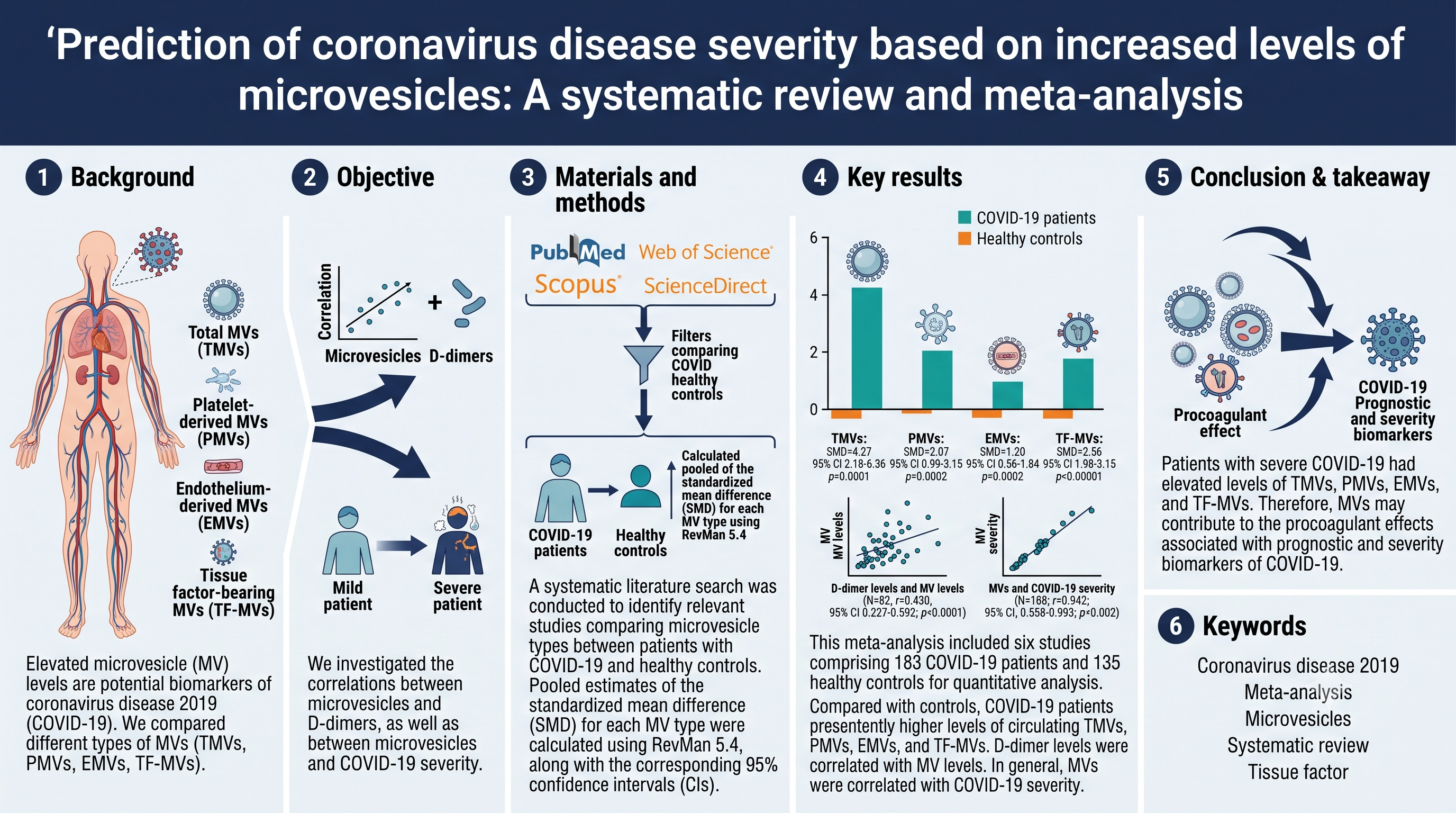
Background: Elevated microvesicle (MV) levels are potential biomarkers of coronavirus disease 2019 (COVID-19). We compared different types of microvesicles (total microvesicles, TMVs), platelet-derived microvesicles (PMVs), endothelium-derived microvesicles (EMVs), and tissue factor-bearing microvesicles (TF-MVs).
Objectives: We investigated the correlations between microvesicles and D-dimers, as well as between microvesicles and COVID-19 severity.
Materials and methods: A systematic literature search was conducted in PubMed, Web of Science, Scopus, and ScienceDirect to identify relevant studies comparing microvesicle types between patients with COVID-19 and healthy controls. Pooled estimates of the standardized mean difference (SMD) for each MV type were calculated using RevMan 5.4, along with the corresponding 95% confidence intervals (CIs).
Results: This meta-analysis included six studies comprising 183 COVID-19 patients and 135 healthy controls for quantitative analysis. Compared with controls, COVID-19 patients presented significantly higher levels of circulating TMVs, PMVs, EMVs, and TF-MVs (TMVs: SMD=4.27, 95% CI 2.18-6.36, p<0.0001; PMVs: SMD=2.07, 95% CI 0.99-3.15, p=0.0002; EMVs: SMD=1.20, 95% CI 0.56-1.84, p=0.0002; and TF-MVs: SMD=2.56, 95% CI 1.98-3.15, p<0.00001). D-dimer levels were correlated with MV levels (N=82, r=0.430, 95% CI 0.227-0.592, p<0.0001). In general, MVs were correlated with COVID-19 severity (N=168; r=0.942; 95% CI, 0.558-0.993; p=0.002).
Conclusion: Patients with severe COVID-19 had elevated levels of TMVs, PMVs, EMVs, and TF-MVs. Therefore, MVs may contribute to the procoagulant effects associated with prognostic and severity biomarkers of COVID-19.
Article Details

This work is licensed under a Creative Commons Attribution-NonCommercial-NoDerivatives 4.0 International License.
Personal views expressed by the contributors in their articles are not necessarily those of the Journal of Associated Medical Sciences, Faculty of Associated Medical Sciences, Chiang Mai University.
References
Li X, Zhong X, Wang Y, Zeng X, Luo T, Liu Q. Clinical determinants of the severity of COVID-19: A systematic review and meta-analysis. PLoS One. 2021; 16(5): e0250602. doi: 10.1371/journal.pone.0250602.
Wool GD, Miller JL. The impact of COVID-19 disease on platelets and coagulation. Pathobiology. 2021; 88(1): 15-27. doi: 10.1159/000512007.
Rostami M, Mansouritorghabeh H. D-dimer level in COVID-19 infection: a systematic review. Expert Rev Hematol. 2020; 13(11): 1265-75. doi: 10.1080/17474086.2020.1813023.
Georgescu A, Simionescu M. Extracellular vesicles: versatile nanomediators, potential biomarkers and therapeutic agents in atherosclerosis and COVID-19-related thrombosis. Int J Mol Sci. 2021; 22(11): 5967. doi: 10.3390/ijms22115967.
Barberis E, Vanella VV, Falasca M, Caneapero V, Cappellano G, Raineri D, et al. Circulating exosomes are strongly involved in SARS-CoV-2 infection. Front Mol Biosci. 2021; 8: 632290. doi: 10.3389/fmolb.2021.632290.
Cappellano G, Raineri D, Rolla R, Giordano M, Puricelli C, Vilardo B, et al. Circulating platelet-derived extracellular vesicles are a hallmark of SARS-CoV-2 infection. Cells. 2021; 10(1): 85. doi: 10.3390/cells10010085.
O’Kennedy N, Duttaroy AK. Platelet hyperactivity in COVID-19: Can the tomato extract Fruitflow® be used as an antiplatelet regime. Med Hypotheses. 2021; 147: 110480. doi: 10.1016/j.mehy.2021.110480.
Balbi C, Burrello J, Bolis S, Lazzarini E, Biemmi V, Pianezzi E, et al. Circulating extracellular vesicles are endowed with enhanced procoagulant activity in SARS-CoV-2 infection. EBioMedicine. 2021; 67: 103369. doi: 10.1016/j.ebiom.2021.103369.
Wijaya T, Hsieh PP, Melinda F, Suarca IK. Hypercoagulation state in infant with COVID-19: a case report. Indones J Biomed Sci. 2022; 16(1): 66-9. doi: 10.15562/ijbs.v16i1.354.
Koupenova M, Corkrey HA, Vitseva O, Tanriveardi K, Somasundaran M, Liu P, et al. SARS-CoV-2 initiates programmed cell death in platelets. Circ Res. 2021; 129(6): 631-46. doi: 10.1161/CIRCRESAHA.121.319195.
Whiteside TL. Procoagulant activity of extracellular vesicles in plasma of patients with SARS-CoV-2 infection. EBioMedicine. 2021; 68: 103411. doi: 10.1016/j.ebiom.2021.103411.
Taus F, Salvagno G, Canè S, Fava C, Mazzaferri F, Carrara E, et al. Platelets promote thromboinflammation in SARS-CoV-2 pneumonia. Arterioscler Thromb Vasc Biol. 2020; 40(12): 2975-89. doi: 10.1161/ATVBAHA.120.315175.
Althaus K, Marini I, Zlamal J, Pelzl L, Singh A, Häberle H, et al. Antibody-induced procoagulant platelets in severe COVID-19 infection. Blood. 2021; 137(8): 1061-71. doi: 10.1182/blood.2020008083.
Zahran AM, El-Badawy O, Ali WA, Mahran ZG, Mahran EEMO, Rayan A. Circulating microparticles and activated platelets as novel prognostic biomarkers in COVID-19; relation to cancer. PLoS One. 2021; 16(2): e0246806. doi: 10.1371/journal.pone.0246806.
Guo D, Lv Y, Qi Y, Pan S. Increased circulating microparticles and inflammatory factors aggravate coronavirus disease 2019 (COVID-19). Research Square [Preprint]. 2020. doi: 10.21203/rs.3.rs-53108/v1.
Sun H, Du Y, Kumar R, Buchkovich N, He P. Increased circulating microparticles contribute to severe infection and adverse outcomes of COVID-19 in patients with diabetes. Am J Physiol Heart Circ Physiol. 2022; 323(5): H1176-H1193. doi: 10.1152/ajpheart.00293.2022.
Hamali HA, Saboor M, Dobie G, Madkhali AM, Akhter MS, Hakamy A, et al. Procoagulant microvesicles in COVID-19 patients: possible modulators of inflammation and prothrombotic tendency. Infect Drug Resist. 2022; 15: 2359-68. doi: 10.2147/IDR.S361405.
Rausch L, Lutz K, Schifferer M, Winheim E, Gruber R, Oesterhaus EF, et al. Binding of phosphatidylserine-positive microparticles by PBMCs classifies disease severity in COVID-19 patients. J Extracell Vesicles. 2021; 10(14): e12173. doi: 10.1002/jev2.12173.
Abdelmaksoud MF, Abdelmaksoud SS, Abdelsamee HF, Ezzelregal HG, Alfeky MA. Platelets derived microparticles in COVID-19: correlation to inflammatory and coagulation state. J Appl Hematol. 2021; 12(4): 195-202. doi: 10.4103/joah.joah_73_21.
Novena OD. Skin manifestations in coronavirus disease 2019 (COVID-19): A literature review. Indones J Biomed Sci. 2021; 15(2): 113-6. doi: 10.15562/ijbs.v15i2.327.
Hassanpour M, Rezaie J, Nouri M, Panahi Y. The role of extracellular vesicles in COVID-19 virus infection. Infect Genet Evol. 2020; 85: 104422. doi: 10.1016/j.meegid.2020.104422.
Zaid Y, Puhm F, Allaeys I, Naya A, Oudghiri M, Khalki L, et al. Platelets can associate with SARS-CoV-2 RNA and are hyperactivated in COVID-19. Circ Res. 2020; 127(11): 1404-18. doi: 10.1161/CIRCRESAHA.120.317703.
Che Mohd Nassir CMN, Hashim S, Wong KK, Abdul Halim S, Idris NS, Jayabalan N, et al. COVID-19 infection and circulating microparticles-reviewing evidence as microthrombogenic risk factor for cerebral small vessel disease. Mol Neurobiol. 2021; 58(8): 4188-215. doi: 10.1007/s12035-021-02422-1.
Xiang M, Wu X, Jing H, Liu L, Wang C, Wang Y, et al. The impact of platelets on pulmonary microcirculation throughout COVID-19 and its persistent activating factors. Front Immunol. 2022; 13: 955654. doi: 10.3389/fimmu.2022.955654.
Kaur S, Singh A, Kaur J, Verma N, Pandey AK, Das S, et al. Upregulation of cytokine signaling in platelets increases risk of thrombophilia in severe COVID-19 patients. Blood Cells Mol Dis. 2022; 94: 102653. doi: 10.1016/j.bcmd.2022.102653.
Wang J, Pendurthi UR, Yi G, Rao LVM. SARS-CoV-2 infection induces the activation of tissue factor-mediated coagulation via activation of acid sphingomyelinase. Blood. 2021; 138(4): 344-9. doi: 10.1182/blood.2021010915.
Franco C, Lacroix R, Vallier L, Judicone C, Bouriche T, Laroumagne S, et al. A new hybrid immunocapture bioassay with improved reproducibility to measure tissue factor-dependent procoagulant activity of microvesicles from body fluids. Thromb Res. 2020; 196: 414-24. doi: 10.1016/j.thromres.2020.10.003.
Liu G, Yin XM. The role of extracellular vesicles in liver pathogenesis. Am J Pathol. 2022; 192(10): 1358-67. doi: 10.1016/j.ajpath.2022.06.009.
Rodrigues KF, Pietrani NT, Fernandes AP, Bosco AA, de Sousa MCR, de Fátima Oliveira Silva I, et al. Circulating microparticles levels are increased in patients with diabetic kidney disease: A case-control research. Clin Chim Acta. 2018; 479: 48-55. doi: 10.1016/j.cca.2018.01.011.
Garnier Y, Claude L, Hermand P, Sachou E, Claes A, Desplan K, et al. Plasma microparticles of intubated COVID-19 patients cause endothelial cell death, neutrophil adhesion and netosis, in a phosphatidylserine-dependent manner. Br J Haematol. 2022; 196(5): 1159-69. doi: 10.1111/bjh.18001.
Canzano P, Brambilla M, Porro B, Cosentino N, Tortorici E, Vicini S, et al. Platelet and endothelial activation as potential mechanisms behind the thrombotic complications of COVID-19 patients. JACC Basic Transl Sci. 2021; 6(3): 202-18. doi: 10.1016/j.jacbts.2020.12.009.
Yusuf F, Abubakar A, Maghfirah D, Baswin A. Relationship red distribution width to platelet ratio with fibrosis degrees based on transient elastography in chronic hepatitis B patients. Bali Med J. 2021; 10(2): 793-7. doi: 10.15562/bmj.v10i2.2530.
Hernaningsih Y, Aryati, Notopuro PB, Hajat A, et al. Laboratory Aspects of COVID-19. Surabaya: Airlangga University Press; 2021.
Wiyono N, Hernaningsih Y, Hajat A, Notopuro PB, Yusoff NM, Moses EJ. Thromboelastography parameter and its association with survival of COVID-19 patients: A retrospective cross-sectional study. Indones J Biomed Sci. 2023; 19(1): 124-9. doi: 10.15562/ijbs.v19i1.472 .
Kumar MA, Baba SK, Sadida HQ, et al. Extracellular vesicles as tools and targets in therapy for diseases. Signal Transduct Target Ther. 2024; 9(1): 105. doi: 10.1038/s41392-024-01815-3.
Nunki N, Hernaningsih Y, Wardhani P, et al. Platelet and Monocyte Microvesicles as Potential Biomarkers of COVID-19 Severity: A Cross-Sectional Analysis. Ann Lab Med. 2024; 44(5): 392-400. doi: 10.3343/alm.2023.0450.
Wungu CDK, Kurniawan RB, Oktafia P. Tinjauan sistematis dan metaanalisis untuk kedokteran klinis [Systematic review and meta-analysis for clinical medicine]. Surabaya: Airlangga University Press; 2025.
