
Development and preliminary evaluation of a dynamic cognitive training program for healthy older adults
Article Sidebar
Main Article Content
Abstract
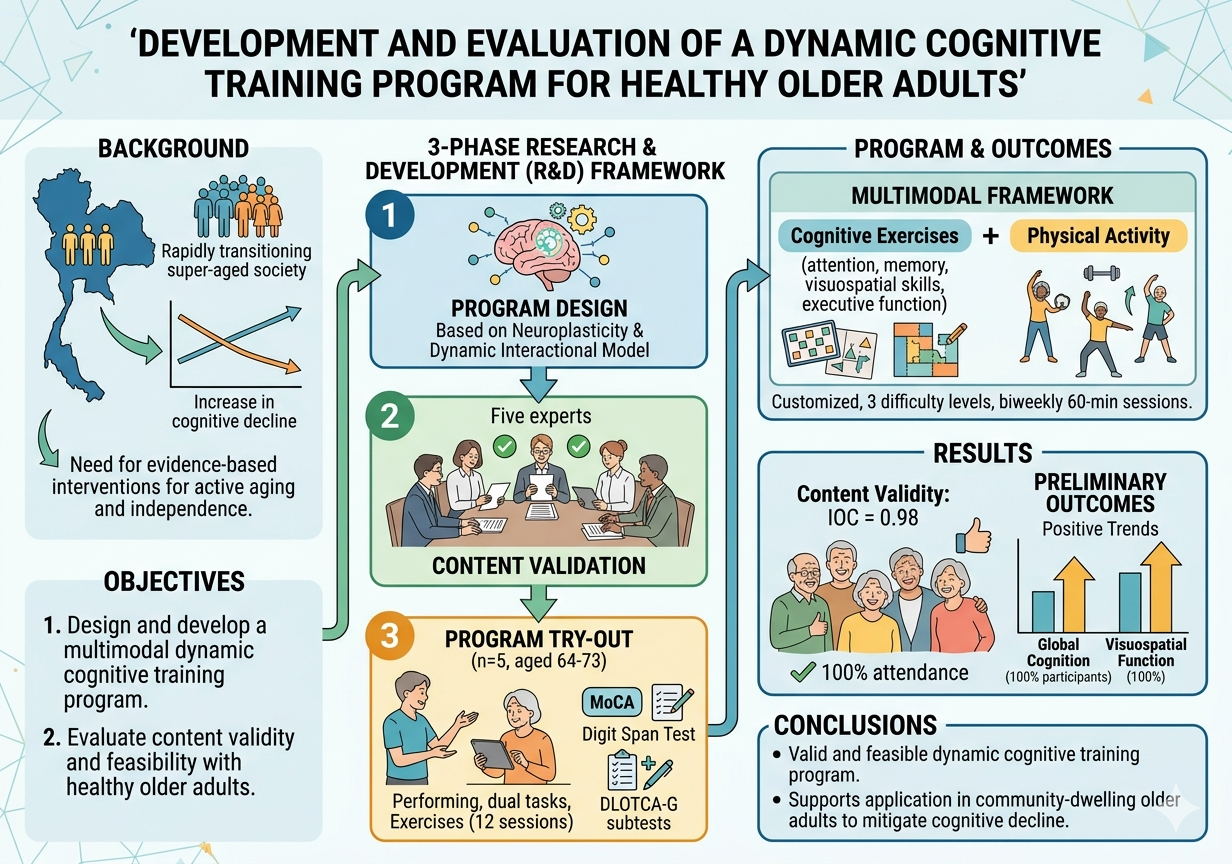
Background: Thailand is rapidly transitioning into a super-aged society, increasing the prevalence of age-related cognitive decline. Preserving cognitive function through evidence-based interventions is essential for active aging and independence.
Objectives: This study aimed to design, develop, and evaluate the content validity and feasibility of a multimodal dynamic cognitive training program through a systematic try-out process with healthy older adults.
Materials and methods: The study employed a three-phase research and development (R&D) framework: 1) program design based on neuroplasticity and the dynamic interactional model, 2) content validation by five experts, and 3) evaluating the program through a try-out with the target group (N=5, aged 64-73) over six weeks (12 sessions). Evaluation metrics included feasibility, acceptability, and preliminary cognitive outcomes using the Montreal Cognitive Assessment (MoCA), Digit Span Test, and subtests of the Dynamic Loewenstein Occupational Therapy Cognitive Assessment-Geriatric Version (DLOTCA-G).
Results: The cognitive training program was developed for improving attention, memory, visuospatial skills, and executive function. The cognitive training program, grounded in theories of information processing, neuroplasticity, cognitive retraining, and dynamic interaction, used a customized, multimodal framework. Over six weeks with biweekly 60-minute sessions, it combined cognitive exercises across three difficulty levels with physical activity. The program achieved an overall the Index of Item-Objective Congruence (IOC) of 0.98. During the Phase 3 try-out, participants demonstrated high engagement and 100% session attendance. Evaluation of cognitive outcomes showed positive trends in global cognition (100% of participants) and visuospatial function (100%).
Conclusion: The dynamic cognitive training program is valid and feasible. The try-out phase provided critical insights for program refinement, supporting its application in community-dwelling older adults to mitigate cognitive decline.
Article Details

This work is licensed under a Creative Commons Attribution-NonCommercial-NoDerivatives 4.0 International License.
Personal views expressed by the contributors in their articles are not necessarily those of the Journal of Associated Medical Sciences, Faculty of Associated Medical Sciences, Chiang Mai University.
References
Paitoonpong S. Promotion of active aging and quality of life in old age and preparation for a complete aged society in Thailand. TDRI Q Rev. 2023; 38(3): 3-14.
Foundation of Thai Gerontology Research and Development Institute. Situation of the Thai Older Persons 2021. Nakhon Pathom: Institute for Population and Social Research, Mahidol University; 2021 (in Thai).
Samanez-Larkin GR, Knutson B. Decision making in the ageing brain: changes in affective and motivational circuits. Nat Rev Neurosci. 2015; 16(5): 278-89. doi: 10.1038/nrn3917.
Prince JB, Davis HL, Tan J, Muller-Townsend K, Markovic S, Lewis DMG, et al. Cognitive and neuroscientific perspectives of healthy ageing. Neurosci Biobehav Rev. 2024; 161: 105649. doi: 10.1016/j.neubiorev.2024.105649.
Cocchi C, Zazzara MB, Levati E, Calvani R, Onder G. How to promote healthy aging across the life cycle. Eur J Intern Med. 2025; 135: 5-13. doi: 10.1016/j.ejim.2025.03.003.
Kumar J, Patel T, Sugandh F, Dev J, Kumar U, Adeeb M, et al. Innovative approaches and therapies to enhance neuroplasticity and promote recovery in patients with neurological disorders: a narrative review. Cureus. 2023; 15(7): e41914. doi: 10.7759/cureus.41914.
Nguyen L, Murphy K, Andrews G. Cognitive and neural plasticity in old age: a systematic review of evidence from executive functions cognitive training. Ageing Res Rev. 2019; 53: 100912. doi: 10.1016/j.arr.2019.100912.
Malmberg Gavelin H, Dong C, Minkov R, Bahar-Fuchs A, Ellis KA, Lautenschlager NT, et al. Combined physical and cognitive training for older adults with and without cognitive impairment: a systematic review and network meta-analysis of randomized controlled trials. Ageing Res Rev. 2021; 66: 101232. doi: 10.1016/j.arr.2020.101232.
Wang Z, Yang Y, Huang Z, Zhao W, Su K, Zhu H, et al. Exploring the transmission of cognitive task information through optimal brain pathways. PLoS Comput Biol. 2025; 21(3): e1012870. doi: 10.1371/journal.pcbi.1012870.
Ryan S, Brady O. Cognitive stimulation and activities of daily living for individuals with mild-tomoderate dementia: a scoping review. Br J Occup Ther. 2023; 86(8): 03080226231156517. doi: 10.1177/03080226231156517.
van Balkom TD, van den Heuvel OA, Vriend C. The effects of cognitive training on brain network activity and connectivity in aging and neurodegenerative diseases: a systematic review. Neuropsychol Rev. 2020; 30(3): 267-86. doi: 10.1007/s11065-020-09440-w.
Gui W, Cui X, Miao J, Zhu X, Li J. The effects of simultaneous aerobic exercise and video game training on executive functions and brain connectivity in older adults. Am J Geriatr Psychiatry. 2024; 32(10): 1244-58. doi: 10.1016/j.jagp.2024.04.009.
American Occupational Therapy Association. Cognition, cognitive rehabilitation, and occupational performance. Am J Occup Ther. 2019; 73(Suppl 2): 7312410010p1-25. doi: 10.5014/ajot.2019.73S201.
Vasquez-Carrasco E, Jamett-Oliva P, Hernandez-Martinez J, Riquelme-Hernandez C, Villagran-Silva F, Branco BHM, et al. Effectiveness of occupational therapy interventions on activities of daily living, cognitive function, and physical function in middle-aged and older people with chronic stroke: a systematic review with meta-analysis. J Clin Med. 2025; 14(7): 2197. doi: 10.3390/jcm14072197.
Thomas H. Occupational and activity analysis. 3rd ed. Abingdon: Routledge; 2022.
Castellote-Caballero Y, Carcelen Fraile MC, Aibar-Almazan A, Afanador-Restrepo DF, Gonzalez-Martin AM. Effect of combined physical-cognitive training on the functional and cognitive capacity of older people with mild cognitive impairment: a randomized controlled trial. BMC Med. 2024; 22: 281. doi: 10.1186/s12916-024-03469-x.
Cruz GP, Pereira LS, Pizzetti CF, Kiel LS, Canella TF, Raymundo TM. Development of an online cognitive training program for healthy older adults: an occupational therapy intervention. Cad Bras Ter Ocup. 2022; 30: e3124. doi: 10.1590/2526-8910. CTOAO239231242.
Kuha O, Vidhyachak C, Phatcharapisitgul P, Kumniyom N, Mungklang P, Wisajun P, et al. Cognitive training for the elderly with mild neurocognitive disorder: utilizing TEAM-V program in urban and rural areas with a six-month followup. J Psychiatr Assoc Thailand [Internet]. 2023 [cited 2026 Jan 24]; 68(1): 102-14. Available from: https://he01.tci-thaijo.org/index.php/JPAT/article/view/254346 (in Thai).
Srisuwan P, Nakawiro D, Kuha O, Kengpanich S, Gesakomol K, Chansirikarnjana S. Efficacy of a group-based 8-week multicomponent cognitive training on cognition, mood and activities of daily living among healthy older adults: a twoyear follow-up of a randomized controlled trial. J Prev Alzheimers Dis. 2025; 12(2): 100033. Available from: https://repository.li.mahidol.ac.th/handle/123456789/104268.
Versi N, Murphy K, Robinson C, Franklin M. Simultaneous dual-task interventions that improve cognition in older adults: a scoping review of implementation-relevant details. J Aging Res. 2022; 2022: 6686910. doi: 10.1155/2022/6686910.
Kazazi L, Shati M, Mortazavi SS, Nejati V, Foroughan M. The impact of computer-based cognitive training intervention on the quality of life among elderly people: a randomized clinical trial. Trials. 2021; 22(1): 51. doi: 10.1186/s13063-020-05008-4.
Lampit A, Hallock H, Valenzuela M. Computerized cognitive training in cognitively healthy older adults: a systematic review and meta-analysis of effect modifiers. PLoS Med. 2014; 11(11): e1001756. doi: 10.1371/journal.pmed.1001756.
Katz N, Averbuch S, Bar-Haim Erez A. Dynamic Lowenstein Occupational Therapy Cognitive Assessment-Geriatric Version (DLOTCA-G): assessing change in cognitive performance. Am J Occup Ther. 2012; 66(3): 311-9. doi: 10.5014/ajot.2012.002485.
Hornstein S, Zantvoort K, Lueken U, Funk B, Hilbert K. Personalization strategies in digital mental health interventions: a systematic review and conceptual framework for depressive symptoms. Front Digit Health. 2023; 5: 1170002. doi: 10.3389/fdgth.2023.1170002.
Taber KS. The use of Cronbach’s alpha when developing and reporting research instruments in science education. Res Sci Educ. 2018; 48(1): 1-24. doi: 10.1007/s11165-016-9602-2.
Hertzog MA. Considerations in determining sample size for pilot studies. Res Nurs Health. 2008; 31(2): 180-91. doi: 10.1002/nur.20247.
Hemrungrojn S, Tangwongchai S, Charoenboon T, Panasawat M, Supasitthumrong T, Chaipresertsud P, et al. Use of the Montreal Cognitive Assessment Thai Version to discriminate amnestic mild cognitive impairment from Alzheimer’s disease and healthy controls: machine learning results. Dement Geriatr Cogn Disord. 2021; 50(2): 183-94. doi: 10.1159/000517822.
Wongpakaran N, Wongpakaran T. The use of GDS-15 in detecting MDD: a comparison between residents in a Thai long-term care home and geriatric outpatients. J Clin Med Res. 2013; 5(2): 101-11. doi: 10.4021/jocmr1239w.
Katz N, Erez AB, Livni L, Averbuch S. Dynamic Loewenstein Occupational Therapy Cognitive Assessment (DLOTCA) [Manual]. Pequannock, NJ: Maddak Inc; 2011.
de Paula JJ, Malloy-Diniz LF, Romano-Silva MA. Reliability of working memory assessment in neurocognitive disorders: a study of the Digit Span and Corsi Block-Tapping tasks. Braz J Psychiatry. 2016;38(3):262-3. doi:10.1590/1516-4446-2015-1879.
Giuli C, Papa R, Lattanzio F, Postacchini D. The effects of cognitive training for elderly: results from My Mind Project. Rejuvenation Res. 2016; 19(6): 485-94. doi: 10.1089/rej.2015.1791.
Chen Y, Denny KG, Harvey D, Farias ST, Mungas D, DeCarli C, et al. Progression from normal cognition to mild cognitive impairment in a diverse clinicbased and community-based elderly cohort. Alzheimers Dement. 2017; 13(4): 399-405. doi: 10.1016/j.jalz.2016.07.151.
Weicker J, Hudl N, Frisch S, Lepsien J, Mueller K, Villringer A, et al. WOME: theory-based working memory training - a placebo-controlled, doubleblind evaluation in older adults. Front Aging Neurosci. 2018; 10: 247. doi: 10.3389/fnagi.2018.00247.
Li G, Xia H, Teng G, Chen A. The neural correlates of physical exercise-induced general cognitive gains: a systematic review and meta-analysis of functional magnetic resonance imaging studies. Neurosci Biobehav Rev. 2025; 169: 106008. doi: 10.1016/j.neubiorev.2025.106008.
Xue D, Li PWC, Yu DSF, Lin RSY. Combined exercise and cognitive interventions for adults with mild cognitive impairment and dementia: a systematic review and network meta-analysis. Int J Nurs Stud. 2023; 147: 104592. doi: 10.1016/j.ijnurstu.2023.104592.
Shatil E. Does combined cognitive training and physical activity training enhance cognitive abilities more than either alone? A four-condition randomized controlled trial among healthy older adults. Front Aging Neurosci. 2013; 5: 8. doi: 10.3389/fnagi.2013.00008.
Buitenweg JIV, van de Ven RM, Prinssen S, Murre JMJ, Ridderinkhof KR. Cognitive flexibility training: a large-scale multimodal adaptive active-control intervention study in healthy older adults. Front Hum Neurosci. 2017; 11: 529. doi: 10.3389/fnhum.2017.00529.
Theill N, Schumacher V, Adelsberger R, Martin M, Jancke L. Effects of simultaneously performed cognitive and physical training in older adults. BMC Neurosci. 2013; 14: 103. doi: 10.1186/1471-2202-14-103.
Hudak EM, Bell KL, Hall C, Grismore LD, LaVere J, Edwards JD. Dynamic useful field of view training to enhance older adults’ cognitive and motor function: a pilot study. J Cogn Enhanc. 2021; 5(4): 411-9. doi: 10.1007/s41465-021-00219-2.
Man DWK, Chung JCC, Lee GY, Chow SMK. Evaluation of a virtual reality-based memory training programme for Hong Kong Chinese older adults with questionable dementia: a pilot study. Int J Geriatr Psychiatry. 2012; 27(5): 513-20. doi:10.1002/gps.2746.
Anguera JA, Boccanfuso J, Rintoul JL, Al-Hashimi O, Faraji F, Janowich J, et al. Video game training enhances cognitive control in older adults. Nature. 2013; 501(7465): 97-101. doi: 10.1038/nature12486.
Lavner Y, Rabinowitz I. Increasing stimulus duration improves attention and memory performance in elderly with cognitive impairment. SAGE Open Med. 2015; 3: 2050312115621566. doi: 10.1177/2050312115621566.
