
Effectiveness of a tele-pulmonary rehabilitation program in individuals at risk of chronic obstructive pulmonary disease from artificial intelligence predictions
Article Sidebar
Main Article Content
Abstract
Background: Chronic Obstructive Pulmonary Disease (COPD) is a major global health burden, and early intervention in at-risk individuals may improve outcomes. Emerging technologies such as artificial intelligence (AI) offer novel means of identifying individuals at risk of COPD, enabling targeted preventive strategies. Tele-pulmonary rehabilitation (Tele-PR) has shown promise in managing chronic respiratory conditions, but its effectiveness in AI-identified at-risk individuals remains underexplored.
Objectives: To evaluate the effectiveness of a 12-week Tele-PR program in improving disease-related symptoms, muscular strength, and exercise capacity in individuals identified as at risk of COPD by AI prediction.
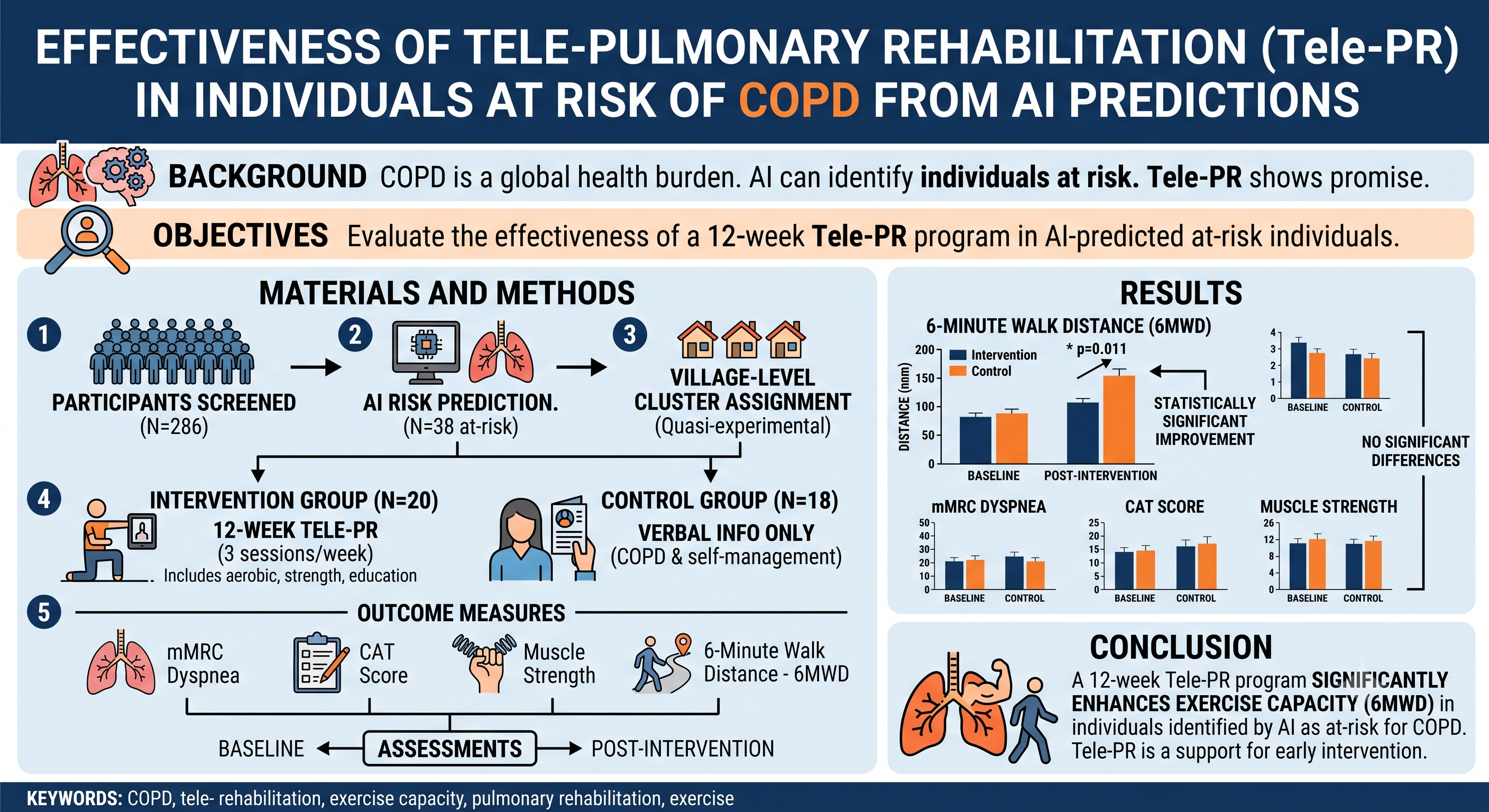
Materials and methods: Out of 286 screened participants, 38 were identified by AI as being at risk of COPD and enrolled in the study. They were allocated by village-level cluster assignment (quasi-experimental design) to either an intervention group (N=20) or a control group (N=18). The intervention group participated in a Tele-PR program conducted three sessions per week for 12 weeks. The control group received only verbal information on COPD and preventive self-management. Outcome measures included the modified Medical Research Council (mMRC) dyspnea scale, COPD Assessment Test (CAT), back and leg muscle strength using a dynamometer, and six-minute walk distance (6MWD). Assessments were conducted at baseline and post-intervention.
Results: All participants completed the study without adverse events. Following the intervention, the Tele-PR group showed a statistically significant improvement in 6MWD compared to the control group (p=0.011). However, no significant differences were observed between groups in mMRC scores, CAT scores, or muscle strength measurements.
Conclusion: A 12-week Tele-PR program significantly enhances exercise capacity, as measured by 6MWD, in individuals identified by AI as being at risk for COPD. These findings support the use of Tele-PR as an early intervention strategy in high-risk populations.
Article Details

This work is licensed under a Creative Commons Attribution-NonCommercial-NoDerivatives 4.0 International License.
Personal views expressed by the contributors in their articles are not necessarily those of the Journal of Associated Medical Sciences, Faculty of Associated Medical Sciences, Chiang Mai University.
References
Kyu HH, Abate D, Abate KH, Abay SM, Abbafati C, Abbasi N, et al. Global, regional, and national disability-adjusted life-years (DALYs) for 359 diseases and injuries and healthy life expectancy (HALE) for 195 countries and territories, 1990-2017: a systematic analysis for the Global Burden of Disease Study 2017. Lancet. 2018; 392: 1859-922. doi: 10.1016/S0140-6736(18)32335-3.
Global Initiative for Chronic Obstructive Lung Disease [Internet]. USA: GOLD; [cited 2025 Apr]. Available from: http://goldcopd.org/2022-goldreports-2/.
Roig M, Eng JJ, MacIntyre DL, Road JD, Reid WD. Deficits in muscle strength, mass, quality, and mobility in people with chronic obstructive pulmonary disease. J Cardiopulm Rehabil Prev. 2011; 31: 120-4. doi: 10.1097/HCR.0b013e3181f68ae2.
Chuatrakoon B, Ngai SPC, Sungkarat S, Uthaikhup S. Balance impairment and effectiveness of exercise intervention in chronic obstructive pulmonary disease-a systematic review. Arch Phys Med Rehabil. 2020; 101: 1590-602. doi: 10.1016/j.apmr.2020.02.007.
Zhang L, Maitinuer A, Lian Z, Li Z, Ding W, Wang W, et al. Home based pulmonary telerehabilitation under telemedicine system for COPD: a cohort study. BMC Pulm Med. 2022; 22(1): 284. doi: 10.1186/s12890-022-02077-w.
Li LSK, Butler S, Goldstein R, Brooks D. Comparing the impact of different exercise interventions on fatigue in individuals with COPD: a systematic review and meta-analysis. Chronic Respir Dis. 2019. doi: 10.1177/1479973119894855.
Moore E, Palmer T, Newson R, Majeed A, Quint JK, Soljak MA. Pulmonary rehabilitation as a mechanism to reduce hospitalizations for acute exacerbations of COPD: a systematic review and meta-analysis. Chest. 2016; 150(4): 837-59. doi: 10.1016/j.chest.2016.05.038.
Ora J, Prendi E, Attinà ML, Cazzola M, Calzetta L, Rogliani P. Efficacy of respiratory telerehabilitation in COPD patients: systematic review and metaanalysis. Monaldi Arch Chest Dis. 2022. doi: 10.4081/monaldi.2022.2105.
Vasilopoulou M, Papaioannou AI, Kaltsakas G, Louvaris Z, Chynkiamis N, Spetsioti S, et al. Homebased maintenance tele-rehabilitation reduces the risk for acute exacerbations of COPD, hospitalisations and emergency department visits. Eur Respir J. 2017. doi: 10.1183/13993003.02129-2016.
He K, Zhang X, Ren S, Sun J. Deep residual learning for image recognition. In: Proceedings of the IEEE Conference on Computer Vision and Pattern Recognition (CVPR). Piscataway (NJ): IEEE; 2016.p. 770-8. doi: 10.1109/CVPR.2016.90.
Chuatrakoon B, Uthaikhup S, Ngai SPC, Liwsrisakun C, Pothirat C, Sungkarat S. The effectiveness of home-based balance and pulmonary rehabilitation program in individuals with chronic obstructive pulmonary disease: a randomized controlled trial. Eur J Phys Rehabil Med. 2022; 58(3): 478-86. doi: 10.23736/S1973-9087.22.06866-1.
ATS Committee on Proficiency Standards for Clinical Pulmonary Function Laboratories. ATS statement: guidelines for the six-minute walktest. Am J Respir Crit Care Med. 2002; 166: 111-7. doi: 10.1164/ajrccm.166.1.at1102.
Pothirat C, Kiatboonsrian S, Chuchottaworn C. Validation of the new COPD assessment test translated into Thai in patients with chronic obstructive pulmonary disease. BMC Pulm Med. 2014. doi: 10.1186/1471-2466-14-193.
Mahler DA, Ward J, Waterman LA, McCusker C, ZuWallack R, Baird JC. Patient-reported dyspnea in COPD reliability and association with stage of disease. Chest. 2009; 136: 1473-9. doi: 10.1378/chest.09-0260.
Coldwells A, Atkinson G, Reilly T. Sources of variation in back and leg dynamometry. Ergonomics. 1994; 37(1): 79-86. doi: 10.1080/00140139408963625.
Tsutsui M, Gerayeli F, Sin DD. Pulmonary rehabilitation in a post-COVID-19 world: telerehabilitation as a new standard in patients with COPD. Int J Chron Obstruct Pulmon Dis. 2021; 16: 379-91. doi: 10.2147/COPD.S263031.
Paneroni M, Colombo F, Papalia A, Colitta A, Borghi G, Saleri M, et al. Is telerehabilitation a safe and viable option for patients with COPD? A feasibility study. COPD. 2015; 12(2): 217-25. doi: 10.3109/15412555.2014.933794.
Tsai LL, McNamara RJ, Moddel C, Alison JA, McKenzie D, McKeough ZJ. Home-based telerehabilitation via real-time videoconferencing improves endurance exercise capacity in patients with COPD: the randomized controlled TeleR study. Respirology. 2017; 22(4): 699-707. doi: 10. 1111/resp.12966.
Holland AE, Nici L. The return of the minimum clinically important difference for 6-minute-walk distance in chronic obstructive pulmonary disease. Am J Respir Crit Care Med. 2013; 187(4): 335-6. doi: 10.1164/rccm.201212-2272ED.
